

Carry privateness counsel in earlier than any private knowledge hits an AI instrument, and test again in at any time when your use case shifts. Wait till a workflow turns routine, and also you’ll find yourself untangling knowledge offers and permissions you need to’ve sorted out from day one.
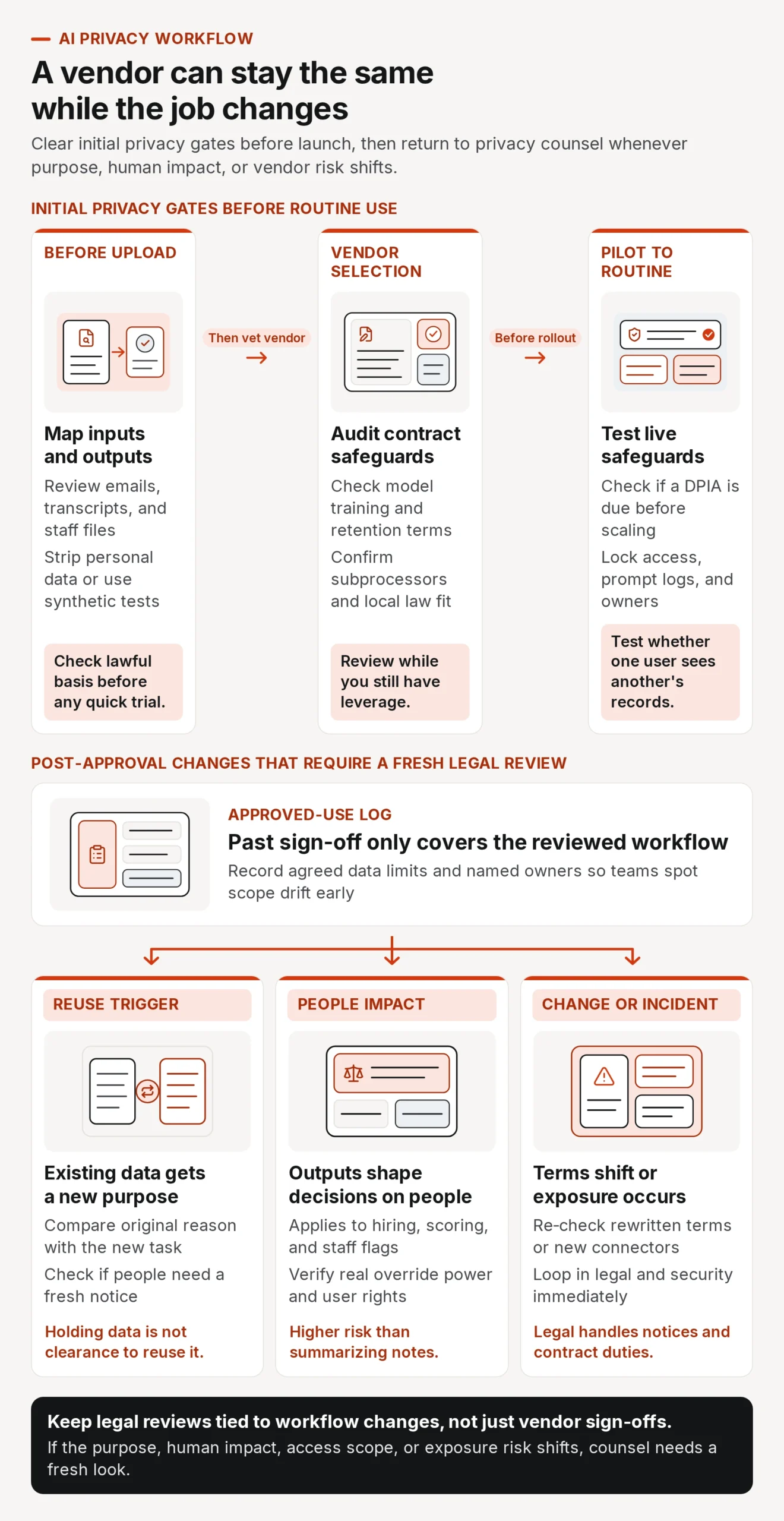
Present counsel what knowledge you propose to make use of earlier than you signal vendor phrases or take a look at with private data. Return to authorized earlier than you reuse saved data for a brand new job, let AI outputs form selections about folks, or transfer a pilot into routine operations. Modified vendor phrases want a contemporary look, and suspected knowledge publicity wants an instantaneous name.
- Clear the info movement with authorized earlier than any take a look at touches buyer emails, worker data, or assembly transcripts.
- Audit AI vendor phrases earlier than signing, protecting mannequin coaching rights, retention home windows, cross-border transfers, and subprocessors.
- Re-check authorized approval earlier than reusing previous data for a brand new process, since vendor sign-off covers solely the reviewed workflow.
- Contain counsel earlier than AI outputs rank, rating, or filter folks, as a result of UK and EU automated-decision guidelines require actual human override authority.
- Take a look at reside entry controls, prompt-history isolation, and DPIA thresholds earlier than opening a small pilot to wider workers.
Groups use AI throughout day by day work, scanning buyer data, summarizing paperwork, or backing up workers calls. Figuring out the correct second to loop in authorized saves actual complications later.
Loop in authorized the second your workforce maps out the knowledge an AI workflow wants. Buyer emails, workers data, and assembly transcripts all want a glance earlier than anybody uploads them, even for a fast take a look at.
Counsel checks the lawful foundation, function, and transparency guidelines for what you’re planning to run. From there, your workforce can strip out private particulars, shrink the dataset, or swap in artificial examples.
Skip the jargon and provides counsel a plain breakdown of the job. Spell out what knowledge goes in, what output you need, and who’ll see the outcomes.
What to carry to your first privateness assessment
Privateness critiques decelerate when authorized has to guess how the system works. Earlier than reserving time with counsel, put 5 concrete info on one web page.
Begin with the precise enter fields and report sources, noting whether or not buyer emails, workers particulars, or particular class attributes similar to well being or monetary knowledge are included. Describe the output the mannequin produces and listing who will learn or act on it. State whether or not knowledge goes to an inner mannequin or a third-party API, and flag whether or not the seller retains prompts or trains on inputs. Lastly, notice how the workforce can find, appropriate, or erase an individual’s report in the event that they submit a rights request.
That one-page abstract lets counsel let you know in a single assembly whether or not you possibly can proceed with stripped or artificial knowledge, whether or not you want a proper Information Safety Affect Evaluation (DPIA) below GDPR Article 35 or UK GDPR, or whether or not vendor phrases should change first.
Throughout Vendor Choice
Have privateness counsel look over any AI vendor earlier than your organization indicators its phrases or runs a trial with private knowledge. Your vendor decide units the place knowledge travels and what safeguards you possibly can really implement.
Native guidelines carry weight when your work touches country-specific operations or covers folks dwelling in a particular place.
As an alternative of taking broad compliance claims at face worth, an area authorized professional checks regional guidelines straight towards the seller’s processing phrases.
A UK-facing enterprise, as an example, can herald a London-based knowledge privateness lawyer to vet knowledge safety agreements, third-party privateness agreements, affect assessments, privateness notices, and extra.
Get clear solutions on a couple of core factors: does the seller prepare in your inputs, how lengthy does it preserve knowledge, and which subprocessors get a duplicate? Type these out whilst you’ve nonetheless obtained room to push again or stroll away.
When Current Information Will get a New Function
Examine again with counsel earlier than pointing previous data at a brand new process. Information you gathered to shut help tickets may look useful for AI-assisted buyer profiling down the highway.
Already holding the info doesn’t imply you’re clear to reuse it. Counsel can weigh whether or not the brand new process suits the unique function, confirm the lawful foundation, and let you know if folks want contemporary discover about how their knowledge’s being processed.
Maintain that assessment tightly scoped to the change itself. Placing the unique cause for assortment facet by facet with the brand new use flags gaps a blanket instrument sign-off will miss.
Write down the agreed limits. That stops one other workforce from treating sign-off on one workflow as a clean test for all the pieces else.
European regulators have additionally tightened guidelines on how private knowledge carries throughout mannequin coaching and downstream deployment. In Opinion 28/2024, the European Information Safety Board clarified that AI fashions skilled on private knowledge will not be nameless by default, and that illegal processing throughout growth can create authorized threat when a mannequin is later deployed.
If AI Outputs Start Shaping Choices About Folks
Carry counsel within the second AI stops organizing notes and begins shaping how folks get handled. Rating job candidates, flagging workers conduct, or scoring buyer eligibility carries way more threat than summarizing a normal enterprise report.
Stroll counsel by means of how workers act on the output and whether or not they can genuinely push again on it. Authorized can spot automated-decision guidelines and information you on transparency, human oversight, and particular person rights.
Transparency and constructing particular person rights straight into generative AI have been a transparent focus for the Info Commissioner’s Workplace. For knowledge groups, which means determining easy methods to monitor down related data and deal with person requests earlier than the workflow locks into place.
Within the UK, Part 80 of the Information (Use and Entry) Act 2025 changed UK GDPR Article 22 with Articles 22A to 22D from February 5, 2026. UK regulation permits solely automated important selections below wider lawful bases when obligatory safeguards are in place. Organisations should inform folks when an automatic determination occurs, give them a strategy to problem the end result, and supply human assessment, with stricter limits at any time when particular class knowledge is concerned. Labeling a scoring instrument as determination help doesn’t clear that bar if human reviewers merely rubber-stamp the mannequin output.
Forward of Shifting From a Trial to Routine Use
A small pilot runs below very totally different situations than an on a regular basis enterprise course of. Loop counsel again in earlier than you open entry to extra workers or swap artificial take a look at knowledge for actual private data.
Deal with this check-in as a take a look at of whether or not your safeguards really maintain up. Counsel can let you know if an information safety affect evaluation is due and flag lingering dangers you need to repair earlier than a wider rollout.
Privateness practitioners have run knowledge safety affect assessments throughout sufficient organizations to see the identical sample: the best state appears to be like nice, however the inputs arrive so slowly that the evaluation goes stale earlier than it’s completed.
Michael Moore in From shadow IT to demonstrable DPIAs: Constructing visibility for contemporary privateness applications
Run hands-on checks too, like testing whether or not one person can pull up another person’s data or delicate immediate histories.
Lock down entry controls, retention guidelines, and who handles person requests. On a regular basis operations want named homeowners, simply as organizations should confirm the human behind an AI agent when automated workflows act at scale. Don’t assume any person else will catch an issue.
After Materials Adjustments or Suspected Information Publicity
Return for a contemporary authorized look at any time when a vendor rewrites key phrases, a brand new integration pulls in knowledge, or one other workforce pitches a unique use case. Previous sign-off solely covers what counsel really reviewed.
Set clear assessment triggers so groups can inform small tweaks aside from shifts that want authorized eyes. A brief log of accredited makes use of and guardrails makes these calls fast.
For those who suspect knowledge publicity, carry counsel in straight away alongside safety and incident-response groups. Whereas technical colleagues hint what occurred, authorized can type out notification duties, contract obligations, and communications.
AI privateness assessment triggers at a look
| Undertaking milestone or change | Authorized test counsel runs | What the info workforce brings | Overview gate |
|---|---|---|---|
| Earlier than private knowledge enters a instrument | Lawful foundation, function match, knowledge minimization, and transparency notices | Enter fields, pattern schema, meant output, and viewers listing | Pause earlier than add, even for trials |
| Vendor choice and contract assessment | DPA phrases, coaching opt-outs, knowledge retention, subprocessors, and native guidelines | Vendor safety docs, DPA draft, knowledge residency wants, and API movement | Pause earlier than signing or testing |
| New function for present data | Function-limitation test (GDPR Artwork. 5(1)(b)), lawful foundation, and contemporary notices | Authentic assortment discover facet by facet with the proposed new process | Scoped re-review earlier than construct |
| Outputs shaping selections about folks | Automated-decision safeguards (UK GDPR Arts. 22A to 22D; GDPR Artwork. 22) and person rights | Scoring workflow, human override guidelines, and attraction or request path | Necessary pre-deployment sign-off |
| Pilot shifting to routine use | DPIA requirement (GDPR or UK GDPR Artwork. 35), residual dangers, and possession | Pilot access-test outcomes, prompt-history controls, retention settings, and proprietor names | Go-live gate earlier than widening entry |
| Vendor time period change or suspected publicity | Contract hole test or breach notification duties, regulatory deadlines, and notices | Diff of up to date phrases, new integration map, or incident timeline from safety | Rapid escalation |
Maintain privateness critiques near AI selections
Say your workforce has approval to summarize help tickets, and a later proposal makes use of those self same tickets in the identical instrument to attain clients for eligibility. Pull up the approved-use log and present counsel the place the rating will go and what workers will do with it. Even when the seller phrases haven’t modified, the rationale for utilizing these data has, so agree on the bounds of that use earlier than workers begin performing on the scores.
Privateness counsel does essentially the most good once you’ve nonetheless obtained actual decisions over knowledge, distributors, and day by day workflows. Plan to test again in at any time when your function, affect on folks, entry scope, or publicity threat shifts. At your subsequent planning assembly, pin down the subsequent name that wants authorized enter and title who’s establishing the assessment.
Ceaselessly requested questions
What ought to an information workforce carry to its first AI privateness assessment?
Carry a plain one-page abstract of the workflow earlier than private knowledge enters the instrument. Listing the precise enter fields, the place these data come from, what output the mannequin will generate, who will see it, and whether or not a third-party vendor retains prompts or trains on inputs. That offers counsel sufficient element to test lawful foundation, function match, and which private fields may be stripped or changed with artificial examples throughout testing.
Does having a workers member assessment every AI rating keep away from automated-decision privateness guidelines?
No. Counsel nonetheless must test whether or not human assessment is real or a rubber stamp. Stroll authorized by means of whether or not the reviewer has the authority, context, and time to overturn the AI output, and present how an affected buyer or applicant can contest the end result or submit an information rights request.
When does an AI challenge require a Information Safety Affect Evaluation (DPIA)?
Beneath GDPR and UK GDPR Article 35, a DPIA is required earlier than processing that’s more likely to create excessive threat for people. In AI tasks, that generally applies when a workforce introduces new expertise at scale, profiles clients or staff, processes particular class knowledge similar to well being or biometric data, or strikes a pilot from artificial take a look at knowledge to reside private data.
If authorized already accredited an AI vendor, do we want one other assessment for a brand new use case?
Sure. Vendor approval covers the contract and the precise workflow counsel reviewed, not each future process. In case your workforce has sign-off to summarize help tickets and later desires to feed those self same tickets into the identical instrument to attain buyer eligibility, the aim and threat to people have modified and require a contemporary scoped assessment.

