

Japan’s Monetary Providers Company has put the self-custody pockets on its regulatory agenda, and a survey it cited reveals a behavior which will put customers at extra danger than any rule.
On November 26, the FSA’s research group on digital and decentralized finance met for the third time this administrative 12 months and reviewed a 52-page workers paper on DeFi and unhosted wallets.
In line with a Nomura Analysis Institute survey for Japan’s Digital Company quoted in that paper, 38.3% of Japanese unhosted pockets customers preserve their seed phrase or keys in a notes app or file on a PC or telephone, screenshots included.
For Bitcoin holders, the extra essential level is what the FSA didn’t suggest: there isn’t any ban and no license for pockets software program.
The larger query now could be whether or not Tokyo protects customers by means of higher instruments and training, or by means of friction on the trade door.
What the FSA Placed on the Desk on November 26
The research group is a part of a development technique the FSA printed on July 21, 2026, which goals for an interim abstract in early 2027 on “on-chain finance”.
The paper itself units out dialogue factors, not new guidelines.
On wallets, the FSA asks members how they view the advantages, use instances and dangers of unhosted wallets, and what may shield customers who handle keys in dangerous methods.
It additionally asks whether or not additional anti-money laundering steps are wanted.

ADVERTISEMENT
On DeFi, it asks who ought to be handled because the regulated occasion when a protocol has no clear operator, and whether or not front-end suppliers ought to face guidelines in any respect.
One choice it floats is to work by means of the regulated companies that contact DeFi, corresponding to stablecoin issuers, on- and off-ramp suppliers and monetary establishments.
The Japan Cryptoasset Enterprise Affiliation additionally offered to the group.
How Japan’s Self-Custody Pockets Customers Retailer Their Keys
The survey knowledge are essentially the most revealing a part of the paper.
Amongst 3,709 crypto and NFT holders surveyed, 812 individuals, or 21.9%, used an unhosted pockets.
After notes apps and information, 32.1% wrote keys on paper, 25.7% used a password supervisor and 16.5% relied on cloud backup.
Solely 7.7% used a {hardware} pockets, 7.5% used multisig and eight.6% cut up keys with MPC. One other 15.2% mentioned they did nothing specifically or didn’t keep in mind.
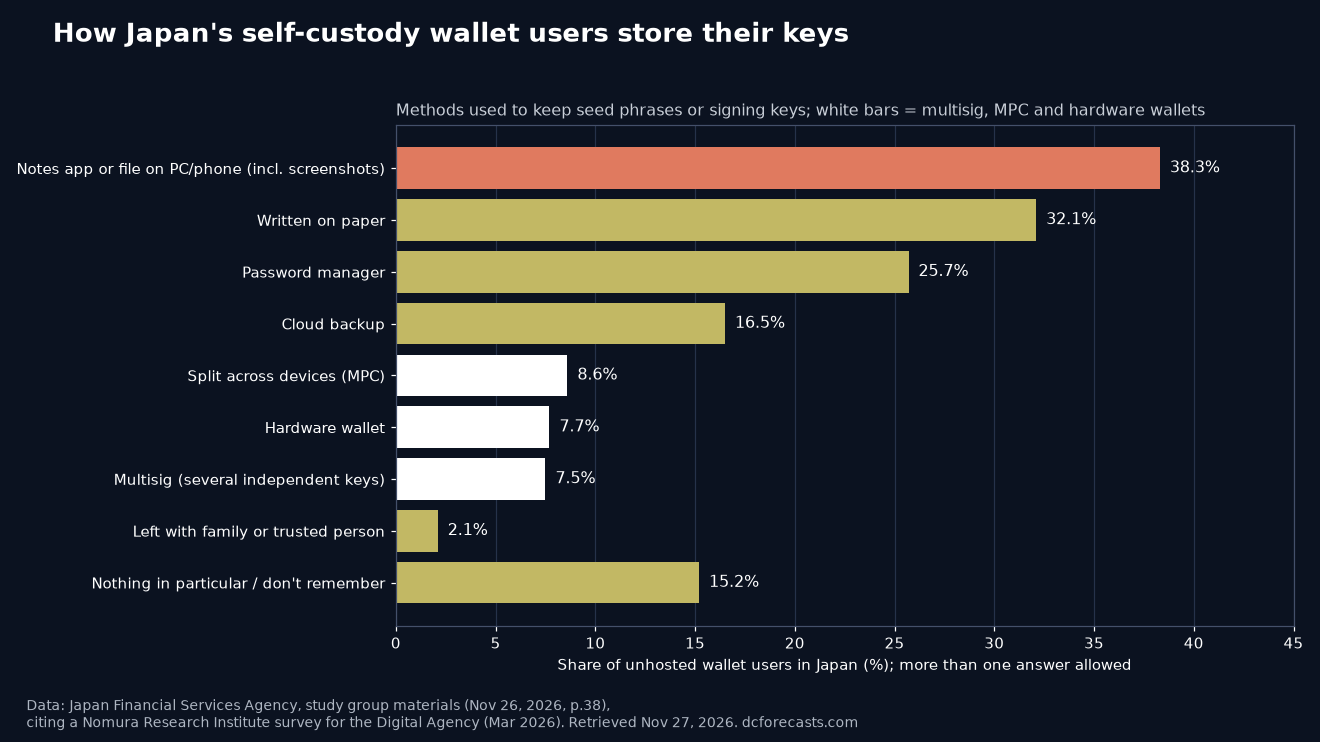
The FSA itself factors to multisig, MPC and sensible contract wallets as methods to chop the chance of misplaced or leaked keys.
We imagine that’s the constructive studying. Seed phrase storage is a abilities hole, and the repair is already out there.
We noticed the identical risk from the opposite facet when iPhone malware hunted seed phrases by means of 480 advert domains.
Why Most Japanese Wallets Nonetheless Connect with Exchanges
The use-case knowledge present that self-custody in Japan is generally a companion to regulated exchanges, not a alternative for them.
Some 59.4% of unhosted pockets customers mentioned they transfer funds to or from exchanges. Rewards got here subsequent at 30.7%, then in-wallet purchases at 25.6% and staking at 21.9%.
DeFi was a smaller 13.1%, and paying for items and providers simply 7.7%.
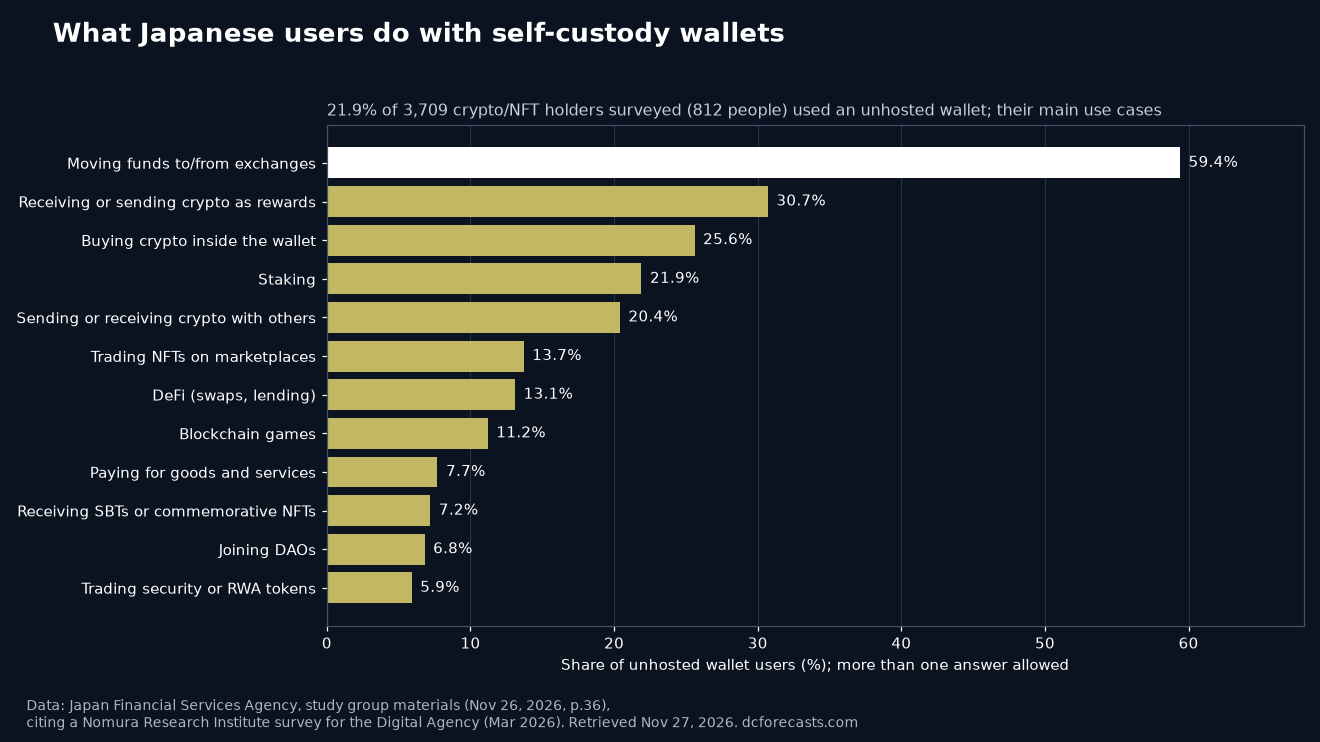
That issues for coverage. The FSA notes that people nonetheless primarily use hosted wallets run by home exchanges.
It repeats the sooner conclusion of its crypto working group that there’s no use to manage non-custodial pockets suppliers instantly, whereas protecting it as a future difficulty.
The bottom retains rising too: Japan reached a file 14.74 million crypto accounts, as we coated when BITPOINT introduced its December 23 closure.
The place Japan Already Attracts Traces on Unhosted Wallets
Japan isn’t ranging from zero.
Beneath the Act on Prevention of Switch of Prison Proceeds, home exchanges that take care of unhosted wallets already should preserve data and gather data on these transfers.
The 2026 amendments to the Monetary Devices and Trade Act and the Fee Providers Act additionally add prior notification and system security duties for companies that provide exchanges with vital custody techniques.
The firmest new step is aimed toward fraud. By way of a Cupboard Workplace ordinance, the FSA plans to require measures corresponding to a cooling-off interval that blocks transfers to unhosted wallets proper after a brand new trade account is opened.
The working group report it cites additionally requires fraud warnings, checks on the aim of a switch and monitoring when cash depart for unhosted wallets or unregistered platforms.
We see that as focused friction in opposition to funding scams, not a restrict on holding your individual keys.
Is a Mild Contact the Proper Mannequin for a Non-Custodial Pockets?
The FSA’s personal analysis factors that method.
The paper says direct regulation of unhosted pockets use, or of companies that solely develop or promote pockets software program or {hardware}, isn’t extensively seen internationally.
It cites FATF steering from October 2021 that such suppliers are normally not digital asset service suppliers, and an April 13, 2026 SEC workers assertion on when pockets interfaces are usually not broker-dealers.
It additionally notes that the Nomura survey discovered no nation with direct guidelines for unhosted wallets.
The paper accepts that utilizing such a pockets with an understanding of the dangers will be seen because the person’s personal accountability, whereas anti-money laundering targets should nonetheless be met.
That stance contrasts with France’s proposed €100,000 self-custody pockets declaration, which focused holders instantly.
What Bitcoin Holders Ought to Watch Earlier than 2027
Bitcoin traded close to $61,576 on Friday, up about 1.6% in 24 hours, based on CoinGecko knowledge retrieved November 27.
For long-term holders, Japan’s selection might matter greater than the each day value.
We’d watch three issues: whether or not the on-chain finance evaluate due in early 2027 retains pockets software program exterior licensing, how lengthy any cooling-off interval runs, and whether or not DeFi guidelines land on entrance ends.
A non-custodial pockets is how Bitcoin’s mounted provide turns into property its proprietor totally controls.
If Japan retains constructing instruments and training round that proper as an alternative of fences, we imagine the 7.7% {hardware} pockets share has loads of room to develop.
DC Forecasts is a pacesetter in lots of crypto information classes, striving for the very best journalistic requirements and abiding by a strict set of editorial insurance policies. In case you are to supply your experience or contribute to our information web site, be at liberty to contact us at [email protected]

