

The primary query a developer asks a few income platform’s API will not be whether or not it exists, however whether or not it exposes sufficient information to justify constructing in opposition to it.
Clari’s API is a REST floor documented as an OpenAPI 3.0 spec at developer.clari.com, at the moment at model 5.0.0. It covers forecast exports, alternative information, exercise logs, and audit occasions on the learn aspect, plus an Ingestion API for pushing customized information into Clari’s Account and Alternative entities. A separate Clari Copilot API exposes dialog intelligence information: name recordings, transcripts, subjects, and CRM objects linked to calls. The platform manages $5 trillion in income for 1,500+ clients together with Adobe, IBM, and Zoom, and the underlying Income Database (RevDB) captures historic snapshots of each income sign change. That could be a substantial information basis.
However the API’s scope and entry mannequin are narrower than the platform’s breadth suggests.
Clari’s API is constructed for one job: getting income execution information out of Clari (forecasts, alternatives, actions, audit trails) and pushing customized entity information in. It doesn’t expose the platform’s AI predictions, deal well being scores, or Income Cadences programmatically. It doesn’t present contact enrichment, firm intelligence, org charts, technographics, or purchaser intent alerts. And it’s not self-serve: API entry requires a characteristic flag enabled by Clari’s help staff, which means you open a help ticket and CC your Buyer Success Supervisor earlier than you write your first line of integration code.
That is the place ZoomInfo enters the image. ZoomInfo exposes a REST API suite overlaying search, enrichment, AI intelligence, and viewers administration throughout 500M contacts and 100M firms, with OAuth 2.0 authentication, tiered price limits as much as 35 req/sec, and an MCP server for AI-agent workflows. The 2 APIs sit at completely different layers of the income stack: Clari’s API strikes income execution information via your pipeline, ZoomInfo’s API supplies the B2B intelligence that Clari’s floor was by no means designed to cowl.
This assessment covers the Clari API in full technical depth first (authentication, endpoints, price limits, documentation, and pricing), then critiques ZoomInfo’s API because the intelligence layer that fills the information gaps a income operations API leaves open.
Clari API at a Look
Clari API: What Works Properly & What to Plan Round
|
What works effectively |
What to plan round |
|---|---|
|
Full OpenAPI 3.0 spec with interactive Authorize-and-test reference |
API entry will not be self-serve: requires CSM-enabled characteristic flag and a help ticket |
|
Forecast export consists of week-over-week historic information by way of includeHistorical |
No webhooks: export jobs use a polling mannequin (POST job, ballot for standing, obtain) |
|
Ingestion API accepts 100 req/sec per token for information push workflows |
No official SDKs in any language |
|
Alternative endpoint returns pattern historical past (previous worth, new worth, path) per subject |
Export API has concurrent job and month-to-month quota caps (org-level, adjustable by way of CSM) |
|
A number of API keys attainable per account for per-integration utilization monitoring |
Static API key auth solely: no OAuth, no token rotation, no scoped delegated entry |
|
Copilot API allows programmatic entry to name transcripts and recordings |
Copilot API price restrict is tight: 10 req/sec and 100,000 requests per week |
Clari API: Authentication & Getting Began
API entry begins with a paid Clari subscription, however a subscription alone will not be sufficient. The group documentation is specific: Clari’s help staff should allow a characteristic flag. The advisable course of is to open a help ticket and CC your Buyer Success Supervisor (CSM) to activate entry. There isn’t any developer portal signup, no free sandbox, and no trial API surroundings.
As soon as Clari allows the flag, authentication makes use of a static API key generated contained in the platform. Navigate to your consumer avatar, then Settings, then the API Token tab, and choose “Generate New API Token.” The platform exhibits the token solely as soon as at technology time, so retailer it securely. Revoking a token breaks any energetic integration utilizing it, and deactivating a consumer mechanically revokes all tokens that consumer created.
Go the token as an apikey header on each request:
curl -X GET “https://api.clari.com/v4/alternative?oppId=006XXXXXXXXXXXX”
-H “apikey: YOUR_API_TOKEN”
-H “Content material-Sort: utility/json”
The Ingestion API (base URL https://api.clari.com/v2) requires a second header: a partnerkey issued to formal integration companions. This dual-header mannequin gates write entry extra tightly than learn entry.
Two constraints to know earlier than you construct:
-
There isn’t any OAuth 2.0 circulation. Authentication is a static key with no token rotation, no scoped permissions, and no delegated entry mannequin. For multi-tenant integrations the place every buyer authenticates independently, that is limiting.
The Clari Copilot API makes use of its personal separate authentication, documented at its personal reference web site. Entry requires an energetic Copilot subscription.
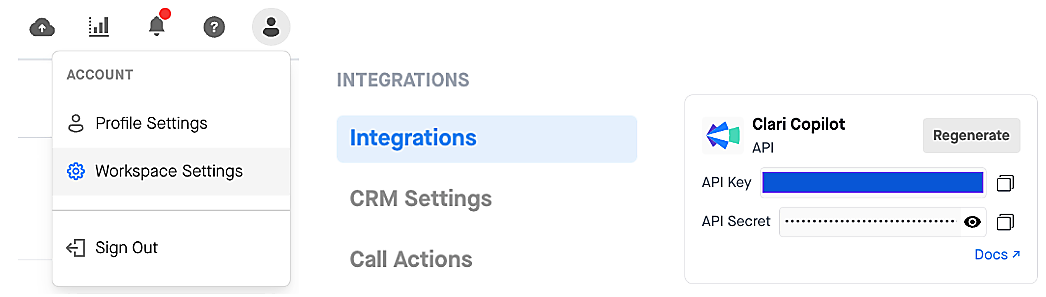
Supply: Clari Copilot API
Clari API: Core Endpoints & Capabilities
The primary Clari API is organized round six useful resource areas. All endpoints return JSON. Exports may also produce CSV. The API handles income information extraction and customized information ingestion, not programmatic management of Clari’s AI options.
Forecast Export
Endpoint: POST /export/forecast/{forecastId}
That is the first information extraction endpoint. It queues an asynchronous bulk export of a Forecast Tab. Parameters embody:
-
dataTypes: a number of of forecast, quota, forecast_updated, adjustment, crm_total, crm_closed
The endpoint returns a jobId for async polling. A schedule parameter controls retry habits if the job fails: NONE (no retry), ONCE (one retry after half-hour), or MAX (three retries with 30-minute gaps).
What you’ll construct with this: a nightly pipeline that exports submitted forecast calls and quota historical past from Clari into an information warehouse (Snowflake, BigQuery) for customized reporting, pattern evaluation, or board-level dashboards that mix Clari’s forecast information with monetary actuals.
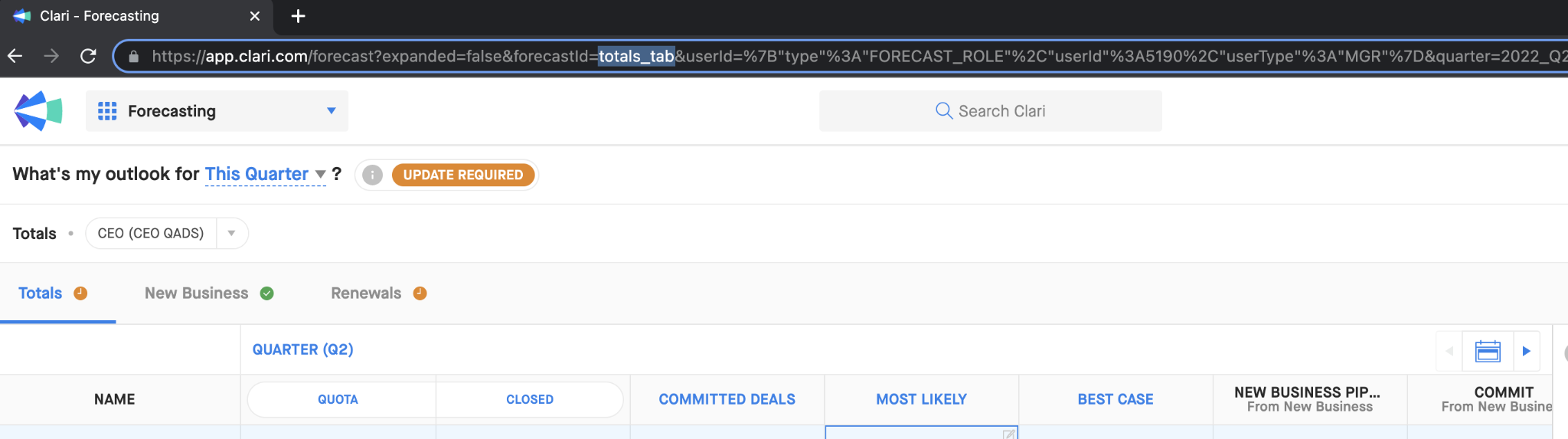
Supply: Clari API
Bulk Export Framework
All async export jobs share a typical lifecycle managed by these endpoints:
The polling mannequin is easy however lacks push notifications. There isn’t any callback URL parameter, no webhook when a job completes, and no occasion subscription. Your integration polls till the standing modifications.
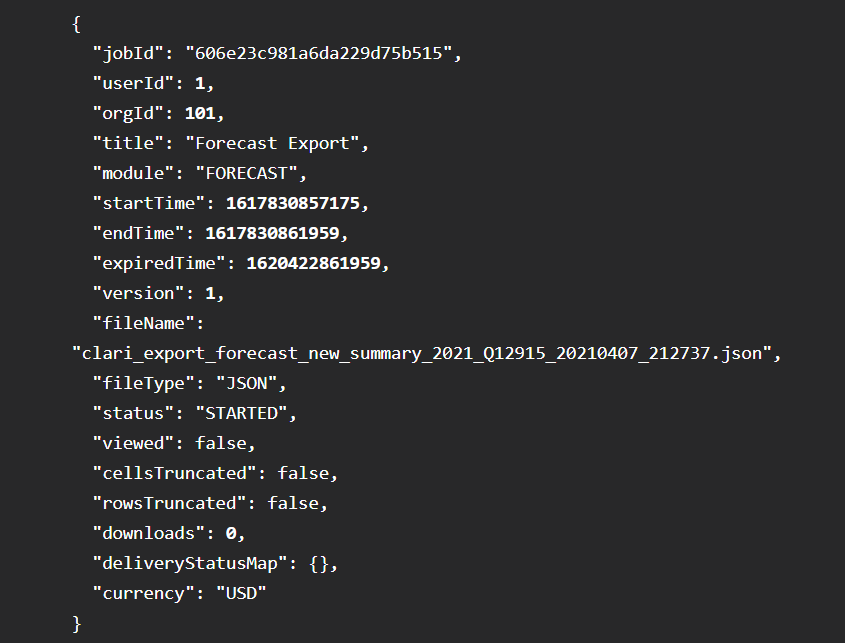
Supply: Clari API
Alternative API
Endpoint: GET /alternative
Retrieves alternative information by Salesforce alternative ID. Accepts as much as 100 oppId values per request. The response consists of:
-
Fields with pattern historical past: previous worth, new worth, date of change, and path (optimistic, unfavorable, impartial)
The pattern historical past is the developer-facing floor of what Clari calls “time-series intelligence.” The place Salesforce offers you the present state of a subject, this endpoint offers you the trajectory: when shut dates moved, how quantities modified, and by which path.
Exercise Export
Endpoint: POST /export/exercise
Async bulk export of gross sales exercise information. Helps filtering by activityTypes (MEETING, EMAIL_SENT, EMAIL_RECEIVED, ATTACHMENT_SENT, ATTACHMENT_RECEIVED), startDate, and endDate in ISO-8601 format. Output consists of participant particulars, account and alternative mappings, and e mail/attachment metadata.
What you’ll construct with this: an activity-based scoring mannequin that pulls engagement information from Clari (which captures actions from e mail and calendar with out guide CRM logging) and feeds it right into a customized lead or deal scoring pipeline.
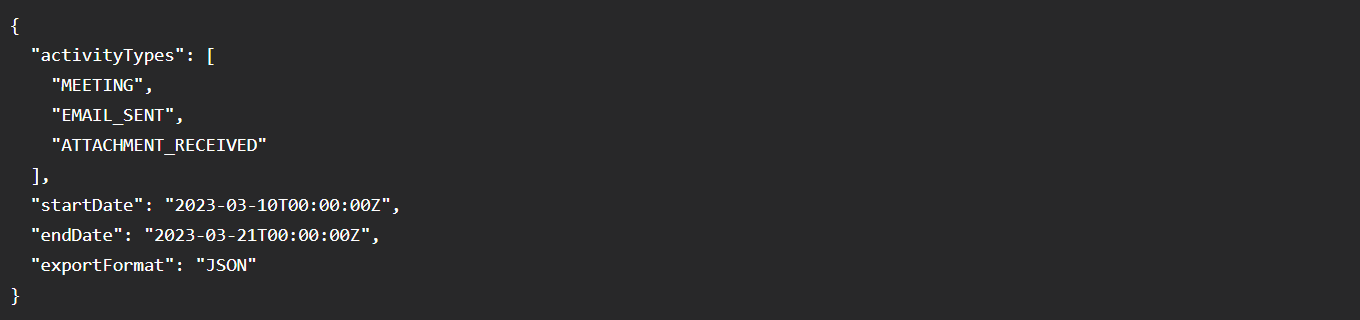
Supply: Clari API
Audit API
Two entry patterns for compliance and operational visibility:
-
POST /export/audit/occasions: async bulk export of audit occasions, filterable by actor, session sort (WEB, IOS, ANDROID), date vary, and occasion class
-
GET /audit/occasions: paginated real-time question with restrict (1 to 1,000, default 100) and nextLink for cursor-based pagination
The actual-time question endpoint is helpful for monitoring: monitoring who submits forecasts, after they do it, and whether or not patterns point out adoption points or course of gaps.
Ingestion API
Base URL: https://api.clari.com/v2
For integration companions pushing information into Clari’s Account and Alternative entities:
If validation fails on a bulk add, Clari rejects your complete batch. You will need to appropriate and retry it. The incremental endpoint at 100 information per request is safer for pipelines the place partial failures want isolation.

Supply: Clari API
Administrative API
Endpoint: GET /admin/limits
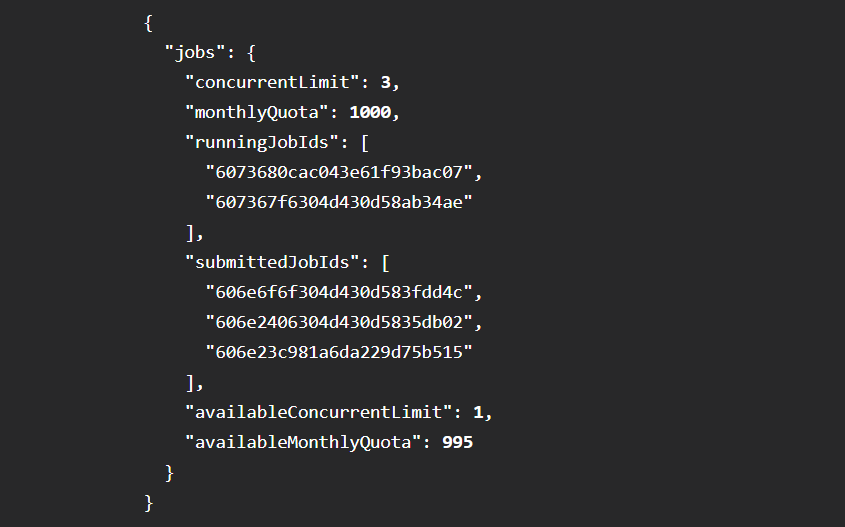
Returns the org’s concurrent export restrict, month-to-month quota, working job IDs, submitted job IDs, and remaining quota. This can be a pre-flight test: name it earlier than queuing exports to verify you’ve gotten capability, particularly when a number of integrations share the identical quota pool.
Clari Copilot API (Separate Product)
The Copilot API is a separate floor for dialog intelligence information:
-
GET /calls: paginated checklist of recorded calls, filterable by standing, date vary, and individuals
-
POST /create-call: ingest externally recorded calls (from Zoom, Twilio, or different sources) for transcription and evaluation
All checklist endpoints help restrict/skip pagination and date-range filters (filterModifiedGt/filterModifiedLt). What you’ll construct with this: an automatic pipeline that pulls name transcripts after each gross sales assembly, extracts key subjects and objections by way of your personal NLP layer, and feeds the outcomes right into a deal danger mannequin alongside Clari’s alternative pattern information.
Clari API: Webhooks & Occasions
Clari doesn’t provide webhooks. Neither the primary API spec nor the Copilot API documentation paperwork webhook endpoints, occasion subscriptions, or callback URLs.
The primary API’s export pipeline makes use of a polling mannequin: you POST an export job, obtain a jobId, then ballot GET /export/jobs/{jobId} till the standing returns DONE. There isn’t any push notification when a job completes, no occasion stream for forecast modifications, and no real-time notification when a chance’s fields replace.
For a developer constructing event-driven workflows (triggering a Slack alert when a forecast lands, updating a BI dashboard when a deal’s shut date slips, kicking off enrichment when a brand new contact seems), the absence of webhooks means you both ballot on a schedule or settle for latency. That is probably the most important architectural constraint for real-time integration patterns.
Clari API: SDKs, Docs & Price Limits
SDKs & Libraries
Clari doesn’t publish official SDKs in any language. The group documentation recommends utilizing a generic API consumer to check calls, then pairing that with an ETL software or customized script to automate recurring exports. For the Copilot API, a Python pattern file (copilot_calls_example.py) is linked from the docs, however that is instance code, not a maintained SDK.
No official SDK means you personal the auth layer, the polling logic, the error dealing with, the retry technique, and the response parsing. For a nightly forecast export pipeline, that is manageable. For a manufacturing integration making dozens of endpoint calls with job-lifecycle administration, the engineering overhead provides up.
Documentation & Developer Expertise
The primary API is documented as a full OpenAPI 3.0 spec at developer.clari.com. The interactive spec consists of endpoint descriptions, request/response schemas with examples, and in-page “Authorize” performance for testing authenticated calls. This can be a customary Swagger/Redoc expertise: navigate by tag (Bulk Export Framework, Forecast API, Audit API, Alternative API, Exercise API, Ingestion API), develop an endpoint, and take a look at it together with your token.
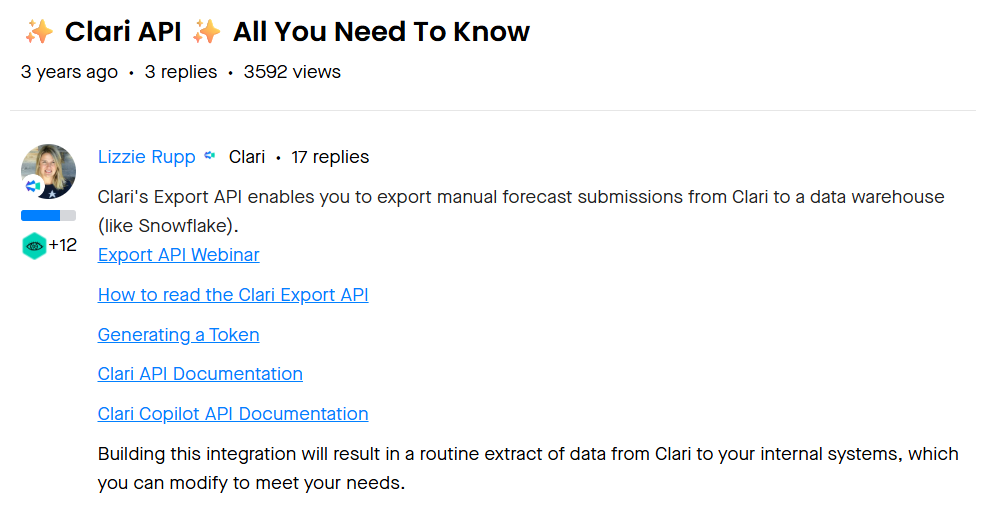
Supplementary documentation lives within the Clari Information Base (authenticated buyer portal), with articles on subjects like “The best way to Learn the Forecast Export” and “Producing a Token for Clari’s API.” The group discussion board has a Product Q&A piece with developer-facing posts, together with the important thing “Clari API: All You Must Know” information that explains the entry provisioning course of.
Supply: Clari Group
The Copilot API has its personal separate reference web site. It’s a JavaScript-rendered single-page app, so its content material will not be indexable with out browser execution and is more durable for AI developer instruments to eat than a static spec.
Three issues the documentation lacks:
Developer help is by way of e mail at help@clari.com, as listed within the API spec itself. For entry provisioning, clients open help tickets and loop of their CSM. There isn’t any devoted developer group, Slack channel, or discussion board past the final Clari Group.
Price Limits & Constraints
The Clari API operates below three rate-limiting fashions relying on which floor you name.
Principal Export API:
Two overlapping org-level constraints, seen by way of GET /admin/limits:
-
A month-to-month quota: a rolling 30-day cap on complete export jobs submitted (the docs present a default of 1,000/month, adjustable by way of CSM request)
When both restrict is hit, POST requests return HTTP 400 with codes like export_monthly_quota_reached. The retry schedule parameter on forecast exports can cut back quota exhaustion from transient failures.
Supply: Clari API
Ingestion API:
100 requests per second per API token, with HTTP 429 returned on breach. Bulk ingestion information are capped at 10 MB. Incremental ingestion is capped at 100 information per request.
Copilot API:
10 requests per second, with a weekly quota of 100,000 requests. Exceeding the weekly quota returns HTTP 403.
The Ingestion API’s 100 req/sec is beneficiant for an information push floor. The Copilot API’s 10 req/sec and 100K weekly cap is tight: at sustained tempo, you exhaust the weekly quota in below three hours. In case your integration pulls transcripts ceaselessly or processes many calls, plan round that ceiling.
Clari API Pricing & Entry Prices
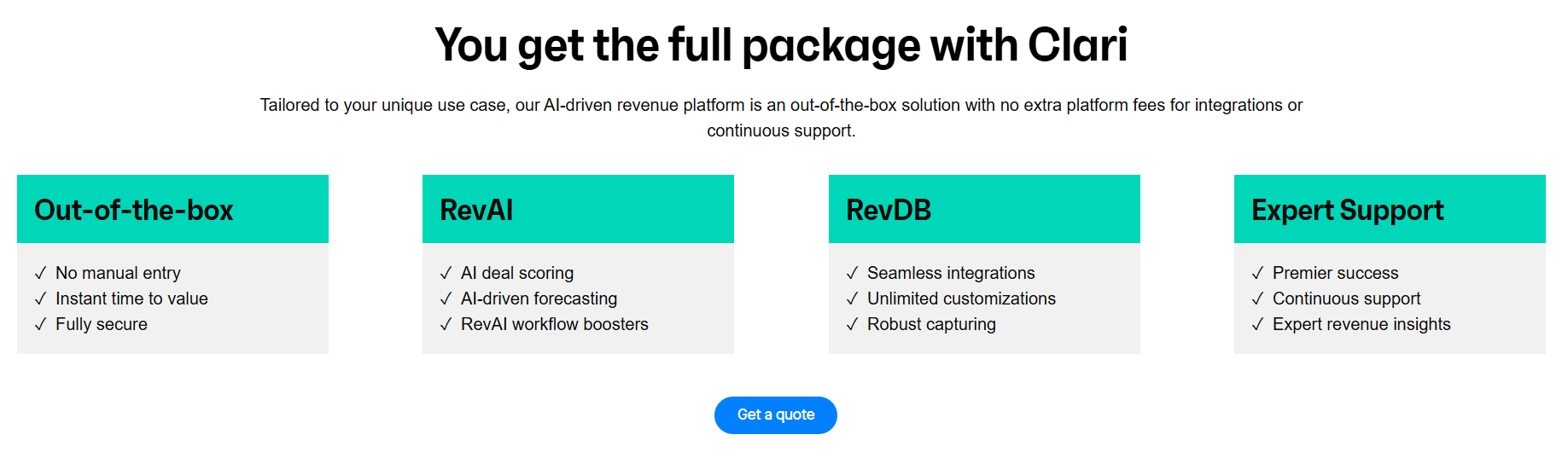
Clari doesn’t publish API pricing. The pricing web page states “no additional platform charges for integrations,” however this refers to native integrations (Salesforce, Slack, information warehouses) and doesn’t make clear the API entry mannequin for customized improvement.
What first-party sources affirm:
All indicators level to API entry being bundled into enterprise contracts on a quote-only foundation. For a developer sizing the price: the API itself might not price additional, however you can not entry it with out an enterprise Clari subscription, and you can not know your quota limits till your CSM confirms them.
Supply: Clari
The place the Clari API Falls Quick
These are the sensible limits a developer ought to plan round. A number of are scope choices that mirror what Clari’s API is (a income information extraction floor) and what it’s not.
The API is enterprise-gated with no self-serve path. You can’t enroll, generate a key, and make your first name. Entry requires an energetic enterprise subscription, a help ticket, CSM involvement, and a characteristic flag. A developer evaluating this API has no option to take a look at it earlier than committing to a contract. The Copilot API has its personal separate entry necessities.
No webhooks, no occasion system. Each integration sample is poll-based. Export jobs require submitting a request, then checking standing till completion. There isn’t any push notification for forecast modifications, deal updates, or exercise occasions. For real-time workflows, it is a important constraint.
No contact enrichment, firm intelligence, or intent information. The API strikes income execution information (forecasts, alternatives, actions, audit occasions). It doesn’t present the B2B intelligence a developer typically wants alongside that information: who the contacts are past what the CRM holds, what firms appear like (business information, technographics, org charts), or whether or not accounts present shopping for intent. In case your pipeline must go from “this deal’s shut date slipped” to “right here is the up to date shopping for committee and their engagement alerts,” you want a second API.
Static API key auth with no scoping. There isn’t any OAuth 2.0, no token rotation, no delegated entry. Each key has the identical permissions. For groups constructing multi-tenant integrations, implementing least-privilege entry, or assembly credential-rotation insurance policies, that is limiting.
No official SDKs. Each integration is uncooked HTTP. You construct and keep the polling logic, the auth layer, the error dealing with, and the retry technique your self.
Copilot API price limits are tight. At 10 req/sec and 100,000 requests per week, high-volume transcript pipelines will hit the ceiling rapidly. The weekly quota is a tough gate that returns 403 when exhausted.
AI options aren’t API-accessible. Clari’s platform consists of AI deal scoring, predictive forecasting, Good Deal Summaries, and Income AI Brokers. None of those are uncovered via the API. The API offers you the uncooked information, not the intelligence the platform applies to it.
ZoomInfo API: The B2B Intelligence Layer Clari Does Not Expose
Clari’s API tells you the place your offers stand: which forecasts had been submitted, how alternative fields modified over time, what exercise occurred on every account. ZoomInfo’s API tells you who the individuals behind these offers are, what their firms appear like, whether or not these accounts are researching your class, and the place the gaps within the shopping for committee sit.
The 2 APIs function at completely different layers. A developer constructing an entire income intelligence pipeline would use Clari’s API to extract deal execution information and ZoomInfo’s API to complement it with the contact, firm, and sign intelligence that income platforms don’t generate on their very own.
What the API Covers: Search, Enrichment, and AI Intelligence
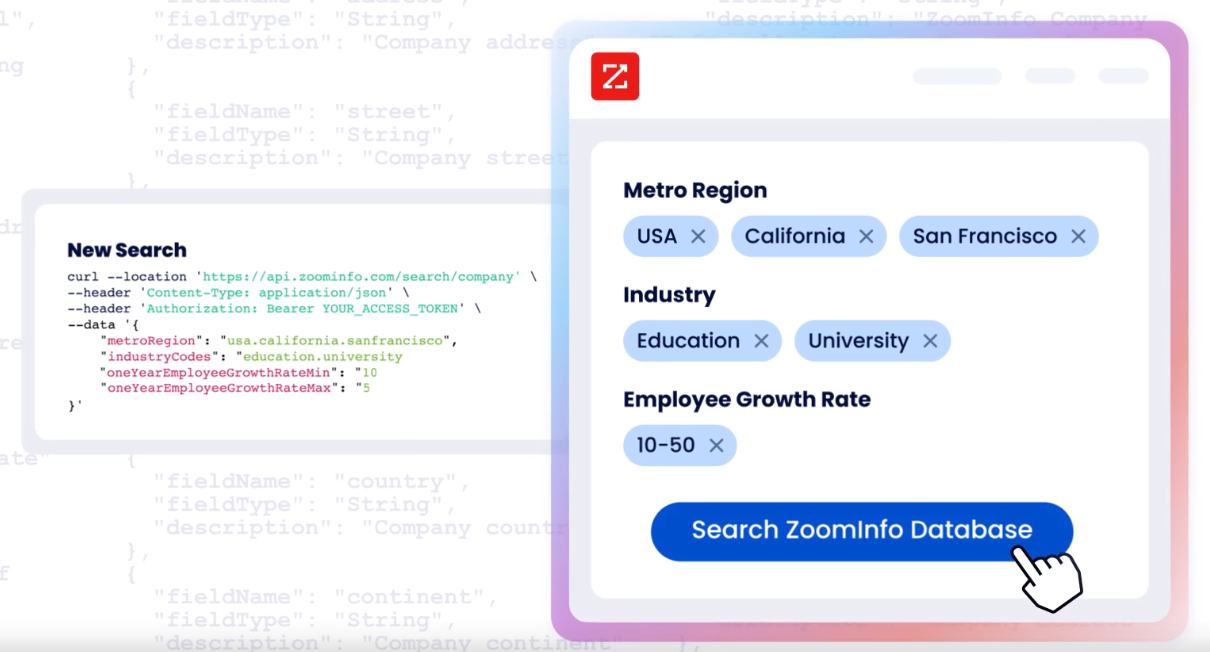
ZoomInfo’s Enterprise API is a REST suite served from https://api.zoominfo.com/gtm, organized into 4 floor areas documented within the interactive API reference:
Information API (Search & Enrich): Search endpoints cowl Contacts, Corporations, Intent, Information, and Scoops, returning matched information with out consuming credit. Enrich endpoints unlock the complete payload: enterprise emails, direct dials, employment historical past, company hierarchy, org charts, technographics, and hashtag alerts, as much as 25 information per name. The search-then-enrich sample means you filter freely, then pay just for the information you decide to. The underlying dataset spans 500M contacts, 100M firms, 135M+ verified cellphone numbers, and 200M+ verified enterprise e mail addresses.
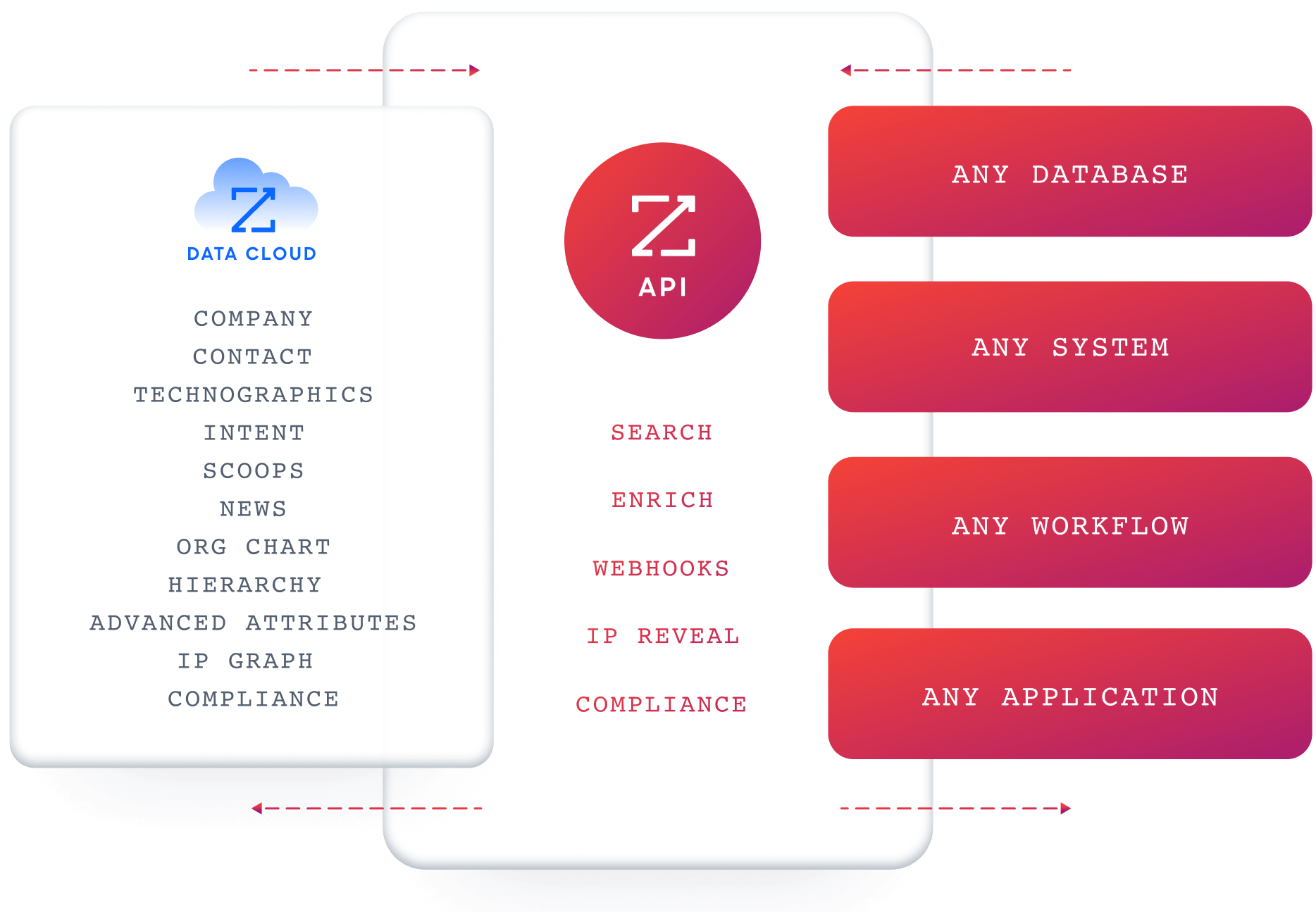
Copilot API (AI Intelligence): Account Abstract returns structured account intelligence with a free-form Q&A endpoint. Discover Comparable Corporations performs lookalike enlargement. Contact Suggestions returns AI-ranked buying-committee ideas by movement (prospecting, deal acceleration, renewals). This floor requires an Enterprise API or Copilot bundle subscription.
Advertising and Platform APIs spherical out the suite with viewers administration (CRUD for promoting audiences) and bidirectional engagement information by way of the Engagements API, at the moment in Beta.
The pairing with a income operations API is direct: pull alternative and exercise information from Clari to determine which offers want consideration, then use ZoomInfo’s enrichment endpoints to fill within the contact particulars, firm context, and intent alerts that Clari’s API doesn’t carry.
Authentication, Price Limits & Credit
Authentication makes use of OAuth 2.0 with PKCE by way of Okta, issuing 24-hour entry tokens with rotating refresh tokens. Three flows are supported: Authorization Code with PKCE (for net functions), Shopper Credentials (for server-to-server), and Refresh Token. Groups register functions via the ZoomInfo Developer Portal, the place they generate credentials, outline scopes, and take a look at endpoints. This can be a essentially completely different authentication mannequin from Clari’s static API key: it helps delegated entry, credential rotation, and scoped permissions out of the field.
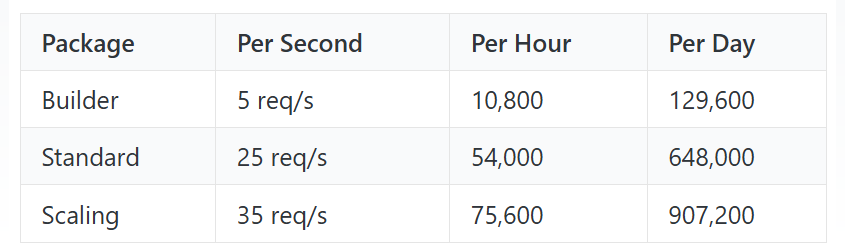
Price limits are printed by tier: Builder (5 req/sec), Customary (25 req/sec), and Scaling (35 req/sec), with per-hour and per-day sliding-window limits enforced concurrently. Each response consists of quota headers with remaining capability, and 429 responses embody a Retry-After header with actual backoff timing. Credit observe a rolling 12-month window: enriching a report for the primary time consumes one credit score; re-enriching the identical report throughout the 12 months is free. Search and lookup operations don’t eat credit.
Webhooks, MCP & Developer Expertise
Webhooks can be found by way of the Brokers API, tied to ZoomInfo’s Agent Groups system. Occasion varieties cowl bulk enrichment jobs finishing, information altering, credit score utilization crossing thresholds, and new GTM alerts (scoops, funding occasions, intent spikes) changing into accessible, with retry habits and throttling configurable per occasion sort.
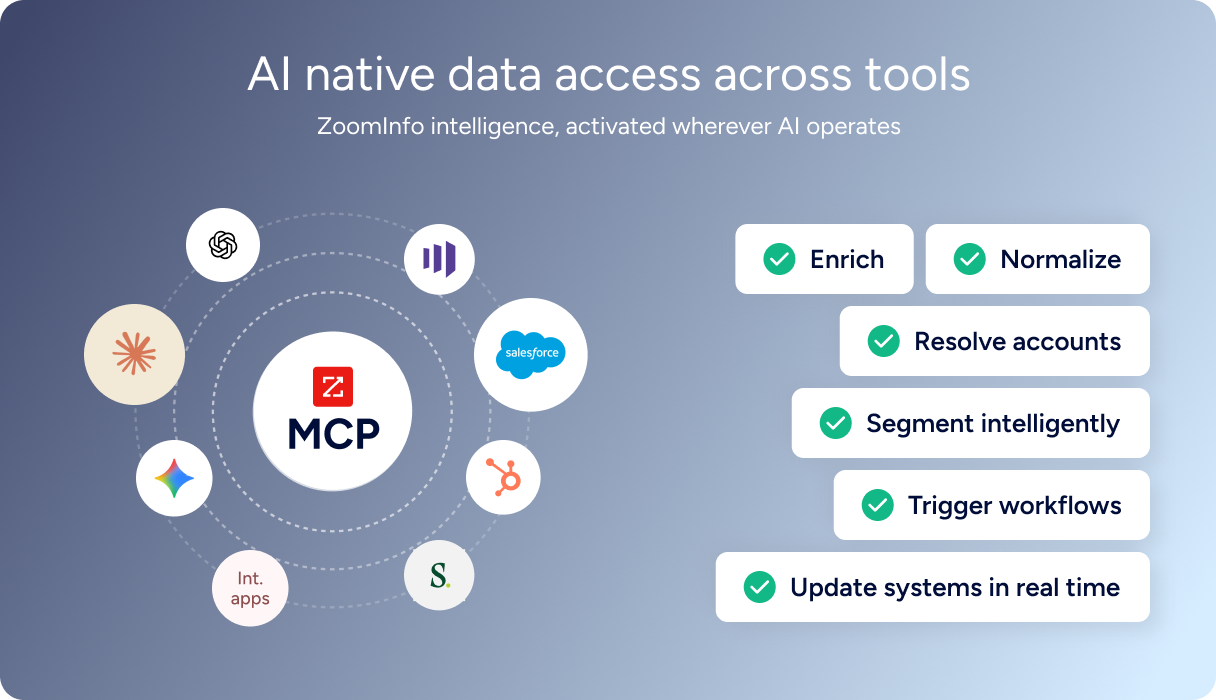
For builders constructing AI brokers, ZoomInfo’s MCP server at https://mcp.zoominfo.com/mcp exposes search, enrich, and account analysis as native instruments for MCP-compatible assistants, at the moment supporting Claude and ChatGPT. The credit score mannequin carries over from the REST API.
ZoomInfo doesn’t publish official SDKs both, so each platforms require direct HTTP integration. The interactive API reference helps stay testing, and a Docs MCP server lets AI improvement instruments generate integration code in opposition to the API spec. ZoomInfo added API entry to all related plans, eradicating the prior enterprise-only gate, with consumption-based pricing quoted per account.
BDO Canada reported an 87% discount in time spent updating inner information dashboards utilizing the ZoomInfo API, with one analyst describing the combination as plug-and-play throughout any course of. (ZoomInfo)
Remaining Verdict
Clari’s API is a centered, well-documented floor for extracting income execution information from probably the most established forecasting platforms in enterprise gross sales. The OpenAPI 3.0 spec is thorough, the chance pattern information is exclusive (historic field-level modifications that CRM exports don’t seize), and the Copilot API opens a programmatic path to dialog intelligence. For the particular job of getting forecast submissions, alternative trajectories, and exercise logs into an information warehouse, the API delivers what it was designed to ship.
The constraints are actual and price naming: no self-serve entry, no webhooks, no SDKs, no OAuth, no AI options uncovered, and a scope that ends at income execution information. These aren’t failures; they’re boundaries that outline what you may and can’t construct on this API alone.
Select the Clari API if your integration is revenue-operations-first: exporting forecast information to a warehouse, pulling alternative pattern historical past for customized analytics, ingesting accomplice information into Clari’s entity mannequin, or feeding name transcripts right into a downstream evaluation pipeline. The API’s strengths lie within the information distinctive to Clari’s platform, significantly the time-series intelligence on deal actions.
Select the ZoomInfo API if your construct wants the B2B intelligence layer that income operations information doesn’t carry: who the contacts are, what their firms appear like, whether or not these accounts are in-market, and the place the shopping for committee gaps sit. The search-then-enrich sample (search is free, enrich consumes credit), OAuth 2.0 with scoped entry, tiered price limits with specific headers, and the MCP server for AI-agent workflows cowl the information and entry mannequin that Clari’s API was not designed to offer. Discover the ZoomInfo Enterprise API or begin with the developer docs to see the endpoint floor immediately.
A developer who wants each layers (deal execution information from Clari and speak to/firm intelligence from ZoomInfo) ought to word that the 2 APIs use completely different authentication fashions (static API key vs. OAuth 2.0), completely different async patterns (Clari polls for export completion, ZoomInfo affords Agent Groups webhooks), and completely different rate-limiting philosophies. Plan the combination layer to deal with each.
FAQ
Is the Clari API free?
Not as a standalone product. API entry is bundled into Clari’s enterprise subscription and requires a CSM-enabled characteristic flag to activate. No per-call or per-credit API pricing is printed. The pricing web page states “no additional platform charges for integrations,” however this refers to native integrations. API entry requires an present paid contract plus support-team activation earlier than you can also make your first name.
Does Clari have a GraphQL API?
No. Clari exposes a REST API documented as an OpenAPI 3.0 specification (model 5.0.0) with JSON request and response our bodies. There isn’t any GraphQL endpoint. The Copilot API can also be REST-based. If you happen to want a GraphQL interface for Clari information, you would want to construct a wrapper layer on prime of the REST endpoints.
What’s the Clari API price restrict?
Clari makes use of three rate-limiting fashions throughout its API surfaces. The primary Export API enforces org-level concurrent job limits and a month-to-month job quota (adjustable by way of CSM). The Ingestion API permits 100 requests per second per API token. The Copilot API is probably the most restrictive at 10 requests per second and 100,000 requests per week, with HTTP 403 returned when the weekly quota is exhausted.
Are there official Clari SDKs?
No. Clari doesn’t publish official SDKs in any language. The group documentation recommends utilizing a generic API consumer for testing and an ETL software or customized script for automated workflows. A Python pattern file for the Copilot API is linked from the docs, however it’s instance code, not a maintained SDK bundle. Builders combine immediately over HTTP.
Does the Clari API help webhooks?
No. Neither the primary Clari API nor the Copilot API helps webhooks or occasion subscriptions. The export pipeline makes use of a polling mannequin: you submit a job, obtain a job ID, and ballot a standing endpoint till the job completes. There isn’t any callback URL parameter and no push notification system. For event-driven integration patterns, you construct polling logic in your aspect.
What does ZoomInfo’s API add to a Clari construct?
ZoomInfo’s API supplies the B2B intelligence layer that Clari’s API doesn’t cowl. The place Clari’s API extracts income execution information (forecasts, alternatives, actions, name transcripts), ZoomInfo’s API enriches that information with the contact and firm intelligence behind it: verified enterprise emails, direct-dial cellphone numbers, employment historical past, org charts, technographics, purchaser intent alerts, and AI-powered account analysis and buying-committee suggestions throughout 500M contacts and 100M firms. The 2 APIs use completely different authentication fashions (API key vs. OAuth 2.0) and completely different async patterns, so plan the combination layer to deal with each. ZoomInfo’s MCP server extends the identical intelligence to AI-agent workflows, including an entry path Clari’s API doesn’t at the moment provide.
Examine extra instruments on this area:

