

Lenders typically begin with one system to course of purposes, add one other to handle repayments, and usher in a 3rd to deal with collections. Every device may work wonderful by itself. Hassle begins within the gaps between them: shifting information between disparate programs results in double entry, mismatched balances, and delayed experiences that get more durable to untangle as a portfolio grows.
Lending information reconciliation is the recurring effort to align borrower, loan-term, stability, and payment-status information throughout separate origination, servicing, and collections databases. Working all three levels on one shared information mannequin eliminates inner re-keying whereas retaining API connections to exterior credit score bureaus, cost rails, and accounting ledgers.
In keeping with the seller’s product documentation, Finspectra’s Prizm platform takes a special method by bringing mortgage origination, servicing, and collections into one related lending atmosphere. Groups learn and replace the identical underlying borrower and mortgage information throughout the total credit score time period with out passing static exports from one division to the following.
TL;DR – Key Takeaways for Information & Lending Leaders
- The foundation information downside: Most operational delays in lending hint again to information reconciliation, the place origination, servicing, and collections retailer separate borrower information that drift out of sync.
- System integration gaps: Trade survey benchmarks cited on this article spotlight poor integration between programs and purposes as a persistent effectivity downside for banking leaders.
- Shared-record structure: Working origination, servicing, and collections on one shared information mannequin removes inner re-keying whereas retaining API connections to credit score bureaus and cost rails.
- Governance boundary: Consolidating databases doesn’t substitute monetary controls. Dependable portfolio information nonetheless depends upon validated cost feeds, position permissions, audit trails, and common ledger reconciliation earlier than and after migration.
Why Three Separate Programs Create One Information Reconciliation Downside
Specialised lending instruments often enter a corporation at totally different progress levels as an alternative of by a single architectural plan. A lender adopts an origination system to maintain up with rising utility quantity, introduces servicing software program to trace repayments, and provides a collections platform as soon as overdue accounts demand devoted queues.
Every system maintains its personal database. Friction begins the second these programs must alternate state.
In a typical disconnected workflow, an accepted utility may nonetheless require guide re-entry into the servicing ledger. A borrower cost cleared on Friday afternoon can sit in a batch job whereas collections information nonetheless present the mortgage overdue on Monday morning. Assist representatives find yourself switching throughout three screens simply to piece collectively an account’s historical past.
These handoffs introduce 4 recurring information and operational dangers:
- Duplicate information entry: Workers enter the identical borrower and contract fields into a number of programs, elevating the prospect of transcription errors and mismatched phrases.
- Delayed account state: Downstream groups make credit score, billing, or outreach selections utilizing balances and statuses which have already modified upstream.
- Restricted portfolio visibility: Managers battle to tug one constant view of mortgage efficiency with out first reconciling departmental spreadsheets.
- Larger upkeep overhead: IT groups should preserve separate vendor schemas, batch sync scripts, model upgrades, and entry controls.
Fragmented stacks additionally multiply copies of delicate borrower information and broaden the variety of handoff interfaces by which that info travels. In an evaluation of fragmented lending tech stacks from Baker Hill citing KPMG’s 2025 banking survey, 93% of banking executives recognized information privateness and threat as a prime data-modernization problem. Each further database copy and batch switch makes information lineage, entry management, and retention guidelines more durable for engineering and compliance groups to manipulate and audit.
Trade experiences cited by the writer level to the identical integration pressure. As cited from Cornerstone Advisors’ 2026 banking analysis, 69% of surveyed banks recognized poor integration between programs and purposes as a know-how effectivity problem, in contrast with 62% within the prior 12 months’s survey. Reviewing financial institution readiness in that very same analysis cycle, Cornerstone Chief Analysis Officer Ron Shevlin supplied a blunt reminder for establishments chasing automation on prime of fragmented stacks: “There is no such thing as a significant AI technique with out a credible, prioritized information technique.”
What number of software program purposes a lender owns issues far lower than whether or not these purposes share clear, constant information.
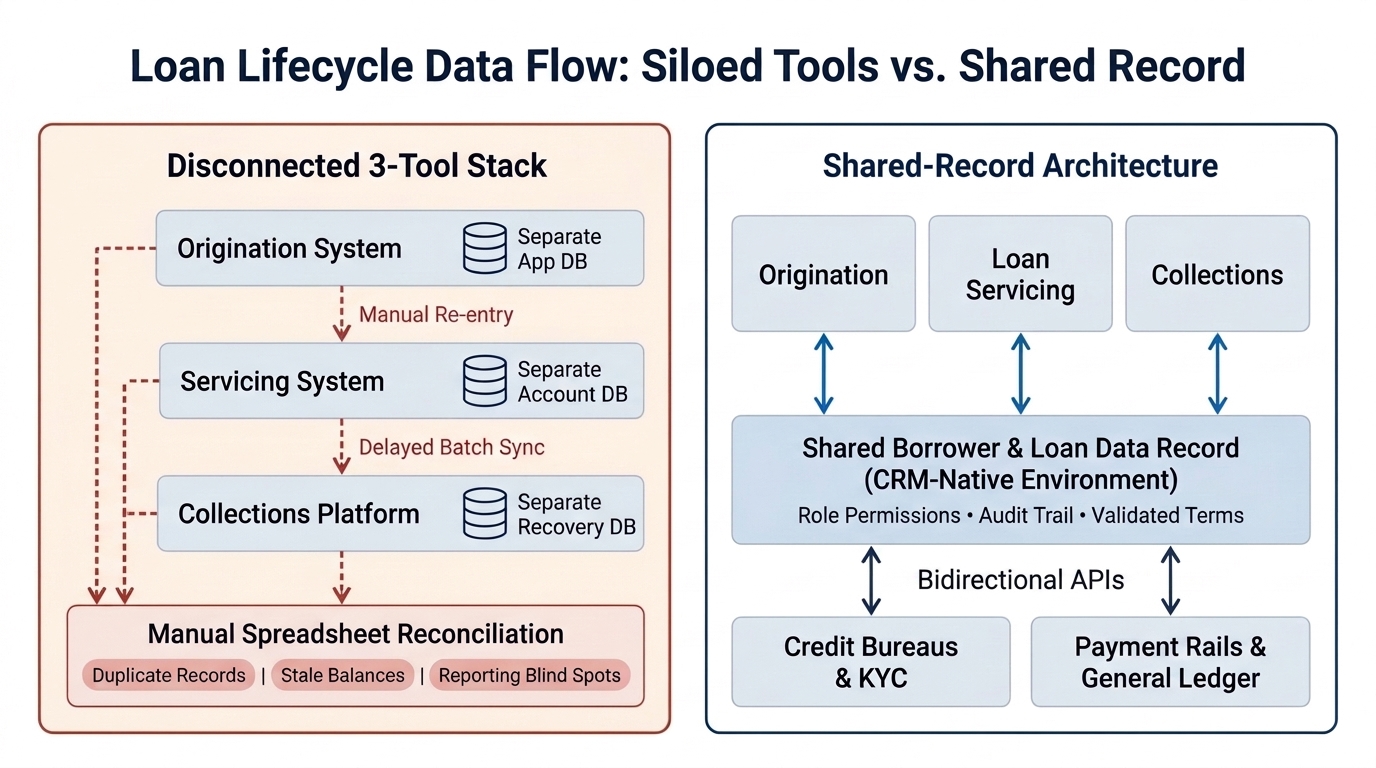
Time stress at month-end makes this information reconciliation hole even more durable to handle. Steerage on monetary information reconciliation from Safebooks notes that compressing monetary shut timelines pressure finance groups to report sooner whereas transaction quantity and complexity make guide reconciliation virtually unimaginable. Dashing lending information reconciliation to satisfy a good shut deadline will increase the danger of lacking important stability discrepancies throughout origination, servicing, and normal ledger experiences.
Determine 1: How borrower and account information transfer throughout a disconnected three-tool stack versus a shared-record lending structure.
Retaining One Clear File From Utility to Approval
Mortgage origination covers utility consumption, doc assortment, identification verification, credit score evaluation, underwriting, and ultimate approval. Within the writer’s operational remark, when these actions run throughout disconnected instruments, borrower information begins fragmenting earlier than a single greenback is disbursed.
An built-in lending suite retains these steps hooked up to shared information and configurable workflows. Consumption fields move straight into underwriting with out repeated typing. Credit score bureau pulls and verification checks keep linked to the identical utility ID, whereas doc administration instruments hold revenue proofs and disclosures tied to the underwriting file.
The business has spent many years making borrower info simpler to acquire and lending selections sooner. Credit score reporting, digital verification, banking connections, mortgage origination programs and automatic underwriting have remodeled each ends of the method. Synthetic intelligence guarantees to speed up them once more.
Gerald Inexperienced in Mortgage Lending Danger Grows within the Information-to-Resolution Hole
In keeping with Finspectra’s product description, Prizm’s origination capabilities embrace multi-channel utility seize, credit score scoring integrations, configurable routing workflows, and centralized doc administration.
For operations and threat groups, the sensible achieve is report consistency. Lenders can apply commonplace determination guidelines to routine purposes whereas routing exceptions to an underwriter with the total consumption path intact.
Workflow automation nonetheless requires tight controls. Credit score selections should comply with the lender’s threat insurance policies and relevant lending laws, whereas complicated borrower information nonetheless name for human judgment.
Carrying Verified Mortgage Phrases Into Servicing With out Handbook Re-Entry
As soon as a mortgage will get accepted and funded, the info problem shifts from evaluating an utility snapshot to sustaining a dwelling account ledger over the total reimbursement time period.
Servicing groups observe principal balances, calculate curiosity and charges, publish funds, handle amortization schedules, and ship borrower notices. When servicing runs independently of origination, workers typically must recreate contract fields that exist already upstream.
A related platform is designed to hold accepted mortgage phrases and verified borrower particulars straight into servicing workflows to scale back guide boarding handoffs. In keeping with Finspectra’s platform overview, Prizm’s servicing module supplies cost monitoring, full account histories, automated notifications, reimbursement changes, and portfolio reporting.
Take a typical servicing occasion: a borrower asks to change their reimbursement schedule. On a shared report, approved workers can assessment the unique mortgage phrases, apply an accepted schedule change, and protect a transparent audit log with out exporting information between departments.
In follow, that continuity straight improves downstream analytics. When account state stays aligned, finance and threat managers can measure reimbursement efficiency with out spending month-end shut reconciling conflicting exports. Banking supervisors have emphasised this precept for over a decade: beneath Precept 3 of the Basel Committee’s BCBS 239 threat information requirements, “Danger information needs to be aggregated on a largely automated foundation in order to minimise the likelihood of errors,” with establishments anticipated to work towards “a single authoritative supply for threat information per every sort of threat.”
Integration by itself doesn’t assure clear servicing numbers. As a sensible operational baseline, lenders nonetheless want reliable cost processing feeds, field-level information validation, clear exception queues for partial or returned funds, and scheduled general-ledger reconciliation, as detailed in Solvexia’s information on mortgage reconciliation.
Bringing Collections Into the Identical Information Mannequin
Collections sits downstream of each prior step, which means restoration groups depend upon information generated throughout all the mortgage lifecycle. Workers want precise payoff balances, cleared cost histories, delinquency growing older, and logs of earlier borrower communications.
When these information sit in separate databases, collections specialists spend hours looking down account context, or threat contacting a borrower over an installment that has already posted within the servicing device.
An built-in suite connects collections queues on to stay servicing information and prior interplay logs. In Finspectra’s product description, Prizm helps configurable delinquency and hardship workflows, prioritized workload queues, compliance checks, and post-collection transaction posting. When an account turns overdue, a configured rule can flag the file and route the follow-up activity so approved workers assessment full cost and outreach historical past earlier than taking motion beneath lender coverage.
File continuity in servicing and collections carries regulatory weight as effectively. For mortgage servicers particularly, federal Regulation X servicing requirements (12 CFR § 1024.38) require insurance policies making certain the “well timed switch of all info and paperwork within the possession or management of the servicer” in a kind that preserves accuracy, whereas BCBS 239 units risk-data-aggregation ideas for giant banking organizations. Automated collections workflows should implement statutory contact restrictions, client safety guidelines, and documented hardship procedures utilizing present account information.
What Modifications When the Programs Share Information?
Transferring to an built-in lending suite is much less about trimming vendor depend for its personal sake and extra about eradicating translation errors between mortgage lifecycle levels.
When origination, servicing, and collections function on shared information, lenders see 4 sensible shifts:
- Constant borrower and mortgage information: Shared tables take away the routine chore of reconciling duplicate buyer IDs and mismatched balances throughout departmental databases.
- Fewer guide handoffs: Configured workflows transfer mortgage state from approval to lively servicing and delinquency assessment with out repeated workers re-entry.
- Clearer portfolio visibility: Danger and finance leaders can analyze underwriting cohorts alongside stay reimbursement and restoration efficiency in a single enterprise intelligence reporting layer.
- Easier integration administration: Consolidating overlapping inner programs reduces the variety of brittle point-to-point sync jobs and vendor upgrades IT groups should preserve.
In keeping with Finspectra’s documentation, Prizm is constructed on Salesforce so origination, servicing, and collections workflows can run contained in the Salesforce information atmosphere. On the identical time, the seller notes that it helps API integrations with exterior instruments for lenders that hold established credit score bureaus, cost processors, normal ledgers, and specialist verification providers.
A shared platform by no means eliminates each integration requirement. As an operational rule of thumb, the purpose is to cease spending engineering time syncing inner mortgage levels that belong in the identical database, which makes important exterior connections simpler to manipulate.
| Information & Operational Dimension | Disconnected 3-Software Lending Stack | Shared-File Lending Suite |
|---|---|---|
| Underlying Information Mannequin | Three separate databases with distinct schemas and duplicate borrower IDs | Single ruled borrower and mortgage report shared throughout lifecycle levels |
| Stage-to-Stage Handoffs | Handbook re-keying, batch CSV uploads, or customized middleware scripts | Configured workflow transitions studying and writing to the identical tables |
| Steadiness & Cost Latency | Hours or days of lag between cost clearing and collections queues | Close to-real-time account updates seen throughout servicing and restoration |
| Schedule Modifications & Hardship | Phrases typically stranded in notes or upstream information; increased drop-off threat | Authorized changes replace the stay contract report with full historical past |
| Portfolio & Danger Reporting | Requires guide spreadsheet joins and cross-system reconciliation | Direct cohort and delinquency reporting from one authoritative supply |
| Governance & Auditability | Fragmented consumer permissions and separate audit logs throughout three instruments | Unified role-based permissions, field-level audit trails, and controls |
How you can Consider an Built-in Lending Suite
Transferring from separate level instruments to at least one lending suite takes deeper scrutiny than evaluating characteristic checklists. Information architects and lending leads ought to hint the place account information stall or drift out of sync, then confirm whether or not consolidation solves these particular failure factors.
5 analysis standards deserve shut assessment:
- Lifecycle protection: Does the platform natively run origination, servicing, and collections on one shared schema, or are separate databases merely hidden behind a single login?
- Integration flexibility: Can it join cleanly through APIs with present credit score bureaus, cost rails, identification instruments, and accounting ledgers that should keep in place?
- Workflow configuration: Can operations groups adapt underwriting guidelines, reimbursement constructions, and delinquency queues to totally different mortgage merchandise with out customized code rewrites?
- Information governance: Are role-based entry permissions, immutable audit trails, retention guidelines, and information high quality checks clearly outlined?
- Implementation necessities: What historic information migration, schema mapping, workers coaching, customization, and ongoing help will cutover demand?
Lenders also needs to seize baseline metrics earlier than migration begins. Measuring application-to-funding cycle occasions, guide contact charges, month-to-month reconciliation discrepancies, servicing price per mortgage, and collections remedy charges offers management exhausting proof of whether or not consolidation is paying off.
Steadily Requested Questions
Why do information reconciliation errors occur so typically in lending operations?
Most lending stacks are assembled in levels, leaving origination, servicing, and collections on separate databases with totally different subject guidelines and replace schedules. Every time mortgage phrases, cost statuses, or hardship flags transfer through guide re-entry or in a single day batch information, timing lags and mapping mismatches produce conflicting numbers throughout departments.
How does a shared-record lending platform deal with third-party integrations in comparison with a bundled suite?
Within the writer’s remark, some distributors package deal acquired origination and servicing instruments behind a single sign-on display whereas nonetheless syncing separate databases beneath. A shared-record platform shops borrower, contract, and transaction information in a single ruled schema with unified permissions and audit logs. It doesn’t remove all third-party integrations: lenders nonetheless depend on exterior APIs for credit score bureau experiences, KYC identification checks, ACH or card cost processing, and general-ledger accounting, whereas eradicating redundant inner syncs between mortgage levels.
How does shared servicing information scale back compliance threat in collections?
Collections groups depend upon correct payoff balances, cleared cost timestamps, prior contact logs, and lively hardship or modification phrases. Working straight from stay servicing information with out ready on delayed batch exports lowers the danger of contacting debtors over already-paid installments or lacking an accepted reimbursement association.
Which baseline metrics present whether or not lending system consolidation improved information high quality?
Baseline metrics that present whether or not lending system consolidation improved information high quality embrace monitoring duplicate information entry, guide re-entry charges, and mismatched balances throughout origination, servicing, and collections databases. Groups may also benchmark common general-ledger reconciliation discrepancies, audit path errors, and reporting delays earlier than and after migration to confirm cleaner portfolio information.
Necessary Be aware: Lending laws, client safety guidelines, and risk-reporting requirements differ by constitution and jurisdiction; platform and data-governance selections needs to be evaluated alongside certified compliance and authorized counsel.
Closing the Information Gaps Throughout Lending Operations
Three separate instruments can serve a lender effectively when mortgage quantity is small and every device solves an remoted downside. As soon as portfolios scale and exterior integrations multiply, retaining unbiased databases in settlement turns into an operational burden of its personal.
An built-in lending suite addresses that downside by connecting origination, servicing, and collections by shared information and ruled workflows. How a lot worth a lender realizes depends upon clear information migration, dependable upstream validation, and the way effectively the platform suits its credit score merchandise and regulatory duties.
For know-how and information leaders planning their subsequent lending stack funding, the sensible query comes right down to report continuity: do your programs carry one reliable mortgage report throughout its total time period, or do they pressure your groups to reconcile the gaps by hand?

