

The query builders ask when evaluating a work-management API will not be whether or not it might probably learn boards and replace gadgets. It’s how a lot of the combination you’ll be able to construct on the API alone, earlier than you want one thing outdoors it.
monday.com’s API is a GraphQL floor that covers the complete platform by way of a single endpoint, with quarterly versioning, official SDKs in JavaScript/TypeScript and Python, and API entry on each plan, together with the free tier.
The developer docs are public, the API playground is interactive, and a devoted MCP server exposes 50+ instruments for AI agent workflows. For a work-management platform, that may be a mature developer floor.
However platform depth and knowledge depth are various things.
monday.com’s API offers you programmatic management over the platform’s knowledge layer: boards, gadgets, columns, teams, customers, automations, webhooks, and docs, throughout work administration, CRM, dev, service, and campaigns. The place its scope stops is exterior intelligence.
There are not any endpoints for contact enrichment, firm attributes, technographic profiles, purchaser intent indicators, or org chart knowledge. In case your integration must push enriched B2B knowledge into monday.com boards, or cause concerning the contacts and corporations saved in them, that intelligence has to come back from a second API.
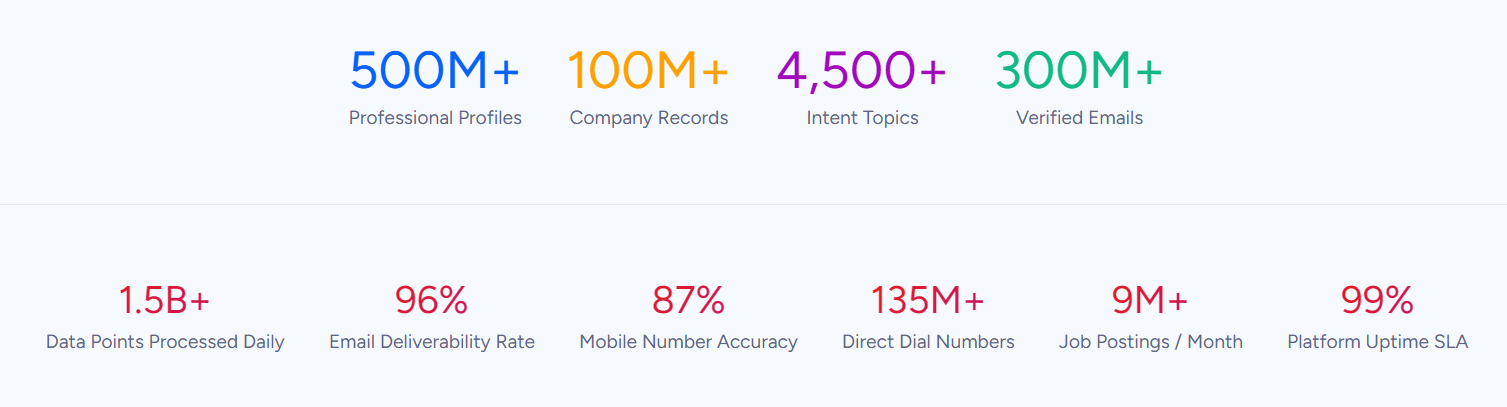
That is the place ZoomInfo enters the image. ZoomInfo is a B2B knowledge and go-to-market platform constructed on 500M contacts and 100M corporations, 135M+ verified telephone numbers, and 200M+ verified enterprise emails.
Its GTM Context Graph processes 1.5B+ knowledge factors day by day, combining this dataset along with your first-party knowledge to disclose which accounts matter and why.
ZoomInfo’s Enterprise API exposes that intelligence as a REST suite protecting search, enrichment, AI intelligence, and viewers administration, with an MCP server for AI-agent workflows. ZoomInfo offers the B2B intelligence layer that monday.com’s platform API doesn’t ship.
This assessment covers the monday.com API in full technical depth first (authentication, endpoints, webhooks, SDKs, price limits, and pricing), then evaluations ZoomInfo’s API as the information layer that picks up the place platform administration stops.
monday.com API at a Look
|
Attribute |
Element |
|---|---|
|
API kind |
GraphQL (queries and mutations through a single endpoint) |
|
Authentication |
Private API token (Authorization header) / OAuth 2.0 for market apps |
|
Base URL |
https://api.monday.com/v2 |
|
Present model |
2026-04 (versioned quarterly; 2026-07 Launch Candidate obtainable) |
|
Fee limits |
Complexity-based (5M-10M factors/minute by token kind) plus day by day name limits (1,000-25,000 by plan) |
|
SDKs |
Official JavaScript/TypeScript and Python |
|
Webhooks |
Sure, board-level occasion subscriptions through GraphQL mutation |
|
MCP server |
Sure, 50+ instruments for AI agent workflows |
|
Documentation |
developer.monday.com (API reference, playground, guides, changelog) |
|
Pricing / entry |
Included on all plans (Free by way of Enterprise); day by day name limits scale by tier |
monday.com API: What Works Properly & What to Plan Round
|
What works nicely |
What to plan round |
|---|---|
|
GraphQL permits you to request precisely the fields you want, avoiding over-fetching |
Day by day name limits are tight on decrease tiers: 1,000/day for Free, Primary, and Commonplace |
|
API entry included on all plans, together with the free tier |
Complexity scoring provides a second rate-limit dimension past uncooked name counts |
|
Official JS/TS SDK with TypeScript varieties generated from the stay API schema |
GraphQL solely: no REST various for groups that favor it |
|
Quarterly versioning with six months’ deprecation discover earlier than removing |
Scope is platform administration solely: no contact enrichment, B2B intelligence, or exterior knowledge |
|
Interactive API playground, Postman assortment, and in-docs AI assistant |
File uploads require a multi-step mutation circulation (get add URL, add to S3, finalize) |
|
MCP server with 50+ instruments for AI agent workflows |
monday.com API: Authentication & Getting Began
API entry is on the market to Admin, Member, and Visitor customers on any paid or free plan, although day by day name limits differ by tier. Viewers, deactivated customers, and student-account customers can not entry the API.
The first authentication methodology is a private V2 API token, distinctive per person. Every token carries the identical permissions as that person within the UI: if a person can not view a workspace within the interface, their token can not learn it by way of the API. You discover tokens beneath your profile image, then Builders, then API token. Account admins may retrieve tokens from the Administration tab.
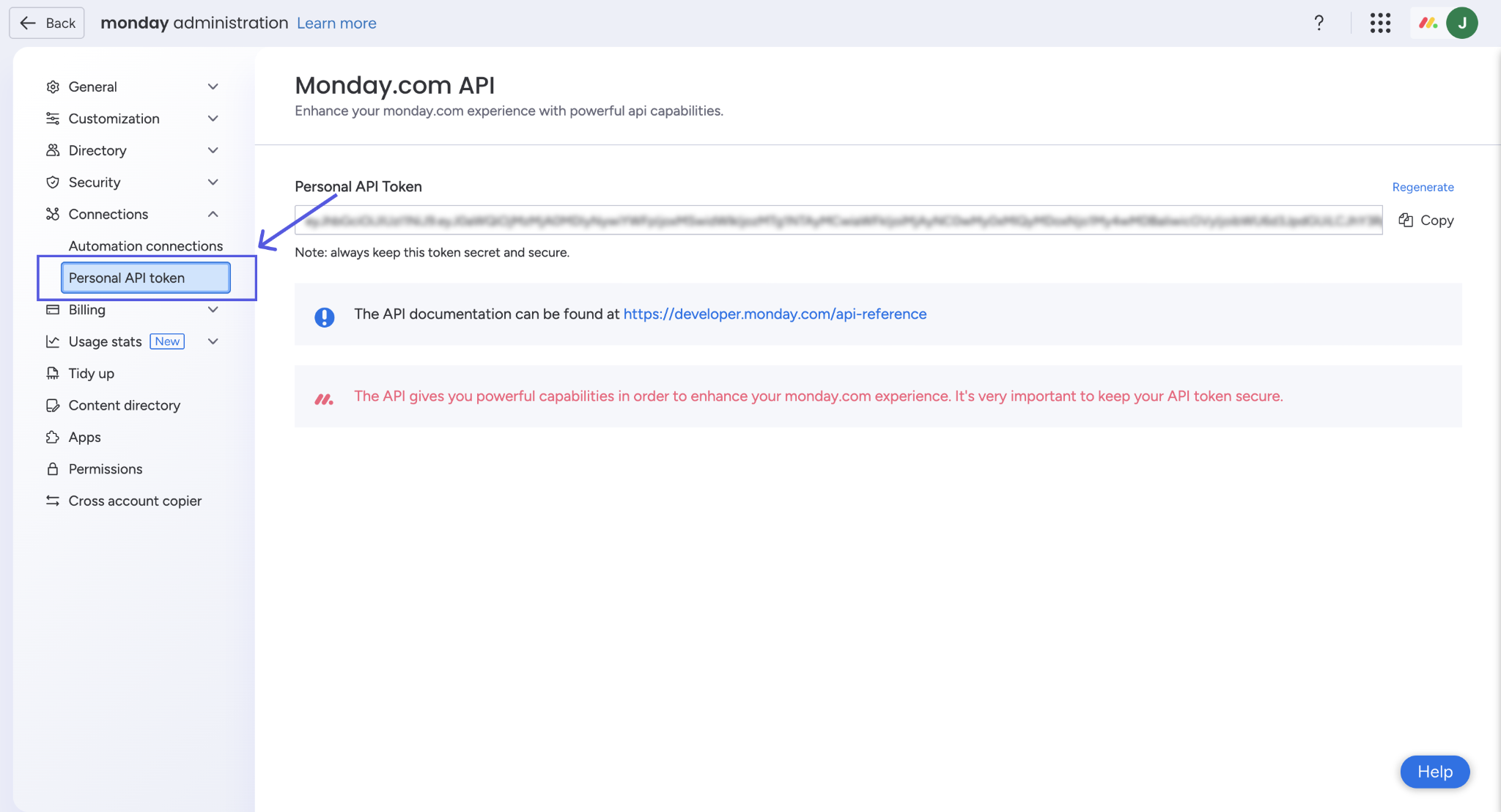
Supply: monday.com
You move the token because the Authorization header in each request. A fundamental authenticated question:
curl -X POST “https://api.monday.com/v2”
-H “Authorization: YOUR_API_TOKEN”
-H “Content material-Sort: utility/json”
-d ‘{“question”: “{ boards (restrict: 5) { id title } }”}’
As a result of the API is GraphQL, each request is a POST to the one endpoint. You specify which fields you need returned, avoiding the over-fetching that comes with fastened REST response shapes. You too can batch a number of queries or mutations in a single request.
OAuth for apps: Apps constructed on the monday apps framework use OAuth 2.0 with configurable permission scopes. Not like private tokens (which inherit all scopes), OAuth app tokens carry solely the scopes declared at registration. That is the trail for market apps and multi-tenant integrations the place every buyer authenticates independently.
Quick-lived tokens: Visitor customers who can not maintain private API keys can authenticate through OAuth or a shortLivedToken, a scoped, time-limited credential issued for particular operations.
One element price figuring out earlier than you construct: the complete API schema is publicly obtainable at https://api.monday.com/v2/get_schema in introspection JSON or SDL format, requestable for any particular model through question parameter. This makes it easy to generate varieties, validate queries offline, or construct tooling towards the stay schema.
monday.com API: Core Endpoints & Capabilities
As a result of the API is GraphQL, there are not any discrete endpoints within the REST sense.
Each request goes to https://api.monday.com/v2, and also you specify the useful resource kind (boards, gadgets, columns, customers, and so forth.) contained in the question or mutation physique. The API helps two operation varieties: queries (read-only) and mutations (create, replace, delete). Information strikes as JSON, with GraphQL variables enabling dynamic parameterization with out string interpolation.
The API reference paperwork the complete schema. Here’s what you’ll be able to construct towards, organized by useful resource area.
Boards, Objects & Teams
Boards are the first containers in monday.com. Objects are the rows. Teams set up gadgets inside a board.
Boards: question (listing, filter, search by workspace), create, replace, duplicate, archive, delete. You possibly can filter boards by workspace and construct multi-level buildings together with subitems.
Objects: create, learn, replace, delete, search, and bulk import through the import_items mutation. Objects are the first knowledge rows throughout all boards, whether or not these boards signify duties, CRM leads, dev sprints, or service tickets. Pagination makes use of a restrict and cursor-based method, which handles giant boards with out loading all the pieces without delay.
Teams: create, replace, duplicate, delete, and transfer between boards.
What you’d construct with this: a CRM integration that creates gadgets on a monday.com CRM board at any time when offers shut in Salesforce, grouping them by quarter and populating columns with deal worth, stage, and proprietor.
Columns & Information Sorts
Columns outline the schema of every board.
The API helps 30+ column varieties together with textual content, numbers, standing, date, individuals, system, dependency, timeline, and extra. Operations embrace create, replace, delete, learn column definitions and kinds, and alter column values for gadgets.
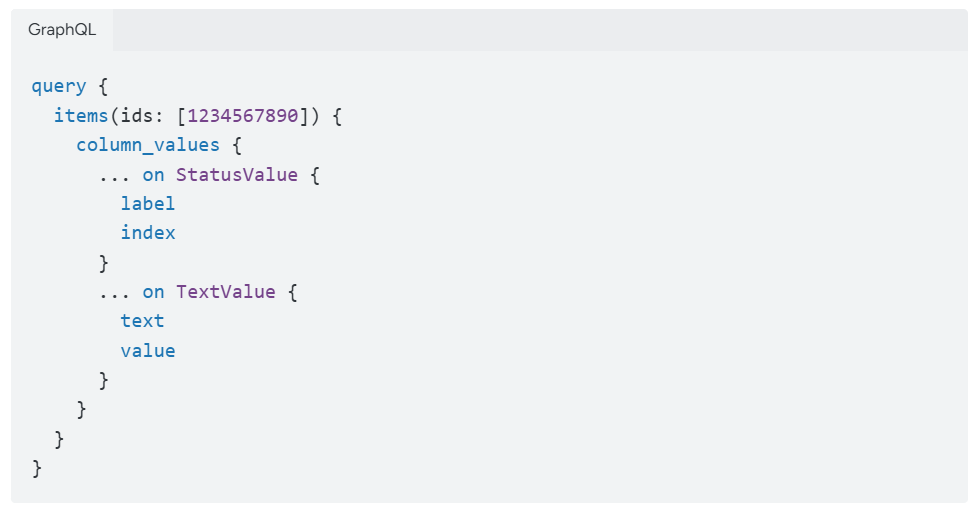
Supply: monday.com
The flexibility to create columns and set their values programmatically is what makes monday.com’s API helpful for data-pipeline integrations: you’ll be able to outline a board’s construction in code, then populate it from an exterior supply, moderately than setting it up manually within the UI.
Workspaces, Customers & Groups
Workspaces: listing, create, replace, with folder assist. Workspaces are the top-level organizational unit.
Customers & Groups: question person profiles and staff memberships, assign customers to gadgets. Helpful for provisioning and entry administration integrations.
What you’d construct with this: an onboarding automation that creates a workspace for every division, units up normal board templates, and assigns staff members based mostly on an HR system feed.
Docs, Dashboards, Varieties & Belongings
Docs (WorkDocs): create, replace, and skim collaborative paperwork that stay contained in the workspace and join on to board knowledge.
Dashboards: create dashboards and add widgets programmatically, aggregating knowledge throughout boards.
Varieties: create, replace, learn, and submit kinds for structured knowledge consumption.
Belongings: question file belongings connected to gadgets and add recordsdata through a two-step mutation circulation: name get_asset_upload_url to get a presigned URL, add the file to S3, then name finalize_asset_upload. This provides implementation overhead however offers you direct management over file dealing with.
Automations & Workflows
The API permits you to listing, create, replace, and publish automations programmatically. You possibly can outline trigger-condition-action workflows by way of the API moderately than configuring them within the UI.
What you’d construct with this: a deployment instrument that units up standardized automation recipes throughout consumer workspaces, so each new board will get the identical notification guidelines, status-change triggers, and handoff automations with out handbook setup.
monday.com API: Webhooks & Occasions
monday.com helps two webhook techniques, every serving a distinct viewers.
Platform API Webhooks (Board & Merchandise Occasions)
Builders subscribe to board-level occasions through the create_webhook mutation, pointing to any HTTPS endpoint. monday.com delivers a POST payload to that URL when the subscribed occasion fires.
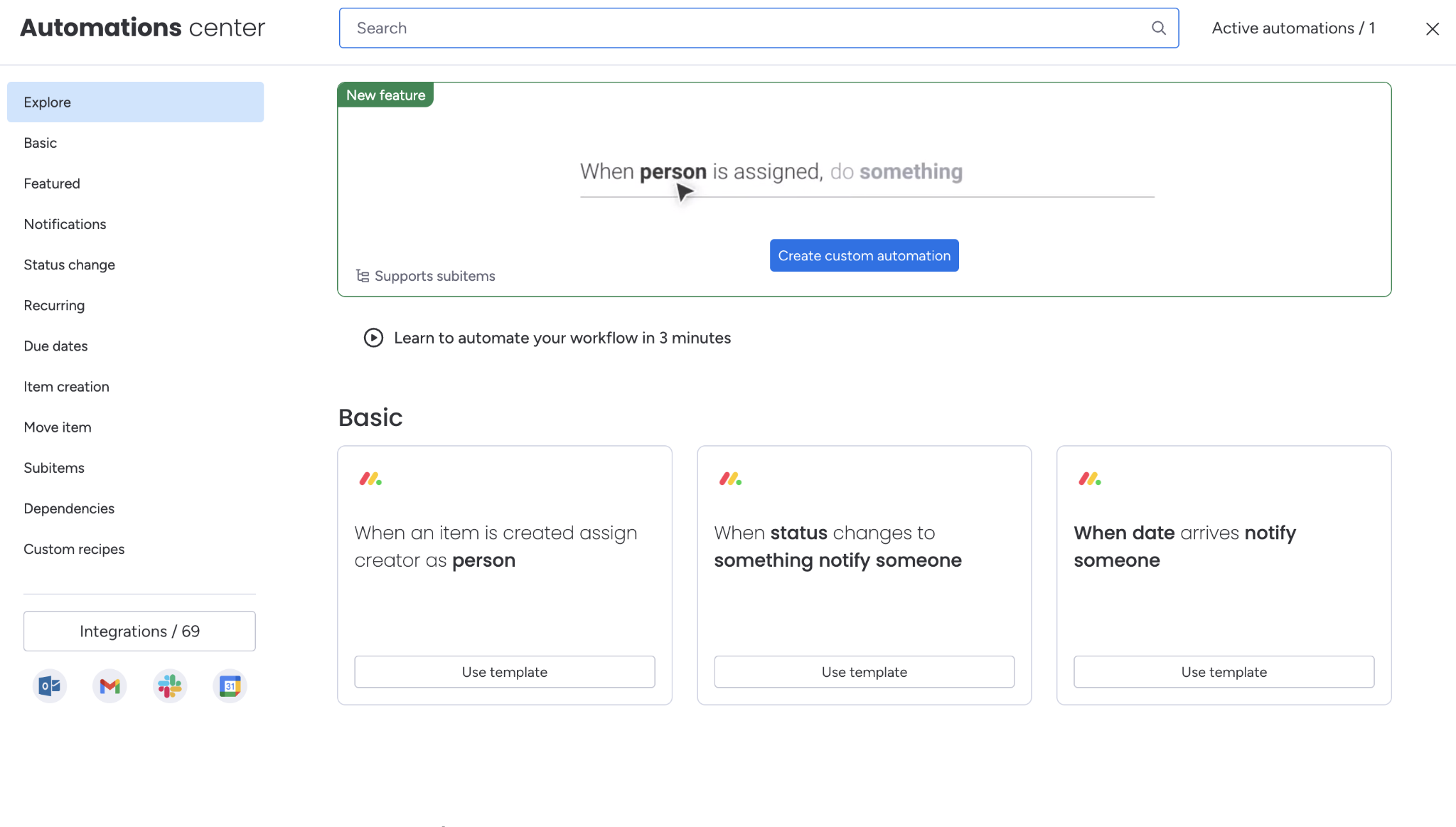
Supply: monday.com
You handle webhook subscriptions solely by way of GraphQL: create_webhook to subscribe, delete_webhook to unsubscribe, and the webhooks question to listing energetic subscriptions.
The platform webhook system covers occasions throughout boards, gadgets, columns, teams, and updates. Most API builders will use this method: it lets your utility react to adjustments in monday.com in actual time moderately than polling.
What you’d construct with this: a Slack integration that posts a message to a channel at any time when a CRM deal’s standing adjustments to “Closed Gained,” triggered by a webhook on the offers board.
App Lifecycle Webhooks (Market Apps)
Apps revealed to the monday market can subscribe to 13 lifecycle occasions protecting set up and subscription state adjustments:
Every webhook request features a JWT within the Authorization header, signed with the app’s Shopper Secret, for verification. Payloads carry occasion metadata, person knowledge, account particulars (ID, title, tier, max customers), model data, and subscription particulars. You configure webhooks by way of the Developer Middle. No historic backfill is supplied.
Two issues to plan round:
monday.com API: SDKs, Docs & Fee Limits
SDKs & Libraries
monday.com offers two official SDKs:
JavaScript / TypeScript SDK (@mondaydotcomorg/api): obtainable through npm, works in Node.js (v18+) and browser environments. Ships pre-built GraphQL operations, TypeScript varieties generated from the stay API schema, and automated API versioning.
The SDK reads rate-limit response headers and retries throttled requests after the indicated delay. A companion CLI bundle (@mondaydotcomorg/setup-api) scaffolds a customized GraphQL codegen pipeline for type-safe customized queries.
Python SDK: documented at developer.monday.com/api-reference/docs/python-sdk, coated within the official documentation alongside the JS SDK.
CLI instrument: a command-line interface for scaffolding, deploying, and managing apps constructed on the monday apps framework.
Apps framework client-side SDK: a separate JavaScript SDK (monday.api, monday.pay attention, monday.get, monday.execute, monday.storage, monday.set) for apps rendered contained in the monday.com UI as iframes or board views. It handles context, storage, and cross-frame communication throughout the platform.
The TypeScript SDK’s auto-retry on rate-limit responses is a helpful function. Many API SDKs go away backoff logic to the developer; monday.com handles it on the SDK layer.
Documentation & Developer Expertise
The developer portal at developer.monday.com splits into two areas:
-
Platform API reference (developer.monday.com/api-reference): covers the GraphQL schema, authentication, versioning, price limits, guides for frequent operations, and a whole reference for every type and fields.
-
Apps & Brokers framework (developer.monday.com/apps/docs): covers constructing, internet hosting, submitting, and monetizing apps on the monday market, together with OAuth, MCP integration, and the Developer Middle.
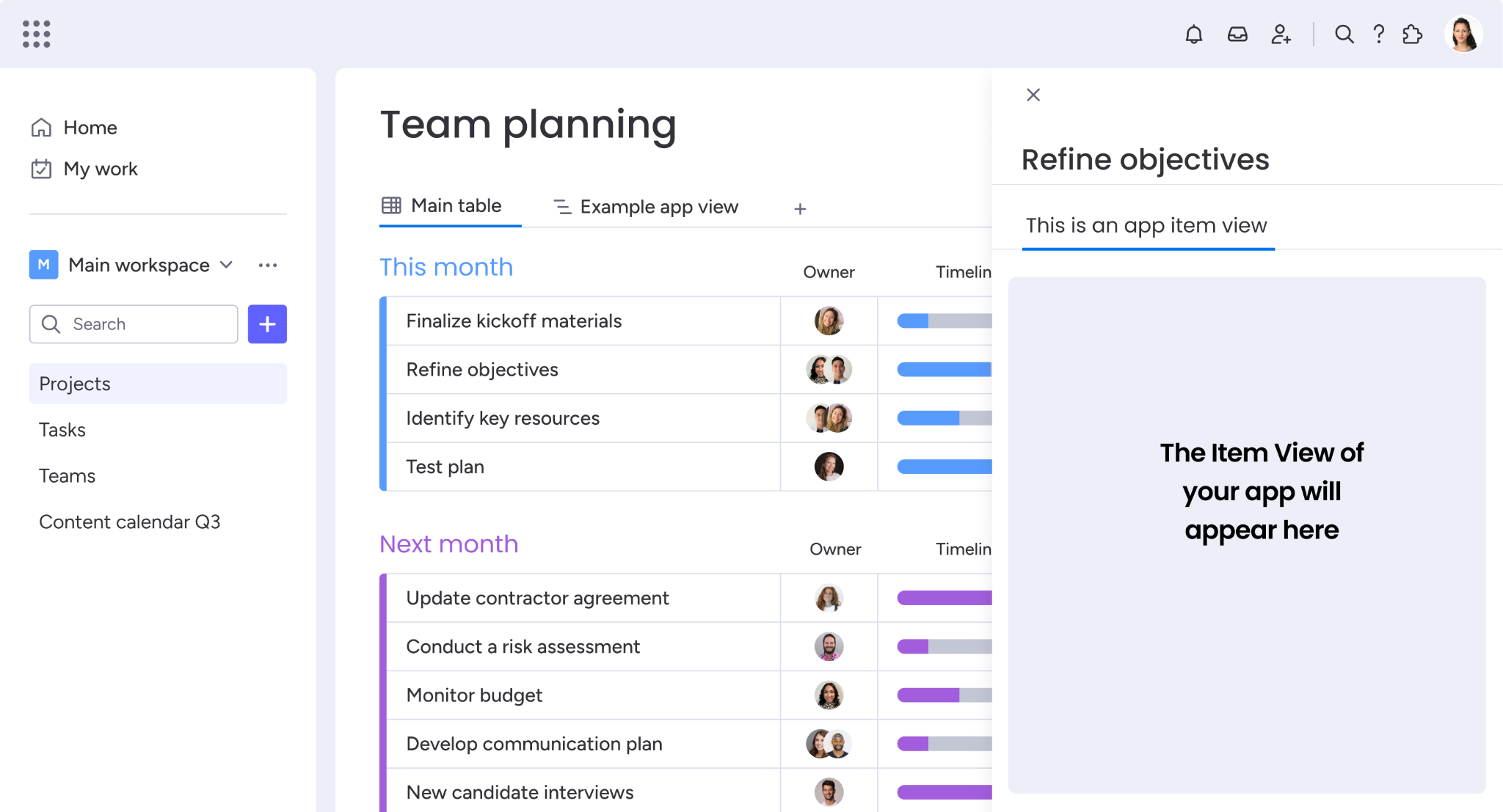
Supply: monday.com
Interactive tooling is powerful:
A public API changelog and launch notes ship with each quarterly model launch. Developer assist runs by way of the developer group discussion board, a devoted YouTube channel, and an API analytics dashboard for monitoring utilization. Enterprise plans embrace 24/7 precedence assist.
The documentation is well-organized. The API playground is the quickest technique to verify a question form, and the AI assistant is a helpful shortcut for GraphQL syntax questions. The quarterly changelog with six months’ deprecation discover offers integrators a predictable migration cadence.
Fee Limits & Constraints
monday.com’s API enforces a number of rate-limit dimensions without delay. Response headers (RateLimit-Coverage and RateLimit) expose present quota, remaining quota, and reset timing in actual time.
Complexity restrict: every GraphQL question is scored by its load on the API. A single question can not exceed 5,000,000 (5M) complexity factors. Per-minute complexity budgets differ by token kind:
Complexity budgets comply with a sliding window that resets 60 seconds after the primary name. The API returns a ComplexityException error when the funds is exceeded. You possibly can pre-check any question’s price by together with the complexity discipline within the request.
Day by day name restrict: caps API calls per account per day, resetting at midnight UTC:
|
Plan |
Day by day name restrict |
|---|---|
|
Free / Primary / Commonplace |
1,000 |
|
Professional |
10,000 (tender restrict) |
|
Enterprise |
25,000 (tender restrict) |
Minute restrict: per-minute request caps by plan:
|
Plan |
Requests per minute |
|---|---|
|
Professional |
2,500 |
|
Enterprise |
5,000 |
monday.com doesn’t publish minute limits for Free, Primary, or Commonplace plans.
Concurrency restrict: revealed within the RateLimit-Coverage header. The documentation exhibits a quota of 40 concurrent requests for a higher-tier account; precise quotas differ by tier.
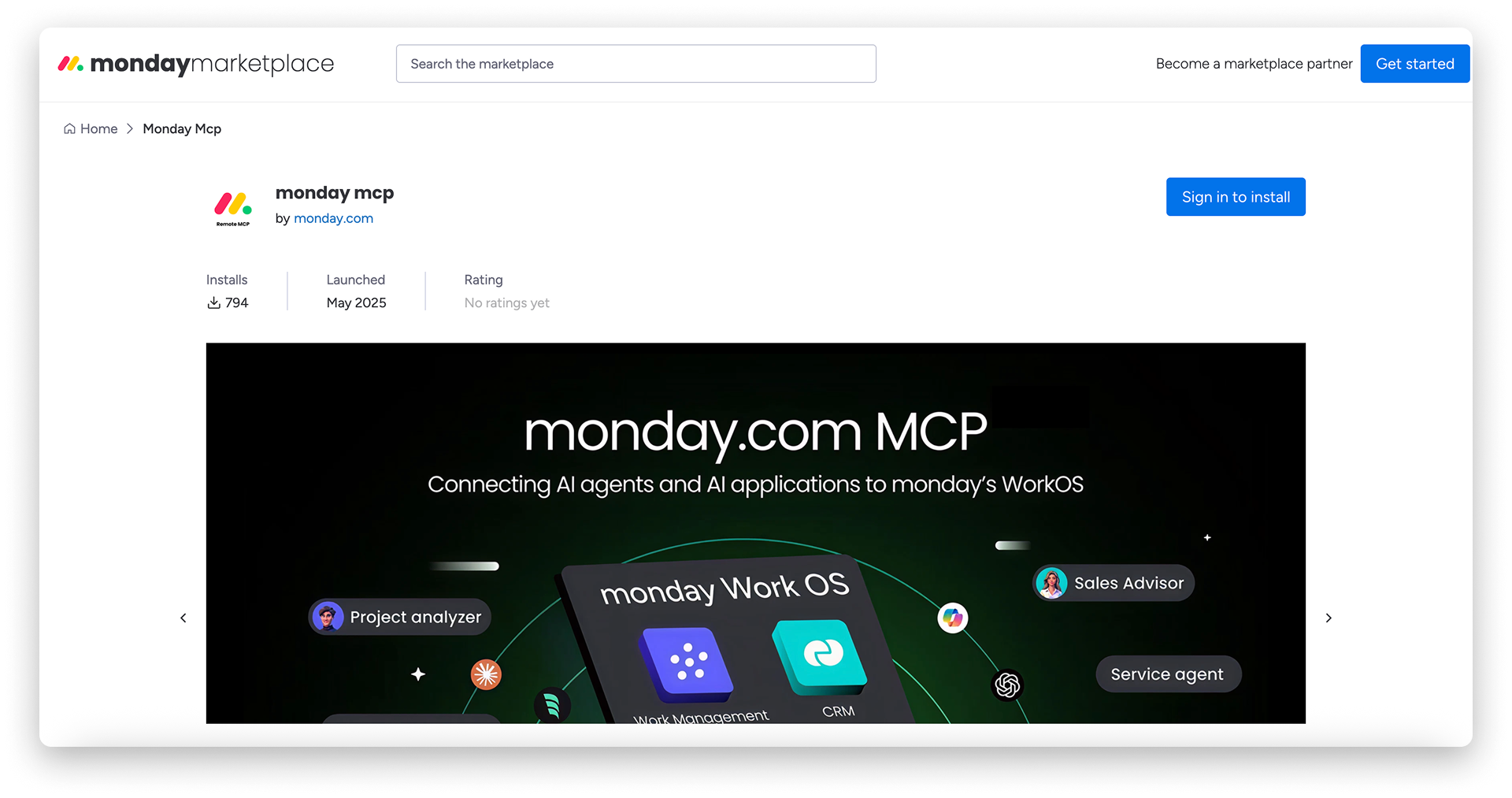
MCP calls: every MCP instrument name counts as one GraphQL API request towards the day by day restrict. When you run AI brokers through the monday MCP server alongside a customized API integration, each compete for a similar quota.
Supply: monday.com
Useful resource safety limits: sure heavy mutations (create/duplicate board, duplicate group, join mission to portfolio) are throttled independently.
Fee-limit errors depend as 0.1 calls moderately than 1, and high-complexity queries could depend as greater than 1. All limits apply per account, per app.
monday.com API Pricing & Entry Prices
API entry is bundled into all monday.com plans, together with the Free tier. There are not any per-call costs, no API-specific credit score system, and no separate developer add-on. The price of constructing on the API is the price of the plan that offers you the day by day name limits your integration wants.
|
Plan |
Value (annual, per seat) |
API calls / day |
|---|---|---|
|
Free |
$0 (as much as 2 seats) |
1,000 |
|
Primary |
$9/seat/month |
1,000 |
|
Commonplace |
$12/seat/month |
1,000 |
|
Professional |
$19/seat/month |
10,000 |
|
Enterprise |
Customized / contact gross sales |
25,000 |
The pricing web page notes for Professional and Enterprise tiers: “Allow brokers, integrations, and customized apps to learn and replace monday knowledge. Purchase extra as wanted.” Further API name capability could be bought, although particular overage pricing will not be revealed.
For a developer sizing prices: the actual constraint is the day by day name restrict, not the per-seat worth. A staff of 10 on the Commonplace plan ($120/month whole) will get just one,000 API calls per day, so a sync that updates 500 gadgets twice day by day exhausts the quota.
Transferring to Professional ($190/month for 10 seats) multiplies the restrict tenfold to 10,000/day. Enterprise clients who want greater than 25,000 calls/day can request a rise by way of the API analytics dashboard.
No separate API pricing tier exists. The choice is which monday.com plan to subscribe to, pushed by the day by day name restrict and the plan options you want. The Free tier’s 1,000/day restrict works for testing and lightweight integrations, however any manufacturing workflow with actual quantity will want a minimum of the Professional plan.
The place the monday.com API Falls Quick
These are sensible limits a developer ought to plan round, not criticisms of the platform. A number of are scope choices that outline what monday.com’s API is (a platform administration floor) and what it isn’t.
The API manages the platform, not the intelligence behind the information. monday.com’s API can create a CRM board, add lead information as gadgets, and replace their standing columns. It can not inform you something about these leads past what a person or automation already put into the board.
There are not any endpoints for contact enrichment (verifying an e-mail, appending a telephone quantity or job title), no firm attribute lookups (income, headcount, trade, know-how stack), no org chart traversal, and no technographic knowledge. In case your integration must go from “a reputation in a column” to “a verified contact at an organization researching your class,” the API doesn’t cowl that path.
No purchaser intent indicators. A developer constructing a lead-scoring or account-prioritization workflow on monday.com’s CRM has no API entry to intent knowledge: which corporations are researching related subjects, which accounts are spiking in shopping for exercise, or which rivals are being evaluated. Intent-driven automation requires a second knowledge supply.
Day by day name limits constrain actual integrations on decrease tiers. 1,000 API calls per day on Free, Primary, and Commonplace plans is a agency ceiling. Even a modest bidirectional sync (studying gadgets, checking for adjustments, pushing updates) can devour this quota inside hours. The soar to 10,000/day requires the Professional plan at $19/seat/month, and the soar to 25,000/day requires a customized Enterprise contract.
For groups evaluating monday.com as a platform to construct on, the API price will not be the API itself (it’s free) however the plan tier wanted to unlock usable limits.
Complexity scoring provides a second rate-limit layer. Past day by day name counts, every GraphQL question is scored for complexity, and the funds varies by token kind and plan. A question with nested relationships (boards to gadgets to column values to subitems) can devour a big share of the complexity funds.
The scoring system is documented, and the complexity discipline permits you to pre-check prices, however it’s an additional dimension that REST APIs don’t impose. New integrators usually tend to hit complexity limits than day by day name limits on their first construct.
MCP calls and API calls share the identical day by day quota. When you run AI brokers through the monday MCP server alongside a customized integration, each draw from the identical day by day name pool. An AI agent that makes 50 MCP instrument calls per run consumes 50 of your 1,000 or 10,000 day by day calls. For groups constructing AI-agent workflows on monday.com, this shared quota is the primary constraint to plan round.
ZoomInfo API: The B2B Intelligence Layer monday.com Does Not Cowl
monday.com’s API tells you what’s on a board.
ZoomInfo’s API tells you who the contacts on that board are, what corporations they signify, what know-how these corporations run, whether or not they’re researching your class, and the place every individual sits within the org chart.
The intelligence comes from ZoomInfo’s GTM Context Graph, which processes 1.5B+ knowledge factors day by day and combines them along with your first-party knowledge to point out not simply what occurred, however why.
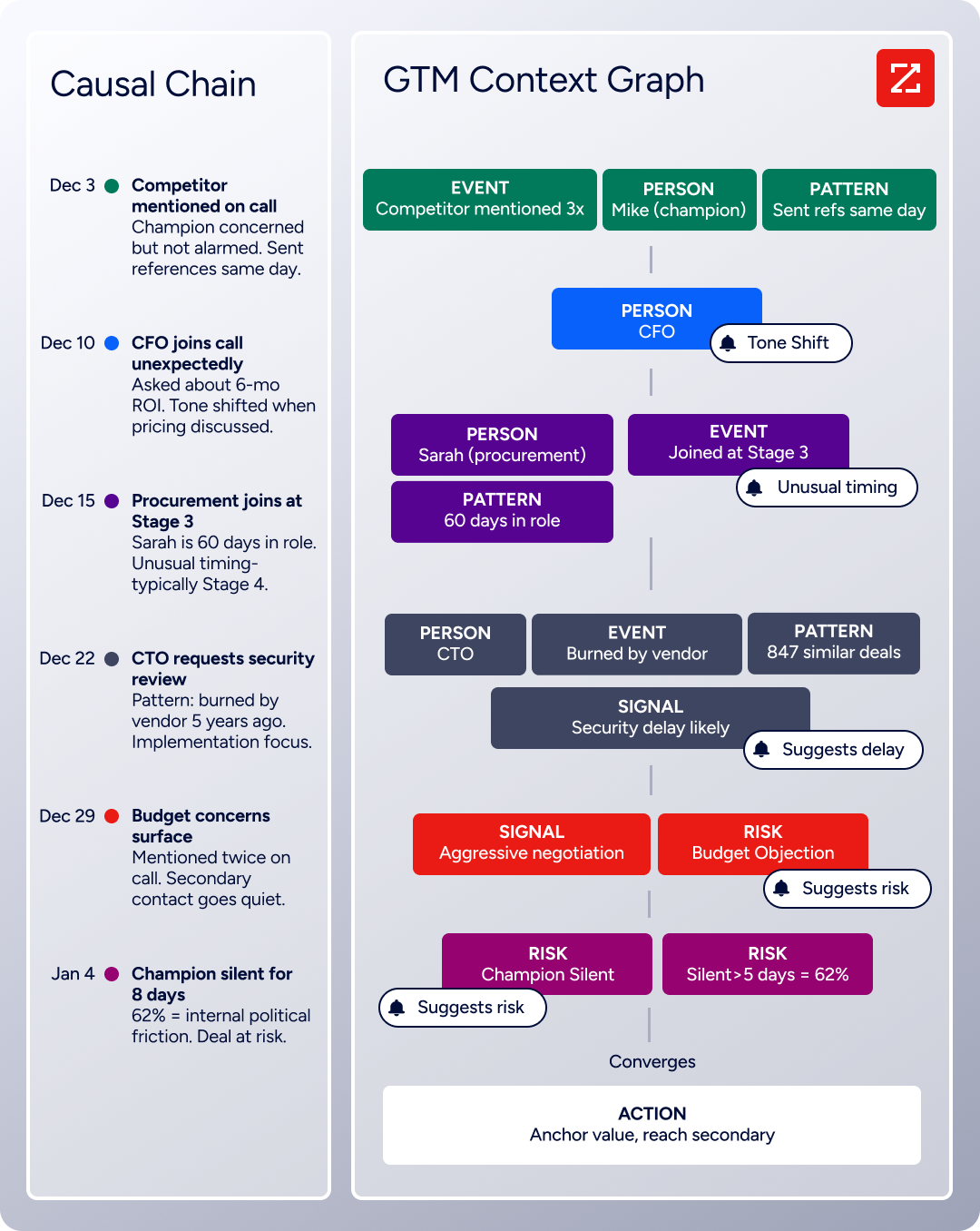
The 2 APIs function at completely different layers. A developer constructing a CRM or gross sales workflow on monday.com would use monday.com’s API to handle the workflow and ZoomInfo’s API to feed it verified, enriched B2B knowledge.
What the API Covers: Search, Enrichment & AI Intelligence
ZoomInfo’s Enterprise API is a REST suite served from https://api.zoominfo.com/gtm, organized into 4 areas documented within the interactive API reference:
-
Information API (Search & Enrich): Search endpoints cowl Contacts, Firms, Intent, Information, and Scoops, returning matched information with out consuming credit. Enrich endpoints unlock full payloads: enterprise emails, direct dials, employment historical past, company hierarchy, org charts, technographics, and hashtag indicators, accepting as much as 25 information per name.
The pairing with monday.com’s API is direct: use ZoomInfo’s search endpoints to search out contacts matching your goal profile (free, no credit consumed), enrich the information price pursuing, then push the enriched knowledge into monday.com CRM boards through the GraphQL API. The search-then-enrich sample means you filter freely and pay just for the information you decide to.
What you’d construct with this: an automatic pipeline that watches a monday.com CRM board for brand spanking new lead gadgets, queries ZoomInfo to counterpoint every lead with verified e-mail, telephone, firm measurement, trade, and know-how stack, then writes the enriched fields again to the board’s columns.
Authentication, Fee Limits & Credit
Authentication makes use of OAuth 2.0 with PKCE through Okta, issuing 24-hour entry tokens with rotating refresh tokens.
Three flows are supported: Authorization Code with PKCE (net purposes), Shopper Credentials (server-to-server), and Refresh Token. You register purposes by way of the ZoomInfo Developer Portal, the place groups generate credentials, outline scopes, and check endpoints.
This can be a completely different authentication mannequin from monday.com’s static private token: it helps delegated entry, credential rotation, and scoped permissions out of the field.
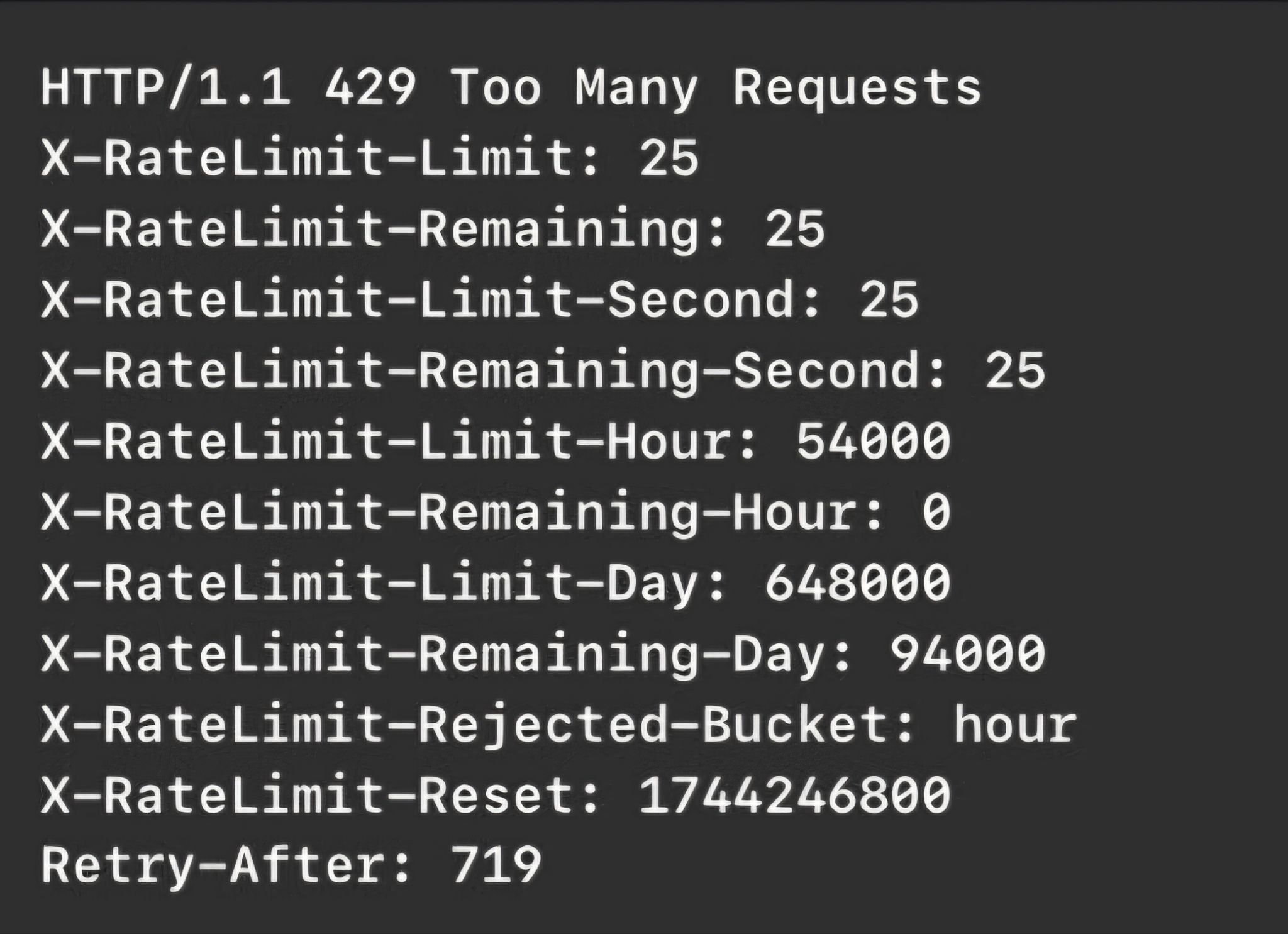
Fee limits are revealed by tier: Builder (5 req/sec), Commonplace (25 req/sec), and Scaling (35 req/sec), with per-hour and per-day sliding-window limits enforced on the similar time.
Supply: ZoomInfo
Each response consists of quota headers with remaining capability, and 429 responses embrace a Retry-After header with actual backoff timing. Credit comply with a rolling 12-month window: enriching a document for the primary time consumes one credit score; re-enriching the identical document throughout the yr is free.
MCP, Webhooks & Developer Expertise
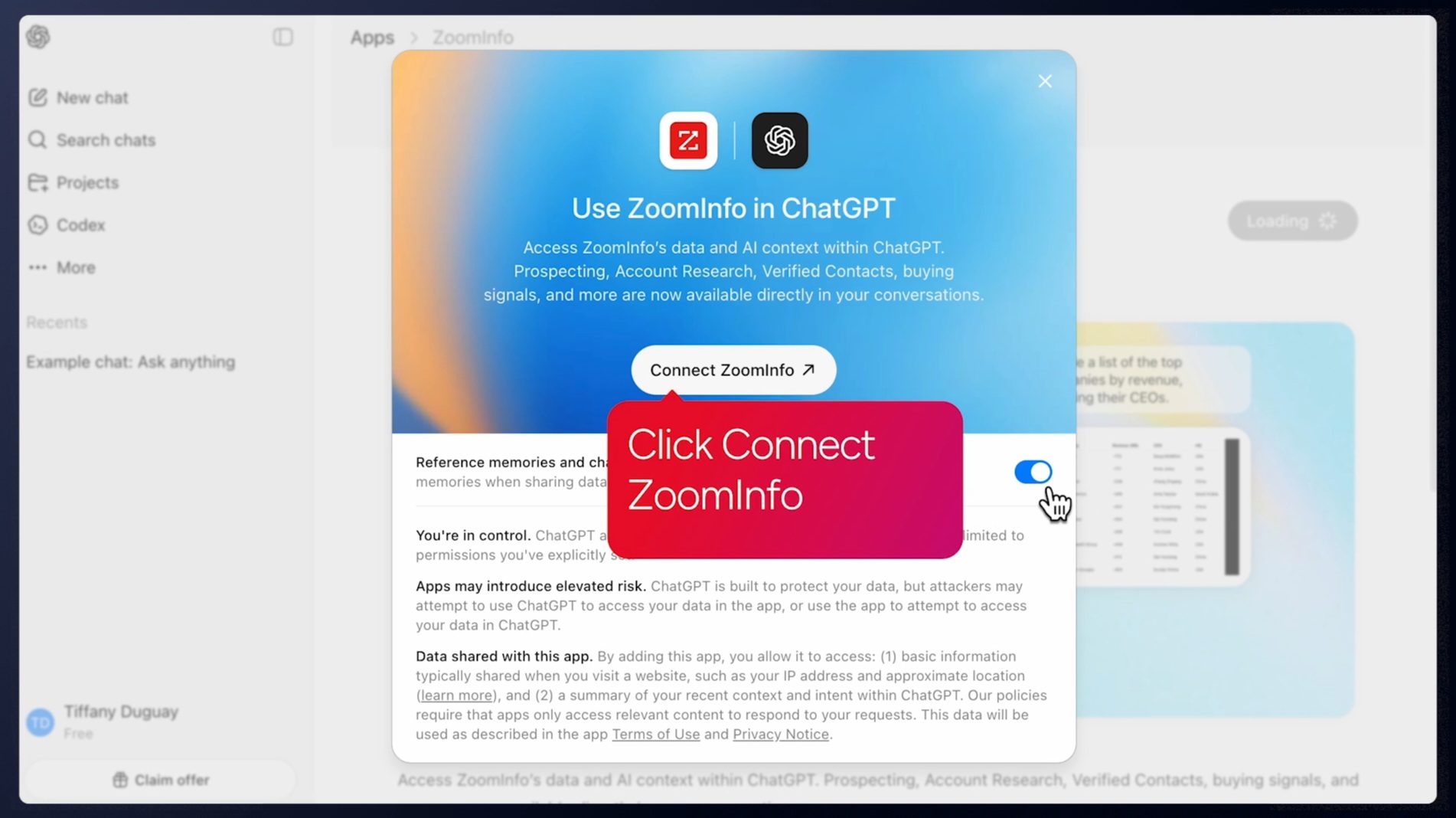
ZoomInfo’s MCP server at https://mcp.zoominfo.com/mcp exposes search, enrich, and account analysis as native instruments for MCP-compatible assistants, at the moment supporting Claude and ChatGPT.
Supply: ZoomInfo
For builders constructing AI brokers throughout each platforms, an agent can learn monday.com board knowledge through monday.com’s MCP server and enrich it with ZoomInfo’s MCP server in the identical workflow, with out writing customized integration code.
Webhooks are obtainable through the Brokers API, tied to ZoomInfo’s Agent Groups system: occasion varieties cowl bulk enrichment jobs finishing, information altering, credit score utilization crossing thresholds, and new indicators (scoops, funding occasions, intent spikes) turning into obtainable.
Documentation lives at docs.zoominfo.com with an interactive API reference, OAuth recipes in 5 languages, and an llms.txt index for AI improvement instruments. A separate Docs MCP server lets AI improvement instruments generate integration code towards the API spec.
ZoomInfo doesn’t publish official SDKs, so that you combine over HTTP and personal the auth-and-retry layer your self. ZoomInfo has expanded API entry throughout its plans, with consumption-based pricing.
BDO Canada reported an 87% discount in time spent updating inside knowledge dashboards utilizing the ZoomInfo API, with one analyst describing the combination as plug-and-play throughout any course of. (ZoomInfo)
Closing Verdict
monday.com’s API is a well-documented GraphQL floor that offers builders programmatic management over a multi-product work platform.
The quarterly versioning, the TypeScript SDK with schema-generated varieties, the interactive playground, and the MCP server with 50+ instruments add as much as a developer expertise that takes integration severely. For automating board administration, merchandise workflows, and platform operations, the API delivers what the UI does, with out the UI.
Select the monday.com API if you might want to automate workflows contained in the platform: syncing gadgets with exterior techniques, provisioning workspaces and boards programmatically, constructing market apps, or working AI brokers that handle monday.com knowledge.
The free-tier API entry and the GraphQL mannequin (request what you want, batch operations in a single name) make it a sensible alternative for inside instruments and integrations.
Select the ZoomInfo API when your construct wants B2B intelligence that monday.com doesn’t retailer: verified contact knowledge, firm attributes, technographic profiles, purchaser intent indicators, org charts, and AI-powered account analysis. The search-then-enrich sample (search is free, enrich consumes credit) and the AI intelligence endpoints cowl the information layer that no work-management API offers.
Discover the ZoomInfo Enterprise API or begin with the developer docs to see the endpoint floor straight.
A developer whose integration wants solely platform administration (board automation, merchandise sync, dashboard technology) doesn’t want ZoomInfo’s API. monday.com’s GraphQL API handles that scope nicely. The query turns into related when the contacts and corporations on these boards have to be greater than names in columns.
FAQ
Is the monday.com API free?
API entry is included on all monday.com plans, together with the everlasting free tier. There are not any per-call costs and no separate developer add-on.
The sensible price is the plan subscription that units your day by day name restrict: Free, Primary, and Commonplace plans enable 1,000 API calls per day, Professional permits 10,000, and Enterprise permits 25,000. Further capability could be bought on Professional and Enterprise tiers. The free tier’s 1,000/day restrict works for testing and lightweight integrations however won’t assist a manufacturing sync with actual quantity.
Does monday.com use GraphQL or REST?
GraphQL solely. All API operations undergo a single endpoint (https://api.monday.com/v2) utilizing queries for reads and mutations for writes. There isn’t any REST various. GraphQL permits you to specify which fields to return in every request, avoiding over-fetching, and batch a number of operations in a single name.
The tradeoff is that groups used to REST conventions (resource-based URLs, normal HTTP verbs) have to study GraphQL question development and complexity administration.
What’s the monday.com API price restrict?
monday.com enforces a number of rate-limit dimensions without delay. Every question is scored for complexity, with budgets of 5M to 10M factors per minute relying on token kind (1M free of charge and trial accounts). Day by day name limits are 1,000 for Free, Primary, and Commonplace plans, 10,000 for Professional, and 25,000 for Enterprise. Professional plans additionally cap at 2,500 requests per minute; Enterprise permits 5,000 per minute.
A concurrency restrict (roughly 40 concurrent requests on larger tiers) applies as nicely. MCP instrument calls depend towards the day by day restrict. Response headers expose remaining quota in actual time.
Are there official monday.com SDKs?
Sure. monday.com publishes an official JavaScript/TypeScript SDK (@mondaydotcomorg/api) through npm, supporting Node.js v18+ and browser environments. It consists of pre-built GraphQL operations, TypeScript varieties generated from the stay API schema, and automated retry on rate-limit responses.
A Python SDK can also be documented. A CLI instrument handles scaffolding and deployment for the monday apps framework, and a separate client-side SDK manages context and storage for apps rendered contained in the monday.com UI.
Does the monday.com API assist webhooks?
Sure, by way of two techniques. Platform API webhooks allow you to subscribe to board-level occasions (merchandise adjustments, column updates, group modifications) through the create_webhook GraphQL mutation, delivering POST payloads to any HTTPS endpoint.
Apps revealed to the monday market may subscribe to 13 lifecycle occasions protecting set up and subscription state adjustments, with JWT-signed payloads for verification. Platform webhooks are the system most API builders will use for event-driven integrations.
What does ZoomInfo’s API add to a monday.com construct?
ZoomInfo’s API provides the B2B intelligence layer that monday.com’s API doesn’t cowl.
The place monday.com’s API manages boards, gadgets, and workflows, ZoomInfo’s API offers the information that makes these workflows beneficial: search throughout 500M contacts and 100M corporations, enrich with verified emails, direct dials, employment historical past, org charts, technographics, and firm attributes, detect purchaser intent indicators, and generate AI-powered account analysis and buying-committee suggestions.
Each platforms supply MCP servers, so an AI agent can handle monday.com board knowledge and enrich it with ZoomInfo intelligence in the identical workflow. ZoomInfo makes use of OAuth 2.0 authentication and consumption-based pricing (search is free, enrichment consumes credit), so plan the combination layer to deal with each auth fashions.

