

Key takeaways
- Microsoft has reportedly declared a “Code Pink” to overtake its engineering and disaster response after a world outage on November 12-13 that lasted about 24 hours.
- Coinbase’s Might outage was traced to a cooling failure in an AWS knowledge middle: all 5 matching engine nodes had been in the identical constructing, and three went offline, disrupting buying and selling, deposits and withdrawals for about eight hours.
- Transferring belongings off exchanges doesn’t take away the reliance on centralized infrastructure, as a result of wallets usually rely upon third-party RPC suppliers quite than the person’s personal node.
- The difficulty just isn’t that crypto corporations use the cloud however whether or not they have credible options when it fails, as extra belongings transfer onto blockchains.
Microsoft has reportedly declared a “Code Pink” initiative to overtake its engineering and disaster response following a world service outage that lasted roughly 24 hours. For an business constructed across the thought of decentralization, crypto has good motive to concentrate.
Based on inside memos reviewed by Reuters, the know-how large is reconsidering the way it prevents and responds to main infrastructure failures after its November 12-13 outage disrupted companies, authorities operations and monetary corporations.
Crypto likes to place itself as an alternative choice to centralized infrastructure. But a few of its largest companies rely upon the identical handful of cloud computing corporations, and the results of that reliance have already been felt by merchants.
How A Cooling Failure Introduced Coinbase Buying and selling To A Halt
In Might, Coinbase skilled an infrastructure failure that demonstrated how surprisingly fragile entry to cryptocurrency markets may be.
The alternate’s official incident report, revealed on June 1, traced the disruption to a cooling gear failure inside an Amazon Net Companies (AWS) knowledge middle.
Coinbase had 5 matching engine nodes positioned inside the similar constructing. Three went offline through the incident, leaving the system with out sufficient functioning nodes to function usually.
The alternate had not applied an automatic mechanism to modify its matching engine to a different availability zone.
A separate failure involving AWS’s managed event-streaming infrastructure sophisticated the restoration additional.
For about eight hours, prospects skilled extreme disruptions affecting buying and selling, deposits and withdrawals. Restoring the remaining methods took roughly one other 12 hours.
“
“The length of the outage is unacceptable to us,” Coinbase acknowledged in its subsequent investigation.
Coinbase · June 1 incident report
This was not the primary time the alternate had encountered such issues. An AWS outage in October 2025 resulted in three hours and 17 minutes of degraded efficiency for Coinbase prospects.
Regardless of these incidents, the connection between cryptocurrency companies and cloud suppliers continues to deepen. Extra lately, Coinbase and AWS partnered to deliver x402 funds to CloudFront publishers, bringing blockchain-based funds into current net infrastructure.
The uncomfortable half is that the blockchains themselves didn’t have to fail for purchasers to lose entry to alternate providers.
A decentralized settlement community is of restricted quick use to somebody whose belongings are sitting inside an alternate they can not entry.
Your Crypto Pockets Might Be Much less Decentralized Than You Assume
Transferring belongings away from centralized exchanges does scale back a few of these dangers. Nevertheless, it doesn’t essentially eradicate reliance on centralized infrastructure.
Think about an Ethereum pockets.
When a person opens the applying to verify their stability or ship a transaction, the pockets usually communicates with an Ethereum node by a distant process name, generally referred to as an RPC.
That connection permits the applying to retrieve blockchain data and submit signed transactions.
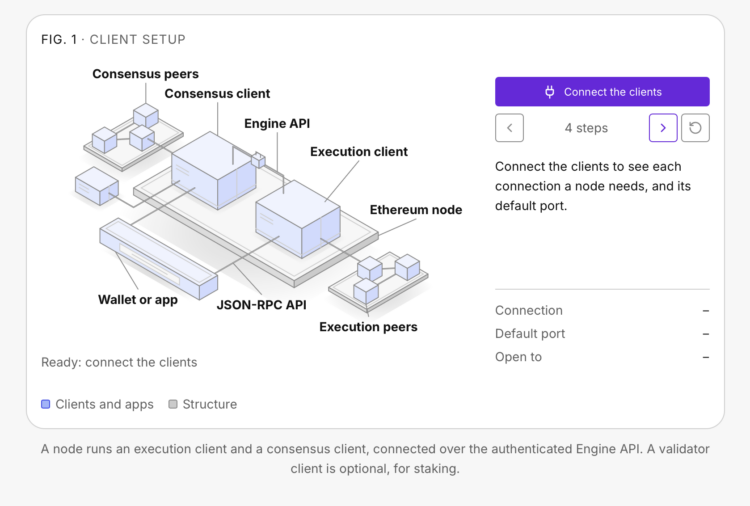
How a pockets app connects to Ethereum by an RPC connection.
Many customers depend on infrastructure operated by third-party suppliers quite than operating their very own nodes. If the supplier turns into unavailable, the pockets could wrestle to show balances or broadcast transactions, even whereas Ethereum continues producing blocks.
In an RPC service outage, the belongings can stay intact on the blockchain even when the pockets’s ordinary connection to the community stops working.
Ethereum’s personal node documentation acknowledges that widespread reliance on cloud internet hosting may introduce a standard level of failure.
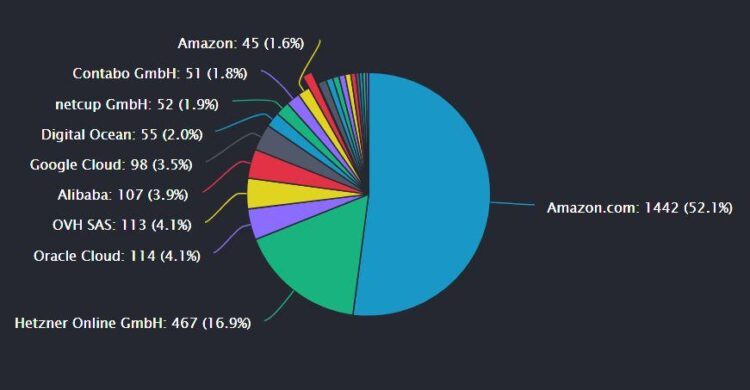
Distribution of Ethereum nodes.
The distribution of Ethereum nodes additionally raises questions on infrastructure focus. Having 1000’s of independently operated nodes doesn’t essentially eradicate shared dependencies if many depend on the identical internet hosting suppliers.
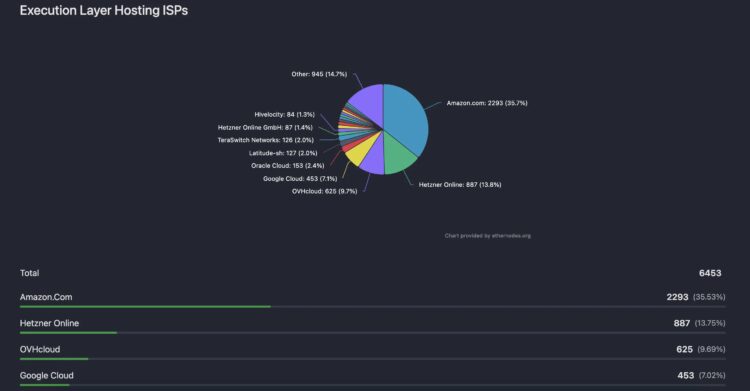
Internet hosting of Ethereum nodes throughout suppliers.
Shared infrastructure can create safety dangers in addition to availability issues. NewsBTC beforehand coated the talk over verifier and RPC safety following the KelpDAO exploit. That incident was an exploit, not a routine cloud outage.
There are options. Customers can join appropriate wallets to a different RPC supplier or function their very own Ethereum nodes. Builders may design functions to modify between independently operated infrastructure suppliers when one turns into unavailable.
However these choices aren’t all the time apparent to the typical particular person opening a pockets on their telephone.
The business has spent years making crypto simpler to make use of, usually by hiding a lot of its technical complexity. In doing so, it has generally reintroduced the dependencies that blockchain know-how was supposed to cut back.
Centralization Is Typically A Deliberate Engineering Alternative
It might be straightforward to criticize each cryptocurrency firm that makes use of Amazon, Google or Microsoft infrastructure. The truth is extra sophisticated.
Coinbase defined that conserving its matching engine nodes bodily shut collectively was a deliberate determination supposed to fulfill the pace and capability necessities of its markets.
Separating these methods introduces communication delays. Operating redundant infrastructure additionally prices cash, notably when corporations should synchronize massive quantities of monetary data throughout a number of places.
Cloud computing suppliers supply appreciable engineering sources and operational capabilities that smaller crypto corporations would wrestle to breed independently.
The issue just isn’t merely that crypto companies use centralized providers. It’s whether or not they have credible options when these providers fail.
Coinbase subsequently outlined plans to enhance restoration throughout availability zones and conduct common failover workout routines in manufacturing environments.
These are helpful commitments, though publishing a restoration plan and efficiently executing one throughout an sudden outage are two various things.
What Microsoft’s Code Pink Means For Crypto
There is no such thing as a established proof that Microsoft’s newest initiative was prompted by a failure of cryptocurrency networks. The relevance lies elsewhere.
As monetary establishments deliver extra belongings onto blockchains, the reliability of the infrastructure connecting buyers to these networks turns into more and more vital.
A tokenized funding fund could exist on a distributed ledger, however buyers can nonetheless rely upon centralized custody suppliers, banking providers, id verification methods and functions to handle their holdings.
A decentralized alternate could execute trades by sensible contracts, however its web site and the infrastructure connecting customers to these contracts can introduce separate vulnerabilities.
Crypto corporations needs to be demonstrating how their merchandise behave when their most popular infrastructure supplier goes offline. Can customers nonetheless submit transactions? Can merchants cancel orders? Can one other operator take over with out ready for an engineering crew to intervene?
Microsoft’s reported response to its November outage is a reminder that even corporations with monumental technical sources can uncover weaknesses in methods they beforehand thought-about dependable.
Crypto doesn’t have to abandon cloud computing. It must cease treating decentralization on the blockchain stage as proof that every little thing constructed round it’s equally resilient.

