

The TaxA tax is a compulsory cost or cost collected by native, state, and nationwide governments from people or companies to cowl the prices of common authorities providers, items, and actions. Basis’s State Tax Competitiveness Index permits policymakers, taxpayers, and enterprise leaders to see how their states’ tax methods measure up throughout a variety of tax measures. Whereas there are a lot of methods to indicate how a lot state governments gather in taxes, the Index evaluates how nicely states construction their tax methods and gives a street map for enchancment.
The Tax Basis has printed this examine, beforehand known as the State Enterprise Tax Local weather Index, since 2003. In 2024, we up to date the methodology to extra comprehensively tackle a spread of rising tax points. As with all methodological modifications, we apply them to prior years as nicely to permit for an apples-to-apples comparability throughout years. At present, backcasting below the brand new methodology stretches again to fiscal yr 2020 (July 1, 2019).
Within the spirit of change and enchancment, it’s price wanting again to see which states have actually embraced tax competitiveness since 2020, and which of them have lagged behind.
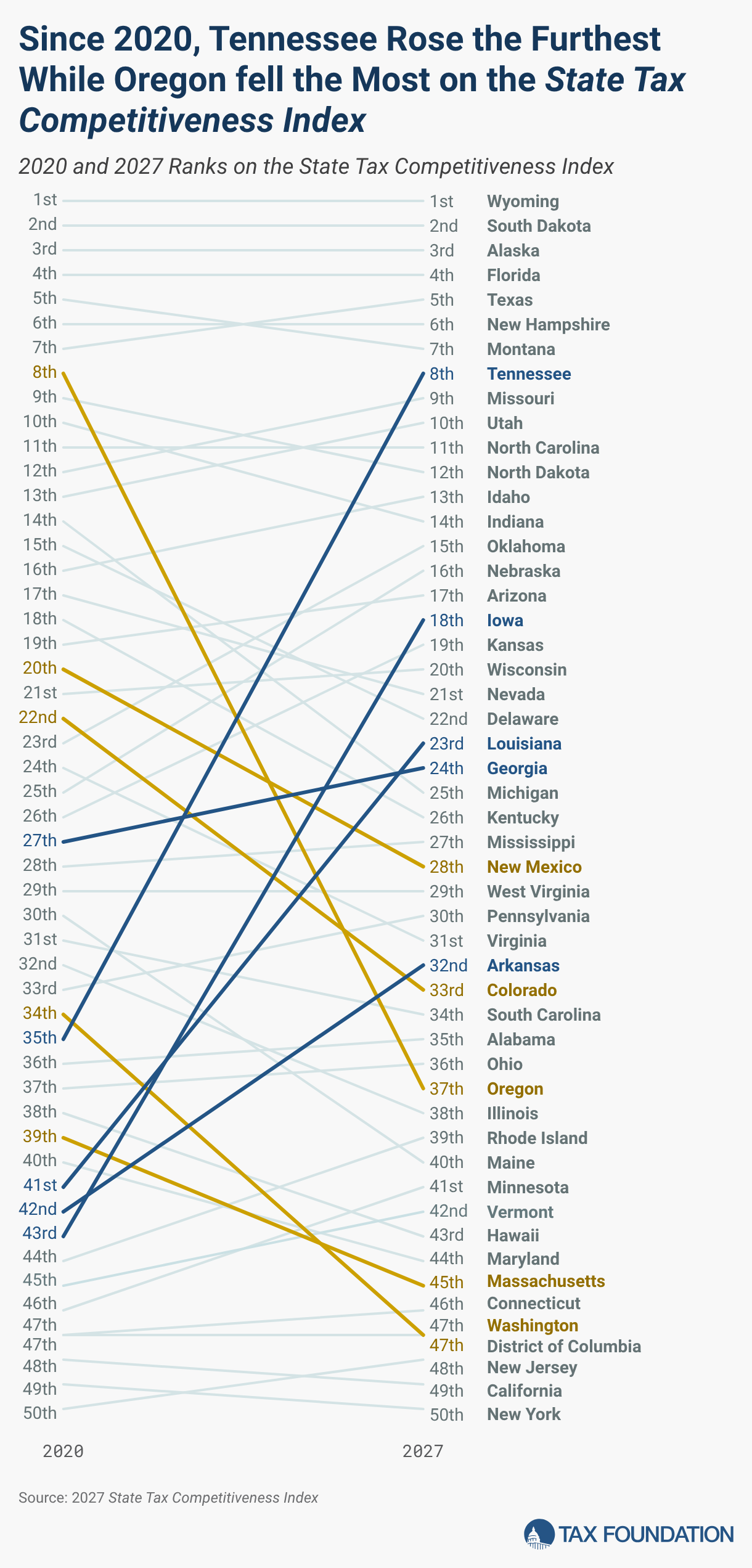
The 5 states that noticed the most important enhancements of their rank over the past seven years are:
- Tennessee, which ranked 35th in 2020, now ranks 8th.
- Iowa, which ranked 43rd in 2020, now ranks 18th.
- Louisiana, which ranked 41st in 2020, now ranks 23rd.
- Arkansas, which ranked 42nd in 2020, now ranks 32nd.
- Nebraska, which ranked 25th in 2020, now ranks 16th.
The 5 states that fell the furthest within the rankings within the final seven years are:
- Oregon, which ranked 8th in 2020, now ranks 37th.
- Washington, which ranked 34th in 2020, now ranks 47th.
- Michigan, which ranked 14th in 2020, now ranks 25th.
- Colorado, which ranked 22nd in 2020, now ranks 33rd.
- Maine, which ranked 30th in 2020, now ranks 40th.
Highlighting the Good
Amidst a country-wide flat tax revolution, the states that noticed the best Index rating enhancements consolidated their particular person revenue taxA person revenue tax (or private revenue tax) is levied on the wages, salaries, investments, or different types of revenue a person or family earns. The U.S. imposes a progressive revenue tax the place charges improve with revenue. The Federal Earnings Tax was established in 1913 with the ratification of the sixteenth Modification. Although barely 100 years previous, particular person revenue taxes are the most important supply brackets and lowered charges throughout a number of main taxes, making their tax codes extra engaging to companies and people alike.
Tennessee lowered the charges of its company gross receipts taxGross receipts taxes are utilized to an organization’s product sales, with out deductions for a agency’s enterprise bills, like compensation, prices of products bought, and overhead prices. Not like a gross sales tax, a gross receipts tax is assessed on companies and applies to transactions at each stage of the manufacturing course of, resulting in tax pyramiding., improved its therapy of enterprise expensing, and absolutely phased out its tax on particular person curiosity and dividends revenue, turning into considered one of eight states to haven’t any particular person revenue tax.
Iowa has been working towards complete tax reform for a number of years, and its dedication is paying off. Since our 2020 rating, the state repealed its different minimal tax, lowered its prime company revenue taxA company revenue tax (CIT) is levied by federal and state governments on enterprise income. Many corporations are usually not topic to the CIT as a result of they’re taxed as pass-through companies, with revenue reportable below the person revenue tax. fee from 12 % to 7.1 %, and consolidated 4 brackets into two. On the person aspect, the state lowered its prime revenue tax fee from 8.53 % in 2019 (and eight.98 % earlier than reforms adopted in 2018) to a extremely aggressive 3.8 % and transformed a nine-bracket system to a flat tax.
Louisiana, too, has been working towards complete tax reform for a few years. Because the 2020 rating, the state has eradicated its uncompetitive throwout rule and its coverage of federal deductibility, eradicated its company franchise tax, introduced down the person revenue tax fee from 6 % to three %, and consolidated 5 company revenue tax bracketsA tax bracket is the vary of incomes taxed at given charges, which generally differ relying on submitting standing. In a progressive particular person or company revenue tax system, charges rise as revenue will increase. There are seven federal particular person revenue tax brackets; the federal company revenue tax system is flat. into one, with a prime fee discount from 8 to five.5 %. Louisiana can also be considered one of three states to undertake everlasting full expensing separate from the federal provision.
Arkansas noticed fee reductions and bracket consolidation as nicely. Lawmakers lowered the highest marginal company and particular person revenue tax charges from 6.5 and 6.9 % to 4.3 and three.7 %, respectively. The company revenue tax now options solely 4 brackets, and the person revenue tax has solely two, whereas each beforehand had six. The state additionally improved its nonresident revenue tax provisions, amongst different reforms. The company fee will proceed to fall to 4.1 % in 2027, serving to the state’s future scores.
Nebraska started a phasedown of its particular person and company revenue tax charges in 2022, accelerating and increasing that phasedown—along with consolidating the state’s company revenue tax brackets—by a 2023 regulation. Since 2022, the 7.81 % prime company and 6.84 % prime particular person revenue tax charges each dropped to 4.55 % and can attain 3.99 % on January 1, 2027.
Studying from the Dangerous
Oregon adopted a modified gross receipts tax along with its regular company revenue tax. This new tax has comparatively excessive charges, which compounds the tax pyramidingTax pyramiding happens when the identical ultimate good or service is taxed a number of occasions alongside the manufacturing course of. This yields vastly completely different efficient tax charges relying on the size of the availability chain and disproportionately harms low-margin corporations. Gross receipts taxes are a chief instance of tax pyramiding in motion. brought on by typical gross receipts taxes.
Washington beforehand had no revenue tax in any respect, and its particular person revenue tax rank bolstered its general Index rating. Nonetheless, in 2022, the state instituted a tax on particular person capital good points revenue over $250,000 (adjusted yearly for inflationInflation is when the final worth of products and providers will increase throughout the financial system, lowering the buying energy of a forex and the worth of sure property. The identical paycheck covers much less items, providers, and payments. It is usually known as a “hidden tax,” because it leaves taxpayers much less well-off resulting from larger prices and “bracket creep,” whereas growing the federal government’s spendin). Then, in 2025, the state added a brand new prime marginal fee of 9.9 % on capital good points exceeding $1 million. With out the assistance of a powerful revenue tax rating, the state’s different classes weighed down its general rank, which shortly plummeted. This yr, lawmakers additionally adopted a 9.9 % tax on common revenue above $1 million, which is scheduled to enter impact in 2028 and can additional hurt Washington’s rating.
Michigan has traditionally ranked nicely on the Index (between 12th and 16th) and didn’t make the massive, detrimental modifications of different states on this record. Nonetheless, the state fell behind by standing nonetheless. Whereas different states lowered their particular person and company revenue tax charges, elevated their tangible private property de minimis exemptions, and improved their expensing provisions consistent with the OBBBA, the Nice Lakes State maintained its historic therapy. Michigan additionally newly exempted tipped and time beyond regulation revenue in 2026, narrowing its revenue tax baseThe tax base is the whole quantity of revenue, property, property, consumption, transactions, or different financial exercise topic to taxation by a tax authority. A slender tax base is non-neutral and inefficient. A broad tax base reduces tax administration prices and permits extra income to be raised at decrease charges..
Colorado didn’t make the numerous detrimental modifications of Washington, Oregon, or Maine—no less than, not within the time interval in query. As an alternative, like Michigan, it demonstrates a cautionary story of resting on laurels at a time when states are strongly competing for the most effective tax code. Colorado was sitting comfortably at 22nd on the Index in 2020 due to its comparatively low-rate flat taxes—and the state even lowered its revenue tax fee from a statutory fee of 4.63 % to a statutory fee of 4.4 %, with further momentary reductions as a result of Taxpayer’s Invoice of Rights (TABOR). Nonetheless, in contrast to different states, Colorado didn’t tackle a few of the inefficiencies in its tax code, like its throwback rule and taxation of web CFC-tested revenue (NCTI, previously GILTI). The state has additionally failed to deal with its lack of a uniform gross sales taxA gross sales tax is levied on retail gross sales of products and providers and, ideally, ought to apply to all ultimate consumption with few exemptions. Many governments exempt items like groceries; base broadening, reminiscent of together with groceries, may preserve charges decrease. A gross sales tax ought to exempt business-to-business transactions which, when taxed, trigger tax pyramiding. base and unified level of administration. Notably, Colorado’s rating is ready to lower considerably in coming years, as voters lately accredited an revenue tax improve for each companies and people that can elevate the highest marginal company and particular person revenue tax charges to eight.4 %, abandoning Colorado’s flat taxAn revenue tax is known as a “flat tax” when all taxable revenue is topic to the identical tax fee, no matter revenue stage or property. construction.
Maine has seen its rankings slide regularly since 2020 however skilled a sudden seven-place drop this yr with its adoption of a 2 % “high-income surcharge.” This surcharge brings the state’s prime marginal particular person revenue tax fee to 9.15 % on incomes over $1 million and features a marriage penaltyA wedding penalty is when a family’s general tax invoice will increase due to a few marrying and submitting taxes collectively. A wedding penalty sometimes happens when two people with comparable incomes marry; that is true for each high- and low-income {couples}.. The state additionally failed to adapt to the improved expensing provisions handed by the OBBBA whereas growing varied excise taxes.
Conclusion
A state’s rating shouldn’t be a everlasting label—as an alternative, it’s meant to indicate states the place they’ve accomplished nicely and the place they will nonetheless enhance. If state legislators make pro-growth modifications, they will bounce up within the rankings, as these states show. And lots of states have accomplished simply that within the final seven years, actually prioritizing tax reform in such a method as to go away behind these states which might be merely standing nonetheless. Each state can profit from a easy, impartial, clear, pro-growth tax construction.
Keep knowledgeable on the tax insurance policies impacting you.
Subscribe to our free e-newsletter to get the most recent tax information, information and evaluation.
Share this text

