

The stress behind each Gong API analysis is scope.
Gong’s platform has grown from dialog intelligence right into a income platform protecting deal execution, forecasting, enablement, and gross sales engagement throughout 5,000+ clients. The API sits behind that platform, giving builders programmatic entry to name knowledge, transcripts, interplay stats, CRM imports, and AI-powered deal intelligence.
However a platform constructed for income groups and an API constructed for builders are totally different merchandise with totally different questions. What are you able to truly retrieve? What are you able to push in? How briskly are you able to name it, and what does it price at scale?
The Gong API is probably going the best selection if:
-
It’s good to add name recordings from exterior telephony programs and have Gong transcribe, analyze, and rating them alongside natively captured calls.
-
You might be constructing {custom} reporting or BI dashboards that pull name metadata, transcript knowledge, tracker outcomes, and scorecard outcomes from Gong into your individual analytics layer.
-
You wish to push CRM knowledge into Gong from a CRM that lacks a local integration (Salesforce, HubSpot, and Dynamics 365 have native connectors; the whole lot else makes use of the CRM API).
-
You want webhook-driven automation that fires when a recorded name matches particular filters (speaker, workforce, matter, tracker).
Nevertheless, it may not be the best match if:
-
You want B2B contact knowledge, firm attributes, org charts, technographic profiles, or purchaser intent indicators on the API layer. Gong’s API surfaces interplay knowledge from calls and emails, not a contact or firm database.
-
You want high-throughput entry. Gong’s fee limits are 3 requests per second and 10,000 per day, with no tiered improve path documented.
-
You want official server-side SDKs. Gong supplies a JavaScript SDK for iFrame integrations however no backend SDKs for Python, Node.js, Java, or different server languages.
-
You might be constructing enrichment, prospecting, or viewers administration pipelines that require contact search, e-mail verification, or firm intelligence endpoints.
-
You want AI-powered account analysis, lookalike growth, or buying-committee suggestions by way of API with out consuming opaque credit score allotments.
On this case, take into account the API from ZoomInfo: a REST suite protecting search, enrichment, AI intelligence, and viewers administration throughout 500M contacts and 100M corporations, with OAuth 2.0 authentication, tiered fee limits as much as 35 req/sec, and an MCP server for AI-agent workflows.
This text evaluations each: the Gong API in full technical depth first, then ZoomInfo’s API the place your construct wants the B2B knowledge and intelligence layer that dialog intelligence doesn’t cowl.
Gong API at a Look
|
Attribute |
Element |
|---|---|
|
API sort |
REST over HTTPS, JSON responses |
|
Authentication |
Primary Auth (API key + secret) for direct entry; OAuth 2.0 (authorization code movement) for Collective companion apps |
|
Base URL |
Buyer-specific (e.g., https://company-17.api.gong.io), returned in OAuth token response as api_base_url_for_customer |
|
Price limits |
3 calls per second, 10,000 calls per day |
|
Pricing / entry |
Included on any Gong plan; AI-powered endpoints moreover eat Gong credit |
|
SDKs |
JavaScript SDK for iFrame integrations; no official server-side SDKs |
|
Webhooks |
Sure, by way of Automation Guidelines (call-level set off with configurable filters) |
|
MCP server |
Coming quickly at https://mcp.gong.io/mcp (OAuth 2.0 auth, shared and private entry modes) |
|
Documentation |
Assist heart at assist.gong.io; interactive API reference at gong.app.gong.io/settings/api/documentation (login required) |
Gong API: What Works Effectively & What to Plan Round
|
What works properly |
What to plan round |
|---|---|
|
API entry included on each Gong plan, no enterprise-only gate |
Price limits are tight: 3 req/sec and 10,000 req/day with no documented improve tiers |
|
Each Primary Auth and OAuth 2.0 supported, relying on use case |
Interactive API reference requires a Gong login; not publicly browsable |
|
Buyer-specific base URLs isolate tenant knowledge cleanly |
No official server-side SDKs: you construct and keep the HTTP layer your self |
|
AI-powered endpoints (ask-entity, get-brief) expose deal intelligence programmatically |
AI API calls eat Gong credit, scaling by scope and date vary |
|
MCP server launching at mcp.gong.io/mcp with shared and private entry modes |
MCP server is just not but typically out there; listed as “coming quickly” |
|
Webhook payloads embody full name knowledge (metadata, contributors, CRM context, transcripts) |
Webhooks have a single set off sort (name match); no lead, deal, or forecast occasion varieties |
Gong API: Authentication & Getting Began
Gong helps two authentication paths. Which one you employ will depend on what you might be constructing.
Primary Auth (direct API entry): For inside integrations, {custom} reporting, and knowledge pipelines constructed by the Gong buyer’s personal workforce. A Gong tech admin generates an Entry Key and Entry Key Secret within the admin heart (Settings, Ecosystem, API).
These credentials function username and password in HTTP Primary Authentication headers. Keys expire on a rolling foundation, and Gong notifies admins forward of expiry. Solely a tech admin can generate these credentials.
API entry is offered on any Gong plan, so there is no such thing as a separate developer tier or enterprise gate.
OAuth 2.0 (companion and Collective apps): For apps that combine with a number of Gong clients or checklist within the Gong Collective market. The movement follows RFC 6749 authorization code grant.
The authorization endpoint is https://app.gong.io/oauth2/authorize, and tokens are exchanged at https://app.gong.io/oauth2/generate-customer-token. Entry tokens default to 1-day validity (configurable by way of validity_duration), with refresh tokens for silent renewal.
One constraint: Gong doesn’t help user-level OAuth. Authentication occurs on the workspace stage, not per consumer. Scopes outline knowledge entry granularity (e.g., api:calls:create, api:calls:learn:primary), and every buyer’s token factors to their distinctive api_base_url_for_customer.
A primary authenticated request utilizing Primary Auth:
curl -u YOUR_ACCESS_KEY:YOUR_ACCESS_KEY_SECRET
“https://company-17.api.gong.io/v2/calls”
Builders constructing Collective apps can request a sandbox/developer occasion, although provisioning takes as much as 5 enterprise days.
Gong API: Core Endpoints & Capabilities
The API organizes round Gong’s main knowledge objects: calls, stats, CRM information, Interact exercise, and AI intelligence. Every serves a definite integration sample.
Calls
The Calls endpoint household at /v2/calls is essentially the most developed useful resource within the API.
What you are able to do:
-
Add name recordings from any exterior telephony system or recorder, together with the consultant’s audio channel, so Gong can transcribe and analyze them alongside natively captured calls.
-
Retrieve analyzed name knowledge: inside and exterior contributors, matters mentioned, Good Tracker matches, public feedback, scorecards, and full transcripts.
That is the core of the API. In case your integration includes getting dialog knowledge out of Gong or getting recordings into Gong, the Calls endpoints are the place you’re employed.
What you’ll construct with this: A nightly pipeline that pulls transcripts and tracker outcomes from each name within the final 24 hours into your knowledge warehouse, then joins them with CRM alternative knowledge for {custom} win/loss evaluation that goes deeper than Gong’s built-in dashboards.
Stats
The Stats endpoints retrieve workforce member utilization knowledge: who used Gong and when, each day exercise metrics, and interplay statistics per consumer. Use these to construct adoption dashboards or monitor which workforce members are actively utilizing the platform.
CRM API
The CRM API enables you to add account, contact, and alternative information on to Gong. It exists for purchasers whose CRM lacks a local integration. Salesforce, HubSpot, and Microsoft Dynamics 365 all have native bi-directional connectors; the CRM API is the fallback for the whole lot else.
One constraint: that is import-only. You may push knowledge into Gong, however you can’t export CRM knowledge again out by way of this API. Native CRM integrations are bi-directional; the API is just not.
Interact API
Supply: Gong
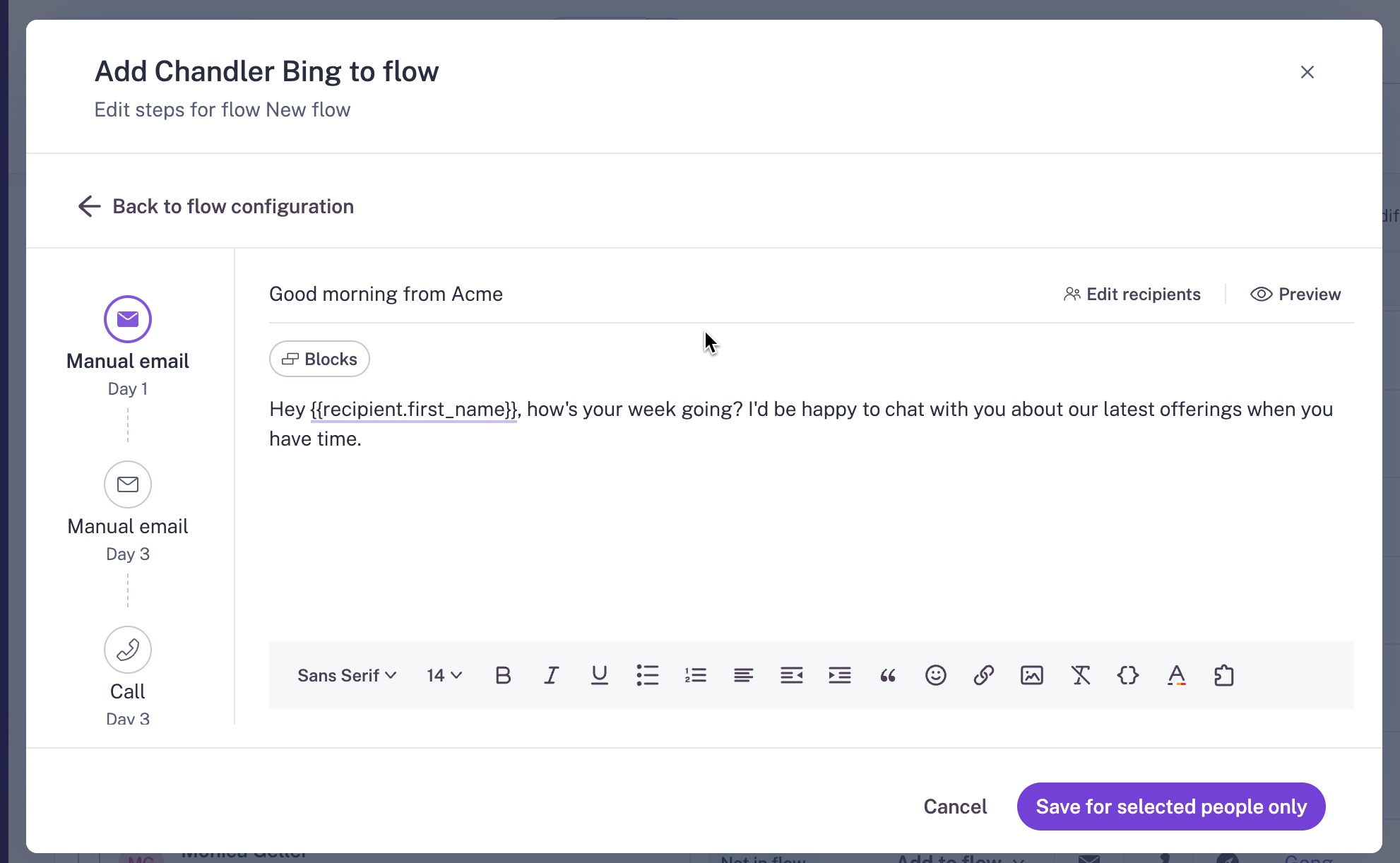
For groups utilizing Gong Interact (gross sales engagement), the API helps reporting on movement assignments, prospect contact knowledge, and outreach exercise. This helps groups that want extra frequent knowledge refresh of Interact metrics than the each day default, or that wish to construct {custom} engagement reporting outdoors Gong’s UI.
AI / Ask APIs
Two AI-powered endpoints can be found:
Each eat Gong credit. Consumption scales with the quantity of calls and emails analyzed per request, the date vary coated, and the scope of the entity queried. Longer ranges and broader scope price extra credit.
The Gong MCP server exposes the identical capabilities as instruments (ask_account, ask_deal, generate_brief), utilizing the identical credit score mannequin.
What you’ll construct with this: An inside Slack bot that solutions “what is the newest on the Acme deal?” by calling ask-entity with the deal ID, returning an AI abstract grounded within the final two weeks of name transcripts and e-mail threads.
Gong API: Webhooks & Occasions
Supply: Gong
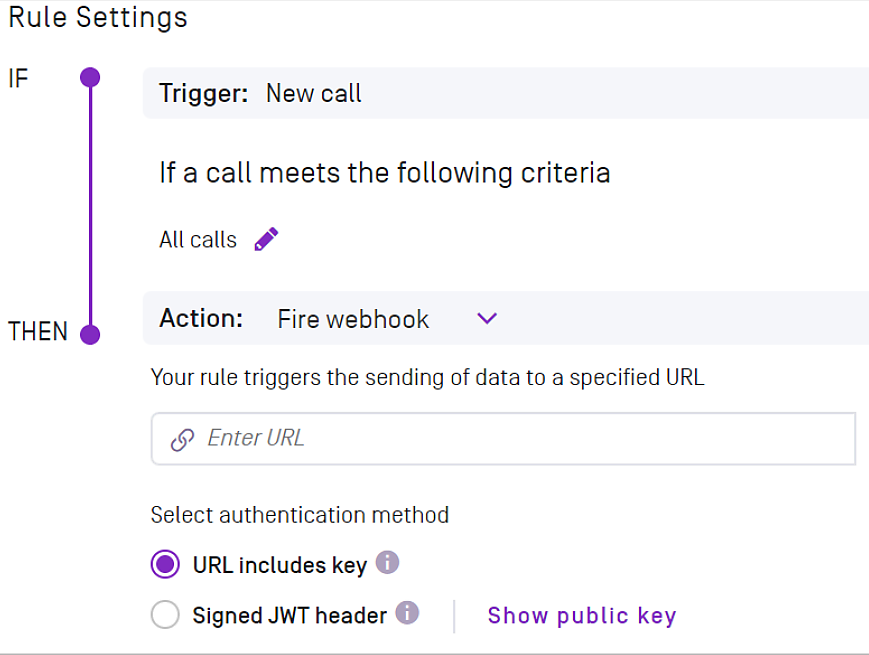
Gong helps webhooks by means of Automation Guidelines, out there on the Gong Basis plan and above. The mannequin is rule-based: an admin defines name filters (utilizing the identical filter logic out there in Gong’s name search), specifies a vacation spot URL, and the rule fires when a recorded name matches these filters.
Set off sort: One set off sort exists: a name matching the configured filters. Gong doesn’t expose named occasion varieties for deal-stage adjustments, leads, or forecasts. Webhooks are scoped to calls.
Authentication on your receiving endpoint: Two choices:
Payload construction: The webhook payload is a JSON object with two top-level fields:
-
callData: the complete name object, similar in construction to the /v2/calls API response. This contains metaData (name ID, URL, title, timing, period, path, system, scope, media, language), context (related CRM objects with fields), and events (contributors with e-mail, title, title, speaker ID, affiliation, CRM context, and assembly strategies).
The payload is dense in a helpful method: you get the complete name report in a single supply, not a notification that requires a follow-up API name.
Two constraints to plan round:
-
Single set off sort. When you want event-driven automation on deal standing adjustments, forecast updates, or Interact exercise, webhooks won’t cowl it. You might be restricted to call-matching guidelines.
Gong API: SDKs, Docs & Price Limits
SDKs & Libraries
Gong supplies a JavaScript SDK for iFrame-based integrations that embed third-party content material inside Gong’s e-mail composer or account/pipeline pages. This can be a frontend SDK for companion apps that floor content material inside Gong’s UI, not a general-purpose API shopper.
No official server-side SDKs exist for Python, Node.js, Java, Ruby, Go, or every other backend language. Builders combine instantly with the REST API over HTTP. The Fivetran neighborhood maintains a connector for extracting Gong knowledge into knowledge warehouses, however that could be a third-party software, not a Gong SDK.
With out an official SDK, you personal the authentication movement, request serialization, rate-limit backoff, error dealing with, and retry logic. For a easy integration pulling name knowledge nightly, that is manageable. For a manufacturing system making lots of of each day calls throughout a number of endpoint households, it provides engineering overhead.
Documentation & Developer Expertise
Gong’s developer documentation lives in two locations:
Assist heart (assist.gong.io): Covers API entry setup, OAuth app creation, webhook configuration, CRM API integration, MCP server setup, Information Cloud configuration, and integration patterns.
Content material contains step-by-step setup guides, code samples for OAuth flows, and a labored JSON instance for webhook payloads. A devoted Gong Builders Hub part exists for expertise companions.
Interactive API reference (gong.app.gong.io/settings/api/documentation): The complete endpoint reference with schemas and examples. That is the place you discover request our bodies, response shapes, and endpoint-level documentation for the /v2/calls household and different sources.
The interactive reference requires a Gong login. You can’t browse endpoint schemas, take a look at requests, or consider the API floor with no buyer or developer account. For a developer evaluating the API earlier than committing, it is a actual barrier.
The assistance heart describes what the API can do at a excessive stage, however the endpoint-level element lives behind the login wall.
No publicly browsable OpenAPI/Swagger spec, no Postman assortment, and no public changelog seem within the documentation. The API is versioned below /v2/, however versioning particulars past the trail prefix aren’t described.
Gong does warn that fields could also be added to JSON output with out discover, so your code should tolerate unknown fields.
Developer help runs by means of Gong’s customary help ticket system. No devoted developer Slack, discussion board, or neighborhood channel is documented.
Price Limits & Constraints
Gong publishes the next fee limits:
Exceeding both restrict triggers HTTP 429 with a Retry-After header indicating seconds to attend. These limits apply uniformly throughout all plan tiers. No tiered rate-limit mannequin is documented, so there is no such thing as a path to increased throughput by upgrading your plan.
Further constraints:
-
AI endpoints eat credit. The ask-entity and get-brief calls are gated by Gong credit, with consumption scaling by the quantity of analyzed interactions, date vary, and entity scope. Repeated requests on the identical entity over totally different time ranges every eat credit.
For context: 10,000 calls per day at 3 per second means your each day quota empties in below an hour of sustained calling. In case your integration wants to tug transcripts for lots of of calls, retrieve stats for dozens of customers, and make AI queries in opposition to a number of offers, plan your name funds fastidiously.
Gong API Pricing & Entry Prices
Gong doesn’t publish standalone API pricing. API entry comes with any Gong plan, bundled with the platform subscription quite than bought as an add-on.
Since Gong’s pricing is quote-based (per-user licenses plus a platform payment, with no revealed worth factors), the price of API entry is embedded in no matter you negotiate for the platform.
The one documented price past the subscription is Gong credit, consumed by the AI-powered APIs (ask-entity and get-brief). Credit score consumption varies: it scales with the variety of calls and emails analyzed per request, the date vary queried, and the entity scope.
The MCP server instruments use the identical credit score mannequin. Whether or not credit include the bottom subscription or require a separate buy is just not said in public documentation.
For a developer sizing price: the API is free when you already pay for Gong. The true price variables are the platform subscription (custom-quoted, no revealed costs) and credit score consumption from AI endpoints. In case your integration sticks to name knowledge retrieval and CRM imports, credit don’t apply.
If it will depend on AI queries at scale, credit score prices are the unknown you might want to negotiate upfront.
The place the Gong API Falls Quick
These are sensible limits a developer ought to plan round, not criticisms of the platform. A number of mirror the truth that Gong constructed its API to increase a income workforce platform, to not function a general-purpose B2B knowledge floor.
The API exposes interplay knowledge, not B2B intelligence. No endpoints exist for contact search, firm enrichment, org-chart traversal, technographic lookup, or purchaser intent indicators. In case your pipeline must go from “who was on this name?” to “what firm do they work for, what’s that firm’s tech stack, and are they displaying shopping for intent?”, you want a second API.
Gong captures what occurred in conversations; it doesn’t keep a contact or firm database.
Price limits are restrictive for data-heavy integrations. At 3 requests per second and 10,000 per day, the throughput ceiling is low. No documented tiered improve path exists. A workforce pulling transcripts, stats, and AI insights throughout a big Gong occasion will want cautious name budgeting.
By comparability, most API-first platforms supply 25+ requests per second at their customary tier.
The interactive API reference is behind a login wall. You can’t browse endpoint schemas, take a look at requests, or consider response shapes with no Gong buyer or developer account. Throughout a technical analysis, you need to depend on the assistance heart’s high-level descriptions quite than the precise endpoint documentation.
No server-side SDKs. Each backend integration is uncooked HTTP. The JavaScript SDK covers frontend iFrame integrations solely. In case your workforce is accustomed to maintained shopper libraries that deal with auth, retry, and pagination, you construct that layer your self.
Webhook scope is restricted to calls. One set off sort exists: a name matching a filter rule. No webhook occasions for deal adjustments, forecast updates, pipeline actions, or Interact exercise. In case your integration wants event-driven automation past “a name matched these standards,” webhooks won’t cowl it.
AI endpoint prices are opaque. The ask-entity and get-brief endpoints eat Gong credit, however credit score pricing, allocation, and consumption charges aren’t publicly documented. Constructing a value mannequin for an integration that makes frequent AI queries requires a dialog with Gong’s gross sales workforce.
MCP server is just not but typically out there. The MCP server at mcp.gong.io/mcp is introduced however listed as “coming quickly.” Builders constructing AI-agent integrations right now can’t depend on it.
ZoomInfo API: The B2B Information and Intelligence Layer
Gong’s API provides you programmatic entry to what occurred in income workforce conversations.
ZoomInfo provides you the B2B knowledge that tells you who these individuals are, what corporations they work for, what expertise these corporations use, whether or not these accounts are researching your class, and the way the shopping for committee is structured. This intelligence attracts from ZoomInfo’s GTM Context Graph, which processes 1.5B+ knowledge factors each day.
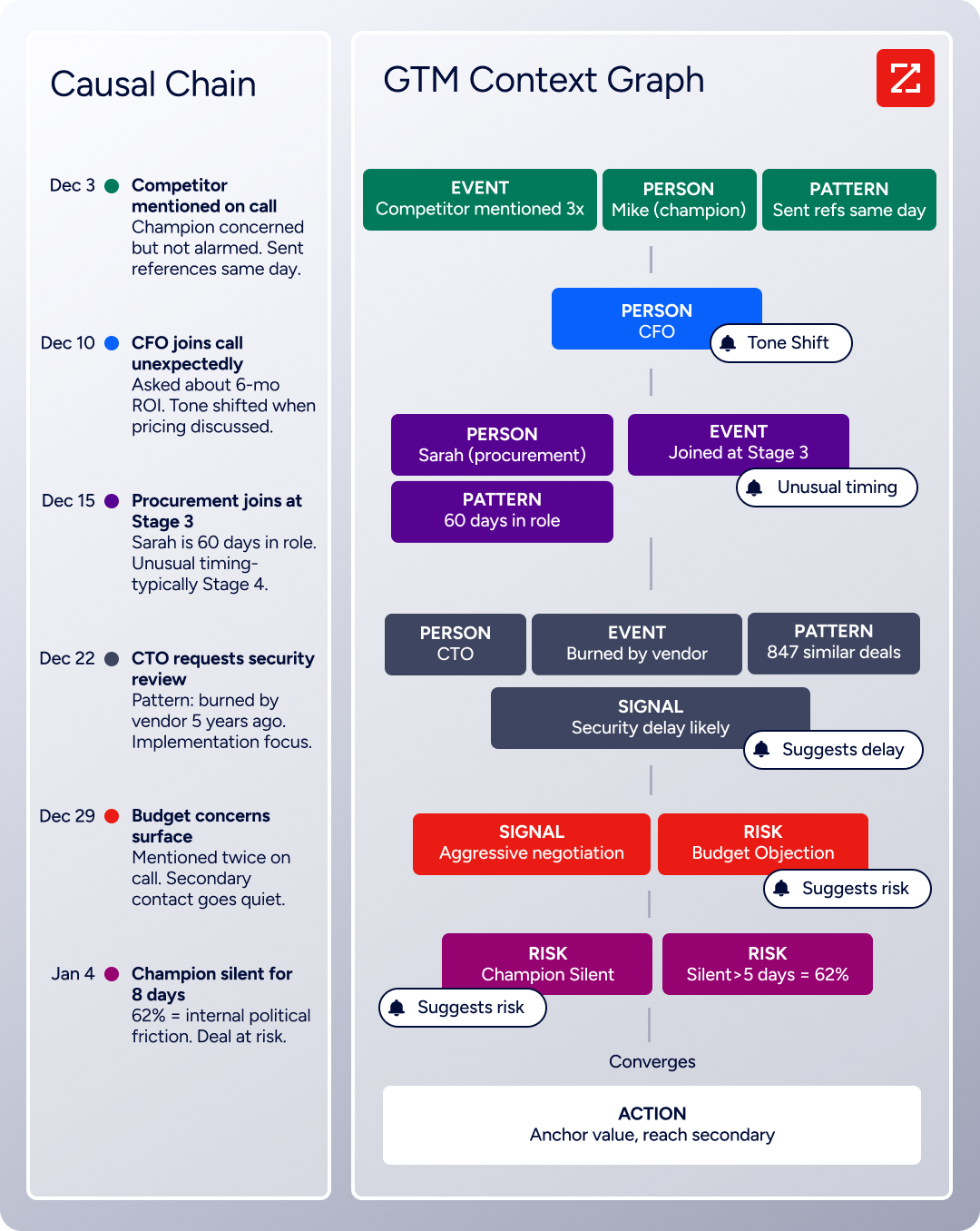
The 2 APIs function at totally different layers. A developer constructing a whole income intelligence pipeline would use Gong’s API for interplay knowledge and ZoomInfo’s API for the contact, firm, and intent knowledge that dialog intelligence doesn’t seize.
What the API Covers
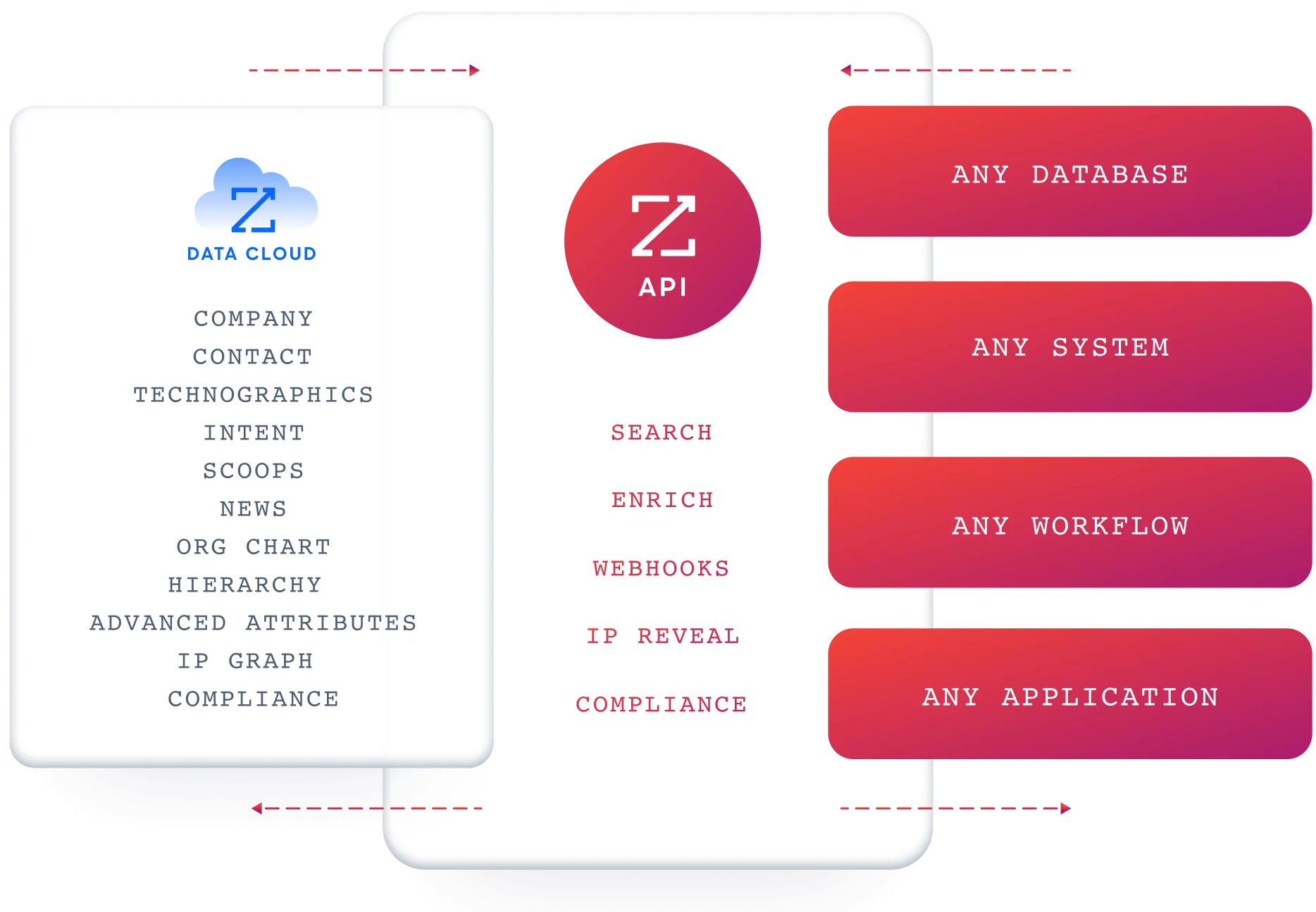
ZoomInfo’s Enterprise API is a REST suite served from https://api.zoominfo.com/gtm, organized into 4 areas documented within the interactive API reference:
-
Information API (Search & Enrich): Search endpoints cowl Contacts, Corporations, Intent, Information, and Scoops, returning matched information with out consuming credit. Enrich endpoints unlock the complete payload: enterprise emails, direct dials, employment historical past, company hierarchy, org charts, technographics, and hashtag indicators, as much as 25 information per name. The underlying dataset spans 500M contacts, 100M corporations, 135M+ verified telephone numbers, and 200M+ verified enterprise e-mail addresses.
-
AI Intelligence API: Account Abstract returns structured account intelligence with a free-form Q&A endpoint. Discover Related Corporations performs lookalike growth from a seed account. Contact Suggestions returns AI-ranked buying-committee recommendations by movement (prospecting, deal acceleration, renewals).
The search-then-enrich sample means you filter freely (search and lookup calls are free), then pay just for the information you enrich. This can be a totally different price mannequin from one the place each API name consumes credit no matter what it returns.
Authentication & Entry
ZoomInfo makes use of OAuth 2.0 with PKCE by way of Okta, supporting three flows:
Entry tokens final 24 hours as Bearer tokens with rotating refresh tokens. Groups register purposes by means of the ZoomInfo Developer Portal, the place they generate credentials, outline scopes, and take a look at endpoints.
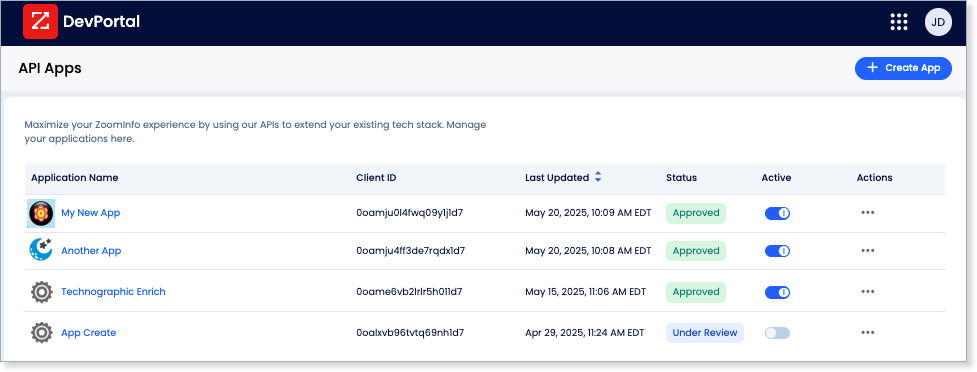
Two app varieties are supported: {custom} purposes (auto-approved on registration) and companion purposes (requires ZoomInfo assessment).
The developer portal additionally helps producing bearer tokens instantly within the UI for testing, which helps you to consider endpoint responses earlier than constructing the complete OAuth movement.
Endpoints, Price Limits & Credit
Price limits are revealed by tier: Builder (5 req/sec), Commonplace (25 req/sec), and Scaling (35 req/sec), with per-hour and per-day sliding-window limits enforced concurrently.
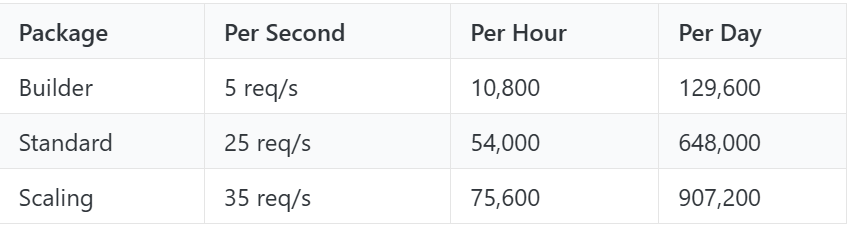
Each response contains quota headers with remaining capability, and 429 responses embody a Retry-After header with actual backoff timing plus identification of which window was exhausted.
Credit observe a rolling 12-month window: enriching a report for the primary time consumes one credit score; re-enriching the identical report inside the 12 months is free. Search and lookup operations price nothing. AI analysis endpoints (Account Analysis, Contact Analysis) eat a separate AI motion credit score pool.
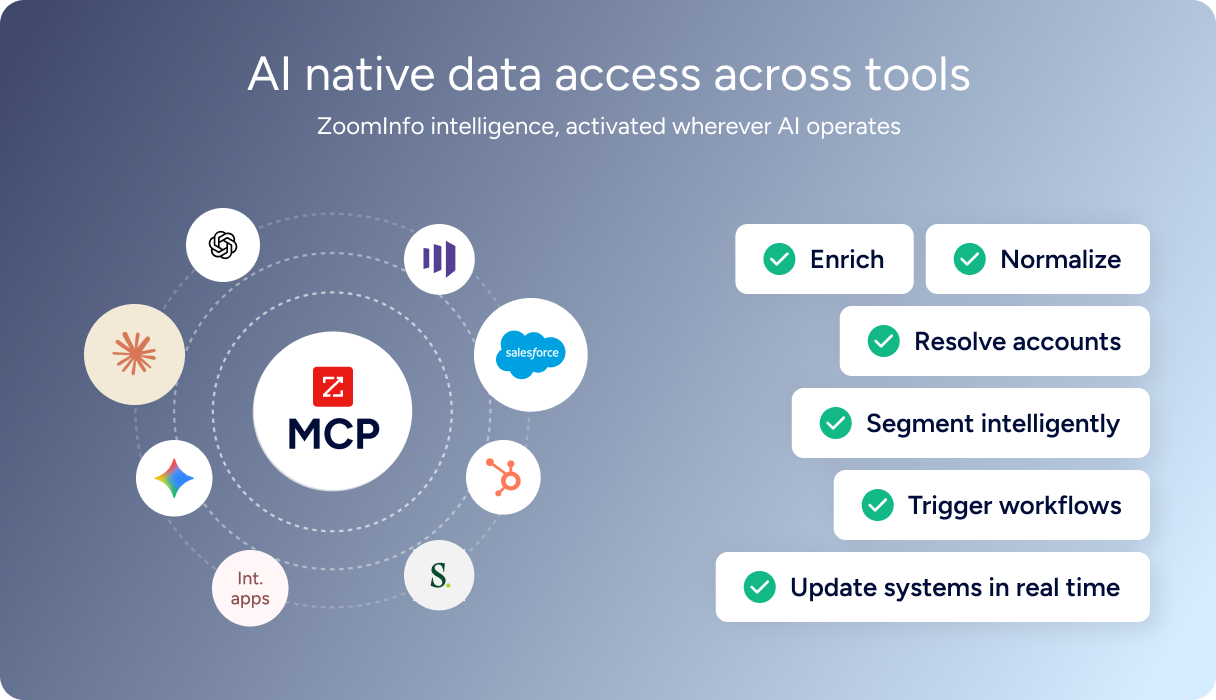
For builders constructing AI brokers, ZoomInfo’s MCP server at https://mcp.zoominfo.com/mcp exposes search, enrich, and account analysis as native instruments for MCP-compatible assistants, at the moment supporting Claude and ChatGPT. The credit score mannequin carries over from the REST API.
Developer Expertise
Documentation lives at docs.zoominfo.com with an interactive API reference, OAuth recipes in 5 languages (Shell, Node, Ruby, PHP, Python), and an llms.txt index for AI growth instruments. A separate Docs MCP server allows AI-assisted code technology in opposition to the API spec.
ZoomInfo doesn’t publish official SDKs both, so each Gong and ZoomInfo require direct HTTP integration.
Pricing follows a consumption-based mannequin and is custom-quoted. ZoomInfo has added API entry to all related plans, eradicating a previous enterprise-only gate.
BDO Canada reported an 87% discount in time spent updating inside knowledge dashboards utilizing the ZoomInfo API, with one analyst describing the combination as plug-and-play throughout any course of. (ZoomInfo)
Gong API vs. ZoomInfo API
|
Dimension |
Gong API |
ZoomInfo API |
|---|---|---|
|
API sort |
REST, JSON |
REST, JSON:API format |
|
Authentication |
Primary Auth (key + secret) or OAuth 2.0 (workspace-level) |
OAuth 2.0 with PKCE (24-hour tokens, rotating refresh) |
|
Main scope |
Dialog intelligence: name recordings, transcripts, trackers, scorecards, AI deal/account Q&A |
B2B knowledge intelligence: contact/firm search, enrichment, intent, org charts, technographics, AI analysis |
|
Database |
Interplay knowledge from buyer calls and emails captured by Gong |
500M contacts, 100M corporations, 135M+ verified telephone numbers, 200M+ verified enterprise emails |
|
Contact/firm knowledge |
Not out there (captures name contributors, not a contact database) |
Full contact and firm profiles with search, enrich, and hierarchy endpoints |
|
Intent indicators |
Not out there by way of API |
Purchaser intent search and enrichment with topic-level sign knowledge |
|
Webhooks |
Name-matching guidelines (single set off sort, full name payload) |
Agent Groups-based webhooks (enrichment jobs, sign alerts, credit score thresholds) |
|
SDKs |
JavaScript (iFrame solely); no server-side SDKs |
No official SDKs; recipes in 5 languages |
|
Price limits |
3 req/sec, 10,000 req/day (no tiers) |
5-35 req/sec by tier, with per-hour and per-day sliding home windows |
|
Pricing mannequin |
Bundled with Gong subscription; AI endpoints eat credit |
Customized-quoted, consumption-based (search free, enrich consumes credit) |
|
AI endpoints |
ask-entity (deal/account Q&A), get-brief (summaries) |
Account Abstract, Discover Related Corporations, Contact Suggestions, Account/Contact Analysis |
|
MCP server |
Coming quickly at mcp.gong.io/mcp |
Reside at mcp.zoominfo.com/mcp (Claude, ChatGPT) |
|
API docs entry |
Login required for interactive reference |
Publicly browsable interactive reference with try-it explorer |
Ultimate Verdict
Gong’s API does what it was constructed for: giving builders programmatic entry to the dialog intelligence, deal insights, and interplay knowledge that Gong captures from income workforce actions.
The webhook payloads (full name objects in each supply), the AI-powered ask-entity and get-brief endpoints, and the upcoming MCP server make it a succesful integration layer for groups already on the Gong platform. Its limits are limits of scope and throughput, not high quality.
Select the Gong API if your construct begins with dialog knowledge: pulling name transcripts right into a {custom} analytics layer, importing recordings from exterior programs for Gong to course of, triggering workflows when particular name patterns are detected, or querying deal intelligence by way of the AI endpoints.
In case your workforce already runs on Gong and the combination extends what Gong captures, the API delivers that entry at no further price past the platform subscription.
Select the ZoomInfo API if your construct wants the B2B knowledge layer that dialog intelligence doesn’t present: looking and enriching contacts and firms, detecting purchaser intent, mapping org charts and expertise stacks, producing AI account analysis, or constructing viewers segments programmatically.
The search-then-enrich sample (search is free, enrich consumes credit), revealed tiered fee limits as much as 35 req/sec, and the dwell MCP server give builders a broader, higher-throughput floor for data-intensive pipelines.
Discover the ZoomInfo Enterprise API or begin with the developer docs to judge the endpoint floor instantly.
A developer who wants neither ought to know that Gong’s API doesn’t expose B2B contact or firm knowledge, and ZoomInfo’s API doesn’t seize or analyze gross sales conversations. In case your pipeline wants each interplay intelligence and knowledge enrichment, the 2 are complementary layers, not competing surfaces.
FAQ
Is the Gong API free?
API entry comes with any Gong plan at no further cost. There isn’t any separate developer tier, API add-on, or per-call pricing for normal endpoints (calls, stats, CRM imports). The exception is the AI-powered endpoints (ask-entity and get-brief), which eat Gong credit.
Credit score pricing and allocation aren’t publicly documented, so groups planning to make use of AI endpoints at scale ought to make clear credit score phrases throughout contract negotiation.
Does Gong have a GraphQL API?
No. Gong exposes a REST API with JSON responses, versioned below /v2/. There isn’t any GraphQL endpoint. When you want a GraphQL interface for Gong knowledge, you’ll construct a wrapper on prime of the REST API.
What’s the Gong API fee restrict?
Gong enforces two simultaneous limits: 3 API calls per second and 10,000 API calls per day. Exceeding both triggers a 429 response with a Retry-After header. These limits apply uniformly throughout all plan tiers, and no documented improve path to increased throughput exists. At sustained calling, the each day quota empties in below an hour.
Are there official Gong SDKs?
Gong supplies a JavaScript SDK for iFrame-based frontend integrations (embedding companion content material inside Gong’s e-mail composer or account pages). No official server-side SDKs exist for Python, Node.js, Java, Ruby, Go, or every other backend language. Builders construct instantly in opposition to the REST API. The Fivetran neighborhood maintains a separate connector for extracting Gong knowledge into knowledge warehouses.
Does the Gong API help webhooks?
Sure, by means of Automation Guidelines. An admin defines name filters and a vacation spot URL; when a recorded name matches these filters, Gong delivers the complete name object as a JSON payload to your endpoint. Authentication choices embody a URL-embedded token or a signed JWT header.
The limitation is scope: webhooks solely fireplace on name occasions. No webhook triggers exist for deal standing adjustments, forecast updates, pipeline actions, or Interact exercise.
What does ZoomInfo’s API add to a Gong construct?
ZoomInfo’s API provides the B2B knowledge and intelligence layer that Gong’s API doesn’t cowl. The place Gong’s API returns dialog knowledge (who was on a name, what was stated, how a deal is trending), ZoomInfo’s API supplies the contact and firm intelligence behind these interactions: verified emails and direct dials throughout 500M contacts, firm attributes and org charts throughout 100M corporations, technographic profiles, purchaser intent indicators, and AI-powered account analysis.
The 2 APIs use totally different authentication fashions (Primary Auth/OAuth 2.0 vs. OAuth 2.0 with PKCE) and totally different pricing constructions (platform-bundled vs. credit-based), so plan the combination layer to deal with each. ZoomInfo’s MCP server extends the identical knowledge to AI-agent workflows, including a dwell functionality that Gong’s MCP server has not but reached.

