

On this episode of Understanding Economics, I clarify why revenue must be understood because the reward for enterprise, and that it isn’t a return for the possession of cash, property or shares.
Enterprise entails bringing collectively individuals, abilities and assets to supply items and providers that meet human wants. Revenue is the unsure reward for enterprise that work, which is that of the entrepreneur – who’s at all times an individual.
The issue is that each trendy economics and nearly all typical accounting confuse revenue with different types of revenue, together with curiosity and financial hire.
I clarify how this occurred, suggesting that using restricted corporations has allowed shareholders to assert income generated by the work and enterprise of workers, even when these shareholders contribute nothing past monetary capital. This may need resulted within the greatest misallocation of financial returns in historical past.
For instance this, I exploit an instance primarily based on a café to display the distinction between wages, revenue, curiosity, and financial hire.
Drawing on the concepts of Adam Smith, I argue that shareholders ought to obtain a good return for offering finance, whereas the rewards of enterprise ought to belong to those that truly create them.
If we would like an economic system that rewards work pretty, we have to basically rethink who receives enterprise income, and it isn’t shareholders.
That is the audio model:
This infographic helps this video:
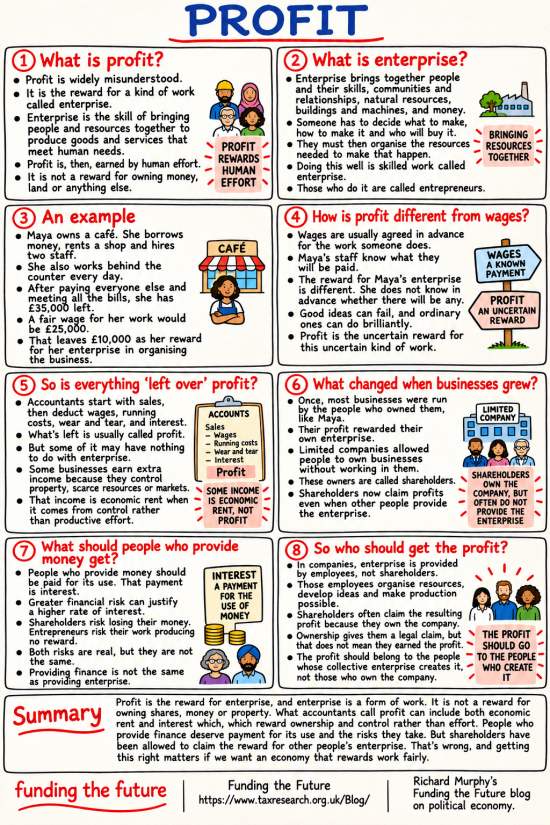 That is the transcript:
Good day, I am Richard Murphy, and that is Understanding Economics. That is the collection of movies that I’m making, which explains how I see economics in the actual world. And on this video, I wish to discuss probably the most troublesome ideas in economics, which I believe can be probably the most misunderstood, and that’s revenue.
Revenue, whether it is correctly understood, is a reward for a selected and fairly particular sort of work referred to as enterprise. Enterprise is the talent of bringing collectively individuals and assets to supply items and providers that meet human want. Revenue is then earned by human effort. It’s not a reward for proudly owning cash. It’s not a reward for proudly owning land. It is not a reward for the rest. It’s earned revenue, however of a really specific kind.
An enterprise brings collectively individuals and their abilities, communities and relationships, all types of capital, together with pure assets, buildings , machines, and cash, and combines them in a manner that meets human want.
Somebody has to resolve what to make, the way to make it, and who will purchase it. The talent of doing that is known as enterprise. And that particular person should then organise the assets wanted to make that each one occur. And this, once more, is a part of this talent base. Those that have this talent are referred to as entrepreneurs. The exercise they undertake is known as enterprise. And the return they make for his or her efforts is revenue.
So, let’s use an instance as a result of on this case I believe it should assist. Maya desires to create a restaurant. She borrows cash, rents a store, and hires two employees, and she or he herself works behind the counter each single day. And after paying all of the payments and totting up all of the receipts, on the finish of her first yr, she’s received £35,000 left.
Now a good wage for her work behind the counter could be £25,000. And which means she’s earned £10,000 in extra of her labour reward for enterprise exercise on this cafe. That extra reward is her return for her enterprise in organising, organising and operating this enterprise. That is her revenue.
What is the distinction between this and wages then? Wages are normally agreed upfront for the work somebody does. Maya’s employees, for instance, know the way a lot they are going to be paid. However the reward for Maya’s enterprise is completely different. She doesn’t know upfront whether or not there might be any, in actual fact. Good concepts can fail, and unusual ones can do brilliantly. Revenue is the unsure reward for this unsure sort of work the place the end result can’t be recognized upfront.
So is all the things left over within the backside line of a set of accounts revenue? The reply is, it isn’t. Accountants would possibly describe that revenue as revenue, however it is not. Accountants are usually not economists. They don’t perceive this distinction, and they need to. And I have been an accountant for forty-two years and a professor of political economic system and different issues since then. And the very fact is that the excellence issues, and the confusion has brought on numerous hassle on the earth.
Accountants, after they begin to calculate revenue for a enterprise, begin with its gross sales, after which they deduct wages, operating prices, put on and tear, which they name depreciation, and curiosity. They name what’s left over revenue. However a few of that revenue could don’t have anything to do with enterprise of the type that I’ve simply described. Some companies earn further revenue as a result of they management property, which they hire, or they handle scarce assets, which they’ll cost for at an extra value, or they’ll merely speculate in markets. In each a kind of instances, these companies are incomes an financial hire.
They aren’t assembly human want. They aren’t partaking enterprise. They aren’t releasing productive effort. They aren’t, subsequently, enterprise the exercise which may give rise to revenue, which is the return to enterprise. They’re creating rents. And we must always not confuse these two. They’re basically completely different financial ideas, and to lump them collectively within the time period revenue, which is what accountants do, is to misrepresent the reality.
To get our financial understanding proper, to get our organisation of the economic system proper, even to get our taxation proper, we now have to grasp that revenue is just not the identical as each backside line in each set of accounts. And that is significantly essential once we perceive the position of restricted corporations in all of this.
As soon as upon a time, all companies have been run by individuals like Maya, who ran the cafe in my instance that I’ve simply given. She owns that enterprise. She runs it in her personal title. She provides the providers. She will get the reward. The return to her enterprise is hers to get pleasure from. However then somebody created the restricted firm.
Now, these have been very largely unknown earlier than the 1850s. And when Adam Smith was writing within the 1770s, and that’s when he wrote The Wealth of Nations, the primary ever economics guide of substance, he condemned the concept of restricted corporations, which he thought have been a market imperfection. He believed that individuals ought to personal their very own companies, and they need to commerce in their very own names, and they need to take duty for his or her actions.
In different phrases, he thought that individuals ought to earn revenue from their enterprise, and he may see no cause to tell apart the particular person and the enterprise from the revenue, as a result of so far as he was involved, they need to all be linked.
However then from the 1850s onwards, as a consequence of the rise of the railway period within the UK, Parliament allowed corporations to be shaped by registration fairly than by Act of Parliament, and as a consequence, the variety of restricted corporations within the economic system grew enormously. There are actually almost six million of them within the UK.
And restricted corporations enable individuals to personal companies with out ever working in them. Actually, that was the unique concept behind restricted corporations. They have been designed to pool individuals’s monetary capital in a manner that may enable those that had entrepreneurial potential, and who may subsequently undertake the exercise of enterprise, to generate a revenue consequently.
However these house owners are referred to as shareholders. They are not referred to as entrepreneurs. And shareholders do, nonetheless, now declare income when different individuals truly present the enterprise. That is the place the huge confusion in our economic system round income has arisen.
So what ought to individuals who present cash get in the way in which of a return? They need to be paid curiosity. That’s the price of return on monetary capital that Adam Smith recognized in 1776 in The Wealth of Nations, and I believe he was proper.
Now, I am not saying everybody ought to get the identical price of curiosity. I’m saying if there’s higher danger in an enterprise, the next price of curiosity is justified. However that’s the reward that individuals get for offering monetary capital. They don’t get an entitlement to share within the return from the enterprise of those that present that talent and their human work to produce it. Shareholders would possibly danger shedding their cash. Entrepreneurs would possibly danger producing no reward. Each dangers are actual, however they don’t seem to be the identical. Offering finance is just not the identical as offering enterprise.
And in corporations, enterprise is supplied by workers and never by shareholders. These workers organise the assets, develop the concepts, and make manufacturing doable. And this may not simply be the board of administrators. This enterprise will happen all through the organisation. The particular person proper down on the store flooring who decides the way to schedule manufacturing in a manner that maximises the effectivity of their crew is exercising enterprise as a lot because the chief govt, the finance director, or anyone else is perhaps. Shareholders usually declare the ensuing revenue as a result of they personal the corporate, however possession provides them a authorized declare, however that doesn’t imply that they really earned the revenue.
The reward for enterprise ought to, for my part, belong to these whose work created it, and that’s actual individuals. The revenue in an organization ought to belong to the individuals whose collective enterprise creates it, and never those that personal the corporate. Shareholders shouldn’t be capable of declare this cash as their very own, and the truth that they’ve is the results of one of many greatest distortions in financial historical past that has ever been created as a consequence of using restricted corporations and the declare by shareholders that they in the end decide the reward of the corporate once we know that’s completely unfaithful.
Revenue is the reward for enterprise, and enterprise is a type of work. It’s not a reward for proudly owning shares, cash, or property. What accountants name revenue can embody each financial hire and curiosity, which reward possession and management fairly than effort. The individuals who present finance deserve cost for it, and they need to be compensated for the dangers they take. However shareholders have been allowed to assert the reward for different individuals’s enterprise. For my part, that is improper. That reward must be paid to the individuals who work for it inside the corporate that they work for, and the shareholders ought to get what they’re owed, which is curiosity on the cash they’ve supplied.
Getting this proper issues if we would like an economic system that rewards work pretty. We’ve not received that at current. We have to generate it. This implies we have to rethink massive components of our private-sector economics. However that is what Adam Smith actually mentioned in 1776. Now’s the time to get this proper.
That is what I believe. What do you suppose? Please go away us your feedback.
Ballot
Loading …
Thanks for studying this publish.
You’ll be able to share this publish on social media of your alternative by clicking these icons:
There are hyperlinks to this weblog’s glossary within the above publish that designate technical phrases utilized in it. Observe them for extra explanations.
You’ll be able to subscribe to this weblog’s day by day e mail right here.
And if you need to help this weblog you possibly can, right here:

