

A Brazil stablecoin backed by the nation’s inventory trade and 6 of its largest monetary teams is now on the drafting board, and it’s coming into a market that {dollars} nonetheless dominate.
On Nov. 27, B3 mentioned it has joined Bradesco, BTG Pactual, Itaú Unibanco, Safra, Santander and XP to develop Open BRL, a token referenced to the Brazilian actual, together with shared infrastructure for utilizing it throughout the monetary system.
The timing is notable. Brazil’s personal tax knowledge present that real-backed tokens made up lower than 1% of declared stablecoin buying and selling in 2025.
For Bitcoin traders, the larger sign is that Brazil’s largest establishments at the moment are constructing blockchain settlement rails collectively slightly than one by one.
The open query is whether or not a bank-grade token in reais can win enterprise that has flowed nearly completely to greenback stablecoins.
What B3 and Six Banks Introduced on Nov. 27
In accordance with B3’s announcement, the undertaking goes past issuing a digital foreign money.
The companions desire a widespread normal that connects contributors, improves interoperability between techniques and opens new makes use of for digital belongings, together with shifting worth and settling trades.
Within the preliminary stage, B3 will run the know-how and its banking arm, Banco B3, will challenge the stablecoin.
The associate establishments will construct integrations and consider use circumstances on the shared infrastructure.

ADVERTISEMENT
“The evolution of digital belongings opens alternatives to remodel the best way the monetary market operates and connects,” mentioned Luiz Masagão, B3’s vp of merchandise and shoppers, in remarks translated from Portuguese.
B3 didn’t give a launch date. It mentioned the primary section will deepen working definitions amongst contributors, together with governance, topic to relevant approvals.
The trade additionally mentioned the design consists of danger administration, auditing and reserve-backing mechanisms, plus anti-money laundering and cybersecurity controls.
Why a Shared Brazil Stablecoin Makes Sense Now
Interoperability is the core thought. B3 says establishments ought to be capable of transfer worth between one another even after they run completely different know-how platforms.
That issues as extra establishments experiment with digital belongings on completely different know-how stacks.
A single settlement token, issued by a regulated financial institution and run by the trade that already sits on the middle of Brazil’s markets, might scale back that fragmentation.
A number of companions framed it the identical means. Bradesco treasury director Luiz Philipe Biolchini spoke of integration between techniques and the accountable adoption of digital belongings.
Itaú Unibanco’s Eric Altafim mentioned a typical, safe infrastructure aligned with regulation creates the situations for tokenization to achieve scale.
The regulatory backdrop can also be clearer than it was a yr in the past. Brazil’s central financial institution has already drawn traces round how stablecoins match its foreign-exchange guidelines, as we defined in our report on the central financial institution’s stablecoin sandwich guidelines.
We consider a bank-issued token constructed inside that framework is precisely the sort of step that turns regulation into adoption.
Greenback Tokens Run Brazil’s Stablecoin Market
The info clarify why Open BRL has room to develop, and why it faces a steep climb.
In a July word, the Receita Federal mentioned about R$1.58 trillion in purchase and promote operations on main crypto belongings have been declared between August 2019 and December 2025.
Stablecoins accounted for roughly R$1.13 trillion of that, or 71.7%. In 2025, their share was about 80%.
Tether’s USDT alone made up 88.7% of declared stablecoin quantity over the interval. USDC adopted with 7.1%, and BRZ, the main real-backed token, held 3.4%.
We used the company’s open knowledge file, dated Aug. 26, 2026, to trace real-backed tokens yr by yr. Their share of declared stablecoin quantity peaked at 10.67% in 2021.
It fell to 0.75% in 2025, when real-backed tokens logged R$2.75 billion in opposition to about R$366 billion for greenback tokens.
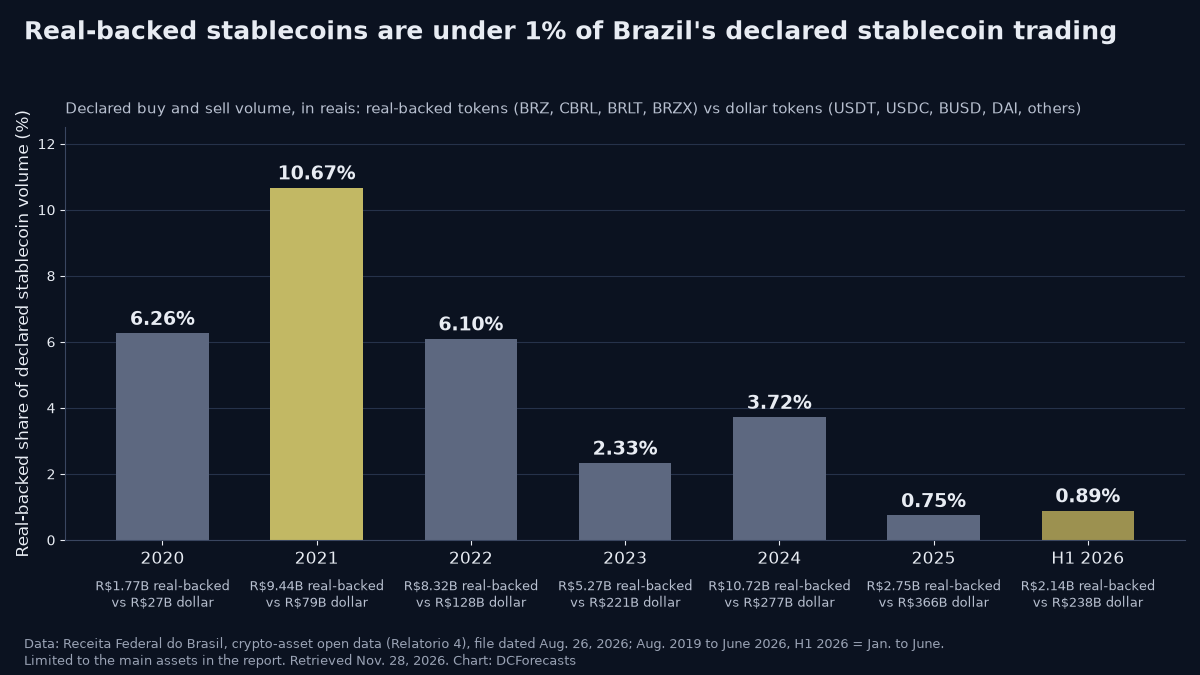
There’s a small signal of life. BRZ recorded R$2.14 billion within the first half of 2026, already 78% of its full-year 2025 complete, lifting the real-backed share to 0.89%.
The file covers solely the primary belongings declared to the tax authority, so newer actual tokens could not seem in it.
The place Bitcoin Suits in Brazil’s Declared Buying and selling
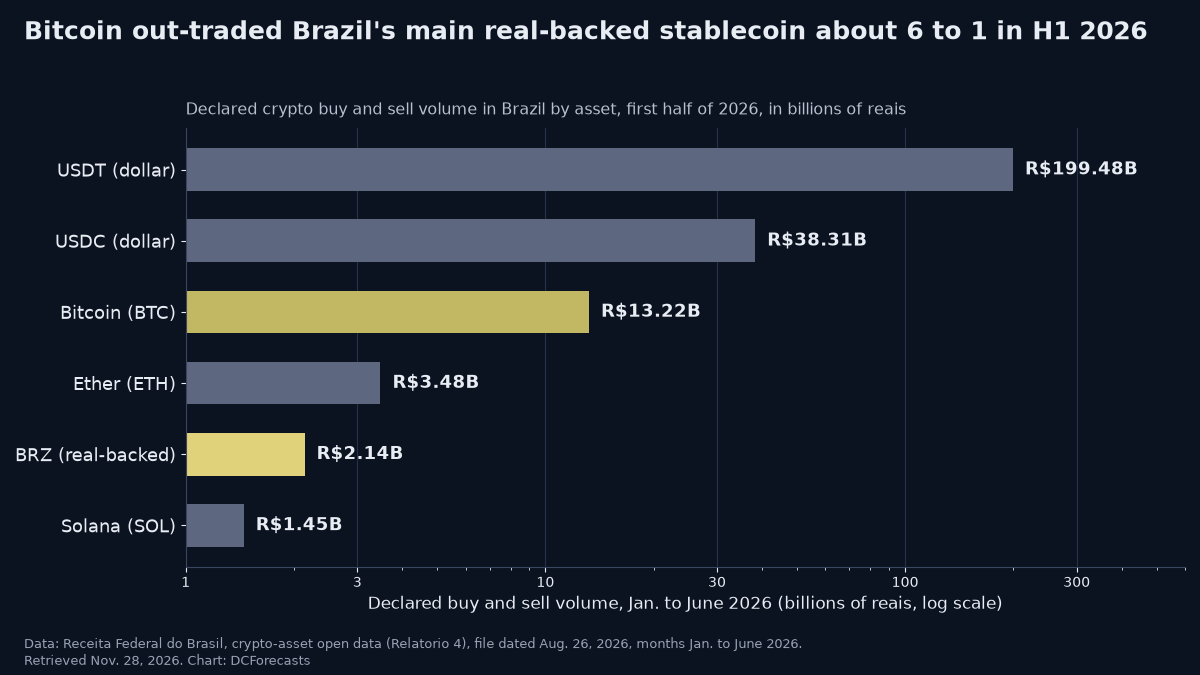
Bitcoin stays the biggest asset within the file outdoors stablecoins.
Declared Bitcoin quantity reached R$48.17 billion in 2025, forward of Ether at R$16.91 billion and Solana at R$8.15 billion.
Within the first half of 2026, Bitcoin logged R$13.22 billion, about six occasions BRZ’s R$2.14 billion.
Stablecoins are sometimes step one for Brazilians shifting between reais and crypto.
We consider a regulated, real-denominated token that works throughout main banks might make that step less complicated and cheaper over time, which might help demand for Bitcoin as effectively.
That’s our interpretation, not a declare made by B3 or its companions.
Reporting guidelines are tightening on the identical time. Since July 2026, transactions have been reported underneath DeCripto, which Receita Federal says aligns Brazil with the OECD’s Crypto-Asset Reporting Framework and likewise covers overseas suppliers that focus on Brazilian clients.
What We Will Watch Earlier than Open BRL Goes Reside
First, governance. B3 says the primary section will settle working guidelines and governance among the many companions, and it describes the shared base as one thing the broader market might use.
Second, the regulatory sign-off. The discharge refers to relevant approvals, and the central financial institution remains to be processing an extended queue of crypto licence requests, as we coated in our take a look at Brazil’s crypto license queue.
Third, use circumstances. Interbank transfers and settlement of tokenized belongings are the apparent beginning factors.
Retail funds could be a a lot tougher check in opposition to USDT and Brazil’s instantaneous fee system, Pix.
For us, the important thing takeaway is that Brazil’s monetary core is shifting onto shared blockchain rails with the regulator in view.
That sort of institutional plumbing has traditionally widened entry to digital belongings, and Bitcoin, with its mounted provide and rising adoption, stands to profit as these rails mature.
The approaching months ought to present whether or not Open BRL can flip a 0.89% share into one thing a lot bigger.
DC Forecasts is a frontrunner in lots of crypto information classes, striving for the best journalistic requirements and abiding by a strict set of editorial insurance policies. In case you are to supply your experience or contribute to our information web site, be at liberty to contact us at [email protected]

