

AI brokers in CRM now not cease at solutions. They append firmographics, merge duplicates, replace lead scores, assign house owners and draft the subsequent step on a deal, usually earlier than anybody on the staff opens the file. That’s what folks imply by agentic CRM: a system the place brokers learn, determine and write, as a substitute of ready for a rep to click on.
I have been on the constructing facet of this. At Frequent Room, I helped re-architect our personal occasion and construct the outbound engine with AI brokers as its mind. The toughest query was by no means whether or not an agent may make a change. It was whether or not it ought to. AI can replace a contact file sooner than any human. What issues is what occurs when it will get it incorrect.
So the query for RevOps groups utilizing AI is now not whether or not to make use of AI brokers for CRM work. It’s which writes an agent will get to make by itself, which of them wait in a evaluation queue, and which of them solely a human can commit. The reply is definitely fairly easy: tier each CRM motion by what a incorrect write prices you. Automate the place unhealthy knowledge prices time. Preserve folks in cost the place it prices cash.
What modifications when AI brokers write to your CRM
For many of its life, the CRM was a file that people saved updated. I put it plainly on Income Architects, the GTM.AI podcast I host with my ZoomInfo colleague John Lloyd: “CRMs have been designed because the static system of file for people to replace.”
Autonomous CRM work flips that mannequin. Brokers now sit on the write path, and the CRM turns into the place the place their selections land.
Most enterprise groups are already there. For the podcast, John and I interviewed about 50 senior GTM leaders at US firms with 1,000+ staff, and roughly 60% have their CRM related to AI workflows. The identical leaders flagged the issue beneath: 72% say the best way knowledge flows between their instruments and the CRM wants fixing, and 50% say the static nature of CRM data holds them again.
Belief is the opposite half. In the identical interviews, 50% of leaders stated AI outputs cannot be trusted with out heavy human evaluation, and 40% stated their AI instruments work with incomplete or inaccurate knowledge. When the fields an agent reads are empty or stale, each write wants checking, which is why so many groups discover their CRM knowledge is not AI-ready as soon as CRM AI brokers begin writing. The repair is to not evaluation every little thing or nothing. It’s to determine, motion by motion, the place evaluation earns its price.
Tier CRM autonomy by the price of a incorrect write
My recommendation is to not gate all AI. Kind CRM actions by two questions as a substitute: can a incorrect write be fastened cheaply, and the way far does it journey earlier than somebody notices?
A incorrect business worth on an account is annoying, however the subsequent enrichment move overwrites it and nothing downstream is dedicated. Now take into consideration a incorrect alternative stage. It strikes the forecast and may change a rep’s comp. It additionally shifts pipeline protection and may attain management reporting earlier than anybody traces it again. Similar agent, identical pace, very totally different blast radius.
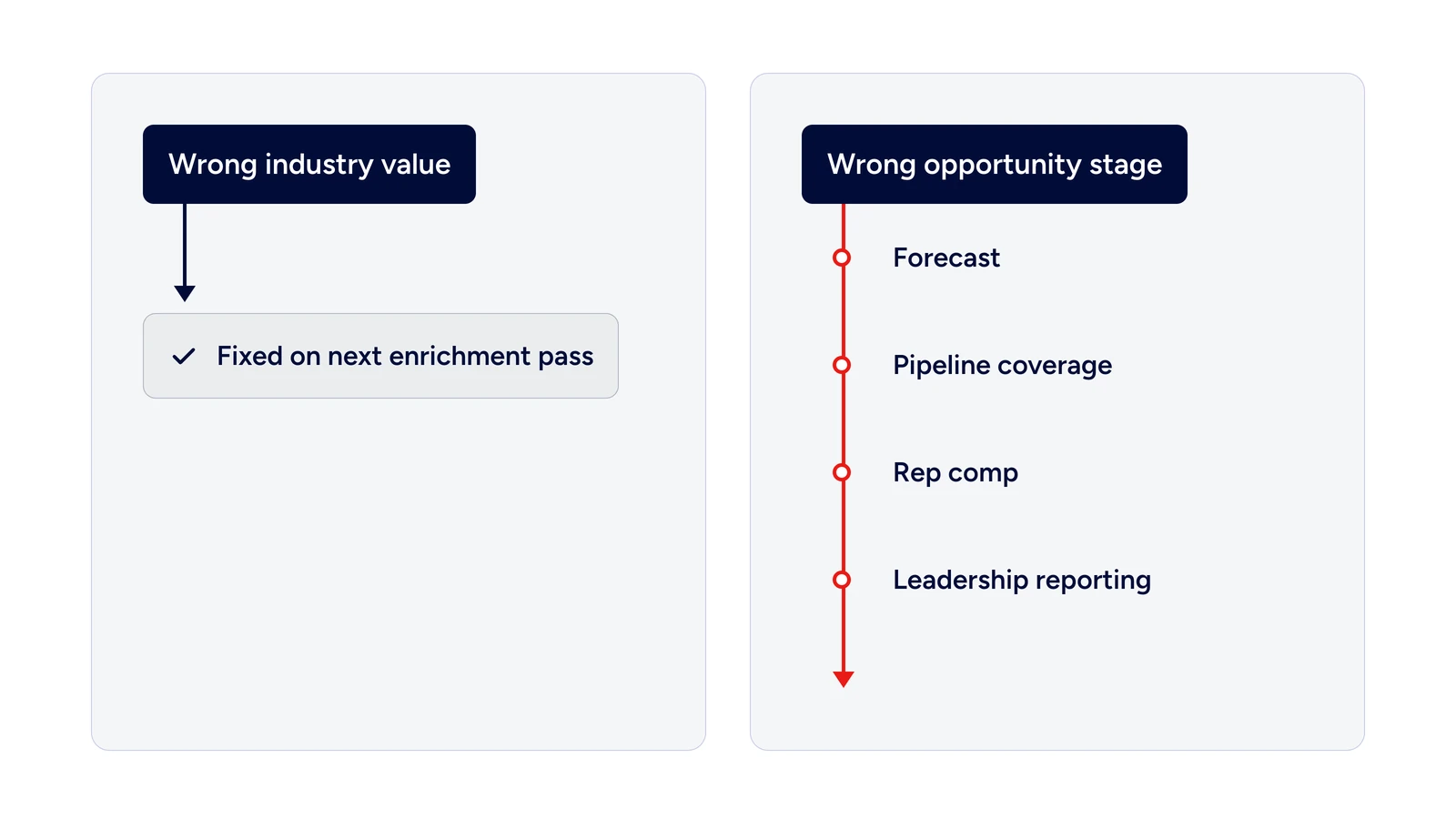
Similar agent, identical pace, very totally different blast radius.
That offers you three tiers for AI brokers in CRM:
-
Totally automate. Enrichment and knowledge validation, the place errors are recoverable and solely price time.
-
Automate with a evaluation queue. Account scoring, lead-to-account matching and lead routing, the place most data are routine however edge circumstances want an individual.
-
Human decides. Stage modifications, alternative creation and anything that strikes a income quantity.
The CRM autonomy matrix: which actions go during which tier
Use this matrix as a beginning task for each write an agent could make. The “management” column is what makes the tier secure, not an non-obligatory additional.
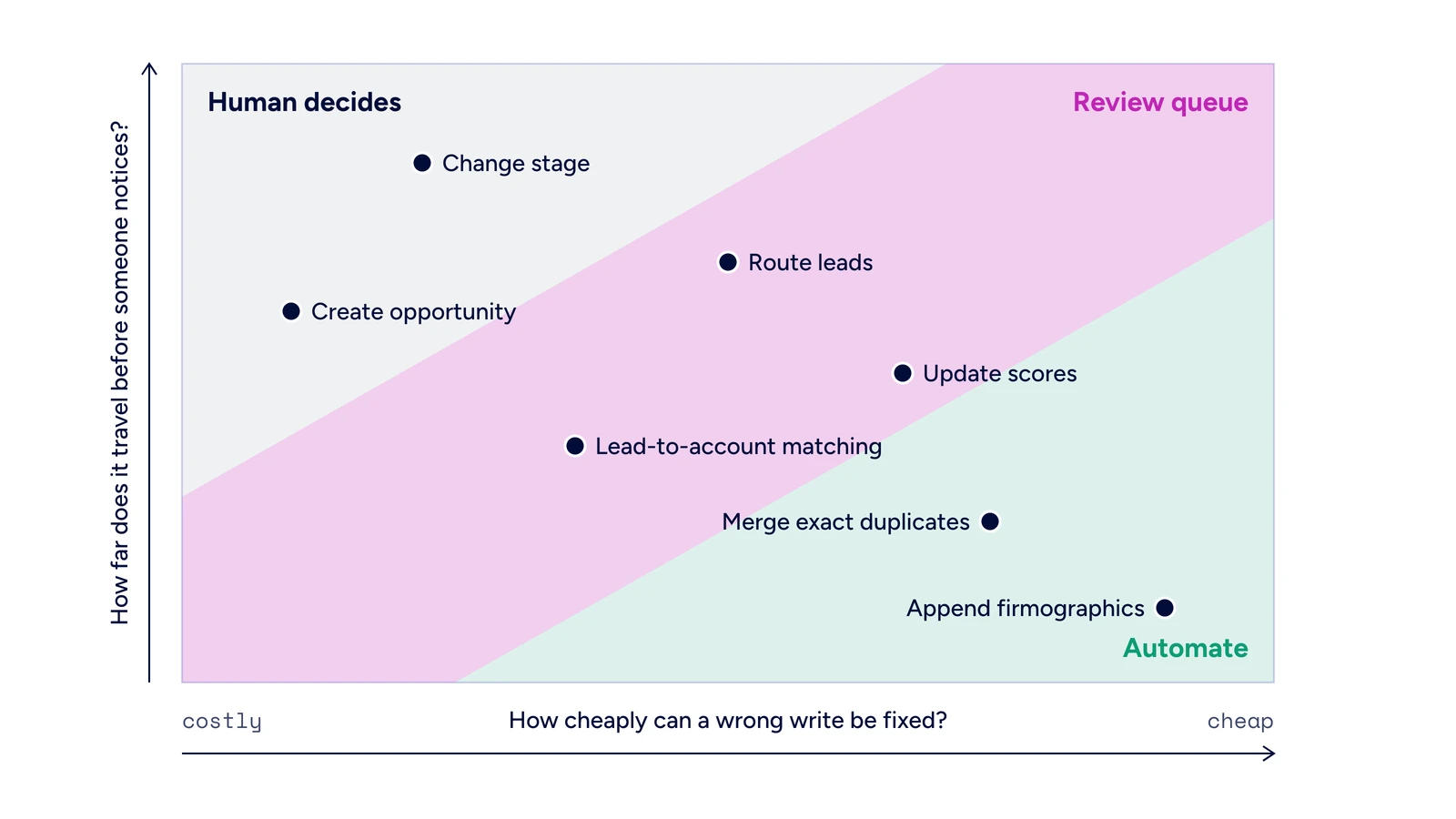
The CRM autonomy matrix: tier every write by how cheaply a mistake might be fastened and the way far it travels.
|
CRM motion |
Tier |
Why |
Management that makes it secure |
|---|---|---|---|
|
Append lacking firmographics (business, worker depend, HQ) |
1: Totally automate |
Recoverable on the subsequent move; no income quantity strikes |
Fill empty fields solely; stamp supply and timestamp |
|
Validate and standardize e-mail, cellphone and deal with fields |
1: Totally automate |
Formatting and verification are deterministic |
By no means overwrite a rep-entered worth with no verified substitute |
|
Flag job modifications and bounced contacts |
1: Totally automate |
A flag is reversible and informs people |
Flag, do not delete; maintain the previous file |
|
Merge exact-match duplicates |
1: Totally automate |
Guidelines are clear and testable |
Surviving-record guidelines; protect alternatives and opt-outs |
|
Merge fuzzy or ambiguous duplicates |
2: Evaluate queue |
Two data might be legitimately separate |
Queue something under a match-confidence threshold |
|
Lead-to-account matching |
2: Evaluate queue |
Most matches are clear; private emails and subsidiaries are usually not |
Auto-match excessive confidence; queue free-mail and conflicts |
|
Replace lead and account scores |
2: Evaluate queue |
Scores drive routing and territory selections |
Log inputs; queue massive swings on named accounts |
|
Route leads and assign house owners |
2: Evaluate queue |
Velocity issues, however conflicts price relationships |
Auto-route by default; queue proprietor conflicts |
|
Reassign territory or account proprietor |
3: Human decides |
Adjustments who will get paid and who calls the client |
Agent proposes with proof; supervisor approves |
|
Create a possibility |
3: Human decides |
Provides to pipeline and forecast |
Agent drafts; rep confirms |
|
Change alternative stage or shut date |
3: Human decides |
Strikes the forecast and protection math |
Agent recommends with proof; proprietor commits |
|
Change quantity or mark closed-won or closed-lost |
3: Human decides |
Hits income reporting and comp instantly |
Human solely; agent can remind |
Deal with the tiers as a default, not a verdict. A CRM AI agent that proves itself on a Tier 2 motion for 1 / 4 can earn Tier 1 for the routine slice of that motion, and a Tier 1 write that retains getting rolled again ought to drop a tier.
Tier 1: let brokers enrich and validate with out evaluation
Enrichment and AI knowledge validation are the most secure locations to take people out of the loop. The errors are recoverable, the subsequent move corrects them, and no income determine relies on a single write. It is usually the place plenty of handbook ops time goes. Keying in worker counts, fixing cellphone codecs and chasing bounced emails (e-mail enrichment handles most of that) is often the primary work groups need off their plate, and it’s the pure place to automate CRM knowledge entry with AI.
Full automation nonetheless wants guidelines. The secure model of AI CRM knowledge enrichment seems like this:
-
Fill, do not overwrite: an agent can fill an empty discipline, nevertheless it mustn’t exchange a worth a rep entered or a verified worth with a lower-confidence guess.
-
Stamp each write: file the supply and timestamp so any change might be traced and rolled again.
-
Use surviving-record guidelines for merges: determine upfront which worth wins and which associated data should be preserved.
-
Escalate ambiguity: our information to knowledge deduplication recommends human evaluation checkpoints for ambiguous merges, plus enriching earlier than routing, to stop the most typical failure modes. Ambiguous merges belong in Tier 2.
The catch is that “full” and “right” aren’t the identical factor. We just lately examined this: identical AI agent, identical immediate, 5 totally different knowledge sources for contact enrichment, 450 runs. Specialist knowledge instruments returned a verified work e-mail 94% of the time. Net search returned one 22% of the time. Each confirmed up as a “full” file. The total methodology behind our agent benchmarks is in GTM Bench.
Brokers additionally must be advised what to not invent. John, Supervisor of Go-to-Market Consulting at ZoomInfo, has seen brokers fill gaps on their very own, as he defined on the podcast: if 4 of 5 accounts have product utilization knowledge, the agent might make up the fifth. His recommendation is to instruct brokers explicitly to “not deal with a null worth as a possibility to fill a clean.”
The payoff is actual when the supply is verified, which is the very first thing to test once you examine knowledge enrichment instruments. Sendoso makes use of CRM Enrichment to auto-enrich and dedupe data coming in by Marketo kinds and listing imports, so solely clear data attain sellers. Sendoso saved 1,100+ hours of handbook knowledge enrichment and noticed not less than a 70% discount in inaccurate knowledge.

“Since implementing ZoomInfo, now we have instantly elevated entry to our ICP by 10%. This has given us over $4.9M in pipeline alone up to now two quarters.”
Generated$4.9Min pipeline in two quarters after cleaning and enriching CRM knowledge with ZoomInfo Operations
When Kaseya wanted to wash up after six acquisitions, Kaseya deduped its database over one weekend with field-level management over surviving values, preserving associated alternatives, subscriptions and opt-outs. That’s AI CRM automation with the guardrails written down first.
For the mechanics of batch versus real-time enrichment and waterfall sequencing, see this information to CRM knowledge enrichment and this explainer on waterfall enrichment.
Tier 2: automate scoring and routing, queue the sting circumstances
Scoring and routing sit within the center as a result of pace issues and most data are routine. Holding each inbound lead for human evaluation would throw away the principle good thing about AI lead routing. Momentive minimize lead follow-up from 20 minutes to beneath 60 seconds after consolidating a number of knowledge distributors onto ZoomInfo Operations, which now runs matching, enrichment, scoring and routing by one system.

“Due to ZoomInfo, we now not need to query the supply or reliability of the info in our programs.”
Minimize60 seclead follow-up time, down from 20 minutes, with ZoomInfo Operations
Scores written again to the CRM carry weight too. Snowflake’s propensity scores movement into the CRM for territory planning and account distribution, and top-tier accounts present 90% greater alternative open charges. The identical applies to AI lead scoring on the advertising facet, lined in depth on this information to predictive lead scoring. When a rating decides who will get a territory, a foul rating is just not a formatting error.
So automate by default and route exceptions to a queue. Our steering on linking intent knowledge to CRM data follows the identical logic: high-confidence matches can auto-create data, whereas ambiguous alerts go to a handbook evaluation queue the place a false optimistic would waste rep time. Good queue triggers embrace:
-
Low match confidence on lead-to-account matching
-
A lead submitted with a private e-mail area, which ought to skip area matching and fall to evaluation or fallback guidelines, as lined on this roundup of lead matching and routing instruments
-
A battle with an current proprietor or a named strategic account
-
A rating change on a strategic account that crosses a routing threshold
-
A potential duplicate the merge guidelines cannot resolve
Mallory Lee, VP of Income Operations at Zipline, described the place these workflows actually break when she joined John on Income Architects: “Normally in my expertise when a workflow fails, it’s as a result of there’s an edge case that we’ve not constructed for.” Her instance is a purchaser who indicators up for content material with a private e-mail whereas the CRM holds their work e-mail. The queue exists for precisely these data. The remainder of your lead routing ought to run with out anybody watching.
Tier 3: maintain people deciding stage modifications and alternatives
Some writes ought to by no means commit with no individual, regardless of how good the agent is. Alternative creation, stage modifications, shut dates, quantities and closed-won or closed-lost standing feed the forecast, pipeline protection and comp. A incorrect write right here is just not caught by the subsequent enrichment move. It will get reported upward.
That is the place AI pipeline administration ought to imply higher suggestions, not silent modifications. Brendan Powers, Principal GTM Operations and Engineering Supervisor at ZoomInfo, described Salesforce’s function at ZoomInfo this manner on Income Architects: “it is nonetheless the supply of reality in relation to who owns what account and who has open alternatives and what statuses they’re in.” Something that modifications these information deserves human oversight of AI.
In Tier 3, the agent does the prep and the human makes the decision:
-
The agent detects a sign, comparable to a purchaser confirming funds on a name picked up by dialog intelligence.
-
It drafts the change, for instance shifting the chance to the subsequent stage, and attaches the proof: the decision second, the sign and the timestamp.
-
The chance proprietor approves, edits or rejects it in a single step.
Mallory Lee, whose staff at Zipline runs a thought of enterprise sale the place a slip-up with an enormous model is pricey, retains an individual within the loop even earlier than outreach goes out, which is a lower-stakes write than a stage change: “I nonetheless simply want that human within the loop or I would not be capable to sleep at evening.”
Human within the loop AI with out the rubber stamp
Human within the loop AI fails in a predictable approach. If each write lands in a queue, reviewers cease studying and begin clicking approve. You retain the price of evaluation and lose the safety. John sees the identical fatigue on the rep facet, as he stated on the podcast: “They’re exhausted by AI that is nearly proper.” He additionally named the associated fee: “The evaluation cycles get longer and longer and that simply pushes your effectivity out.”
A queue that works is small and quick, and each merchandise exhibits the reviewer:
-
The proposed change: the previous worth subsequent to the brand new worth.
-
The proof: the supply, timestamp and sign behind the change.
-
The explanation code: why this file was queued as a substitute of auto-committed.
-
One-click actions: approve, edit or reject, with the choice logged.
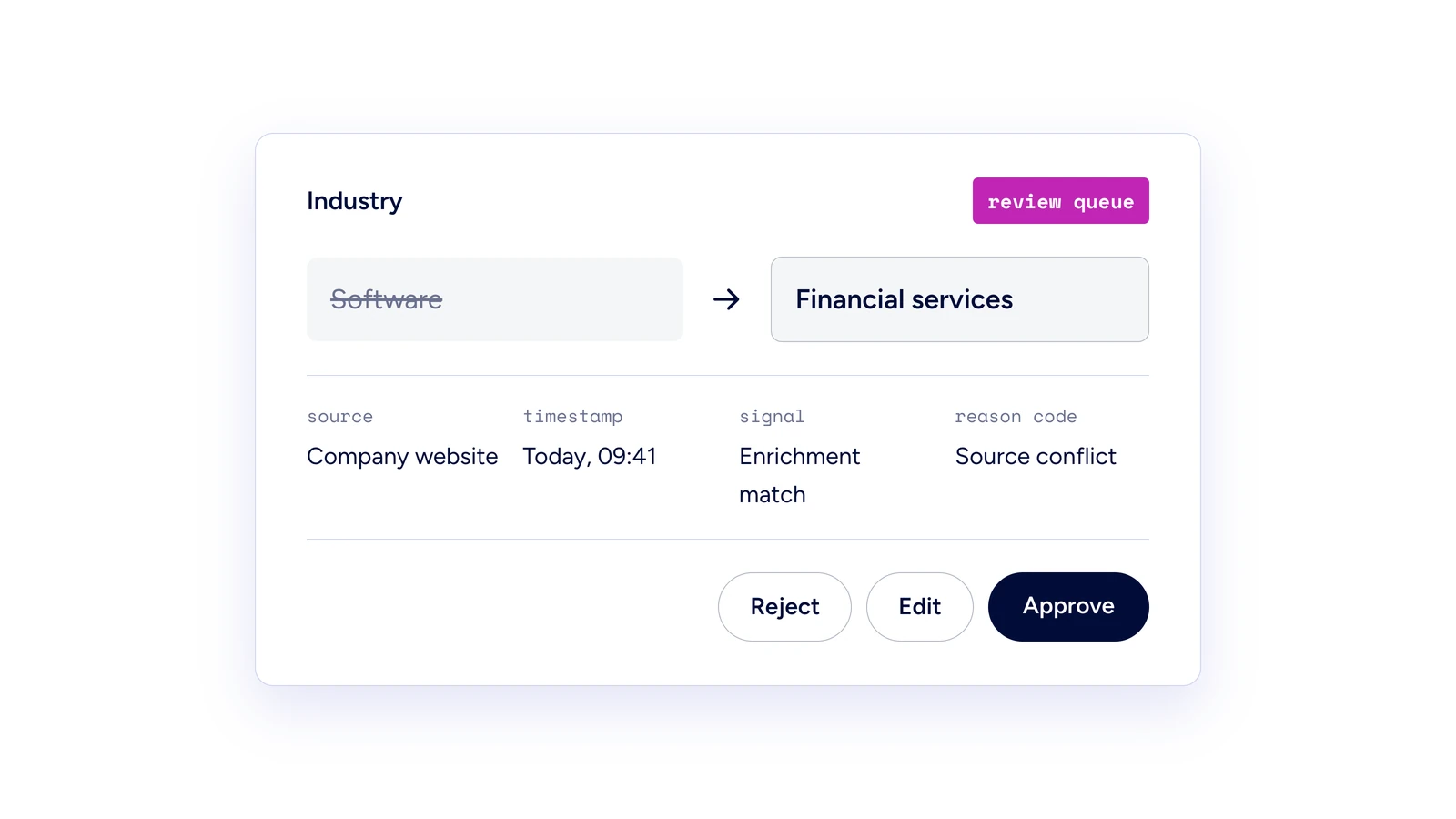
What a helpful evaluation queue merchandise exhibits: the change, the proof, the rationale it was queued, and one-click actions.
Protecting the queue small begins earlier than evaluation, in how the agent is constructed. Brendan Powers, who builds the brokers that run autonomously throughout ZoomInfo’s go-to-market course of, says of their prompts: “I’ve deliberately written and reviewed each sentence that is in there.” His rule is to make as a lot of the agent deterministic as potential, handing it knowledge as a substitute of asking it to determine, so when a write goes incorrect you possibly can inform whether or not the info or the immediate failed. Grounding brokers in verified knowledge for AI brokers does the identical job from the opposite facet.
Then deal with the AI agent approval workflow as a suggestions loop: observe how usually reviewers override every motion kind, transfer hardly ever overridden actions up a tier, and provides incessantly corrected ones higher knowledge or a decrease tier. The caveat: if the evaluation queue turns into a bottleneck, the tiering is incorrect, not the reviewers.
AI agent guardrails and permissions that make the tiers stick
A tier is barely actual if the system enforces it. That’s what AI agent governance means on the CRM stage: deciding which writes every agent is allowed to make, who owns the outcome and the way you undo it. 5 AI agent guardrails do a lot of the work:
-
Discipline-level write scopes: give every agent AI agent permissions for the precise objects and fields its tier permits, and nothing else.
-
A named proprietor and a backup: Mollie Bodensteiner, VP of Income Operations at ZoomInfo, argued on Income Architects that possession of an agent is “not a division.” It’s a individual, with a backup who can repair it when that individual is out.
-
An audit path: log the set off, the info the agent learn and the change it made, so a foul file might be traced to its supply.
-
A rollback path: each Tier 1 and Tier 2 write must be reversible in bulk.
-
Change management on fields: Mollie’s instance of a failure no one catches is an admin repurposing a discipline an agent relies on, so the output quietly turns to gibberish. Schema modifications have to notify agent house owners.
These AI guardrails are supposed to widen what brokers can do, not gradual groups down. Brendan Powers put it this manner when speaking about totally automated processes: “it is not about slowing down momentum or gatekeeping, it is about making certain exploration and innovation resulting in income driving use of AI can happen with out knowledge leakages or propagation of inaccurate knowledge.”
Good CRM governance additionally means asking what ought to land within the CRM in any respect. Mallory Lee’s Salesforce admin acts because the governor of what goes out and in, and Mallory retains asking the identical query: “I’m nonetheless always asking myself, what must get written again to the CRM?” For the fleet-level view of possession, visibility and blast radius after you have many brokers, see this information to governing brokers at scale.
The right way to roll out tiered autonomy in 5 steps
You do not want a brand new platform to start out. You want a list and some guidelines.
-
Stock each write. Listing every object and discipline any agent can change at the moment, together with brokers in your CRM, your gross sales engagement platform and any custom-built agent. Your current knowledge governance framework is the pure dwelling for this listing.
-
Assign a tier to every write. Use the matrix above because the default and doc any exceptions.
-
Set queue triggers and an approval SLA. Outline the boldness thresholds and battle guidelines that ship a file to evaluation, and how briskly reviewers should act.
-
Activate logging and identify house owners. Each agent will get an proprietor, a backup and an audit path earlier than it will get write entry.
-
Evaluate the numbers month-to-month. Have a look at override charges, rollbacks and queue age by motion kind, then promote or demote writes.
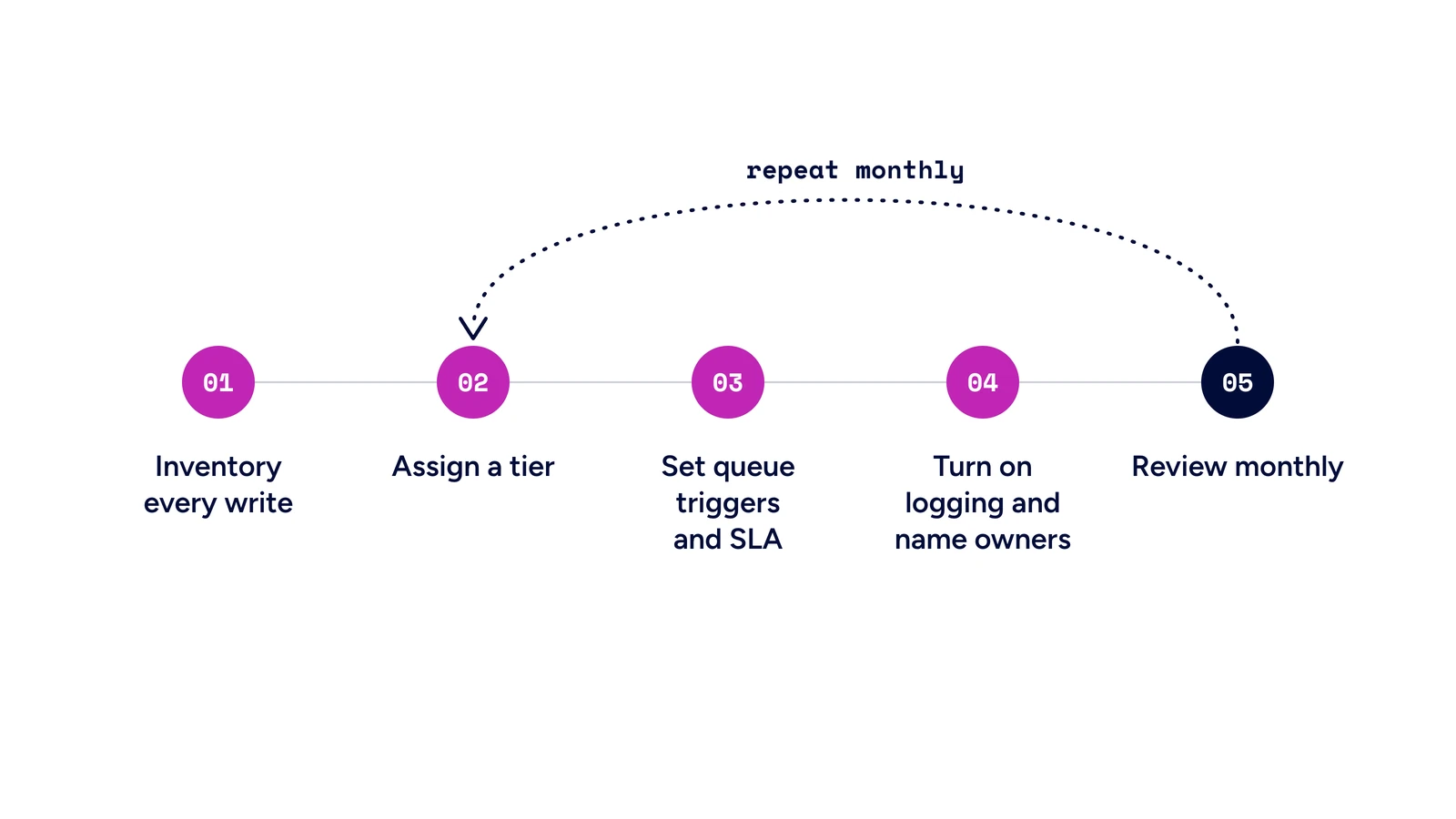
5 steps to roll out tiered autonomy, with a month-to-month evaluation loop.
The strain is pace versus security, and tiering is the way you get each: begin with a couple of Tier 1 writes you possibly can measure, and increase as soon as the logs present the agent is true.
The place Agent Groups suits with native CRM brokers
Many groups already run AI brokers for CRM work contained in the CRM itself. Native brokers inherit the CRM’s permission mannequin and audit log, which solutions who can write.
The layer beneath solutions whether or not a write is secure: is that this the best individual and account, is the context present, and can the outcome land cleanly again within the CRM? That is the job of a ruled execution layer, and it really works alongside the brokers you already run in Salesforce or HubSpot. This comparability of AI CRM instruments covers the platform choices.
Salesforce Agentforce
Salesforce positions Agentforce as “the agentic AI platform constructed into the world’s #1 CRM.”
It runs autonomous AI brokers inside Salesforce CRM, and Agent Builder lets groups create {custom} brokers for their very own workflows. Its energy is native Salesforce context and permissions. Agentforce brokers motive over Salesforce knowledge, and companions carry within the outdoors alerts that assist determine whether or not a write is secure, comparable to verified firmographics, intent and dialog historical past.
ZoomInfo is a kind of companions: the Agentforce Prospecting Agent runs on ZoomInfo knowledge, drafts first-pass outreach with every sign cited to its supply, and leaves the rep to evaluation, edit and ship.
HubSpot Breeze
HubSpot Breeze is HubSpot’s AI layer, with AI brokers for prospecting, content material and repair workflows. Breeze Assistant, which HubSpot’s Fall 2026 launch places accountable for coordinating its different brokers, is in public beta.
Its energy is that brokers have full HubSpot CRM context contained in the platform. ZoomInfo knowledge can be obtainable in Breeze, so these brokers can draw on verified firm and call knowledge alongside HubSpot data.
Agent Groups: the ruled execution layer beneath your CRM brokers
Agent Groups is ZoomInfo’s flagship multi-agent product, inbuilt GTM Studio. It really works alongside the brokers in your CRM because the execution layer beneath them, with three jobs:
-
Identification resolved. Earlier than an agent touches a file, the GTM Context Graph resolves the individual and the account throughout your CRM, ZoomInfo knowledge, conversations and intent. When a previous champion strikes from Uber to DoorDash, the play lands on the best DoorDash account and proprietor, with no duplicate contact.
-
Context verified. A supervisor agent checks every step with real-time evaluations grounded in verified knowledge. Brokers work from sourced data, which is the way you keep away from the null-value drawback John describes in Tier 1.
-
Writes again to Salesforce or HubSpot. Native integrations put each outcome the place your staff already works: up to date contacts, logged exercise and account context in Salesforce or HubSpot, plus a quick for the proprietor in Slack. Playbooks set the objective and bounds of every play, and each set off, choice and motion is logged.
In tier phrases, Agent Groups does most of its work in Tier 1 and Tier 2: enriching, matching and routing, with each step on the audit path. For Tier 3 writes like alternative creation or a stage change, it assembles the proof and briefs the proprietor, who commits the change within the CRM.
Agentforce and Breeze maintain doing what they do greatest inside their CRMs. Agent Groups makes positive the data they learn are resolved and verified, and that performs operating throughout the inbox, Slack and gross sales engagement instruments land again in the identical place.
How ZoomInfo runs ruled brokers on CRM knowledge
ZoomInfo is an all-in-one AI GTM Platform and the primary place for gross sales, advertising and RevOps to run agentic workflows. It is inbuilt three layers: Knowledge, together with the GTM Context Graph, Agent Orchestration, and Common Entry. Every one maps to part of the tiering drawback.
The Knowledge layer is what makes Tier 1 secure to automate. It covers 500M contacts and 100M firms, and the GTM Context Graph connects that knowledge along with your CRM data, conversations and behavioral alerts into one construction processing 1.5B+ knowledge factors each day. Getting all of that resolved onto the identical file is extremely onerous. Good luck attempting to vibe code it. An agent writing firmographics or matching a result in an account works from resolved, sourced data.
Agent Orchestration is the place brokers learn that graph, motive over it, act and write outcomes again. Its governance airplane applies entry management, permissioning, knowledge lineage, AI coverage and audit logging persistently throughout each floor that makes use of it, so the identical guidelines comply with an agent whether or not it runs in ZoomInfo, in Salesforce or in a {custom} construct. That’s the concept behind income motion orchestration. Agent Groups, the flagship product on this layer, runs on the identical governance. Its guardrails cowl monitoring, price controls, admin oversight, entry management, grounding, real-time evaluations and an audit path of each set off, choice and motion.
Common Entry means groups eat all of it the place they already work: GTM Workspace for sellers, GTM Studio for RevOps and GTM engineers constructing performs, and GTM.AI for any instrument or agent by its API, CLI and MCP. Should you’re selecting MCP servers for ops work, see this listing of MCP servers for RevOps. We run the identical sample ourselves: Brendan’s staff triggers most of its manufacturing brokers from Salesforce occasions, comparable to an inbound lead, a accomplished demo or an upcoming renewal. ZoomInfo was additionally named a Visionary within the 2025 Gartner Magic Quadrant for Income Motion Orchestration.
Need to see Agent Groups run ruled performs in your CRM? See it in motion.
Continuously requested questions on AI brokers in CRM
What’s agentic CRM?
Agentic CRM is a CRM the place AI brokers learn data, make selections and write modifications, comparable to up to date fields, scores, house owners and duties, as a substitute of solely suggesting them. The governance query shifts from who can edit a file to which writes an agent might make with no human.
Can AI brokers replace CRM data routinely?
Sure, inside the permissions you grant. Let an AI agent CRM workflow run unsupervised on recoverable writes like CRM knowledge enrichment and validation, ship scoring and routing edge circumstances to a evaluation queue, and maintain stage and alternative modifications for a human.
What does human within the loop AI imply in a CRM?
It means an individual approves, edits or rejects an agent’s proposed write earlier than it commits. It solely works when the queue stays small and every merchandise exhibits the previous worth, the brand new worth, the supply and the rationale it was queued.
What’s AI agent governance?
AI agent governance is the set of possession guidelines, permissions, audit trails and evaluation insurance policies that management what brokers can entry and alter. In a CRM, which means field-level write scopes, a named proprietor and a log of each set off, enter and alter. This information to governing brokers at scale covers the fleet-level view.
Which CRM modifications ought to at all times want human approval?
Any change that strikes a income quantity: alternative creation, stage modifications, quantities, shut dates, closed-won or closed-lost standing, and proprietor reassignment on named accounts. Brokers can draft these modifications with proof, however an individual ought to commit them.
How do you retain CRM knowledge safe when AI brokers entry it?
Give every agent least-privilege write scopes, log each motion, and require the identical permissions for brokers connecting by an MCP server as for native ones. Test vendor certifications too: ZoomInfo maintains SOC 2 controls and is ISO 27001 and ISO 27701 licensed.
Do you want Agent Groups in case you already use Agentforce or HubSpot Breeze?
They do totally different jobs. Agentforce and Breeze brokers work inside their very own CRM. Agent Groups is the ruled execution layer beneath: it resolves id, verifies context and runs performs throughout the CRM, inbox, Slack and gross sales engagement instruments, then writes the outcomes again to Salesforce or HubSpot.

