

An AI agent that books a gathering, updates a report, or triggers a workflow doesn’t simply danger a improper reply. It dangers a improper motion. AI agent observability, generally referred to as agentic AI observability, is the apply of monitoring what an agent really did, step-by-step, so a foul final result is a traceable bug as an alternative of a thriller. This information covers what agent observability means, the way it differs from LLM observability, the tracing requirements behind it, and why the platform the place your brokers already run is usually the quickest place to get it.
For a broader overview of AI observability throughout LLMs, brokers, and utilization governance, see What Is AI Observability? A Sensible Information.
Key Takeaways
- AI agent observability tracks an agent’s execution path, not simply its last output: which instruments it referred to as, what knowledge it retrieved, and what number of steps it took.
- Brokers fail in another way from single-call LLM purposes as a result of they chain a number of selections collectively, so one improper step compounds right into a improper motion.
- OpenTelemetry’s rising GenAI Semantic Conventions present a vendor-neutral basis for tracing mannequin calls, brokers, device use, retrieval, and different GenAI operations, whereas extra conventions for areas corresponding to reminiscence and agent lifecycle are nonetheless evolving.
- Bolt-on observability instruments usually lack the utilization and workspace context that the platform working the agent already has.
- Begin observability with instrumentation and analysis gates earlier than an agent goes into manufacturing, not after the primary incident.
What Is AI Agent Observability?
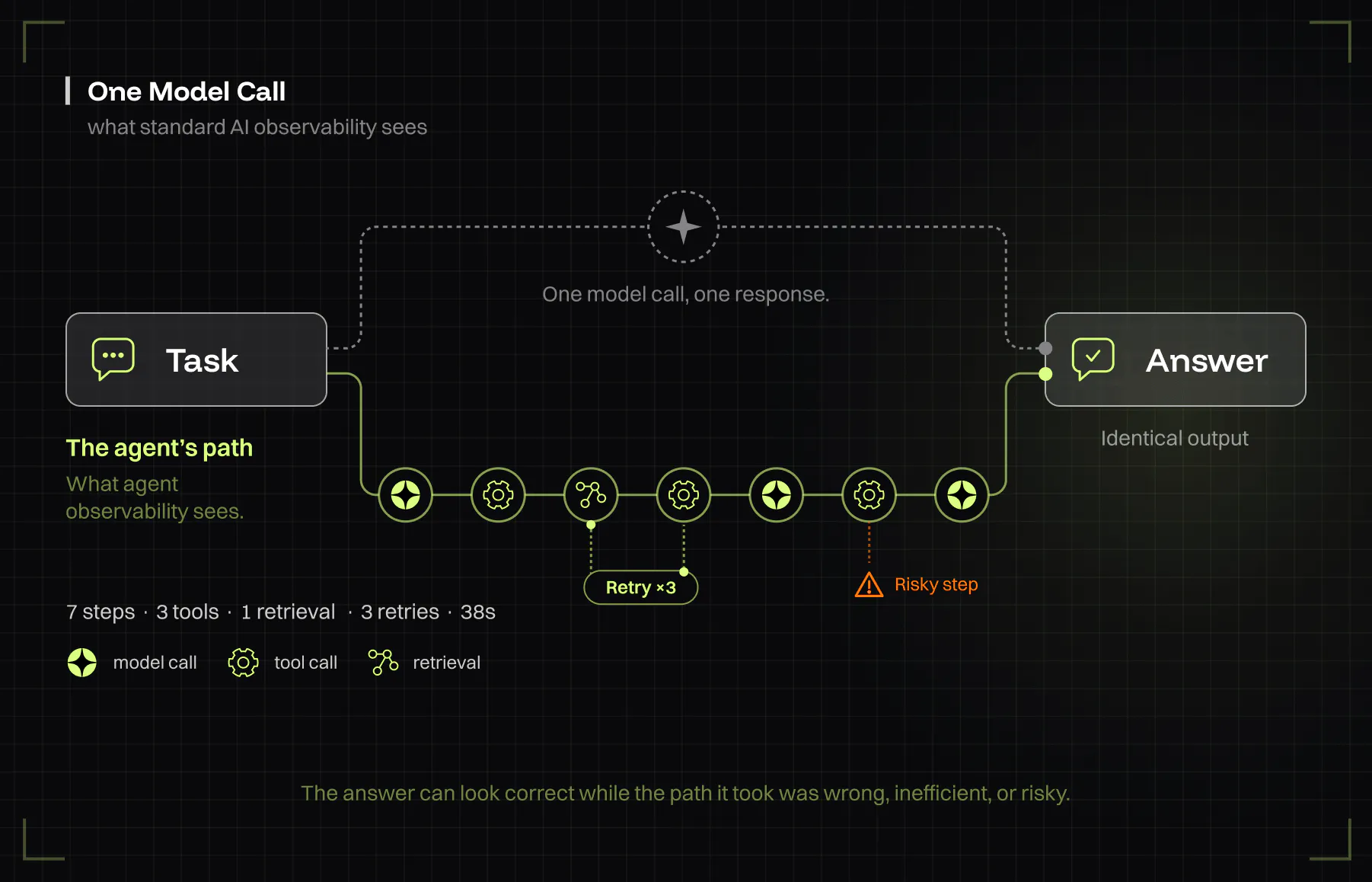
AI agent observability is the power to see what an AI agent did internally whereas finishing a job: which instruments it referred to as, what knowledge it retrieved, the way it reasoned between mannequin calls, retrievals, and gear calls, and what number of iterations it took to achieve an final result. It goes additional than normal AI observability, which may cease at monitoring a single mannequin name, as a result of an agent’s output is the product of a sequence of selections, not one response.
This distinction issues as a result of an agent’s last reply can look right whereas the trail it took to get there was improper, inefficient, or dangerous. A assist agent that finally provides the appropriate refund quantity however acquired there by calling the improper buyer’s report first shouldn’t be successful story; it’s an incident that has not been seen but.
Why Agent Observability Differs from LLM Observability
LLM observability tracks a single name to a language mannequin: the immediate, the completion, token utilization, and latency for that one alternate. Agent observability tracks every little thing round that decision: which device the agent determined to make use of, what it retrieved earlier than producing a response, whether or not it looped again to attempt once more, and the way the items chain collectively right into a last motion.
The sensible distinction reveals up in debugging. If a single LLM name returns a improper reply, the issue might lie within the immediate, retrieved context, mannequin configuration, or utility logic. If an agent takes a improper motion after 5 steps, the repair might dwell in any a type of 5 steps, and with out a hint of every one, a workforce is lowered to reproducing the failure by hand and guessing the place it went improper.
Brokers additionally introduce failure modes LLM calls alone should not have: looping on the identical device with out making progress, deciding on the improper device for a job, or shedding observe of context throughout an extended chain of steps. None of those present up in a model-level hint that solely captures the ultimate enter and output.
A working agent observability apply rests on three technical constructing blocks that map onto how brokers really execute duties. These map onto the broader traces-evaluations-metrics framework used throughout AI observability typically: traces report what occurred, evaluations rating whether or not it was good, and metrics combination each into developments a workforce can watch over time. For brokers particularly, tracing carries a lot of the weight, since a single improper step can compound right into a improper motion.
Tracing the Full Determination Path
A helpful agent hint usually comprises a number of associated spans representing mannequin invocations, device calls, retrievals, and orchestration steps within the order they occurred. This lets a workforce reconstruct precisely what the agent did, not simply what it will definitely returned. OpenTelemetry’s GenAI Semantic Conventions already outline standardized attributes for GenAI operations, whereas extra agent- and workflow-specific conventions proceed to evolve throughout OpenTelemetry and the broader observability group.
Device Calls as First-Class Occasions
Each time an agent calls a device, whether or not it’s a database question, an API name, or one other agent, that decision is a discrete occasion price tracing by itself: what was referred to as, what arguments have been handed, what got here again, and the way lengthy it took. Rising GenAI conventions more and more deal with device execution as a first-class observable operation, together with the device invoked, related arguments and outcomes, period, and errors. With out this stage of element, a failed job reveals solely that one thing went improper, not which device name prompted it.
Multi-Step Reasoning and Reminiscence
Brokers that plan throughout a number of steps, or that draw on reminiscence from earlier in a dialog, want their state tracked because it modifications, not simply at first and finish of a job. Group proposals are additionally exploring conventions for observing reminiscence operations and agent lifecycle state, however these areas are much less mature than core mannequin and tool-call telemetry. That is what makes it attainable to reply “at which step did the agent’s reasoning go improper,” relatively than solely “did the agent get the appropriate reply.”
Uncover how GoodData.AI helps you construct, govern, and scale analytics, AI, and brokers from one platform.
Why Bolt-On Observability Instruments Miss Context Your Analytics Platform Already Has
Most AI agent observability instruments are constructed to instrument an agent from the surface: add an SDK, route traces to a brand new backend, and think about them in a brand new dashboard. That works, but it surely begins from zero. It doesn’t mechanically have application-specific context such because the consumer’s workspace, permissions, semantic mannequin, or tenant except that context is explicitly instrumented and handed into the observability system.
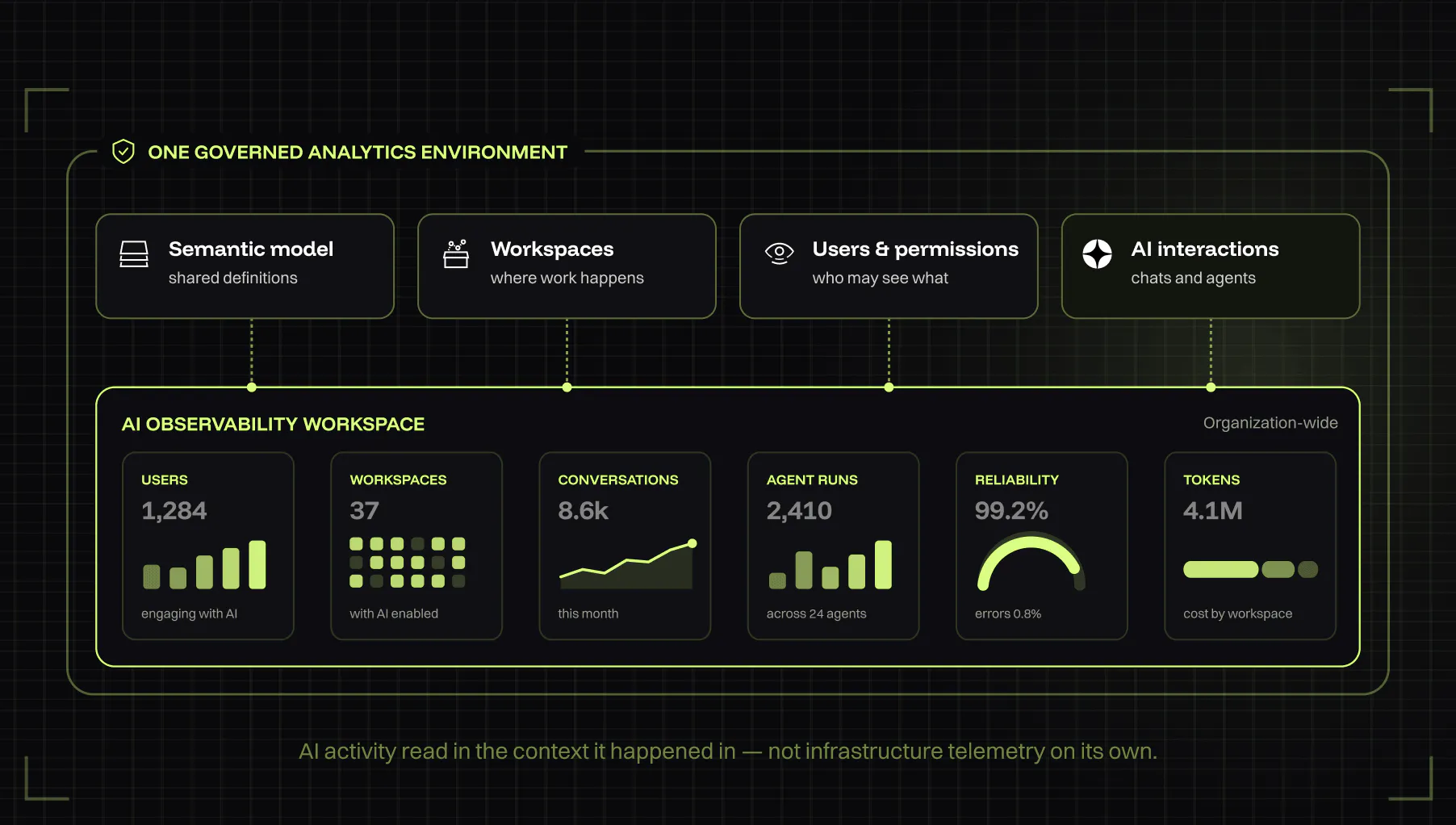
An analytics platform that runs the agent is usually a lot nearer to that context as a result of it already manages ideas corresponding to customers, workspaces, permissions, and the semantic mannequin. Including observability at that layer means a hint doesn’t simply present what a device name returned; it reveals what that decision meant within the context of the workspace’s knowledge and the consumer’s function.
That is additionally a sensible argument, not simply an architectural one: each extra device provides authentication, knowledge replication, and a dashboard to examine. For a full breakdown of what that provides as much as and when it’s price paying anyway, see AI Observability Instruments: Do You Want a Separate One?. For a workforce already working brokers inside an analytics platform, the quickest path to agent observability is normally checking what that platform already surfaces earlier than including a brand new one.
This doesn’t imply a devoted observability device isn’t the appropriate name. Groups constructing customized brokers fully exterior any current platform, with no system already holding utilization or workspace context, are precisely the case the place a devoted device earns its place. The choice level is whether or not that context already exists someplace your agent runs.
AI Agent Observability Greatest Practices
Instrumenting an agent nicely from the beginning is way cheaper than retrofitting it after a manufacturing incident. These practices cowl the sequence most groups comply with.
Instrument earlier than launch, not after the primary incident. Wire up tracing utilizing a regular like OpenTelemetry GenAI Semantic Conventions earlier than an agent goes into manufacturing, so the primary failure comes with a hint as an alternative of a assist ticket and a guess.
Hint each device name, not simply the ultimate output. A hint that solely captures the agent’s final message hides precisely the knowledge wanted to debug a improper motion: which device was referred to as, in what order, and with what end result.
Set analysis gates earlier than scaling utilization. Automated analysis scores or human assessment on a pattern of interactions catch high quality regressions earlier than they attain each consumer, relatively than after sufficient complaints accumulate to note a sample.
Deal with prompts, responses, device arguments, retrieved content material, and agent reminiscence as doubtlessly delicate telemetry. Seize them solely when wanted, apply applicable redaction and entry controls, and keep away from indiscriminately indexing massive uncooked payloads.
Alert on habits anomalies, not simply errors. An agent that loops on the identical device name 5 occasions, or that all of a sudden takes twice as many steps to finish a routine job, has not thrown an error, however it’s a sign price catching earlier than it turns into one.
Observe value and iteration depend per agent, not simply in combination. A single misbehaving agent can quietly dominate token spend or iteration depend; per-agent breakdowns catch this lengthy earlier than it reveals up as a shock on the month-to-month invoice.
How GoodData.AI Approaches This At the moment
GoodData.AI treats observability as a part of the identical platform that runs analytics, knowledge apps, assistants, and brokers collectively, not a separate system to configure and preserve. As a result of all of them share the identical semantic mannequin and governance layer, debugging a failed agent job surfaces who was affected, what knowledge was concerned, and the way that ties again to the remainder of the group’s analytics, not simply what one device name returned. Reliability points, token consumption, and inconsistent agent habits present up alongside the reporting groups already use, managed as a part of the platform relatively than a separate stack to run.
The place to Go From Right here
Agent observability is not only LLM observability with extra steps. It requires tracing the complete determination path, treating each device name as a traceable occasion, and having sufficient context concerning the workspace and knowledge an agent touched to inform whether or not an motion was proper, not simply whether or not it ran with out an error.
Earlier than including a devoted observability device, examine what your current analytics or agent platform already surfaces. For the broader image, see What Is AI Observability? A Sensible Information; for the way agent utilization ties into governance and price accountability, see AI Governance Begins with Understanding Who’s Utilizing AI and for limiting what an agent can attain earlier than it acts, see AI agent entry management.
In case your workforce is weighing whether or not so as to add a devoted agent observability device, see how GoodData.AI’s agentic analytics platform surfaces AI utilization out of the field, or request a demo to see it in motion.
Uncover how GoodData.AI helps you construct, govern, and scale analytics, AI, and brokers from one platform.
Steadily Requested Questions
LLM observability generally focuses on mannequin interactions corresponding to prompts, responses, tokens, latency, and high quality. Agent observability extends that view throughout the sequence of mannequin calls, retrievals, device calls, and iterations concerned in finishing a job.
Begin with device calls and their outcomes. Understanding which instruments an agent referred to as, in what order, and what each returned normally explains a failure sooner than capturing each attainable execution element.
OpenTelemetry’s GenAI Semantic Conventions are the rising vendor-neutral normal for this, with community-proposed extensions particularly for agent lifecycle, device calls, and reminiscence operations. Utilizing a regular schema avoids locking telemetry into one vendor’s proprietary format.
Not mechanically. In case your brokers already run inside a platform that has utilization, workspace, and knowledge context, examine what that platform surfaces earlier than including a separate device. Devoted instruments take advantage of sense for brokers constructed fully exterior any current platform.
Output is the ultimate reply or motion an agent produces. Habits is every little thing that led to it: which instruments it referred to as, what knowledge it retrieved, and what number of steps or iterations it took. An agent can produce an accurate output by way of an inefficient or dangerous habits path.
An agent taking the improper motion, not simply giving a improper reply. As soon as an agent can replace information or set off workflows, an unobserved failure in its determination path can have penalties past a foul response on a display screen.

