

It has been some time since I revealed my final weblog and YouTube video. Life obtained a bit busy, and to be sincere, discovering sufficient centered time grew to become tougher than I anticipated. However right here I’m, on the final day of 2025.
I do probably not see this weblog as the ultimate publish of 2025. I see it extra as a gap for what’s coming subsequent. In a few hours, we will likely be in 2026. Wanting again, 2025 was a 12 months stuffed with ups and downs. Some superb moments, some unhappy ones too. However all in all, as Brian Could from Queen as soon as stated, “The Present Should Go On”.
So allow us to begin the subsequent 12 months with a subject that has been on my thoughts loads lately. Agentic AI, and the way it can realistically assist us in Microsoft Cloth and Energy BI tasks.
In the event you prefer to take heed to the content material on the go, right here is the AI generated podcast explaining every little thing about this weblog 👇:
Why this subject wants a sequence, not a single weblog #
Earlier than we go into any definitions, I need to clarify why I’m turning this right into a multi-part sequence.
Agentic AI is a broad subject. It touches tooling, course of, security, productiveness, and likewise mindset. Making an attempt to cowl all of this correctly in a single weblog publish would both make it too shallow, or too lengthy and onerous to observe. Neither is helpful.
So I made a decision to interrupt it down right into a sequence:
- This primary weblog is about ideas and terminology
- The following weblog will cowl preliminary setup and instruments
- The next one will concentrate on hands-on Energy BI situations
This primary half deliberately stays away from instruments and demos. The purpose is to construct a strong psychological basis first.
What this sequence is and what it’s not #
Agentic AI is a kind of matters the place expectations can simply go within the incorrect course. So it is very important be very clear.
This sequence is not:
- A narrative about changing engineers, analysts, or architects
- A full AI or machine studying concept course
- A generic immediate checklist with out context
This sequence is:
- About bettering productiveness in actual supply tasks
- About helping individuals, not changing them
- About utilizing AI in a managed and accountable method
- Centered on Microsoft Cloth and Energy BI implementations
If you’re anticipating magic or shortcuts, this sequence might be not for you.
The place Agentic AI matches as we speak within the Microsoft Cloth world #
Earlier than going additional, one essential clarification is required.
On the time of penning this weblog, Agentic AI shouldn’t be accessible within the built-in Copilot experiences in Microsoft Cloth or Energy BI. Copilot as we speak is principally a conversational assistant. It doesn’t plan duties, use exterior instruments freely, or execute multi-step workflows in the best way Agentic AI does.
All the things mentioned on this sequence is about agentic setups, for instance utilizing instruments like VS Code, exterior brokers, and Mannequin Context Protocol servers, which we’ll cowl later within the sequence.
This distinction is essential, in any other case expectations will likely be incorrect from the beginning.
Why Agentic AI is sensible for knowledge and analytics work #
Now allow us to discuss why Agentic AI even issues for knowledge and analytics tasks.
Most Energy BI and Cloth tasks will not be onerous due to superior maths or algorithms. They’re onerous due to course of. The identical kinds of duties come up time and again:
- Reviewing semantic fashions
- Checking relationships and cardinality
- Validating measures and enterprise logic
- Studying and understanding current documentation
- Repeating the identical checks throughout a number of tasks
These duties are essential, but in addition repetitive and time consuming. That is the place Agentic AI matches very nicely.
Not as a result of it’s smarter than us, however as a result of it’s good at following structured steps and guidelines constantly.
Chat-based AI vs Agentic AI #
Most of us already use chat-based AI instruments. You ask a query, and also you get a solution. This works nicely for studying and fast explanations.
However supply work is completely different.
In actual tasks, you normally need:
- A repeatable course of
- Proof from actual programs
- Structured outputs you possibly can evaluate
Agentic AI is designed for this.
With Agentic AI:
- You give a purpose, not only a query
- The agent breaks the purpose into steps
- It makes use of instruments to examine actual programs
- It applies guidelines and limits
- It produces structured outcomes
In easy phrases, chat-based AI talks.
Agentic AI follows a workflow.
A easy psychological mannequin to bear in mind #
Earlier than defining particular person phrases, it helps to have a transparent psychological mannequin.
There’s at all times a human in management. The human defines the purpose and provides suggestions.
On the centre sits the AI agent. The agent plans what to do subsequent. It doesn’t act randomly.
Across the agent are a number of constructing blocks:
- Expertise
- Guardrails
- Reminiscence
- Instruments
The agent makes use of planning to interrupt objectives into steps and executes them as actions.
The instruments are sometimes uncovered by means of a Mannequin Context Protocol (MCP) server. On this setup, the MCP server acts as a managed bridge between the agent and actual programs akin to recordsdata, APIs, databases, Microsoft Cloth workspaces, or Energy BI metadata.
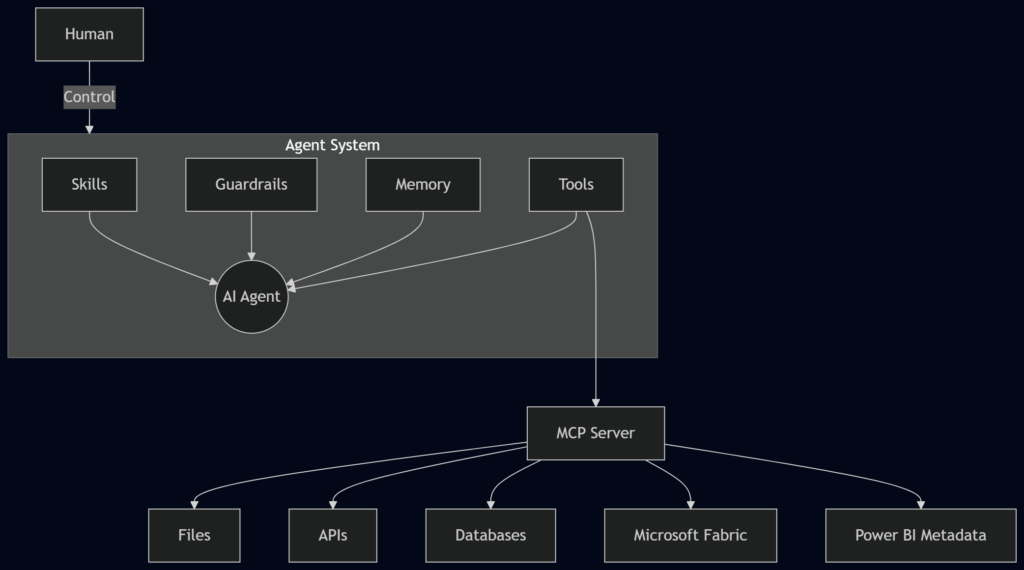
Nothing right here is magic. All the things is specific and structured.
Agentic AI #
Earlier than defining Agentic AI, it’s price taking a step again and fascinated about why this time period even exists. During the last couple of years, many people have been utilizing AI instruments in a conversational method. We ask questions, we get solutions, and generally these solutions are superb. However in actual undertaking work, particularly in knowledge and analytics area, this type shortly hits its limits.
In actual Energy BI and Cloth tasks, we hardly ever want simply a solution. We want a sequence of steps. We have to examine actual programs, apply guidelines, examine assumptions, after which produce one thing that we will evaluate and belief. That is the place the thought of Agentic AI is available in.
Agentic AI shouldn’t be about making AI smarter. It’s about making AI extra structured.
Once we say Agentic AI, we’re speaking about AI programs which are designed to behave extra like an assistant that follows a course of, reasonably than a chatbot that responds to particular person questions. The important thing distinction shouldn’t be intelligence, however behaviour.
Agentic AI refers to AI programs that may:
- Take a purpose as an alternative of a single query
- Break that purpose into smaller steps
- Determine what must occur first and what comes subsequent
- Use instruments to assemble actual data
- Carry out actions in a managed method
- Cease when boundaries are reached
This doesn’t imply the AI is appearing by itself with out supervision. In actual fact, the other is true. Agentic AI solely is sensible when a human is clearly in management. The human defines the purpose, the boundaries, and what’s thought of acceptable output.
One other essential level is that Agentic AI shouldn’t be one thing you at the moment get from the built-in Copilot expertise in Microsoft Cloth or Energy BI. In the present day, Copilot is principally conversational. It could possibly clarify, summarise, and counsel, however it doesn’t plan multi-step workflows or use exterior instruments in a managed, agentic method. The Agentic AI mentioned on this sequence is applied outdoors of Cloth, utilizing exterior instruments and configurations, which we’ll cowl later.
In easy phrases, Agentic AI is about turning AI from a speaking assistant right into a working assistant. One which follows steps, makes use of instruments, respects guidelines, and produces outputs you possibly can evaluate, validate, and belief.
This idea is the muse for every little thing else on this sequence. Expertise, instruments, guardrails, reminiscence, and MCP servers all exist to help this fashion of working. If this concept is obvious, the remainder of the ideas will begin to make way more sense as we transfer ahead.
The AI Agent #
Thus far, we talked about Agentic AI at a excessive stage and why it exists. At this level, it’s pure to ask a quite simple query. If Agentic AI is about planning, actions, instruments, and guidelines, then what precisely is the factor that ties all of those collectively?
That is the place the AI agent is available in.
When individuals hear the phrase “agent”, they typically think about one thing autonomous, appearing by itself, possibly even making selections with out supervision. That psychological picture shouldn’t be very useful right here. Within the context of Agentic AI, an agent shouldn’t be a free actor. It’s a coordinator.
The AI agent is the element that sits in the midst of every little thing. Its fundamental job is to resolve what ought to occur subsequent, based mostly on the purpose it was given, the foundations it should observe, and the knowledge it has entry to.
Within the context of this weblog specializing in Agentic AI utilization in Microsoft Cloth and Energy BI tasks, the agent doesn’t do the work itself. It doesn’t instantly learn recordsdata, question programs, or change something. As a substitute, it decides:
- Which step ought to come subsequent
- Whether or not extra data is required
- Which instrument must be used
- Whether or not a boundary or guardrail has been reached
- When the duty ought to cease
In different phrases, the agent thinks and orchestrates. It doesn’t execute.
This distinction is essential, particularly for knowledge and analytics tasks. In Energy BI and Cloth work, we care loads about traceability and accountability. If one thing goes incorrect, we need to know why it occurred and which determination led to it. Having an agent that makes selections, separate from instruments that execute actions, makes this a lot simpler to motive about.
One other essential level is that the agent at all times operates beneath directions. These directions normally come from system or chat-level configurations within the instrument we’re utilizing, for instance in VS Code. That is the place we outline:
- What the agent is allowed to do
- What its position is
- What it ought to by no means try
- How cautious it must be
The agent doesn’t invent its position on the fly. It follows what we outline for it.
It is usually price repeating that, as we speak, this sort of AI agent doesn’t exist contained in the built-in Copilot expertise in Microsoft Cloth. Copilot can help by means of dialog, however it doesn’t act as a coordinating agent that plans steps and makes use of instruments in a managed workflow. The agentic behaviour described on this sequence is achieved by means of exterior setups, which we’ll cowl later.
In the event you preserve just one factor in thoughts from this part, let it’s this:
The AI agent is your sidekick and coordinator.
As soon as this concept is obvious, ideas like abilities, guardrails, instruments, and MCP servers begin to fall into place way more naturally within the following sections.
Up up to now, we talked in regards to the agent. We’ll discover extra about planning, abilities, and guardrails later on this weblog. All of those describe how selections are made and managed. Nonetheless, none of that issues a lot if the agent can not truly work together with the actual world.
That is the place instruments are available in.
With out instruments, an agent can solely assume and discuss. It could possibly motive, clarify, and counsel concepts, however it can not examine a semantic mannequin, learn a file, or examine metadata. Instruments are what flip an agent from a pondering assistant right into a sensible one.
In easy phrases, instruments are the agent’s method of touching actual programs.
A instrument is a really small and really centered functionality. Every instrument is designed to do one particular factor, and nothing extra. This design is intentional. Instruments are saved easy so they’re predictable, protected, and straightforward to motive about.
Examples of instruments in knowledge and analytics work embody:
- Studying recordsdata from a folder or repository
- Querying metadata from a semantic mannequin
- Calling an API to checklist Cloth gadgets
- Looking out official documentation
- Operating a validation question
You will need to perceive that instruments don’t make selections. They don’t analyse outcomes or resolve what to do subsequent. A instrument solely executes an motion and returns the outcome. The pondering at all times stays with the agent.
One other essential level is that instruments will not be prompts. They’re executable capabilities. When an agent makes use of a instrument, it’s not guessing or hallucinating. It’s asking an actual system for actual data.
This distinction is important, particularly in Energy BI and Cloth situations. When an agent opinions a semantic mannequin utilizing instruments, it’s working with precise metadata, not assumptions. That’s what makes the output helpful and reliable.
Later on this sequence, once we transfer into setup and hands-on situations, you will note how instruments are uncovered to the agent by means of MCP (Mannequin Context Protocol) servers, and the way we management precisely what the agent is allowed to do with them.
For now, the important thing takeaway is that this:
- Instruments are the agent’s arms.
- They don’t assume.
- They don’t resolve.
- They merely do what they’re advised, and nothing extra.
That is by design, and it is among the causes Agentic AI can be utilized safely in actual tasks.
Expertise #
Earlier than going additional, it’s price mentioning the place the time period abilities comes from.
The idea of abilities as a first-class constructing block in agentic programs was coined by Anthropic. Anthropic launched abilities as reusable capabilities that sit between the agent and instruments, serving to construction how work is completed. Yow will discover extra about this on their web site and documentation.
A ability is a reusable recipe for finishing a job.
A ability:
- Makes use of a number of instruments
- Follows outlined guidelines
- Applies checks
- Produces constant outputs
In knowledge tasks, abilities can signify issues like:
- A semantic mannequin audit
- A measure naming evaluate
- A governance readiness examine
Expertise will not be instruments, and they don’t seem to be simply prompts. They’re structured job definitions.
Mannequin Context Protocol (MCP) #
By now, we have now talked about brokers, instrument, and abilities. At this level, a vital query normally comes up, even when individuals don’t ask it instantly. If an agent can use instruments, how does it truly hook up with actual programs in a protected and managed method?
That is the place the Mannequin Context Protocol, normally known as MCP, comes into the image.
With out MCP, each agentic setup would want its personal customized and infrequently messy method of connecting to recordsdata, APIs, databases, or companies. That shortly turns into onerous to handle, onerous to safe. MCP exists to resolve this precise downside.
Mannequin Context Protocol (MCP) is an ordinary protocol designed to reveal instruments, knowledge, and capabilities to an AI agent in a structured and safe method. It defines how an agent can uncover and use instruments with out realizing the inner particulars of the programs behind them.
An MCP server is an exterior service or course of that implements this protocol. Its job is to sit down between the agent and actual programs.
In follow, an MCP server:
- Exposes a set of instruments the agent is allowed to make use of
- Controls how these instruments could be known as
- Enforces entry guidelines and permissions
- Acts as a transparent boundary between the agent and exterior programs
This level is essential. An MCP server is not a part of the language mannequin. It’s not a immediate. It’s not a chat instruction. It runs outdoors of the AI interface we use, for instance outdoors VS Code, and is configured individually.
Consider the MCP server as a managed gateway. The agent can solely see and use what the MCP server exposes. If a instrument shouldn’t be uncovered by means of MCP, the agent can not use it, regardless of how intelligent it’s.
In a Energy BI and Microsoft Cloth context, MCP servers are what enable an agent to securely:
- Learn semantic mannequin metadata
- Checklist workspace gadgets
- Entry recordsdata or repositories
- Name APIs
On the identical time, MCP servers are additionally the place many security selections are enforced. For instance, read-only entry, surroundings separation akin to our native machine or the cloud, and permission boundaries typically stay at this layer.
This separation is intentional. It retains tasks clear:
- The agent plans and decides
- Expertise outline how work must be performed
- Instruments execute small actions
- MCP servers management entry to actual programs
Later on this sequence, once we transfer into setup and hands-on situations, you will note how MCP servers are configured and related to the instruments we use. For now, the important thing takeaway is straightforward.
Mannequin Context Protocol is the muse that makes Agentic AI sensible and protected. With out it, agentic programs could be fragile and dangerous, particularly in actual knowledge and analytics tasks.
Guardrails #
By the point individuals attain this level within the dialogue, they normally begin feeling each excited and barely uncomfortable. Excited, as a result of the agent can plan, use instruments, and work together with actual programs. Uncomfortable, as a result of a pure query seems in a short time. What stops this factor from doing one thing it mustn’t do?
That is precisely why guardrails exist.
Guardrails will not be an non-compulsory further in Agentic AI. They’re a core a part of the design. In actual fact, with out guardrails, Agentic AI shouldn’t be used in any respect in actual tasks, particularly not in knowledge and analytics environments the place errors could be costly.
In easy phrases, guardrails outline the boundaries of behaviour. They describe what the agent is allowed to do, what it must not ever do, and the way cautious it must be when working with actual programs.
You will need to perceive that guardrails will not be a single factor. They don’t stay in a single place, and they don’t seem to be only a paragraph of textual content someplace in a immediate. Guardrails normally exist throughout a number of layers of an agentic setup.
On the highest stage, guardrails typically begin within the MCPs or chat directions of the agent. That is the place you outline the position of the agent and its normal behaviour. For instance, you might state that the agent is simply allowed to analyse and evaluate, to not modify or deploy something. These directions form how the agent thinks and plans.
Guardrails additionally exist inside abilities. A ability might explicitly state that it should run in read-only mode, or that it should cease if sure situations are met. For instance, a semantic mannequin audit ability is perhaps allowed to learn metadata and run validation queries, however by no means allowed to vary a mannequin or write recordsdata again.
One other crucial layer for guardrails is exterior configuration, particularly entry and permissions. That is the place instruments and MCP servers come into play. Even when an agent tries to do one thing unsafe, it shouldn’t be technically potential. For instance, if an MCP server exposes solely read-only instruments, then harmful actions are merely not accessible to the agent.
Widespread examples of guardrails in knowledge and analytics tasks embody:
- Learn-only entry to fashions and metadata
- Express authentication strategies
- No execution of harmful operations
- No dealing with or storage of secrets and techniques
- Express cease situations when uncertainty is excessive
One essential factor to bear in mind is that guardrails will not be there to gradual us down. They’re there to make the system predictable. When guardrails are clear, we will belief the agent extra, as a result of we all know precisely what it can not do.
In Energy BI and Microsoft Cloth tasks, guardrails are particularly important. We regularly work with shared semantic fashions, manufacturing workspaces, and delicate enterprise logic. An agent that may examine and analyse these safely is helpful. An agent that may freely change them is harmful.
As we transfer into the subsequent blogs, you will note guardrails utilized time and again. Typically as a part of directions, generally inside abilities, and generally enforced totally by MCP servers and permissions. This layered method is intentional.
In the event you keep in mind just one factor from this part, keep in mind this.
Guardrails will not be about limiting the agent.
They’re about defending our undertaking, and our knowledge property.
Reminiscence #
After speaking about brokers, abilities, instruments, MCP servers, and guardrails, there’s one other idea that always will get misunderstood in a short time. Reminiscence. Many individuals hear this phrase and instantly take into consideration one thing mysterious and even dangerous, just like the AI remembering every little thing eternally. That’s not a useful method to consider it.
In Agentic AI, reminiscence exists for a really sensible motive.
In actual tasks, work isn’t performed in a single step. Choices are made, assumptions are agreed on, constraints are found, and context builds up over time. If the agent forgets every little thing between steps, it would preserve asking the identical questions, repeating the identical checks, and even contradicting itself. That’s the place reminiscence is available in.
Reminiscence permits the agent to retain helpful context throughout steps and duties, so it will possibly behave constantly as an alternative of ranging from zero each time.
You will need to be clear that reminiscence shouldn’t be the identical as data. The agent doesn’t all of a sudden change into smarter as a result of it has reminiscence. Reminiscence merely helps the agent keep in mind issues that had been already determined or found.
Examples of what reminiscence may embody in knowledge and analytics tasks:
- Enterprise guidelines that had been clarified earlier
- Assumptions about knowledge granularity
- Identified limitations of a semantic mannequin
- Choices made throughout an audit
- Constraints akin to read-only entry
Identical to guardrails, reminiscence doesn’t stay in a single single place.
In follow, reminiscence can exist in several types:
- Some instruments handle short-term reminiscence mechanically throughout a session
- Some setups retailer reminiscence explicitly in recordsdata, akin to notes or determination logs
- Some reminiscence is written and browse as a part of ability execution
What issues shouldn’t be the place the reminiscence lives, however that it’s specific and reviewable. Hidden or implicit reminiscence is harmful. It’s best to at all times be capable to see what the agent remembers and why.
One other essential level is that reminiscence must be handled as context, not fact. Reminiscence can change into outdated. Assumptions can change. That’s the reason good agentic setups enable reminiscence to be up to date, corrected, or cleared when wanted.
In Energy BI and Microsoft Cloth tasks, reminiscence is very helpful when working throughout a number of steps. For instance, throughout a semantic mannequin evaluate, the agent might establish sure design selections early on after which use that context when reviewing measures or relationships later. With out reminiscence, every step would really feel disconnected.
Later on this sequence, once we have a look at hands-on situations, you will note reminiscence utilized in a really managed method. Usually so simple as a small set of notes or a call log that the agent reads and updates because it goes.
For now, the important thing thought to bear in mind is that this.
Reminiscence shouldn’t be about making the agent intelligent.
It’s about making the agent constant.
Planning and Actions #
At this stage, we have now talked about many constructing blocks. The agent, abilities, instruments, MCP servers, guardrails, and reminiscence. All of those items are essential, however with out one idea, they don’t actually come collectively into one thing helpful.
That lacking piece is how work truly progresses from begin to end. That is the place planning and actions are available in.
In actual knowledge and analytics tasks, work hardly ever occurs in a single massive bounce. We don’t go from “evaluate this semantic mannequin” on to a completed outcome. We first have a look at metadata, then relationships, then measures, then efficiency, and solely after that we kind conclusions. This step-by-step method of working could be very pure for people, and Agentic AI follows the identical sample.
Planning is the section the place the agent takes a purpose and breaks it down into smaller, manageable steps. As a substitute of attempting to do every little thing without delay, the agent asks itself what must occur first, what is determined by what, and what data is lacking.
For instance, if the purpose is to evaluate a Energy BI semantic mannequin, the plan may embody steps like:
- Examine mannequin metadata
- Determine tables and relationships
- Overview measures and calculations
- Verify naming conventions
- Summarise findings
The plan shouldn’t be the work itself. It’s a roadmap.
As soon as a plan exists, the agent strikes into actions.
Actions are the person steps the agent executes one after the other. Every motion normally entails utilizing a instrument. For instance, calling a instrument to learn metadata, or operating a question to examine measures. After every motion, the agent appears on the outcome and decides what to do subsequent.
This loop is essential. Plan, act, observe, then act once more. The agent doesn’t blindly observe a set script. It adapts based mostly on what it finds, whereas nonetheless staying inside guardrails.
That is additionally the place the distinction between Agentic AI and chat-based AI turns into very clear. A chat-based system responds as soon as and stops. An agentic system plans, executes actions, checks outcomes, and continues till the purpose is reached or a boundary is hit.
One other essential level is that planning and actions are normally seen. Good agentic instruments present you the plan and the steps being taken. This transparency is important in skilled environments like Energy BI and Microsoft Cloth tasks, the place it’s essential to perceive why a conclusion was reached. Fortunately, instruments like VS Code that we are going to use within the following blogs on this sequence, now have a Plan mode to explicitly specify what should occur, when, the place, and the way. The traditional 5W1H technique (the who’s the agent proper?).
Later on this sequence, once we transfer into hands-on examples, you will note planning and actions working collectively very clearly. Particularly in situations like auditing a semantic mannequin or beginning a undertaking from scratch, this step-by-step movement is what makes Agentic AI dependable as an alternative of unpredictable.
For now, keep in mind this.
Planning decides about what ought to occur, when, the place and the way.
Actions carry out all that.
Collectively, they’re what flip Agentic AI right into a structured assistant as an alternative of simply one other chat window.
Prompts #
That is normally the place one other quite common query comes up. If the agent plans and acts, the place do prompts match into all of this? Are prompts nonetheless essential, or are they changed by abilities and instruments?
The quick reply is that prompts nonetheless matter loads, however their position is completely different than what many individuals are used to.
In chat-based AI, prompts are sometimes every little thing. You rigorously craft an extended immediate, hope it covers all instances, after which watch for a single response. In Agentic AI, prompts are now not defining the entire interplay with AI. They change into one half of a bigger system.
A immediate in an agentic setup is principally used to speak with AI. We will nonetheless use it to inform the mannequin who it’s, the way it ought to behave, what tone to make use of, and what normal guidelines to observe, however these are typically outlined in different blocks we disused to this point. Prompts present steerage, not execution.
In follow, prompts are normally break up into completely different layers.
On the prime stage, there are system or agent prompts. These outline the position of the agent. For instance, you may state that the agent is appearing as a Energy BI reviewer, that it have to be cautious, and that it must not ever try to vary manufacturing property. These prompts stay contained in the agent configuration of the instrument you might be utilizing, akin to an MCP server.
Then there are job or purpose prompts. These are the directions we give once we begin a particular piece of labor. For instance, asking the agent to evaluate a semantic mannequin or to analyse a set of measures.
So the prompts we use to speak with AI are normally quick and centered, as a result of a lot of the behaviour is already outlined elsewhere.
You will need to perceive what prompts will not be in an agentic setup. Prompts will not be instruments. They aren’t abilities. And they don’t seem to be guardrails by themselves. A immediate can say “don’t modify something”, however actual security ought to nonetheless be enforced by guardrails, permissions, and MCP server configuration.
One other essential distinction is that prompts in Agentic AI are sometimes supported by recordsdata. As a substitute of writing every little thing inline, prompts can reference:
- Ability definitions saved in separate recordsdata
- Undertaking context saved as documentation
- Assumptions or selections saved as directions
This makes prompts smaller, clearer, and simpler to take care of.
In Energy BI and Microsoft Cloth tasks, this method is very helpful. Relatively than writing an enormous immediate each time you need to evaluate a mannequin, you outline the behaviour as soon as, reuse abilities, after which use quick prompts to set off particular duties.
So when working with Agentic AI, consider prompts because the voice and intent of the agent, not its mind. Planning decides the steps. Actions execute them. Prompts merely information how the agent behaves alongside the best way.
Understanding this separation early will prevent a number of confusion later, particularly once we transfer into setup and hands-on examples within the subsequent blogs.
The place these ideas stay in follow #
So far, we talked about many ideas. Agent, abilities, instruments, guardrails, reminiscence, planning, actions, MCP servers, and prompts. Each was defined by itself. That is normally the purpose the place readers begin feeling that every little thing is sensible individually, however the full image continues to be a bit blurry. That’s regular.
The confusion normally comes from one easy query that isn’t at all times requested clearly. The place do these items truly stay once we use an agentic AI instrument in actual life?
If we don’t reply this correctly, every little thing stays theoretical. So allow us to convey all these ideas out of the summary world and place them clearly into an actual setup.
First, the AI agent itself lives contained in the instrument we’re utilizing. For instance, if you’re working in VS Code with an agentic extension akin to GitHub Copilot, the agent is outlined by that instrument. Its position, behaviour, and normal angle are normally outlined by means of system-level or chat-level directions. That is additionally the place the system immediate or agent immediate lives. These prompts outline who the agent is, the way it ought to behave, and what it must not ever try.
Subsequent, abilities normally stay outdoors the chat window. They’re typically outlined as separate immediate templates, instruction recordsdata, or structured configurations inside a particular folder. The important thing level is that abilities are reusable. We don’t need to rewrite how one can audit a semantic mannequin each time. We outline that when as a ability, then reuse it throughout tasks.
Activity prompts or purpose prompts are completely different from abilities. These are the quick directions you give whenever you begin a particular piece of labor. For instance, asking the agent to evaluate a semantic mannequin or to analyse a selected subject. These prompts are normally written inline whenever you work together with the agent, they usually depend on abilities and guardrails which are already outlined.
Guardrails don’t stay in a single place. This is essential to grasp. Some guardrails are outlined within the agent or system prompts, akin to telling the agent it’s only allowed to analyse and never modify something. Some guardrails are outlined inside abilities, for instance forcing a ability to run in read-only mode. Different guardrails are enforced technically, by means of permissions, credentials, and MCP server configuration. Good setups at all times use a couple of layer.
Reminiscence can stay elsewhere relying on the instrument and the setup. Typically it’s managed mechanically throughout a session. Typically it’s saved explicitly in recordsdata, notes, or determination logs that the agent reads and updates. What issues most shouldn’t be the storage technique, however visibility. It’s best to at all times know what the agent remembers and why.
Instruments are normally offered by the platform, the MCP servers or by extensions. They aren’t written inside prompts. A instrument is one thing executable, like studying a file or calling an API. The agent can solely use the instruments which are uncovered to it.
That is the place Mannequin Context Protocol (MCP) servers are available in. MCP servers stay utterly outdoors the agent interface. They’re exterior companies or processes that expose instruments to the agent in a managed method. They outline what instruments exist, what knowledge could be accessed, and beneath what permissions.
Lastly, planning and actions stay contained in the agent’s execution loop. Planning is how the agent decides what to do subsequent. Actions are the person steps it executes utilizing instruments. Good instruments make this seen, so you possibly can see the plan and observe every step.
In the event you put all of this collectively, the image turns into a lot clearer.
- The agent thinks and coordinates
- Prompts talk and form behaviour and intent
- Expertise outline how duties must be performed
- Guardrails restrict behaviour at a number of layers
- Reminiscence retains context constant
- Instruments execute small actions
- MCP servers management entry to actual programs
As soon as we see the place every idea lives, Agentic AI stops feeling like a black field. It turns into a structured system with clear tasks. This readability is what makes it usable and protected in actual Energy BI and Microsoft Cloth tasks.
Greatest practices to bear in mind #
At this level within the weblog, we have now coated many ideas and it will possibly begin to really feel a bit theoretical. That is normally the second the place readers ask a really sensible query. “If I need to do that, how do I keep away from making a multitude?”
That’s precisely why it is sensible to speak about greatest practices now, earlier than touching any instruments or setup. These are easy habits, however they make an enormous distinction when working with Agentic AI in actual Energy BI and Microsoft Cloth tasks.
The primary and most essential follow continues to be to begin in read-only mode. Particularly in knowledge and analytics work, there’s hardly ever an excellent motive for an agent to switch something early on. Studying metadata, analysing fashions, and producing suggestions already ship a number of worth. Write entry can at all times come later, whether it is wanted in any respect.
One other essential follow is to preserve the scope small and clear. This is applicable very strongly to prompts. Don’t give the agent a obscure or overly broad instruction like “evaluate every little thing”. As a substitute, be specific about what you need reviewed, what’s in scope, and what’s not. Clear prompts result in predictable behaviour.
You must also watch out to separate prompts by duty. System or agent prompts ought to outline behaviour and limits. Ability definitions ought to describe how a job is carried out. Activity prompts ought to solely describe the purpose of the present work. Mixing these collectively into one lengthy immediate normally creates confusion and inconsistent outcomes.
It is usually an excellent behavior to keep away from placing important guidelines solely in prompts. A immediate can say “don’t modify something”, however that ought to by no means be the one line of defence. Vital guidelines should even be enforced by means of guardrails, permissions, and MCP server configuration. Prompts information behaviour, however they don’t assure security.
One other key follow is to at all times ask for proof in prompts. Particularly in Energy BI and Cloth situations, you need to anticipate the agent to level to metadata, question outcomes, or recordsdata that help its conclusions. If a immediate doesn’t explicitly ask for proof, the output is extra prone to keep at a excessive and fewer helpful stage.
You must also evaluate and refine prompts over time. Prompts will not be one-off directions. As you find out how the agent behaves, you’ll discover the place prompts could be simplified, tightened, or clarified. Maintaining prompts small and centered normally works higher than writing very lengthy ones.
Keep away from putting in each MCP server you come throughout. Deal with MCP servers like every other software program that may entry your knowledge and programs. If you’re not technical, be further cautious with MCP servers that require native set up, as a result of you might not be capable to validate what you might be operating. Even be cautious with on-line MCP servers from unknown suppliers. A well known vendor can cut back danger, however it doesn’t take away the necessity for least privilege, read-only entry, and sandbox testing. If somebody is promoting a ‘tremendous instrument’ with massive claims, that isn’t proof of safety. Except I can validate the supply, the permissions, and the info dealing with, it’s a no from me.
Lastly, keep in mind to doc essential prompts and selections. If a sure immediate construction works nicely for auditing a semantic mannequin, put it aside. If a immediate prompted confusion, be aware why. Over time, this builds a small however very precious library of prompts that suit your method of working.
When these practices are adopted, prompts cease feeling like magic phrases you should get precisely proper. They change into easy directions that sit alongside abilities, instruments, and guardrails. That is when Agentic AI begins to really feel boring in a great way. Predictable, managed, and reliable.
The place this matches in Energy BI and Cloth tasks #
After going by means of all these ideas, it’s honest to pause and ask a really sensible query. Even when all of this sounds fascinating, the place does it truly make sense to make use of Agentic AI in Energy BI and Microsoft Cloth tasks?
The reply shouldn’t be “all over the place”. Agentic AI is most helpful in areas the place work is structured, repeatable, and based mostly on inspection reasonably than creativity. Fortunately, a number of knowledge and analytics work falls precisely into that class.
One of many strongest use instances is reviewing current semantic fashions. This contains duties like checking relationships, reviewing measures, validating naming conventions, and figuring out frequent modelling points. These actions observe clear patterns and guidelines, which makes them an excellent match for abilities and structured workflows.
One other good match is auditing and validation work. For instance, checking whether or not a mannequin follows inner requirements, whether or not calculations align with agreed enterprise guidelines, or whether or not sure governance necessities are met. Agentic AI can apply the identical checks constantly throughout a number of fashions or tasks, one thing that’s onerous to do manually at scale. A quite simple however sensible instance is auditing naming conventions throughout our options.
Agentic AI additionally matches nicely if you end up becoming a member of an current undertaking and wish to grasp it shortly. Studying by means of fashions, metadata, and documentation could be time consuming. An agent can assist collect and summarise this data in a structured method, providing you with a quicker start line.
In greenfield tasks, Agentic AI could be useful through the early phases. For instance, when clarifying necessities, outlining a mannequin construction, or making a guidelines for what must be constructed. It mustn’t , and wouldn’t, change design selections, however it will possibly help them by ensuring nothing apparent is missed.
What Agentic AI shouldn’t be nicely fitted to are areas that require sturdy creativity, enterprise judgement or accountability. Choices about structure, trade-offs, or stakeholder priorities nonetheless belong to individuals. The agent can help these selections, however it mustn’t make them.
Within the context of Microsoft Cloth and Energy BI, it’s also essential to do not forget that Agentic AI, as described on this sequence, lives outdoors the built-in Copilot expertise. We’re speaking about exterior agentic setups that work together with Cloth and Energy BI by means of instruments and managed entry, not about clicking a Copilot button contained in the product.
If utilized in the precise locations, Agentic AI can take away a number of friction from day-to-day work. If used within the incorrect locations, it will possibly shortly change into noise and even harmful. Realizing the place it matches is what makes the distinction.
What comes subsequent #
This weblog was about constructing a shared understanding.
Within the subsequent weblog, we’ll transfer into:
- Instruments and setup
- VS Code because the working surroundings
- Expertise in follow
- MCP servers for Cloth and Energy BI use instances
As soon as the muse is obvious, the hands-on work will likely be a lot simpler to observe.
Abstract #
This weblog was deliberately centered on ideas. No instruments, no setup, and no demos. The purpose was to construct a transparent and shared understanding earlier than transferring into something sensible.
We began by explaining why Agentic AI deserves greater than a single weblog publish, particularly within the context of actual Energy BI and Microsoft Cloth tasks. Agentic AI shouldn’t be about changing individuals or automating selections. It’s about helping structured work in a managed and predictable method.
We then walked by means of the core constructing blocks one after the other. The AI agent because the coordinator. Planning and actions as the best way work progresses. Instruments because the agent’s arms. Expertise as reusable job definitions. Guardrails as security boundaries. Reminiscence as a method to preserve context constant. Mannequin Context Protocol servers because the managed bridge to actual programs. Prompts as the best way we form behaviour and intent.
We additionally clarified the place every of those ideas truly lives in an actual setup. Some stay in prompts, some in recordsdata, some in exterior companies, and a few in configuration. Understanding this separation is vital to avoiding confusion and unsafe use instances.
Lastly, we mentioned greatest practices and the place Agentic AI matches, and the place it doesn’t match, in Energy BI and Cloth tasks. Utilized in the precise locations, it will possibly take away a number of repetitive effort. Used within the incorrect locations, it will possibly shortly change into noise or danger.
Within the subsequent weblog, we’ll transfer from ideas to follow. We’ll have a look at instruments, VS Code setup, abilities in motion, and how one can join every little thing collectively safely. Now that the muse is obvious, the hands-on work will likely be a lot simpler to observe.
Thanks for following this sequence to this point. I hope this primary half helped you higher perceive the large image of Agentic AI, in addition to the important thing technical ideas behind it, particularly within the context of Energy BI and Microsoft Cloth tasks.
Since we’re simply getting into a brand new 12 months, I additionally need to want you a really joyful new 12 months. I hope 2026 brings you good well being, fascinating tasks, and loads of studying alternatives.
In the event you discovered this handy, you possibly can observe me on LinkedIn, subscribe to BI Perception on YouTube, or observe the BI Perception podcast on Spotify. I additionally share updates on Bluesky and X, protecting Energy BI, Microsoft Cloth, AI, and the real-world knowledge and analytics issues I come throughout alongside the best way.
Associated
Uncover extra from BI Perception
Subscribe to get the newest posts despatched to your e mail.

