

Each seven years, EU Member States debate Brussels’ long-term price range: how a lot to spend and who pays. At this yr’s Multiannual Monetary Framework (MFF) negotiations, which can cowl the bloc’s collective bills from 2028 via 2034, European Council President António Costa has been calling for extra income sources and to finalize discussions by yr’s finish.
As policymakers collect in Brussels this Thursday to fulfill this bold deadline, the query they need to reply is tips on how to elevate these funds. Whereas Costa goals to keep away from burdening Member States with the invoice, the cash should come from someplace. In actuality, if the income assortment insurance policies aren’t designed accordingly, the taxA tax is a compulsory cost or cost collected by native, state, and nationwide governments from people or companies to cowl the prices of normal authorities companies, items, and actions. burden shall be handed on to EU taxpayers and companies—whether or not it’s collected by Member States or Brussels.
However policymakers can select to gather this income effectively. To do that, the EU ought to set three objectives for this debate.
No New EU Taxes With out Structural Reforms
In latest weeks, Costa has taken the Company Personal Useful resource for Europe (CORE) plan off the desk. That is welcome information. The CORE would have charged companies a set tax based mostly on their revenues as an alternative of their income. An organization struggling to make cash would pay a heavier share of what they earn whereas a extremely profitable enterprise would have a low tax invoice. This isn’t how tax coverage ought to work.
And but, after eradicating the CORE, Costa has reintroduced the idea of a 3 p.c digital companies tax (DST) on revenues of firms with greater than €50 million in annual income throughout the EU and €750 million in world income. Latest Tax Basis Europe modeling of comparable insurance policies and proposals within the United Kingdom and Belgium reveal that the financial prices are bigger than the revenues raised by such taxes.
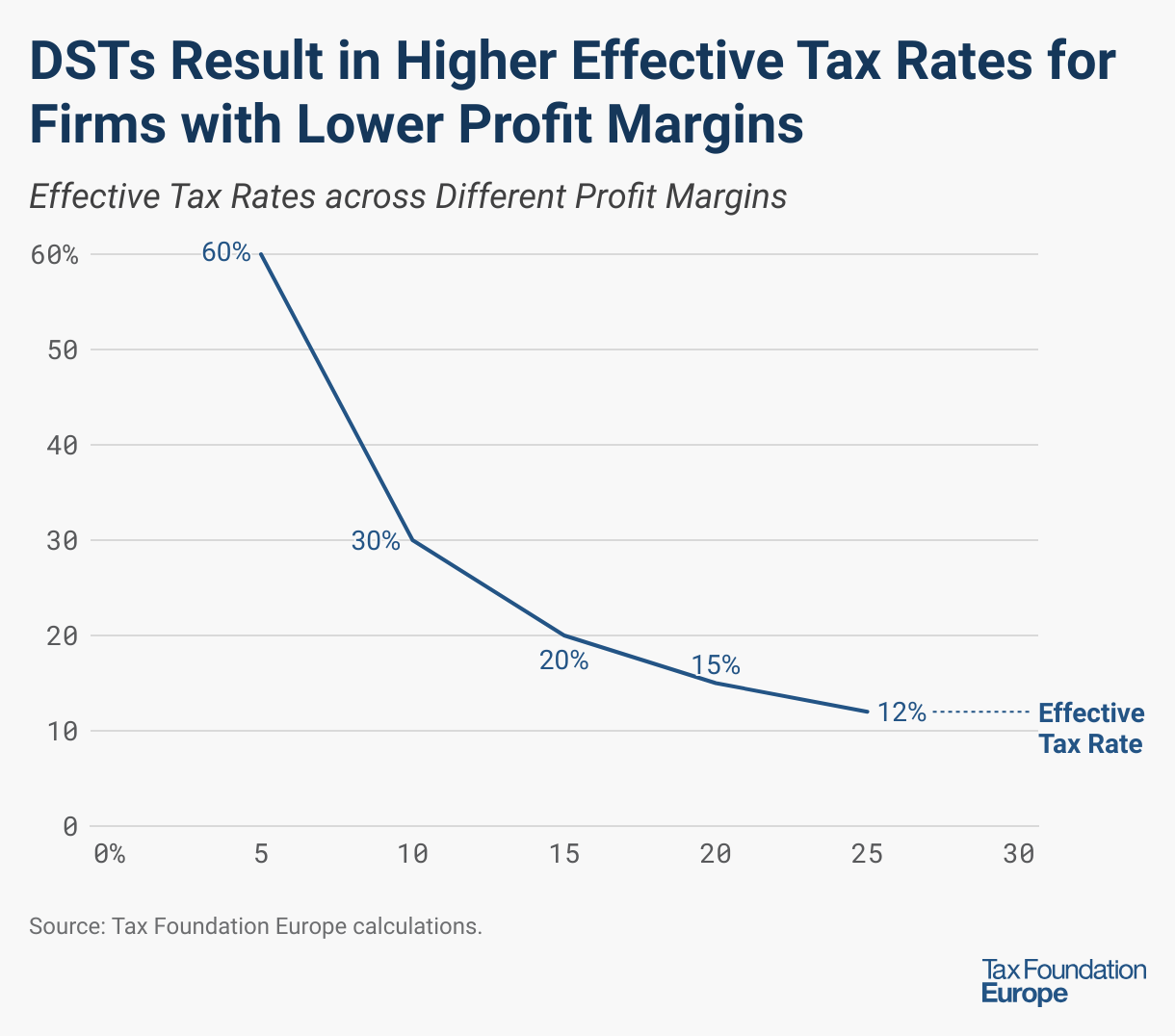
And, as with every tax that applies to income reasonably than income, greater revenue margins imply decrease efficient tax charges. As my colleague Cristina Enache described in her testimony to the European Parliament’s Funds Committee in July:
“…an organization with €100 in income and €15 in revenue faces a 3 p.c DST (€3 in tax), which interprets right into a 20 p.c tax on income. If the revenue margin is decrease, the efficient tax price rises dramatically—as much as 60 p.c or extra.”
That is additionally not how tax coverage ought to work.
Or contemplate the Carbon Border Adjustment Mechanism (CBAM), which is a cost on the carbon content material of imports. This, too, is a flawed strategy. By not providing rebates for exporters, it will increase prices for EU producers who compete overseas. Though we’re in early days of implementation, CBAM has already drawn widespread worldwide criticism from the US and BRICS nations.
Each proposals are sophisticated and lift prices within the EU market. A greater strategy can be to reform the efficient instruments which are already in place.
Repair the Current Levers
As we speak, a lot of the EU price range is funded by two sources: contributions based mostly on every Member State’s gross nationwide earnings (GNI), and their value-added tax (VAT). Collectively, they finance greater than 80 p.c of it. Crucially, each are depending on how properly Member States run their home tax insurance policies. This makes VAT coverage significantly essential for nationwide revenues.
Luckily for Costa and policymakers in search of new income, the outdated VAT system has loads to repair.
Member States fail to gather roughly EUR 128 billion below present guidelines, which is usually referred to as “the compliance hole.” Additionally they quit EUR 742 billion via exemptions and particular charges in VAT guidelines, or “the coverage hole.” By comparability, the brand new income being sought within the EU price range is simply roughly EUR 60 billion.
Closing the compliance and coverage gaps—gathering what’s already owed whereas trimming exemptions and particular guidelines—and adjusting how the EU price range raises funds from VAT can be far simpler than constructing one thing new.
Give attention to Financial Development and Tax Simplicity
Tax coverage shouldn’t solely focus, although, on income. When designing the MFF, Costa and Member States ought to ask every coverage to move a easy check: will this make Europe roughly aggressive? The Worldwide Financial Fund’s (IMF) latest World Financial Outlook reveals that governments have choices to lift further income whereas minimizing financial prices, ideally via broad-based consumption taxes, well-designed earnings taxes, and insurance policies constructed with tax administration in thoughts.
Counting on revenues from insurance policies like DST or CBAM makes that process tougher. However by specializing in simplicity, Member States can refine their very own insurance policies reasonably than worrying about particular new levies out of Brussels. Brussels ought to proceed to determine how Member States may patch up their VAT techniques which are presently leaving cash on the desk.
Policymakers calling for greater EU spending must make their case. And in the event that they make it, the trail ahead ought to run via well-designed insurance policies. Enhancing present techniques on the Member State stage needs to be the 1st step. If Costa as an alternative provides extra complexity and tax hikes into the fold, the EU will find yourself with an inefficient system run from the highest whereas severe issues with nationwide tax techniques persist, placing an extra drag on the financial system.
If we don’t begin right here, policymakers would possibly waste treasured time designing insurance policies that shall be more practical at stopping EU development than elevating income.
Keep knowledgeable on the tax insurance policies impacting you.
Subscribe to our free e-newsletter to get the newest tax information, information and evaluation.
Share this text

