Key Takeaways
- Bitcoin blocks are restricted to 4 million weight items, equal to a most of 1 million digital bytes.
- Mining swimming pools typically prioritize transactions by price price somewhat than cost measurement or arrival time.
- Transactions excluded from full blocks stay unconfirmed and should require greater charges to safe affirmation.
Inside Bitcoin’s Block House Public sale
Think about a crowded airport the place 1000’s of passengers are ready to board, however each departing plane has restricted seating. There is no such thing as a common boarding line, and passengers keen to pay extra typically obtain precedence. These left behind should wait for one more departure, doubtlessly competing in opposition to a wholly new group of vacationers.
Bitcoin operates beneath a comparable association, though its passengers are transactions, its plane are blocks, and its boarding costs are transaction charges. Almost each ten minutes, the Bitcoin community, designed by Satoshi Nakamoto, produces one other block. Miners assemble these blocks from transactions awaiting affirmation, however there’s a catch: Every block has a most capability of 4 million weight items, a measurement launched via Segregated Witness in August 2017.
This interprets into roughly 1 million digital bytes (vB), though the precise quantity of transaction information varies based on its composition. A typical block may comprise a number of thousand transactions, whereas sure data-heavy blocks can method 4 megabytes in serialized measurement. When demand exceeds obtainable capability, miners can’t merely squeeze all the things inside.
Transactions that fail to make the lower stay unconfirmed, making a aggressive market the place customers successfully bid for scarce settlement area. The important distinction is that Bitcoin doesn’t function a first-come, first-served system. A transaction broadcast a number of hours earlier can stay unconfirmed whereas one other submitted seconds in the past enters the following block. The distinction typically comes all the way down to switch charges.
Who Decides Which Bitcoin Transactions Get Confirmed?
Bitcoin miners and mining swimming pools train appreciable discretion over which transactions enter their proposed blocks. Their selections usually replicate financial incentives somewhat than transaction age, cost quantity or the id of the sender. Charges are measured in satoshis per digital byte (sat/vB), which means customers pay based on the area their transactions occupy.
Take into account two transactions competing for inclusion. The primary occupies 200 vB and pays 1,000 satoshis, equal to five sat/vB. The second occupies 150 vB and pays 1,500 satoshis, equal to 10 sat/vB. Though the second transaction pays solely 500 extra satoshis, it presents twice the price price whereas consuming much less block area. A miner looking for to maximise price income would typically desire the second transaction.
Illustrative transaction comparability
| Metric | Transaction A | Transaction B |
| Digital measurement | 200 vB | 150 vB |
| Whole price | 1,000 sats | 1,500 sats |
| Payment price | 5 sat/vB | 10 sat/vB |
| Relative precedence | Decrease | Greater |
Transaction B presents larger price income per unit of block area, making it typically extra enticing to miners.
Nonetheless, miners don’t all the time consider transactions individually. Some rely on earlier unconfirmed transactions, creating parent-child relationships that have to be thought-about collectively. Mining software program evaluates these related transactions based on their mixed financial worth.
Mining swimming pools can even settle for transactions via non-public preparations or embrace transactions for causes unrelated to their marketed charges. Consequently, the price market influences transaction choice with out dictating an absolute order. Each miner and Bitcoin full node independently checks newly found blocks in opposition to the community’s consensus guidelines.
A miner producing a block that exceeds the permitted weight restrict will see that block rejected by validating nodes implementing these guidelines. Builders might suggest modifications, and mining swimming pools might help them, however altering Bitcoin’s consensus necessities finally is dependent upon adoption and enforcement by community contributors.
What Occurs to Transactions That Don’t Match?
Transactions excluded from a full block ordinarily stay within the mempool, brief for reminiscence pool, the place unconfirmed transactions await potential inclusion. Opposite to a standard false impression, Bitcoin doesn’t preserve one huge, centralized ready room. Each collaborating full node maintains its personal mempool, making use of native insurance policies governing transaction acceptance, storage, and relay.
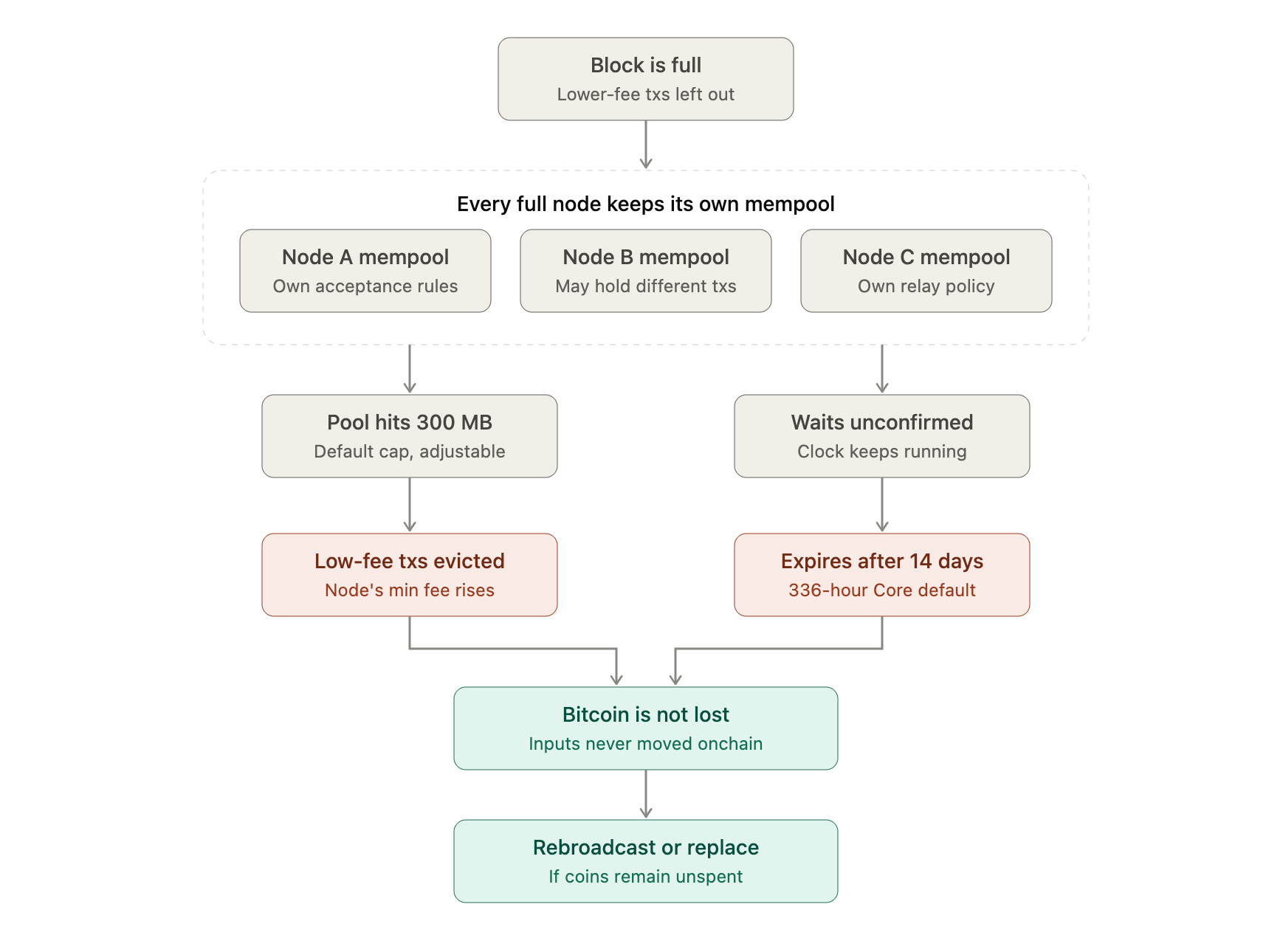
In consequence, totally different nodes might broadcast and maintain, and block explorers might present distinct collections of unconfirmed transactions. A cost seen on one blockchain explorer is perhaps absent from one other node’s mempool. Bitcoin Core software program historically defaults to a 300-megabyte mempool reminiscence restrict, though node operators can modify that setting. When the pool reaches capability, software program begins eradicating much less economically enticing transactions, contemplating the price charges of associated transactions as effectively.
This course of, generally known as eviction, prevents unconfirmed exercise from consuming limitless reminiscence. A node that evicts low-fee transactions additionally raises its efficient minimal acceptance price, making it more and more troublesome for equally priced transactions to enter till congestion subsides. Bitcoin Core’s default transaction expiration interval is 336 hours, or 14 days. Nonetheless, transactions can disappear from particular person mempools significantly sooner during times of intense competitors.
Importantly, eviction doesn’t imply the underlying bitcoin has vanished. An unconfirmed transaction that’s dropped from a node’s reminiscence has not transferred its inputs onchain. The sender can doubtlessly rebroadcast the transaction or assemble a alternative, offered the related cash stay unspent.
Why Full Blocks Can Ship Bitcoin Charges Hovering
The financial penalties turn into significantly seen when transaction demand accelerates quicker than miners can verify exercise. Bitcoin’s block manufacturing goal stays roughly ten minutes, however precise intervals fluctuate significantly. Transactions arrive constantly, whereas confirmations happen in batches each time miners uncover legitimate blocks.
When incoming demand persistently exceeds obtainable capability, unconfirmed transactions accumulate throughout totally different price ranges. In the course of the April 2024 halving, the launch of the Runes protocol contributed to intense competitors for block area. Block top 840,000 carried a median transaction price price of roughly 200 sat/vB. Against this, block 970,789, mined Oct. 10, 2026, recorded a median price price of roughly 0.28 sat/vB.
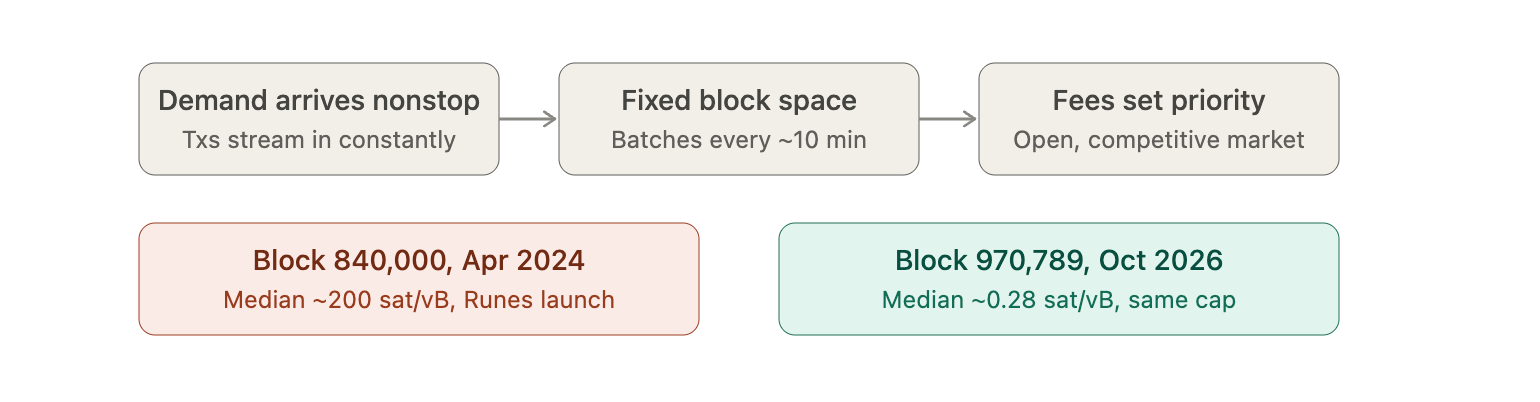
The distinction illustrates how dramatically the market value of transaction precedence can change with none alteration to Bitcoin’s underlying capability restrict. A full block doesn’t essentially point out a malfunction, nor does an overflowing mempool imply the community has stopped processing transactions. As an alternative, congestion reveals the implications of fastened settlement capability assembly unpredictable demand.
The deeper query issues how that scarce capability ought to be allotted as Bitcoin evolves. Bitcoin miners can favor worthwhile transactions, customers can compete via charges, and builders can suggest effectivity enhancements, however no single participant can unilaterally rewrite the foundations enforced by impartial nodes.
Bitcoin’s block area is finite by design; entry to it’s negotiated via an open, aggressive price market.