
You’re studying a four-part collection on how AI has impacted our Lean LaunchPad class and what we did about it.
Half 1: The Yr AI Got here For Us
Half 2: AI Killed the MVP – Lengthy Dwell the IUP
Half 3: The World Outdoors the Classroom Modified, The Class Didn’t
This put up: Lean LaunchPad – The Subsequent Technology
Lean LaunchPad – The Subsequent Technology
Whereas AI accelerates product improvement and buyer discovery, it doesn’t speed up understanding, proof or perception. Groups nonetheless want to find who has the issue, how painful it’s, who controls the funds and knowledge, what final result counts as success, what failure is tolerable, how the product enters the workflow, and why a buyer will select a startup over dozens of quick followers or internally constructed options.
Right here’s how we modified the course design to embrace the velocity of AI whereas instructing college students to first assume deeply about their enterprise, then act rapidly to construct it.
It took all summer time and many recommendations from the Stanford Lean LaunchPad and Hacking for Protection instructors, however on the finish of our personal discovery, we concluded that our redesigned LLP class wanted to:
- Double down within the entrance finish of the category on the rigor of understanding Stakeholders, Issues, Hypotheses and Connections
- Double down on AI for its fast improvement/deployment, time-to-market velocity up and skill to remodel total industries
- Exchange the MVP as proof of the Worth Proposition with “Snippets” (Utilizing a small portion of the preliminary untested product to check a value-proposition)
- Exchange the MVP as proof for testing the opposite components of the Enterprise Mannequin Canvas with “Minimal Examined Canvas” assessments.
- Make Product/Market Match targets class particular
- Change the category tempo to maneuver even quicker
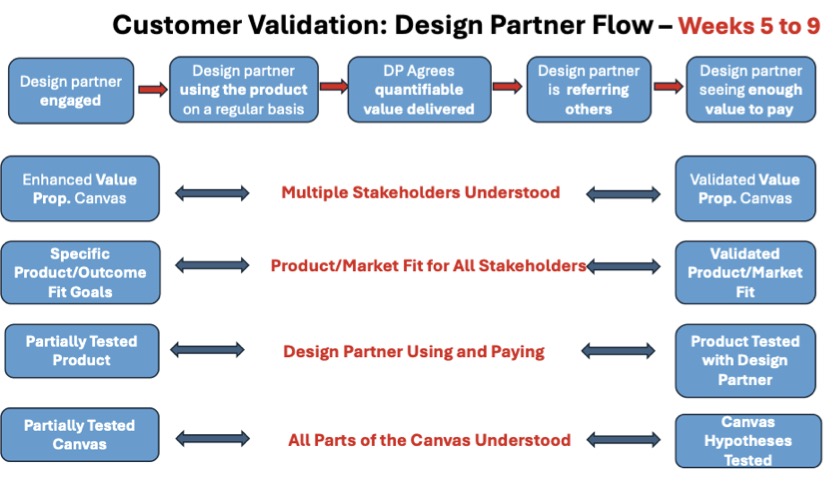
- Use Design Companions as proof of Buyer Validation within the second half of the category
- Change the language to embrace new class ideas
What’s the Similar?
The redesigned class will maintain team-based, experiential studying, Enterprise Mannequin and Worth Proposition Canvases, Buyer Growth, speculation testing, subject interviews, weekly proof critiques, validating the issue earlier than validating the answer, permission to pivot and time strain.
 We’ll Begin with a New Glossary
Renaming isn’t only a semantic hack. Language issues. It shapes behaviors and actions. Within the chaotic and unsure seek for a enterprise mannequin, being exact with college students helps them perceive in the event that they’ve made progress.
Right here’s the brand new language we intend to make use of within the revised Lean LaunchPad class.
Stakeholders: customers, prospects, influencers, decision-makers, financial patrons, regulators, knowledge house owners, safety groups, saboteurs, and so on. Anybody influencing the adoption of your product/service.
Preliminary Untested Product (IUP): For the primary class assembly, this will likely be an AI-created product/digital twin that will resemble an entire answer however has not been validated with prospects or stakeholders.
IUP snippet: A small portion of the IUP used to check one value-proposition speculation with out displaying the total product.
Partially Examined Product (PTP): By the tip of week 4 of the category, groups utilizing IUP Snippets will produce {a partially} examined product primarily based on buyer suggestions to validate/ invalidate/ modify the IUP.
Product-Consequence Match (POF): A substitute for Product-Market Match. A extra targeted aim for AI-accelerated startups to give attention to.
Minimal Examined Canvas (MTC): A substitute for the time period MVP for testing the opposite components of the Enterprise Mannequin Canvas. The smallest set of experiments that meaningfully assessments the non-product components of the Enterprise Mannequin Canvas, together with prospects, channels, income, prices, companions, scientific finish factors, regulatory paths, and key actions.
Design Accomplice: A co-developer who first offers suggestions, knowledge, workflow entry, and real-world testing in alternate for early entry, preferential phrases, or affect over the product. Nevertheless, the true metric for achievement will likely be when the Design Accomplice is utilizing the product and getting worth out of it. (Design companions will be end-users in corporations, warfighters, and so on. who should purchase or affect a sale.)
Design Accomplice Validated Product (DPVP): By the tip of week 9, utilizing successively refined PTPs, groups can have a Design Accomplice validated product.
Minimal Viable Product (MVP): A time period beforehand used to find and iterate on the worth proposition and different components of the Enterprise Mannequin Canvas – not used within the Lean LaunchPad class.
What Modifications – Class Techniques
We’ll break up the category into two components:
Weeks 1 – 4 Suppose Deeply – Stakeholder, Drawback and Hypotheses Maps and Connections
Weeks 5 – 9 Act Rapidly – with a aim to get Design Companions
We’ll double down on Buyer Discovery.
For the primary 4 weeks college students, utilizing IUP Snippets, will get out of the constructing and map Stakeholders, issues, hypotheses and connections. The aim is to rapidly perceive present habits, workarounds, budgets, failure prices, and choice processes.

College students will likely be graded on the standard of their outreach, not on the success of proving their snippet right.

We’re going to Exchange Product/Market Match with Class-specific Product/Consequence Match Objectives. We’re updating generic product/market match to match how AI corporations are being constructed. For every product class, groups will use AI-specific Product-Consequence Match discovery and validation objectives:
- B-to-B enterprise software program groups seek for Consequence/Agent match. The client can outline acceptable work, the agent reaches that threshold within the goal workflow, the group grants the required permissions, and the previous different is lowered or retired.
- B-to-C shopper groups do mass creation and testing, spinning up and testing many variants in parallel. The crew finds an issue/want, goal archetype(s) and habits, acquisition and retention loop, and distribution path that survive repeated testing throughout variants.
- {Hardware} groups construct digital twins. Simulations predict the habits of prototypes carefully sufficient to speed up iteration, whereas manufacturability, reliability, provide, and deployment stay viable.
- Life science groups speed up their Preliminary Untested Product with simulation and modeling instruments and check scientific endpoints (therapeutics, diagnostics, units, scientific trials), reimbursement and financing.
We’re Eliminating MVPs for worth proposition discovery. We’ll implement rigorous downside and stakeholder discovery through speculation assessments, utilizing Stakeholder Maps, the Worth Proposition Canvas and Lean Experiment Playing cards. (These are instruments I’ve used at Imperial Faculty in London to train groups to unravel “Depraved” Issues.) Groups determine and check issues and stakeholder hypotheses. Then they use parts of their preliminary product, the IUP Snippets, to check core worth proposition hypotheses. There will likely be no “full product” demos till discovery is full. The place the previous class iterated low-fidelity to high-fidelity MVPs, the brand new class iterates low-fidelity to high-fidelity worth propositions and stakeholder maps.


We’re Encouraging Artificial Interviews however testing them towards dwell interviews. Groups will create synthetic personas and run weekly artificial interviews. Then they’ll examine these responses with in-person interviews, validating or invalidating the artificial responses and feeding the dwell responses again to the LLM to make the personas and artificial interviews extra correct. Notice the route of authority: the dwell interviews grade the artificial ones, by no means the reverse.
Create the Minimal Examined Canvas (MTC). AI can generate a product quicker than a crew can check the opposite eight bins of the canvas. The “Minimal Examined Canvas” returns the course to a week-to-week give attention to discovery, testing and experimentation of all canvas elements (aside from the worth proposition). It assessments a crew’s understanding of the regulatory course of, spec sheets, demand creation and gross sales mannequin, funding, organizational choice processes, and so on.
Create formal pivot-or-proceed standards for discovery. Groups state their hypotheses throughout the canvas, check the issue, check the answer with IUP Snippets, then face specific verify-or-pivot gates: confirm the minimal IUP, the shopper phase, buyer relationships, the channel, and the income mannequin.
As a result of AI eliminated the pure pacing that constructing and MVP used to impose, the category now imposes go/no-go standards explicitly so a sophisticated product can’t substitute for proof.
Make Design Companions A Group Aim. The crew’s class goal is to get a number of design companions. The accomplice commits scarce assets: employees time, knowledge, integration effort, permissions, check environments, modifications to workflow and the power to affect the product.
A design accomplice is proof of Buyer Validation. In 2026, when anybody will take a web based assembly and pilots spin up in days, a design accomplice who commits pores and skin within the sport is the sincere sign.
AI-Particular Class Additions
Take a look at for Studying Debt. Any crew member ought to have the ability to clarify the shopper, workflow, proof, economics, and key contradictions with out opening a laptop computer. Technical members ought to hear buyer language firsthand. AI-generated work ought to be attributed, and groups will distinguish what the mannequin produced from what the crew verified. (That is particularly necessary in discovery: what was the results of artificial interviews vs precise interviews.)
Consumer Interface. The Preliminary Untested Product has to have a polish that wasn’t beforehand wanted. Stakeholders examine each interface to a chatbots UI/design now has a better significance than a conventional MVP.
LLM Prices. Three questions that didn’t exist in 2011 when this class was created are actually core canvas economics: What does working a LLM price you, and what are your unit economics? And what does it price your buyer to run it?
Autonomy Permissions. Which actions will the shopper enable? At what degree of reliability and reversibility. Human intervention stays particularly necessary throughout early deployment and for delicate, irreversible, or high-stakes actions?
AI Mannequin Portability Is Strategic. Most frontier LLMs have proprietary context, instruments, workflow, analysis, belief, and distribution. A startup ought to assume that its most popular mannequin, pricing, latency, phrases, or relative high quality will change. LLM Mannequin dependence is due to this fact a business-model danger, not solely an engineering selection.
“Belief” Proof Is a Potential Moat In lots of markets, the proof wanted to deploy safely is just not overhead added after product/market match. It’s a part of product/market match. NIST’s Generative AI Profile treats trustworthiness as a lifecycle self-discipline of governance, measurement, and danger administration. The FDA’s AI-device steering equally connects iterative enchancment to deliberate validation, documentation, and influence evaluation.
Defensibility, alternative measurement, crew, and funding. The crew’s defensibility moat must be a part of discovery — from knowledge, to mannequin, to crew, to {hardware}. Alternative measurement and market kind: is that this an incremental enchancment or does this variation or create an trade? Group capabilities: does the crew have distinctive attributes, expertise and/or perception — and who else is required?
Textbooks versus Tokens – College students received’t purchase as many textbooks they’ll purchase AI tokens and design instruments. So count on to spend cash.
Dangers
A Heavier Carry for College. The prevailing Lean Launchpad class had much more shifting components than instructing “how one can write a marketing strategy.” But it succeeded and scaled as a result of it ready college students for the world because it was. This class will increase the bar as soon as once more – for each college students and college. I consider the end result would be the similar.
Achievement inflation. Within the present Lean LaunchPad class college students are already padding the variety of interviews they full. We write off all however probably the most egregious as “dishonest in your entrepreneurship class is like dishonest in your parachute packing class.” The aim of discovering Design Companions now creates new avenues to inflate accomplishments. We’ll be emphasizing companions that assist validate the enterprise and result in progress not demos.
Design Companions as a Metric for Validation will doubtless lead to college students discovering native maxima as an alternative of the very best peak. Nevertheless, that is no completely different from what occurs within the early stage of most startups. We’ll be giving college students heuristics to how time pivots to bigger alternatives.
Educating Scholar Groups How To Promote. Up to now, a Go-to-Market technique was simply a part of the shopper relationship portion of the enterprise mannequin canvas. Whereas a number of groups generated income or obtained letters of intent whereas in school, we discouraged them from promoting as a result of at that time they hadn’t validated your answer. However now? We consider that AI will sufficiently speed up downside and buyer discovery within the front-end of the category. The pedagogy going ahead is in regards to the capability to quickly uncover and quickly validate within the period of AI. So “promoting” is definitely curricula. This can be a enormous departure from the unique Lean LaunchPad.
Placing the items collectively
In the long run, whereas we’re altering the techniques of the Lean LaunchPad class, its foundational beliefs stay unchanged: merchandise succeed once they clear up actual buyer issues/wants or create fully new merchandise that enhance the lives of individuals, communities and companies.
This new syllabus is itself a speculation that will likely be examined in Stanford’s Lean LaunchPad courses. I’ll comply with up with a “What we realized” evaluation of those modifications. And there will likely be updates throughout the spring as we check this strategy.
Feedback, recommendations and your expertise instructing with AI are welcomed.
We’re pondering of making an educators information and holding an in-person convention at Stanford / MIT on these modifications. Tell us through feedback or e-mail for those who’re .
I’ve been fortunate sufficient to have been current on the creation of the final 50 years of disruptive applied sciences (semiconductors, computer systems, the web, sensible telephones). None of us may envision how they might change the world. I can’t wait to see what my college students are going to do with AI.
Puzzling by way of what occurred to the category, the world round it and what to do subsequent was a joint effort. Due to Steve Weinstein, Mar Hershenson, Jennifer Carolan, Chuck Eesley, Tom Byers, Eric Volmar at Stanford; Pete Newell, for suggestions and at Imperial Faculty Cristobal Garcia and Erkko Autio for the chance to show the Stakeholder and Assumptions mapping instruments in our Depraved Issues class.
Beneath is a draft of the up to date syllabus for the scholars. As you learn this, take note the scholars are doing 10-15 Stakeholder interviews per week.
Lean Launchpad Syllabus Course Particulars
Class Web site http://leanlaunchpad.stanford.edu
Professors
Steve Clean sblank@kandsranch.com
Steve Weinstein sweinstein@stanford.edu
Jennifer Carolan jennifer@reachcapital.com
Lee Redden leeredden@gmail.com
Attendance
In-person class attendance, Workplace hours and Workshop attendance is necessary.
Learn this: This class is about how one can construct a sustainable enterprise, not how one can flip one. It’s not an accelerator. If all you wish to do is construct a product don’t take this class.
The category has a really explicit standpoint – {that a} small funding in time to grasp stakeholder issues/wants and how one can construct defensible enterprise mannequin – can return enormous payoffs.
This class works for every type of startups. R&D popping out of a lab, bodily tech, software program concepts, healthcare (together with therapeutics, diagnostics, and medical units) and others. In the event you assume you’ll be able to create a sustainable enterprise from the concept, then this class will train you the mechanics and methodologies.
This class assumes you (and everybody you’d be competing with) can create an AI-generated product or simulate parts of 1. (We name no matter demo/product you convey to class the IUP (Preliminary Untested Product.)
For software program this implies vibe coding, for {Hardware} concepts it means simulations, spec sheets/CAD drawings, digital twins, for healthcare this consists of AI created drug goal profiles, efficacy curves, simulation of output from medical gadget, artificial diagnostic efficiency
Nevertheless, within the first 3-4 weeks of this class, your crew is just not going to be demonstrating your IUP. As an alternative, you’ll map all of the stakeholders and your assumptions, then bodily get out of the constructing to speak to them face-to-face and perceive their issues and their day-in-the-life whereas studying and testing what it takes to construct a repeatable, disruptive and scalable enterprise mannequin with a defensible moat.
Throughout weeks 1 to 4 you should use “Snippets” (components) of your IUP (Preliminary Untested Product) to check your hypotheses. This studying and discovery within the first half of the category will drive further constancy into your unique IUP. By the tip of week 4, you should have a Minimal Examined Canvas (MTC) and a Partially Examined Product.
Within the second half of the category, the techniques shift. Now that you’ve got a deeper understanding of who and why prospects will purchase, your crew aim is to get a number of signed design companions (or have a validated Go-to-Market technique) by the tip of the category.
Warning: This can be a powerful class. We count on so much from you. It has a excessive workload, operates with hustle tradition, requires teamwork underneath strain and affords relentlessly direct suggestions. All crew members – together with these constructing the product – are anticipated to speak to prospects. If they aren’t taken with doing so, don’t take this class.
You’ll be anticipated to journey exterior of Stanford and the Bay Space and pay on your personal journey.
Learn the syllabus rigorously and think about if this class suits along with your schedule, funds and willingness to be taught on this framework and tradition. Learn all the syllabus so that you’re not stunned.
Earlier than Class
- Arrange your groups of AI brokers to have particular experience that will help you type by way of your discovery efforts (analysis, notes, synthesis, creativity, design, and so forth). Take into accout discovery is your job, not the brokers’ job. However they are often highly effective assistants.
- Create an Preliminary untested Enterprise Mannequin Canvas
- Create an preliminary Stakeholder map of all of your hypothetical Stakeholders
- Create an preliminary Hypotheses Map for every of the stakeholders
- Create the preliminary speculation of what Drawback-Consequence would seem like that will fulfill the stakeholders.
- Create the preliminary hypotheses for the opposite canvas elements (demand creation, go to market, prices, income mannequin, and so on.)
- What perception do you’ve gotten – what does the consensus mannequin output say about our downside, and what do you consider that contradicts it?
- For potential software program merchandise, create Product Snippets (not Demos) to check particular hypotheses with stakeholders or use AI to create fashions or different artifacts
- Do at the least 10 precise human interviews (report the interviews)
- Every interview within the format of: a “speculation/experiment/anticipated outcome/precise outcome/path ahead”
- Notice that Stanford college students don’t rely as interviews. 50% have to be in particular person.
- All interviews require that the particular person you interview offer you permission to report the interview. This must be in writing and/or capturing the permission within the recording itself.
- Create 5 potential AI buyer personas and interview them, then have AI analyze the solutions and create a brand new set for precise interviews. What’s the consensus view as decided by AI?
- For {hardware} or bodily merchandise, doubtlessly create a vibe coded digital proxy, digital twin model or use AI to create fashions, spec sheets, and so on.
- Submit all by day-prior to class begin.

Week 1: Stakeholders, Hypotheses, Enterprise Mannequin, Snippets and Buyer Growth
Week 1 Studying Objectives
- Perceive the distinction between product improvement and downside understanding
- Perceive the worth of the:
- Enterprise Mannequin Canvas
- Stakeholders and Hypotheses
- Easy methods to attain Design and conduct stakeholder interviews
- Easy methods to design speculation/experiment interviews
- Easy methods to use Preliminary Untested Product snippets as a software for discovery vs validation of your product
Weekly Shows:
The displays usually comply with a cadence of:
- Right here’s what we thought
- Right here’s what we did
- Right here’s what we discovered
- Right here’s what we’re going to do subsequent.
All crew members ought to be ready to current. We’ll choose the presenter at class time.
Week 1 – Group Presentation Format
Slide 1 – Title Slide
- Group Identify
- Interviews this week in particular person, distant, artificial
- Complete interviews: in particular person, distant, artificial
- Drawback You’re Fixing
- Group Members
Slide 2 – Enterprise Mannequin Canvas
- Briefly spotlight any key insights
- Use the following slide to zoom into the Stakeholders
Slide 3 – Stakeholders
- Present us your Stakeholder Map
- Who’re the customers? Resolution-makers? Influencers? Financial Patrons? Regulators? and so on.
Slide 4 – Hypotheses
- Present us your Hypotheses Map
- Join the Hypotheses to the Stakeholders
Slide 5 – Dwell buyer insights
- Present us a abstract desk of your desk of speculation/experiment/anticipated outcome/precise outcome/path ahead (see pattern slide)
- Quote(s) and pictures listed below are required.
- How did it examine to the artificial interviews?
Slide 6 – Preliminary Untested Snippets
- Briefly, present us the product for those who’ve constructed it.
- Present us the preliminary snippet
- What hypotheses was the snippet(s) testing?
- What have been the outcomes?
Slide 7- Insights?
Slide 8- Subsequent steps?
Week 2: Experiment Design and Execution, Interview Insights
Week 2 Studying Objectives
- Refine Buyer Discovery Abilities
- Refine speculation/experiment interviews
- Design and Run experiments
- Establish Stakeholder archetypes
- Perceive worth proposition and the function of Preliminary Untested Product snippets
- Perceive and observe efficient chilly outreach
Week 2 Group Shows
Slide 1 – Title Slide
Slide 2 – Enterprise Mannequin Canvas
- Briefly spotlight any modifications
- Use the following slide to zoom into the Stakeholders
Slide 3 – Stakeholders
- Improve the Stakeholder Map
- Who’re the customers? Resolution-makers? Influencers? Financial Patrons? Regulators? and so on.
Slide 4 – Hypotheses
- Refine the Hypotheses Map
- Join the Hypotheses to the Stakeholders
Slide 5 – Precise Dwell buyer insights
- Replace the abstract desk of your desk of speculation/experiment/anticipated outcome/precise outcome/path ahead (see pattern slide)
- Embody previous weeks
Slide 6 – Preliminary Untested Snippets
- New/refined snippets? Present us
- What hypotheses was the snippet(s) testing?
- What have been the outcomes?
- Briefly, present us the product for those who’ve constructed it. Spotlight if something has modified
Slide 7- New Insights?
Slide 8- Subsequent steps
Week 3 – Stakeholders, Rivals, Moats
Week 3 Studying Objectives
- Stakeholder Segments
- Enhanced Worth Proposition Canvas
- Aggressive Positioning
- Stakeholder/Consequence Match
- How are potential stakeholders trying to unravel the issue?
- What’s a Design Accomplice/Go-to-Market Technique?
- Outline your moat. E.g. knowledge accrued, distribution channel, model, clearance held, proof accrued, yield realized, deployed-instrument knowledge, certified provide chain, put in base, and so on.
Week 3 Group Shows
Slide 1 – Title Slide
Slide 2 – Aggressive Positioning
- Draw a Petal Diagram
- What’s your aggressive moat?
Slide 3 – Buyer insights
● Replace the abstract desk of your desk of speculation/experiment/anticipated outcome/precise outcome/path ahead (see pattern slide)
Slide 3a – Buyer Makes an attempt
- What have the purchasers already tried, together with with AI, and particularly why did it fail?
Slide 4 – Consequence/Worth Proposition Canvas
- Mix studying from stakeholders & experiments to create an Enhanced Worth Prop Canvas
- See instance in Appendix A
Slide 5- Preliminary Prospects/Design Companions
Slide 6 – Preliminary Untested Snippets
- New/refined snippets? Present us
- Briefly, present us the present state of the product (for those who’ve constructed it.)
- Spotlight what you realized from stakeholder suggestions.
- What is going to you present potential prospects/Design Companions?
Slide 7 -Design Companions
- Utilizing the Enhanced Worth Proposition Canvas who can be Potential Design Companions?
- Engagement plan hypotheses
Week 4 – Stakeholder/Consequence Match? Pivot or Proceed?
Week 4 Studying Objectives
- Day-in-the-Lifetime of Stakeholders
- Setting a Product/Consequence Match Technique
- Testing a Design Accomplice/Go-to-Market Technique
- Easy methods to interact potential Design Companions
- Pivot or Proceed?
Week 4 Group Shows
Slide 1 – Title Slide
Slide 2 – Minimally Examined Enterprise Mannequin Canvas
- Undergo every field of the enterprise mannequin canvas
- Spotlight key learnings and any modifications
- Use the following slide to zoom into the Stakeholders
Slide 3 – Preliminary Prospects/Design Companions
- Who will they be? Why?
- Use Worth Proposition Canvases for instance
Slide 4 -Partially Examined Snippets
- New/refined snippets? Present us
- Briefly, present us the present state of the product (for those who’ve constructed it.)
- Spotlight what you realized from stakeholder suggestions.
- What is going to you present potential prospects/Design Companions?
Slide 5 – Defensibility/Moat
- Brief time period? Long run?
- Distinctive knowledge? Information Entry?
- Belief? Proof/verifications?
Slide 6 – Market/alternative measurement (first move)
- Market/alternative measurement
- Funding/crew wanted
Slide 7 -Design Companions
- Replace the Enhanced Worth Proposition Canvas to level to Potential Design Companions/Go-to-Market Technique
- Outline Product/Consequence Match Technique for Companions
- Companions Engagement plan
Pivot or Proceed Standards
- Stakeholder(s): who’re they and what’s their downside/goal?
- Present me the proof of your understanding!
- Worth Prop: do Stakeholder(s): care about how you propose to create worth / clear up the issue?
- Present me the proof that they care!
- Differentiation & moats: why will Stakeholder(s): choose you and is your benefit defensible?
- Present me the proof they’ll select you!
- Willingness to pay & economics: will prospects pay sufficient, and may you make the economics work?
- Present me the proof they’ll pay!
- Buyer acquisition & retention: How are you going to accumulate and retain prospects?
Group Workshop for Product/Consequence Match Technique
Groups meet individually with school to tailor Product/Consequence Match objectives for his or her particular know-how and market. This will likely be their aim put up for the following 5 weeks.
Week 5 – Lean LaunchPad

Week 5 Studying Objectives
- Testing a Design Accomplice/Go-to-Market Technique
- Easy methods to interact of potential Design Accomplice
- Token spend and inference prices
Weeks 6 – 8 The Search For a Design Accomplice
TBD
Week 9 – Reflection Week
Preparation for Closing Classes Realized Presentationfor Closing
Classes Realized
APPENDICES
LEAN LAUNCHPAD – ATTRIBUITON
We wish you to make use of AI to the utmost extent attainable within the class. Nevertheless, ..
- AI-generated or enhanced work (slides, merchandise, et al) or created by AI should be clearly recognized
In the event you have been in one other lab on campus that was engaged on this concept…
- In the event you have been a part of a lab and used any of their work you could acknowledge these contributors
- And confirm whether or not you’ve gotten the precise to commercialize these innovations
LEAN LAUNCHPAD – INTELLECTUAL PROPERTY
Learn Rigorously: You might be agreeing to those phrases except your crew agrees in writing to one thing completely different
Who owns the mental property you’re testing within the class?
In the event you’re working with a Stanford-related know-how (i.e. both analysis from one of many crew members or College IP), you will need to examine with the Workplace of Know-how, Licensing to grasp Stanford possession rights in any ensuing IP.
- In the event you personally convey any Mental Property (patents, {hardware}, algorithms, and so on.) to the category, its possession will stay with you.
- The one exception is for those who make “greater than incidental use of Stanford assets,” by which case Stanford may have an possession curiosity within the invention
- You and your crew members have to disclose to one another what IP/Licensing rights any firm has to innovations you make at college/on this class.
- If any otherwise you determine to start out an organization primarily based on the category, you personal solely what was written and accomplished within the class.
- You don’t have any declare for work achieved by others earlier than or after the category quarter.
- If a subset of the crew decides to start out an organization they do NOT “owe” something to some other crew members for work achieved in and throughout the class.
- All crew members are free to start out the identical firm, with out permission of the others. (We’d hope {that a} modicum of widespread sense and equity would apply.)
I really feel my concept / Enterprise Mannequin could turn into an actual firm and the “subsequent killer firm” and I wish to personal it myself. What ought to I do?
- Focus on prior Mental Property rights along with your crew from the start
- In the event you can’t come to settlement with the crew, be a part of one other crew, choose one other undertaking, or drop the category
- Your slides, notes and findings will likely be shared.
- Your crew owns the whole lot achieved at the side of this class – interview notes, code, et al. Bear in mind something you do and be taught within the class could also be public.
Will my Mental Property rights be protected after I talk about my concepts with the category?
- You do not need to explain each a part of your know-how.
- Nevertheless you do have to explain what you’re studying.
- At occasions you’ll be taught by seeing how earlier courses solved the identical class of downside by their slides, notes and blogs.
- All of your displays and Buyer Discovery and Validation notes, enterprise mannequin canvas, blogs and slides can, and extra doubtless will likely be shared and put on-line.
- Take into account that profitable corporations are much less in regards to the unique concept and extra in regards to the studying, discovery and execution. (That’s the aim of this class.)
- Due to this fact you should be ready to share your concepts overtly with the category
- It’s a discussion board so that you can “bounce” your concepts off the instructing crew and your friends.
I’m not snug sharing what I be taught with others. What ought to I do?
- While you’re doing buyer discovery it’s not essential to share IP particulars.
- You aren’t sharing each technical element
- If sharing what you be taught within the class makes you uncomfortable this is probably not the precise class.
- Be happy to return to completely different preparations
- In the event you do, we recommend you accomplish that in writing with all crew members
- When you have prior IP seek the advice of with a counsel/Stanford Licensing Workplace for recommendation
ITAR Compliance
The actions on this class are elementary analysis and are in compliance with ITAR laws.
Basic analysis is outlined as fundamental and utilized analysis in science and engineering the place the ensuing data is ordinarily printed and shared broadly throughout the scientific neighborhood, as distinguished from analysis the outcomes of that are restricted for proprietary causes or particular U.S. Authorities entry and dissemination controls.
Utilized analysis is additional outlined as a systemic examine to achieve data or understanding needed to find out the means by which a acknowledged and particular want could also be met. It’s a systematic software of data towards the manufacturing of helpful supplies, units, and programs or strategies, together with design, improvement, and enchancment of prototypes and new processes to fulfill particular necessities. Basic analysis on this class means:
- There aren’t any restrictions on publication of the knowledge you uncover and the IUPs you construct
- There isn’t a particular undertaking funding by the U.S. Authorities and there aren’t any particular entry and dissemination controls defending data ensuing from the analysis you do on this class.
LEAN LAUNCHPAD – INSTRUCTIONAL METHOD
Experiential Studying: This class is just not in regards to the lectures. The training happens exterior of the classroom by way of conversations with prospects. We simulate what entrepreneurship is like in the true world: chaos, unattainable deadlines, conflicting enter, and so on.
Group-Primarily based Studying: This class is team-based. Each crew member ought to take part in buyer discovery actions (out-of-the-building hypotheses testing). You can not delegate buyer discovery. Groups will self-organize and set up particular person roles on their very own. There aren’t any formal CEO/VP’s, simply the fixed parsing and allocating of the duties that have to be achieved.
Relentless Direct Suggestions. The instructing crew assumes you’re a number of the smartest and motivated college students on campus. However as a result of time is brief we do not need the posh to let groups drift or execute snug, flawed assumptions. We’re going to always have you ever separate reality from opinion and we’re going to insist on a Bias for Motion; iterations, pivots, or restarts.

The “Flipped” Classroom: In contrast to a conventional classroom the place the teacher presents lecture materials, you’ll watch core weekly lectures at house. These lectures comprise the knowledge you’ll need to finish that week’s buyer interviews. What’s conventional “homework” (summarizing crew progress and receiving suggestions) is now achieved in school.
Superior Matter Lectures and Workshops: On-line lectures could also be supplemented by a deep-dive, in-class socratic lectures and workshops tailor-made to this week’s subject.
Weekly Shows: Every week all groups will current a 10-minute abstract of what you realized testing particular hypotheses. The instructing crew will present recommendation and steering.
Group Educating: Sitting behind the classroom are skilled instructors and mentors who’ve constructed and/or funded world-class startups and have labored with lots of of entrepreneurial groups. They are going to be giving suggestions on every crew’s progress.
Cohort-Primarily based Group Dynamics: The category is a studying cohort. It’s your duty to assist one another and be taught from each other’s experiences. The professors will embrace pupil suggestions opportunistically throughout suggestions following weekly displays. As well as, there will likely be two periods with one-on-one crew interactions to share perspective and recommendation.
Preserving Monitor of Your Progress: Every week you as a crew will take the time to synthesize and summarize your insights from buyer interviews utilizing a web based instruments (detailed beneath). That is how we monitor progress and supply steering.
Conducting Experiments: You’ll be taught so much by asking folks questions. You’ll be taught much more by observing what folks really do (which frequently is just not what they are saying they might do). For every key speculation, you’ll design and run experiments to gather behavioral knowledge and use these insights to iterate in your IUP.
Filed underneath: Lean LaunchPad, Educating |

