

Bitcoin’s quantum protection effort took a concrete step ahead this week.
A 131-page draft safety evaluation of SHRINCS, a post-quantum signature scheme designed for Bitcoin, was revealed on Nov. 18. The paper is written by Mikhail Kudinov, one of many scheme’s co-authors alongside Blockstream analysis director Jonas Nick and others.
It fills a niche the draft specification itself flagged: till now, the SHRINCS proposal listed its safety proof as a to-do merchandise.
The headline result’s reassuring. Underneath the paper’s framework, the scheme’s classical safety bounds land between 121.4 and 122.7 bits, near the 128-bit classical goal the specification units.
Each web page additionally carries the identical warning: “Proposal for dialogue — not a specification. Not audited; not for deployment.”
What Is SHRINCS?
SHRINCS stands for “Shrunken SPHINCS.” It’s a hash-based signature scheme constructed on SHA-256, the identical hash perform that already secures Bitcoin’s proof-of-work and far of its design.
That alternative is the core of its enchantment. Many post-quantum schemes depend on newer mathematical assumptions, such because the hardness of lattice issues. SHRINCS leans solely on hash-function safety, which Bitcoin builders already belief.
The scheme pairs two signature strategies underneath one 48-byte public key.
The primary is a compact stateful path, constructed from one-time signatures organized in a tree. The second is a stateless fallback primarily based on SLH-DSA, the NIST-standardized model of SPHINCS+, with a non-standard parameter set tuned for Bitcoin.

ADVERTISEMENT
A signature from both path is sufficient to move verification.
How Massive Are the Signatures?
Dimension is the primary impediment for any quantum-resistant improve, as a result of each further byte takes up block house and provides charges.
Bitcoin’s present Schnorr signatures, outlined in BIP340, are 64 bytes. In line with the specification, SHRINCS stateful signatures vary from 548 to 4,619 bytes, whereas the stateless fallback is 5,777 bytes.
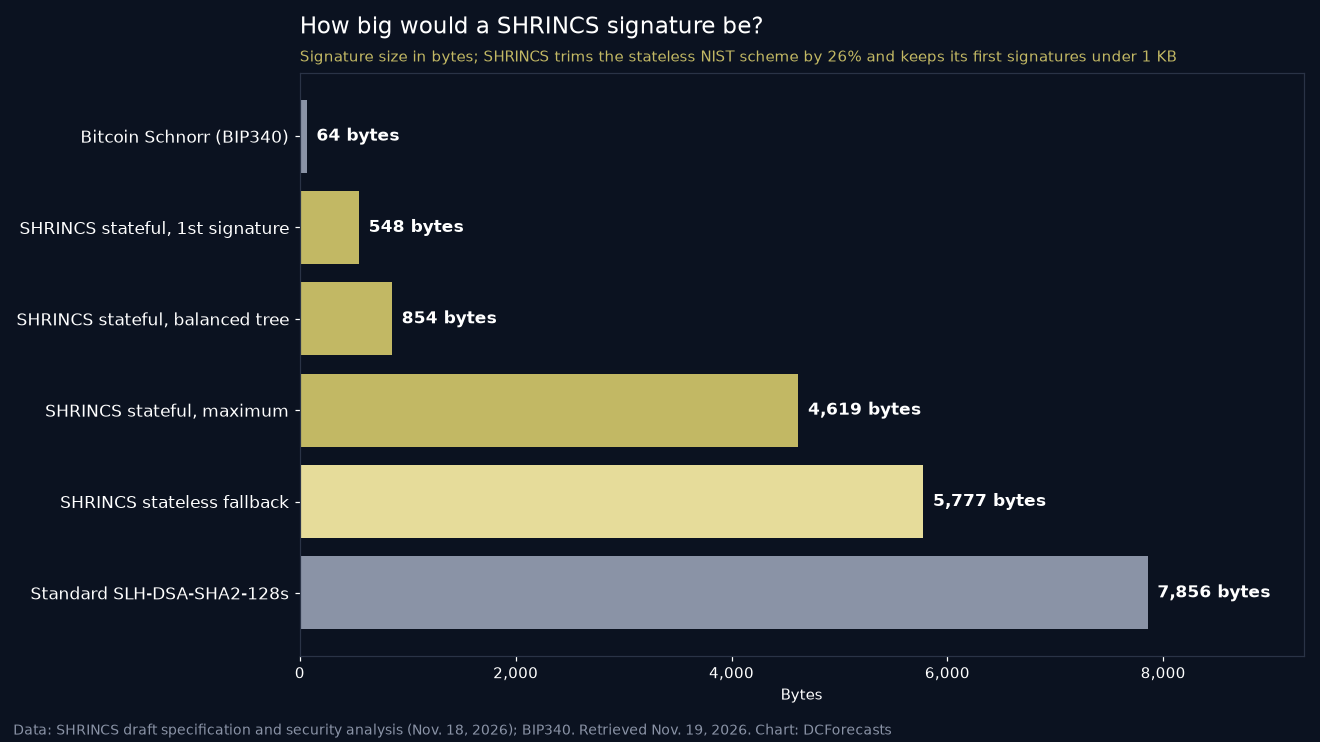
The evaluation provides element on how the stateful path behaves in follow. With an unbalanced tree, the primary signature from a key takes 548 bytes, and every later one provides 16 bytes for the primary eight signatures.
With a balanced tree, each signature is a hard and fast 854 bytes.
Verification stays mild as effectively. The paper says a balanced-tree signature verifies with 262 tweakable-hash calls on the reference tree depth of 20, which issues for nodes that should test each transaction.
The stateless fallback can be leaner than the usual it’s primarily based on. The specification says limiting what number of signatures a key can produce cuts the dimensions from 7,856 bytes for SLH-DSA-SHA2-128s to five,777 bytes, a 26% discount.
For a community the place block house is valuable, maintaining on a regular basis signatures under 1 KB is a significant win.
The authors additionally weighed a devoted hybrid with right this moment’s Schnorr signatures. The specification notes {that a} approach known as Hen-of-Prey-2 may save 32 bytes in contrast with merely attaching each signatures, however it selected to not outline one, citing restricted additional advantage and additional complexity.
Maintaining issues easy has one other upside. The specification factors out that BIP340 already depends on SHA-256 for its safety, so SHRINCS doesn’t ask Bitcoin to undertake a brand new sort of cryptographic guess.
The Commerce-Off: Wallets Should Monitor State
The compact path comes with a strict rule. The specification states {that a} state counter worth must not ever be reused underneath the identical key pair, as a result of reuse “can allow anybody who observes the ensuing signatures to provide forgeries.”
That places the burden on pockets software program. If a key’s state counter is misplaced, corrupted or unsure, the specification says an implementation should refuse stateful signing.
SHRINCS is constructed to deal with that case. It helps static seed-phrase backups and a “stateless-only after restoration” mode, so a restored pockets can preserve signing safely with the bigger fallback.
In different phrases, customers who restore from a seed phrase wouldn’t lose entry. They might merely pay for larger signatures till a contemporary key’s in use.
What the Safety Proof Covers
The paper reduces the scheme’s safety to properties of its underlying hash features and evaluates concrete bounds for the proposed parameters.
It’s upfront about its limits. The figures relaxation on three acknowledged conjectures, and a number of the quantum outcomes rely upon them. The challenge’s repository additionally notes the paperwork haven’t but been sufficiently peer reviewed or independently audited.
That candor is a power. Bitcoin upgrades transfer slowly by design, and a public, line-by-line proof invitations the scrutiny any change to the signature system will want.
Why This Issues for Bitcoin
Strain to organize is rising. International securities regulators just lately instructed monetary companies to plan for quantum code-breakers inside 5 years.
Bitcoin’s publicity is concentrated in cash whose public keys are already seen on-chain, and as we reported, 35.4% of Bitcoin had a visual public key, a lot of which could be mounted by shifting cash.
SHRINCS doesn’t settle the talk, and it might nonetheless want intensive assessment, a separate consensus change and broad settlement earlier than any use. However a compact, SHA-256-based choice with a broadcast proof provides builders a severe candidate to check.
For long-term holders, that’s the sort of gradual, cautious engineering that has stored Bitcoin safe since 2009. Every draft like this one brings the community nearer to a examined, conservative path for the quantum period.
DC Forecasts is a frontrunner in lots of crypto information classes, striving for the very best journalistic requirements and abiding by a strict set of editorial insurance policies. In case you are to supply your experience or contribute to our information web site, be happy to contact us at [email protected]

