

Each go-to-market vendor now says it has a context graph. Some have constructed one. Others have renamed a database, a CRM, or a search index, and the pitch sounds a lot the identical both means.
The declare is spreading quick. Adam’s GTM Report, which tracks the dialog, discovered that the share of core GTM tech homepages utilizing the phrase “context” rose from 26% within the first quarter of 2026 to 40% by November.
I clarify a context graph the way in which I might clarify assembly prep. Earlier than an enormous buyer assembly I ask the vendor to inform me all the pieces we all know concerning the account: each dialog, who the executives are, what know-how they run, what modified there final quarter. Pulling that collectively can take an individual eight hours, they usually nonetheless miss issues. A context graph holds all of it, already related, for an individual or an AI agent to make use of. Our information to the B2B context graph has the total definition.
This text is for the customer who already is aware of the idea and has to decide on. It offers you ten issues to test and the inquiries to put to every vendor. Underneath every, I’ve set out how ZoomInfo’s GTM Context Graph measures up, with proof you’ll be able to test.
I run the corporate that sells one, so check our solutions as exhausting as anybody’s. My view is that the very first thing to test is the reference knowledge a graph resolves towards, and most of this information follows from that.
Why go-to-market context is more durable than it seems
We expect loads about why AI took off in software program engineering and struggled in go-to-market. A coding agent sits on high of your codebase. The codebase is machine-readable, it’s in a single place, and it holds all the pieces the agent wants to jot down the subsequent line.
Go-to-market has two issues that engineering doesn’t. Your first-party knowledge is scattered throughout knowledge silos: the CRM, e mail, name transcripts, advertising and marketing packages, enablement paperwork. And go-to-market context wants third-party knowledge too. If a buyer introduced on yesterday’s earnings name that it’s increasing throughout EMEA, nothing in your personal programs is aware of that.
I feel each group will find yourself with three context graphs. One will serve product and engineering, one will serve enterprise search, and one will serve go-to-market. The primary two run on knowledge the corporate already owns. The third doesn’t, and it modifications each time one thing occurs within the exterior world.
The price of getting it improper isn’t a crash. AI offers you limitless cognition, and most groups are operating it on little items of context. So the agent confidently emails a champion who left two months in the past, or books a renewal name with the improper subsidiary. It’s a massive a part of why AI alone is not sufficient to maneuver the productiveness numbers on most income groups.
5 methods groups attempt to clear up context, and the place every falls quick
Few folks now dispute that context is the issue. They disagree on how you can clear up it. Adam Schoenfeld, the unbiased analyst behind Adam’s GTM Report, types the solutions he sees in the marketplace for GTM context into 5:
-
Construct your personal graph. You get complete management and a graph formed to your movement. You additionally tackle identification decision, hierarchy, and maintenance your self.
-
Purchase a GTM-specific resolution. A vendor has resolved the skin world and retains it present. You depend upon that vendor’s protection and roadmap.
-
Make the CRM your context layer. The data and workflows already stay there. So do the CRM knowledge high quality issues.
-
Purchase an enterprise-wide resolution. A warehouse or enterprise search instrument offers you knowledge governance throughout all firm knowledge. It is aware of little about firms and consumers exterior your partitions.
-
Use the agent’s personal context. There’s nothing to construct, as a result of context comes with the agent you purchased. The agent solely sees what it does and what you give it.
Within the report’s knowledge the final reply is the one gaining floor, up from 8% of posts earlier than October to 14% since. It is usually the toughest to examine, which is an effective purpose to carry a guidelines.
Ten issues to search for in a GTM context graph, and the way ZoomInfo measures up
Don’t accept slides. Any vendor that has a context graph ought to be capable to open it on an account you understand nicely and present you what it holds. We constructed a visible view of the graph for each account for that purpose, as a result of folks understood it as soon as they may see each name, e mail, assembly, and web site go to related to the account.
1. Entity decision
The graph ought to give each firm and each individual one identification and connect each file to it. That’s more durable than it sounds, as a result of the programs that maintain your knowledge share no widespread identifier. Your name recorder could know a buyer as Uber. Your CRM could have it as Uber Freight, or underneath the title of an organization Uber acquired years in the past. An agent has to know these are one buyer earlier than it may let you know something concerning the relationship.
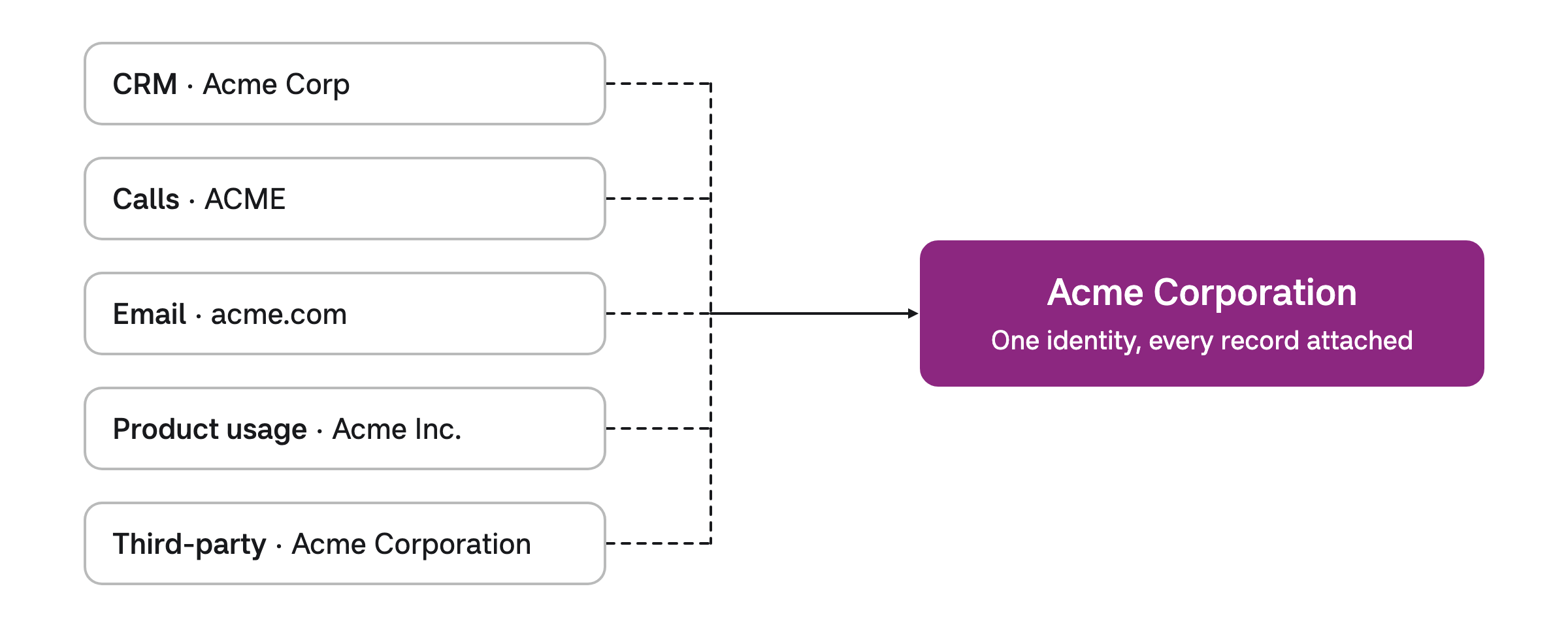
Matching on area or on title and deal with alone will miss renamed firms, shared domains, and individuals who modified jobs. Our information to the identification decision API units out what to guage, and our information to knowledge deduplication covers the cleanup facet.
-
Ask the seller. How do you match data when two sources disagree? In the event you present me a benchmark, does it measure matching accuracy, or does it begin from data that had been already merged?
-
How ZoomInfo measures up. The GTM Context Graph joins data from programs that share no widespread identifier, utilizing 16 patented AI GTM-linkages, and resolves them towards our personal file of every firm and individual. A guardian, its subsidiaries, and the contacts throughout them sit in a single related image. This rests on years of labor no one noticed. We collected each means an organization writes its title and each area it makes use of, in order that uber.com, uber.co, and a subsidiary’s title all roll as much as one account within the company hierarchy.
2. Reference knowledge beneath it
In any universe the place you’re constructing a context graph for go-to-market, you want foundational reference knowledge on the core. Decision wants one thing to resolve towards: a maintained file of authorized names, manufacturers, dad and mom, subsidiaries, and executives, and of how they modify. Your first-party knowledge doesn’t replace itself when a CEO leaves or an acquisition closes. In knowledge phrases that is grasp knowledge administration.
Ask whether or not the seller owns that dataset or rents it from one other B2B knowledge supplier. Renting just isn’t mechanically worse, and operating a waterfall throughout a number of suppliers can widen protection area by area. However, it does depart open which file is the grasp once they disagree.
-
Ask the seller. Do you personal the dataset you resolve towards, how is it verified, and which file wins when sources disagree?
-
How ZoomInfo measures up. We personal it. ZoomInfo maintains 100M+ firms and 500M+ contacts, verified by a multi-source pipeline and 300+ researchers, and validates each file towards 40+ sources. We have no idea of one other system that manages entities on the folks stage and the corporate stage at that scale.
For comparability, Apollo lists 240M+ contacts and 30M+ firms, sourced partly via a contributor community, and Clay attracts on a market of 200+ suppliers that every confirm their very own knowledge. In two unbiased checks in 2026, ZoomInfo matched extra direct dials than Apollo: 71% towards 52% in clugtm’s check and 61% towards 43% in Cotera’s.
3. First-party and third-party knowledge in the identical graph
Your CRM, calls, and emails say what occurred with an account. Exterior knowledge says what is occurring to it: shopping for indicators resembling funding, hiring, and management modifications, the technographics of what they run, and intent knowledge. A graph with solely one of many two offers brokers half the image.
Test the depth of the first-party facet as nicely. An excessive amount of context will get trapped inside conversations and by no means reaches the remainder of the go-to-market movement: the objection a purchaser raised, the three options they mentioned they had been lacking. The graph additionally wants your enterprise context, so it may inform which information matter to you. A buyer’s progress in EMEA is significant to 1 vendor and irrelevant to a different. Our information to context knowledge for AI covers the categories intimately.
-
Ask the seller. Which exterior sources are within the graph? Are calls and emails captured in full, or solely logged as exercise?
-
How ZoomInfo measures up. The graph resolves your CRM, calls, and emails with ZoomInfo’s intelligence on firms, contacts, and billions of indicators into one present file per account. Dialog intelligence feeds what consumers mentioned again into that file. It may well additionally soak up indicators from different sources alongside our personal, which is how some groups run it subsequent to 6sense or Demandbase.
4. Freshness
After getting tied all the pieces collectively, it modifications continuously, and many of the change comes from exterior your partitions. Corporations develop and shrink. Individuals depart and be a part of. Corporations elevate funding, purchase new know-how, change their names, and purchase one another. A coding agent’s context just isn’t affected by the skin world on this means, and a go-to-market graph is affected daily. It’s why B2B knowledge decay by no means stops.
-
Ask the seller. How usually do data replace, what triggers an replace, and what occurs to a proven fact that has gone stale?
-
How ZoomInfo measures up. The graph processes 1.5B+ knowledge factors each day. Indicators, job modifications, and firm occasions are refreshed and verified by the identical pipeline and researchers, so a contact pulled in March displays their July job change. Maintaining the record present stops being your crew’s job, which is most of what CRM hygiene work is right now.
5. A supply on each reality
An agent’s reply is just as reliable as your capacity to test it. Search for the supply and a confidence stage on every attribute, and for solutions that cite the file, name, or sign they got here from. Our information to verified knowledge for AI brokers explains why this issues.
-
Ask the seller. Can I see the place this worth got here from, and the way assured you’re in it?
-
How ZoomInfo measures up. Context is resolved earlier than anybody acts, with a recognized supply behind each reality, and attributes carry confidence scores. When Agent Groups end a chunk of labor, it lands within the vendor’s feed with its sources hooked up, so a rep can see why an account was picked earlier than approving something.
6. Resolution historical past
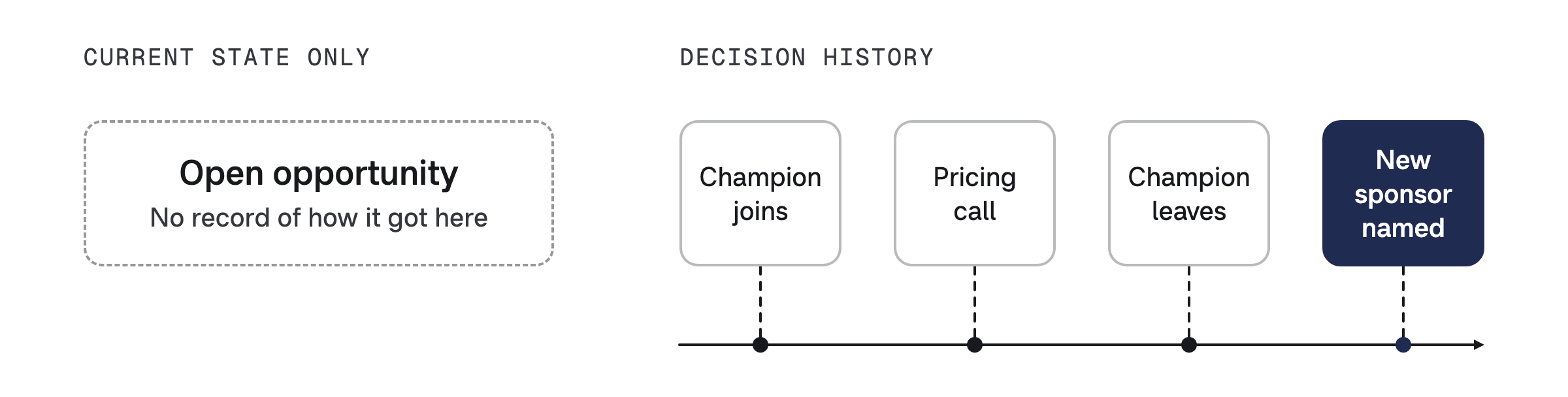
The thought of a context graph got here from buyers at Basis Capital, whose essay on context graphs described it as a file of selections: what was recognized, what was carried out, and what occurred subsequent. In observe, an agent ought to know what you mentioned with an account previously, whether or not you engaged them within the final 30, 60, or 90 days, and what they advised you mattered.
-
Ask the seller. Can I see what modified on this account and in what order, or solely the place it stands right now?
-
How ZoomInfo measures up. The graph holds the sequence of occasions behind every account’s present state: alternatives, conferences, e mail threads, name recordings, and sequence exercise, so as. We’ve got not revealed a proper decision-trace mannequin of the sort some startups describe, so if that’s central to your use case, ask us to point out you the account timeline.
7. Write-back
When a rep edits an agent’s draft or approves an motion, that final result ought to replace the graph. A graph that brokers can solely learn won’t enhance with use. Our information to AI brokers in CRM covers how a lot autonomy to permit.
-
Ask the seller. What occurs to the graph when a rep edits or rejects an agent’s work?
-
How ZoomInfo measures up. Each approval and edit writes again to the graph, so the subsequent play, marketing campaign, or vendor begins from a greater image. What gross sales learns on an account improves the file that advertising and marketing builds its subsequent viewers from.
8. Permissions and governance
Brokers ought to see solely what the individual they act for is allowed to see. Ask how permissions carry over out of your supply programs, whether or not agent exercise is logged, and which certifications the seller holds. Our guides to AI agent governance and B2B knowledge vendor compliance go deeper.
-
Ask the seller. How do my current entry guidelines apply to brokers, and the place is the audit path?
-
How ZoomInfo measures up. Entry via MCP inherits your current role-based permissions, and enterprise controls embrace SCIM, knowledge entry controls, and a DPA. ZoomInfo holds ISO/IEC 27001, 27701, 27017, and 42001 for AI governance, plus SOC 2 Kind II and the TRUSTe Accountable AI Certification. All of it’s revealed in our Belief Heart.
9. Open entry and portability
You’ll run multiple agent, and a few will probably be ones you construct. The identical graph must be reachable via MCP and an API at a minimal, with no decreased model for out of doors instruments, and a command line is a bonus for technical groups. Our information to MCP vs API explains when to make use of which.
Preserve one distinction in thoughts. A connection resembling MCP offers an agent entry to your programs, and entry is completely different from understanding. Open entry is just value having when what sits behind it’s already resolved. We cowl that argument in our piece on the GTM harness debate. Ask what you’ll be able to take with you too, as a result of your corrections and historical past develop into a part of the graph.
-
Ask the seller. Can brokers I construct use the identical graph yours do, and what can I export?
-
How ZoomInfo measures up. You used to get ZoomInfo knowledge in a single place, our personal platform. Right now the identical basis is open via GTM.ai by MCP, API, and command line, with the identical knowledge and the identical governance. Brokers attain it inside Claude, via the gross sales plugin for ChatGPT, inside Snowflake, and from Replit, n8n, and the functions you construct your self. Audiences push to your CRM, your engagement instruments, and your warehouse.
10. Proof, price, and time to worth
Ask for a managed comparability towards plain retrieval by yourself accounts, and for price at your anticipated quantity. Ask how lengthy setup takes and who does the work.
-
Ask the seller. What modified for a named buyer, what’s going to it price at my quantity, and the way lengthy is setup?
-
How ZoomInfo measures up. We publish our personal check and its methodology. In GTM Bench v1, an AI agent completed ten GTM duties in 32 minutes on ZoomInfo’s MCP, towards 101 minutes on Apollo, and stuffed 94% of work-email fields towards 84%. Run price was shut: $15.80 with our MCP and $10.12 with our CLI, towards $14.78.
A scorecard to take to each vendor
|
Criterion |
Query to ask |
Pink flag |
ZoomInfo’s GTM Context Graph |
|---|---|---|---|
|
Entity decision |
How do you match data when sources disagree? |
Area or title match solely |
16 patented AI GTM-linkages, hierarchy-aware |
|
Reference knowledge |
Do you personal the dataset you resolve towards? |
“We use your CRM because the supply of reality” |
Owned: 100M+ firms, 500M+ contacts, 40+ sources per file |
|
First- and third-party knowledge |
Which exterior sources are within the graph, and the way deep is the first-party seize? |
Solely one of many two, or no shared identification |
CRM, calls, emails, and billions of indicators in a single file per account |
|
Freshness |
What triggers an replace, and how briskly? |
“Actual-time” with no element |
1.5B+ knowledge factors processed each day |
|
Supply on each reality |
Can I see the place this worth got here from? |
Accuracy percentages with no methodology |
Recognized supply behind each reality, confidence per attribute |
|
Resolution historical past |
Can I see what modified on this account and in what order? |
Present state solely |
Sequence of occasions per account; no revealed decision-trace mannequin |
|
Write-back |
What occurs to the graph when a rep edits an agent’s work? |
Learn-only entry for brokers |
Each approval and edit writes again |
|
Permissions |
How do my current entry guidelines apply to brokers? |
“Brokers respect permissions” with no mechanism |
Inherited role-based permissions, ISO 42001, SOC 2 Kind II |
|
Open entry and portability |
Can brokers I construct use the identical graph, and might I export my knowledge? |
Restricted model for out of doors instruments, or no export |
MCP, API, and CLI on the identical knowledge and governance |
|
Proof, price, and time to worth |
What modified for patrons, what’s going to it price, and the way lengthy is setup? |
Vendor-run benchmark with no methodology |
Printed benchmark and methodology, named clients, free begin on GTM.AI |
How the principle approaches to a context graph examine
Distributors arrive at a context graph from completely different beginning factors, and the start line decides what the graph is nice at.
-
Knowledge-foundation-led. The graph begins from an owned dataset of firms and other people, then joins your first-party knowledge to it. ZoomInfo takes this strategy.
-
Dialog-led. The Gong Income Graph is constructed on dialog intelligence: captured calls, emails, and CRM exercise. Exterior contact knowledge comes via associate suppliers.
-
CRM-led. HubSpot’s Development Context and Salesforce Knowledge 360 construct on the shopper file they already maintain. Salesforce affords configurable identification guidelines throughout the information you carry to it.
-
Sign-led. 6sense and Demandbase maintain their very own account knowledge and intent indicators, the mannequin of an intent knowledge platform, and expose them to brokers. Widespread Room resolves product, group, and CRM indicators to folks.
-
Income-context startups. Day AI, RevSure, Warmly, Vasco, and Clearskies construct a graph from your personal CRM, calls, and billing. Octave covers a distinct layer: your positioning, ideally suited buyer profile, and messaging.
-
Horizontal enterprise instruments. Glean and Notion index inner paperwork, messages, and notes underneath current permissions, and attain exterior account knowledge via connectors.
|
Method |
Constructed on |
Strengths |
Limitations |
Greatest match |
|---|---|---|---|---|
|
Knowledge-foundation-led |
Owned B2B dataset joined to your CRM, calls, and indicators |
Id, hierarchy, and protection of accounts you might have by no means touched |
Dialog depth is determined by what you join; you depend on one vendor’s dataset |
Groups whose brokers work throughout the entire market |
|
Dialog-led |
Recorded calls, emails, deal exercise |
Wealthy element on stay offers |
No owned reference knowledge; skinny on accounts with no interactions |
Groups centered on deal execution and training |
|
CRM-led |
The CRM file and exercise |
Already the place the work occurs; mature governance |
Inherits CRM duplicates and gaps; exterior knowledge comes from companions |
Groups standardized on one CRM |
|
Sign-led |
Owned account knowledge, intent, behavioral indicators |
Timing and prioritization |
Little determination historical past or write-back described |
Advertising and ABM groups |
|
Income-context startups |
Your individual programs solely |
Clear definitions, cited solutions, determination data in some |
No market knowledge; younger merchandise |
Groups that want their very own numbers and historical past to reconcile |
|
Horizontal enterprise instruments |
Inner content material |
Permission-aware search throughout all the pieces written down |
No mannequin of exterior firms and consumers |
Firm-wide information, alongside a GTM supply |
Why we predict ZoomInfo’s GTM Context Graph is the fullest
A full graph wants 4 issues in a single system: owned reference knowledge, your first-party knowledge resolved towards it, stay indicators from exterior, and open entry for any agent. Most graphs begin robust on one or two of the 4 and fill within the others via companions. That’s what we constructed the knowledge basis for agentic AI to keep away from.
May a competitor with limitless cash purchase its means right here? I don’t suppose so. There’s an excessive amount of area experience in how go-to-market groups want knowledge matched, mapped to hierarchies, and delivered, and it took us years and 1000’s of buyer conversations to construct.
Must you construct a context graph or purchase one?
Constructing is real looking for the first-party half. You’ll be able to pipe CRM, name, and product knowledge right into a warehouse and outline your personal metrics. Groups with robust knowledge engineering do that nicely.
The exhausting half is identification. It’s essential to know when two data are the identical firm, when comparable names are completely different firms, how subsidiaries roll up, who works the place right now, and the way all of it modifications over time. That could be a everlasting upkeep job. It is usually the least attention-grabbing knowledge you may ever collect, which is why most groups would sooner purchase it.
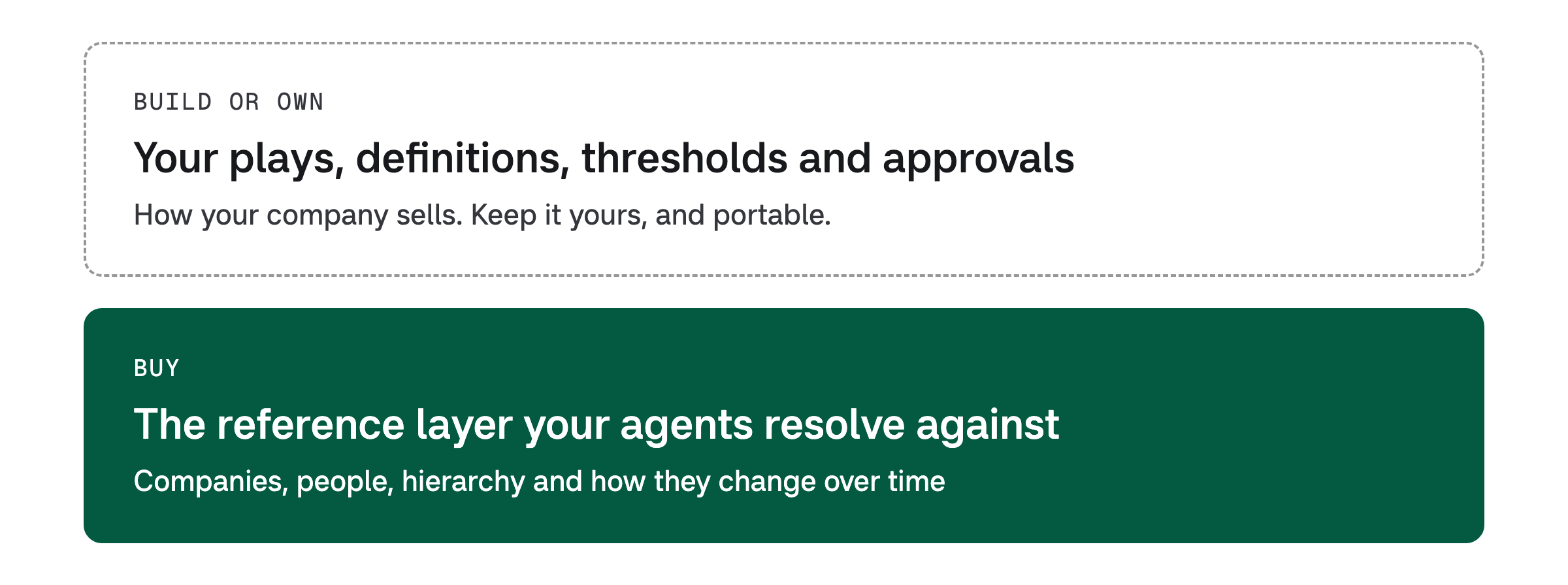
Operators are touchdown in an analogous place. Kyle Norton, a income chief, has written on the query. He argues towards shopping for the layer that encodes how your organization sells: purchase the commodity infrastructure, and construct or a minimum of personal the remainder. By that check a vendor’s graph must be the infrastructure, and your performs and definitions ought to keep yours.
A workable cut up is to personal your performs, thresholds, and approvals, and purchase the reference layer. The winners with AI in go-to-market would be the groups that spend their time on the context graph first, whichever means they get it. Our information to the GTM knowledge basis units out a roadmap by firm dimension.
Incessantly requested questions on evaluating a GTM context graph
What’s a GTM context graph?
A GTM context graph is a related, queryable construction that hyperlinks accounts, contacts, engagements, and indicators so AI brokers can learn them as one image. It combines your first-party knowledge with exterior knowledge about firms and other people. Our B2B context engine information covers how that reaches brokers.
How is a context graph completely different from a CRM?
A CRM data the present state of a relationship as folks enter it. A context graph resolves data from many programs to 1 identification and retains the occasions behind that state. It doesn’t substitute the CRM. It offers brokers a dependable approach to learn it alongside the remainder of your go-to-market intelligence.
Which GTM distributors have a context graph?
ZoomInfo, Day AI, RevSure, Warmly, Vasco, and Octave use the time period for their very own merchandise. ZoomInfo’s it constructed on 20 years’ of proprietary knowledge, plus your personal sources (CRM, and different tooling you employ).
What knowledge does a GTM context graph want?
It wants reference knowledge on firms and other people, the core of go-to-market knowledge, plus your CRM and engagement historical past, dialog knowledge, and out of doors indicators resembling intent and job modifications. The reference knowledge issues most, as a result of each different file is matched towards it.
How do I check whether or not a context graph improves outcomes?
Run the identical agent activity on a set of your personal accounts twice, as soon as with the graph and as soon as with plain retrieval out of your CRM. Examine accuracy, time, and value per run. Then test a pattern of solutions towards their cited sources.

