

The hole between a productiveness platform’s function set and its API floor tells you every thing about what the seller expects builders to do with it.
Movement’s API is a REST floor at v1, protecting duties, tasks, recurring duties, customized fields, feedback, customers, workspaces, schedules, and statuses. Authentication makes use of a static API key in an X-API-Key header, the developer docs are public, and charge limits sit at 12 requests per minute for particular person accounts and 120 for groups. All subscribers get entry, with no enterprise gate.
However the API exposes the duty and undertaking layer solely. Movement’s headline capabilities (AI auto-scheduling, calendar intelligence, capability planning, assembly notetaking, AI Chat, reserving hyperlinks) haven’t any API floor in any respect.
Movement’s API provides you programmatic CRUD over duties, tasks, and a handful of supporting assets. It doesn’t expose the scheduling engine, the calendar, the AI layer, or any event-driven mechanism. In case your integration must create and handle duties inside Movement from an exterior system, the API covers that. In case your construct is dependent upon studying or writing to Movement’s calendar, triggering workflows on scheduling occasions, or accessing AI-driven output, the API stops effectively in need of what the product does.
That is the place ZoomInfo enters the image: an AI go-to-market platform whose API is a REST suite protecting search, enrichment, AI intelligence, and viewers administration throughout a B2B dataset of 500M contacts and 100M firms, with OAuth 2.0 authentication, tiered charge limits as much as 35 req/sec, and an MCP server for AI-agent workflows.
The 2 APIs sit at totally different layers: Movement manages inner work execution, ZoomInfo gives the exterior B2B intelligence that informs who you’re employed on and why.
This evaluation covers the Movement API in technical depth first, then critiques ZoomInfo’s API because the layer that covers what Movement’s API doesn’t.
Movement API at a Look
|
Attribute |
Element |
|---|---|
|
API sort |
REST over HTTPS, JSON responses |
|
Authentication |
API key through X-API-Key header |
|
Base URL |
https://api.usemotion.com/v1 |
|
Present model |
v1 |
|
Charge limits |
12 req/min (Particular person), 120 req/min (Group); Enterprise limits out there on request |
|
Pricing / entry |
Included on all paid plans ($19/seat/month entry); no separate API tier |
|
SDKs |
No official SDKs |
|
Webhooks |
Not out there |
|
Documentation |
Movement API: What Works Nicely & What to Plan Round
|
What works effectively |
What to plan round |
|---|---|
|
API included on all paid plans, no enterprise gate or separate signup |
12 req/min on Particular person tier is restrictive for any manufacturing integration |
|
A number of API keys supported, every named and individually revocable |
No OAuth 2.0: static API keys solely, no delegated entry or scoped permissions |
|
Job CRUD covers create, learn, replace, delete, transfer, and unassign |
No calendar, scheduling, or AI endpoints: the API exposes duties and tasks, not the product’s core intelligence |
|
Customized Fields API permits structured metadata on duties and tasks |
No webhooks or event-driven callbacks; polling is the one possibility |
|
No enterprise approval gate: generate a key in Settings and begin constructing |
No official SDKs in any language |
|
Tasks and recurring duties are first-class API assets |
Zapier integration is one-way solely: exterior occasions create Movement duties, however Movement doesn’t push occasions again |
Movement API: Authentication & Getting Began
Any Movement subscriber can entry the API. The integrations web page confirms “the API is obtainable for all customers,” that means each the $19/month Professional AI and $29/month Enterprise AI plans embrace it. No separate developer signup, no approval workflow, and no enterprise-only gate.
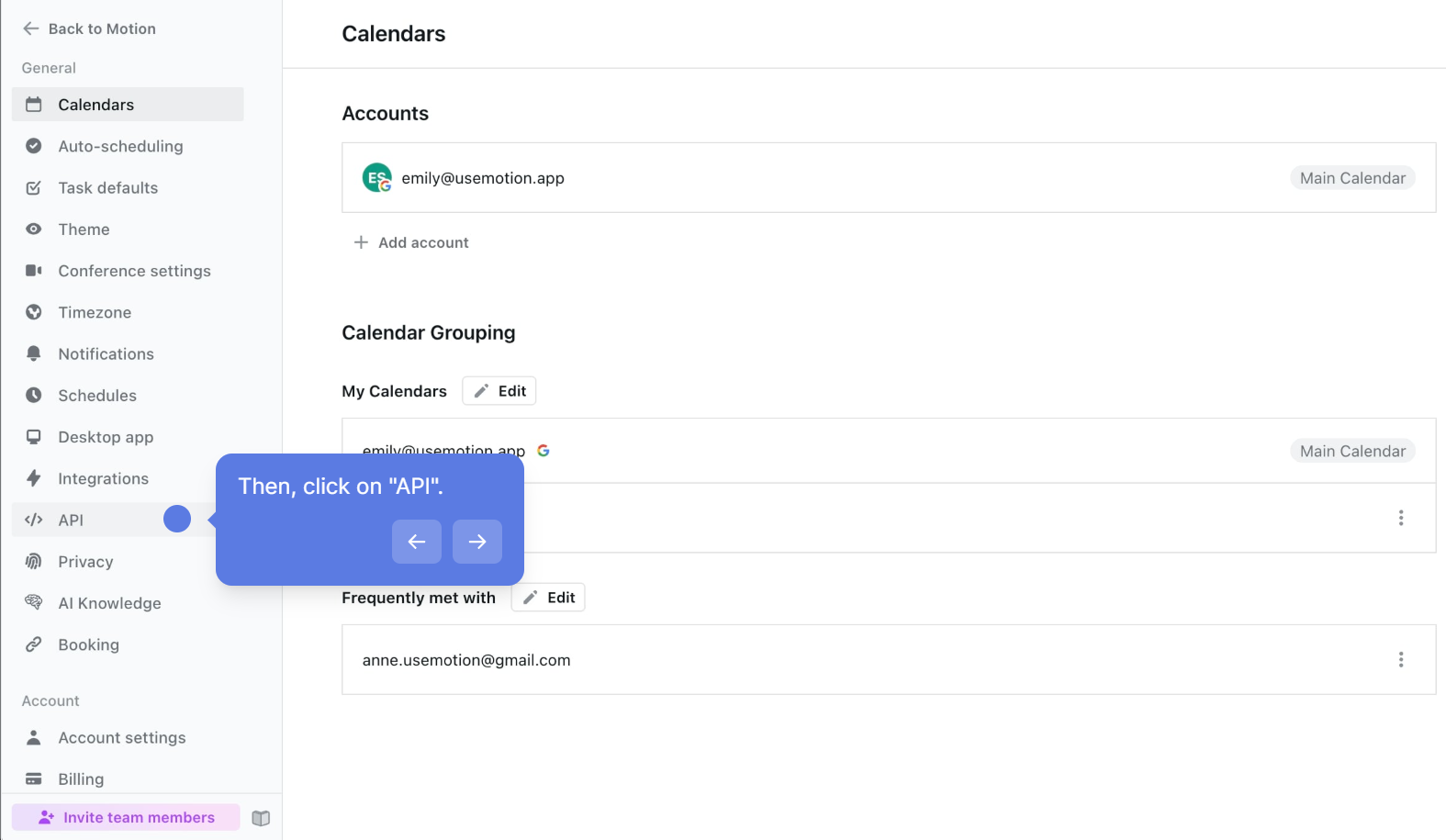
You create keys contained in the Movement app at Settings > API (underneath Integrations). Click on “+ Create API Key,” title it, and duplicate the important thing instantly. Movement exhibits it solely as soon as and won’t get well it after dismissal. You’ll be able to create a number of keys, every with its personal title, and disable or delete them individually.
Supply: Movement
This helps primary rotation and audit practices: title keys by integration, revoke a compromised key with out disrupting others.
Authentication makes use of a customized header on each request:
curl -X GET “https://api.usemotion.com/v1/duties”
-H “X-API-Key: YOUR_API_KEY”
There isn’t a OAuth 2.0 movement, no token alternate, no refresh tokens, and no scoped permissions. Each key has full entry to each API operation within the workspace.
For groups constructing multi-tenant integrations (the place every buyer authenticates with their very own Movement workspace), every buyer should generate and share a static API key manually.
One word earlier than constructing: Movement’s assist middle frames the API as meant for “superior customers” who want customized workflows past what native integrations or Zapier present. The API is supported, however it isn’t the combination path Movement invests in most.
Movement API: Core Endpoints & Capabilities
The API reference paperwork ten useful resource areas. The endpoint catalog covers the duty and undertaking administration layer of the product; it doesn’t lengthen to calendars, scheduling automation, AI options, assembly notes, or reserving hyperlinks.
Duties
Probably the most developed floor within the API, protecting the total process lifecycle.
Operations: Listing, get, create, replace, delete, transfer (between tasks), and unassign.
Key parameters on process creation embrace title, description, undertaking ID, assignee, precedence (ASAP, Excessive, Medium, Low), period, deadline, begin date, and customized subject values. The record endpoint helps filtering and returns duties with their present scheduling state.
What you’ll construct with this: a CRM-to-Movement sync that creates duties in particular tasks when offers attain a stage, or a ticketing system integration that pushes assist tickets into Movement as prioritized duties for the workforce’s auto-scheduler to put.
Tasks
Operations: Listing, get, create.
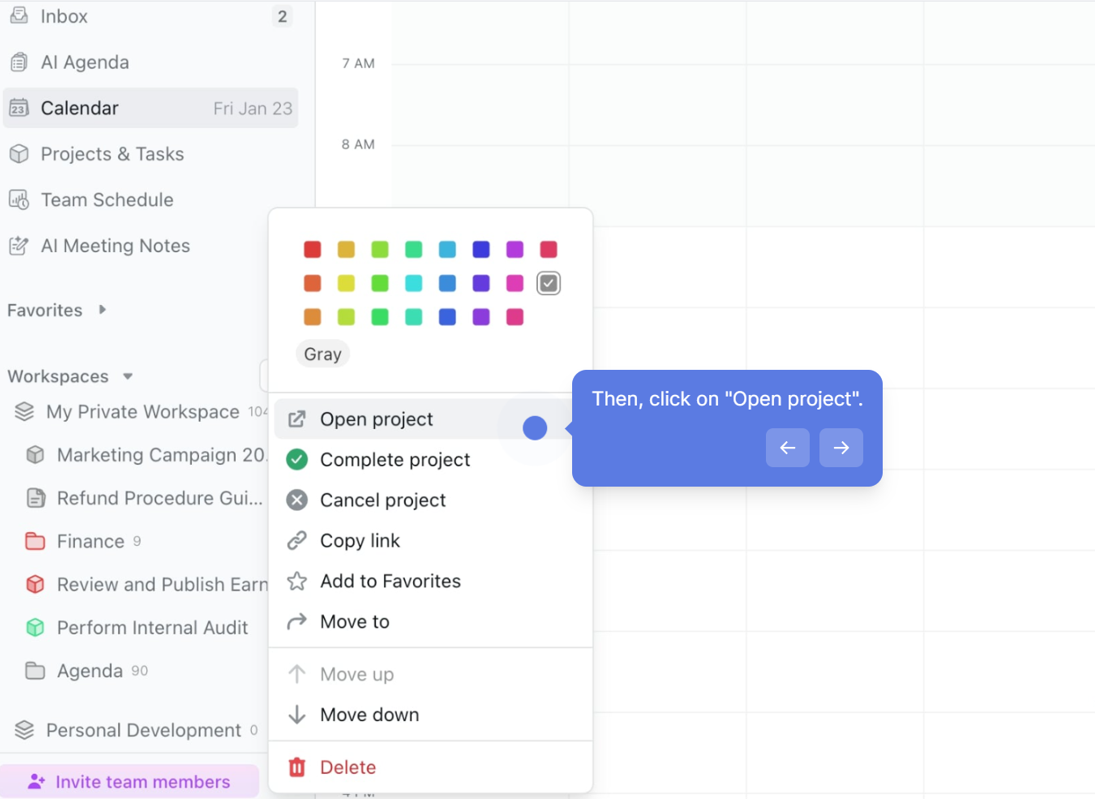
Tasks are containers for duties. The API permits you to record all tasks in a workspace, retrieve a particular undertaking by ID, and create new ones. Replace and delete usually are not out there by means of the API; modifying or eradicating a undertaking requires the Movement UI.
Supply: Movement
Recurring Duties
Operations: Listing, create, delete.
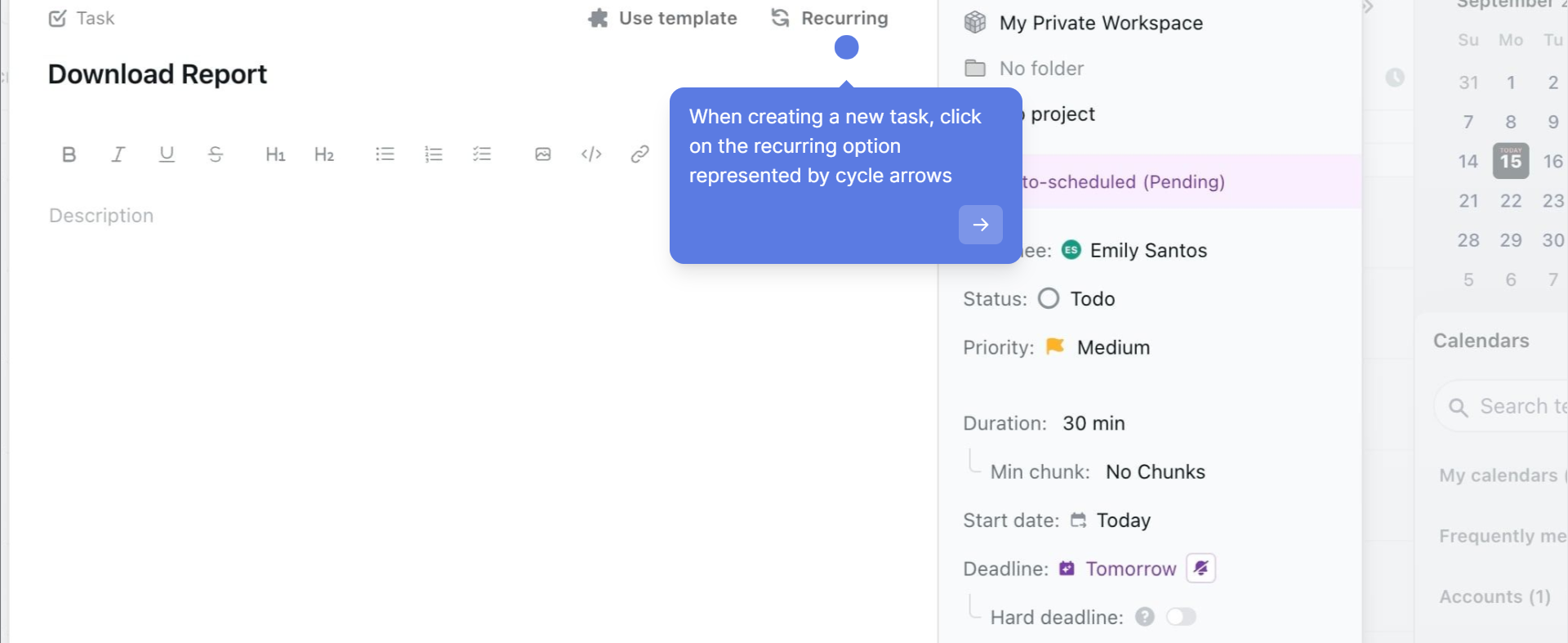
The API manages recurring duties as a separate useful resource. You’ll be able to create recurring process definitions with recurrence guidelines, record present ones, and delete them. The API handles the definition; Movement’s scheduling engine handles placement of recurring situations on calendars.
Supply: Movement
Customized Fields
Operations: Create, get, delete; add to tasks and duties, take away from tasks and duties.
Customized fields allow you to connect structured metadata (textual content, quantity, dropdown, date) to duties and tasks. The API helps the total lifecycle: outline a subject, affiliate it with particular tasks, set values on particular person duties, and take away associations. That is helpful for integrations that must tag Movement duties with exterior identifiers (a CRM deal ID, a assist ticket quantity, a dash label).
Feedback
Operations: Get, create.
Learn and write feedback on duties. The API doesn’t doc replace or delete operations.
Customers
Operations: Listing all customers within the workspace, get the present authenticated consumer through GET /v1/customers/me.
Use the customers/me endpoint to verify which workspace and id your API key belongs to.
Supporting Sources
Three read-only assets spherical out the API:
These are reference endpoints: they return configuration information that different API calls reference by ID.
Movement API: Webhooks & Occasions
Movement doesn’t supply webhooks. The general public developer documentation, assist middle, and API reference doc no webhook functionality. There are not any event-driven callbacks, no push notifications on process state modifications, and no subscription mechanism.
For integrations that must react to modifications in Movement (a process finishing, a undertaking standing shifting, an task altering), polling is the one possibility. At 12 requests per minute on the Particular person tier, polling is each the one path and a constrained one.
The Zapier integration is one-way solely: exterior app occasions can set off process creation in Movement, however Movement process modifications don’t push again to related apps through Zapier. This confirms that Movement has no outbound occasion mechanism, by means of its API or its iPaaS connector.
This can be a actual hole for any developer constructing an integration that is dependent upon Movement as a supply of occasions. With out webhooks, you can’t construct real-time sync, can not set off downstream workflows on process completion, and can’t hold an exterior system consistent with Movement with out steady polling.
Movement API: SDKs, Docs & Charge Limits
SDKs & Libraries
Movement doesn’t publish official SDKs in any language. The developer documentation references no consumer libraries, GitHub repositories, or group wrappers. Builders name the REST API instantly utilizing customary HTTP purchasers in no matter language they like.
No official SDK is a sign, not a dealbreaker. For an API with ten useful resource areas and simple REST conventions, a skinny HTTP wrapper is manageable. However it means you personal the retry logic, the rate-limit backoff, the error dealing with, and the request serialization from day one.
Documentation & Developer Expertise
Movement’s developer documentation lives at docs.usemotion.com and has an API reference part (endpoint-by-endpoint documentation) and a cookbooks part with sensible guides protecting Getting Began and Charge Limits.
The API reference gives endpoint paths, request parameters, and response schemas. Every useful resource has its personal detailed reference, with thorough protection for the endpoints that exist. The documentation doesn’t embrace an interactive OpenAPI/Swagger explorer, a Postman assortment, or a public API changelog.
Builders attain assist by means of Movement’s customary assist e mail moderately than a devoted developer discussion board, Slack workspace, or group channel. Movement publishes no changelog for API modifications and states no versioning coverage. The API sits at v1 with no indication of when or whether or not Movement would model breaking modifications.
For a developer evaluating this API, the docs are sufficient for understanding what the endpoints do. What they don’t present is the interactive testing, machine-readable spec, or change-tracking that manufacturing integrations profit from.
Charge Limits & Constraints
Movement publishes tiered charge limits:
Movement paperwork no per-day caps, burst allowances, or rate-limit response headers, and doesn’t specify whether or not 429 responses embrace a Retry-After header or backoff steering.
The Particular person tier at 12 requests per minute is the constraint almost definitely to form your integration structure. That’s one request each 5 seconds.
For a easy integration that creates a handful of duties per hour, it’s workable. For an integration that should sync a significant quantity of information (pulling all duties for a dashboard, polling for modifications throughout tasks, bulk-creating duties from an import), 12 req/min creates actual throttling strain.
The Group tier at 120 req/min (two requests per second) is extra sensible for manufacturing use however nonetheless conservative in comparison with most trendy APIs. Plan your integration round batching and caching from the beginning.
Movement API Pricing & Entry Prices
Movement bundles API entry into its paid plans moderately than charging individually. Each the Professional AI plan at $19/seat/month and the Enterprise AI plan at $29/seat/month embrace API entry. No per-call fees, no API-specific credit score prices, and no metered pricing.
The sensible value issues:
-
AI credit score overages apply to AI options, not the API. Professional AI consists of 7,500 AI credit/seat/month; Enterprise AI consists of 15,000. These credit cowl AI Chat, AI-generated content material, and different AI options throughout the Movement product. The REST API (which doesn’t expose AI options) doesn’t devour AI credit.
-
No free tier for API exploration. Movement has no completely free plan. The trial requires a fee technique upfront (a $1 card maintain). If you wish to take a look at the API earlier than committing, it’s essential begin a trial.
For a developer sizing prices: the API provides no marginal value past the per-seat subscription. At $19/seat/month, a single seat provides you API entry at 12 req/min. Whether or not that throughput ceiling is adequate is dependent upon your integration’s name quantity.
The place the Movement API Falls Brief
These are sensible limits a developer ought to plan round, not criticisms of the product. Most mirror what Movement selected to show programmatically and what it stored contained in the product.
The API covers duties and tasks. The product’s core intelligence has no API floor. Movement’s principal options are AI-powered auto-scheduling, calendar administration, capability planning, assembly notetaking, AI Chat, and reserving hyperlinks. None of those are accessible by means of the API.
You’ll be able to create a process through the API and Movement’s scheduler will place it on somebody’s calendar, however you can’t learn, write, or question the calendar itself, the scheduling selections, the capability information, or the AI outputs. The API is a process CRUD layer sitting in entrance of a a lot deeper product.
No webhooks, no event-driven structure. With none push mechanism, each integration that should react to Movement state modifications should ballot. At 12 req/min on the Particular person tier, polling is each essential and constrained. There isn’t a strategy to know a process was accomplished, reassigned, or rescheduled with out asking.
Charge limits are restrictive. 12 requests per minute on the Particular person tier is among the many lowest revealed charge limits for any SaaS API. Even the Group tier at 120 req/min is conservative. For comparability, most trendy APIs supply lots of or 1000’s of requests per second. Movement paperwork no rate-limit response headers, making adaptive backoff tougher to construct.
No OAuth 2.0, no scoped entry. Static API keys with no scope restrictions imply each key has full entry to each API operation. For multi-tenant integrations, delegated entry, or environments with credential-rotation insurance policies, this can be a actual constraint.
No official SDKs. Each integration is uncooked HTTP from scratch. For a small API floor that is manageable, however mixed with the absence of an OpenAPI spec and no interactive explorer, the developer expertise requires extra handbook work than comparable platforms.
No iPaaS assist past Zapier. Zapier is the one documented middleware platform, and the connection is one-directional. No Make, Workato, or Tray.io assist is documented. The integrations FAQ states there are not any present plans for native integrations with instruments like Notion, ClickUp, or Google Sheets.
Tasks can’t be up to date or deleted through API. You’ll be able to create and record tasks, however modifying or eradicating one requires the UI. For integrations that must handle the total undertaking lifecycle programmatically, that is an incomplete floor.
ZoomInfo API: The B2B Intelligence Layer
Movement’s API manages duties and tasks inside a workforce’s workspace.
ZoomInfo’s API gives the exterior B2B intelligence that determines what these duties needs to be about: which accounts to pursue, which contacts to achieve, what firms seem like, and whether or not they’re actively in-market. That intelligence comes from ZoomInfo’s GTM Context Graph, which processes 1.5B+ information factors day by day by combining B2B information along with your first-party alerts.
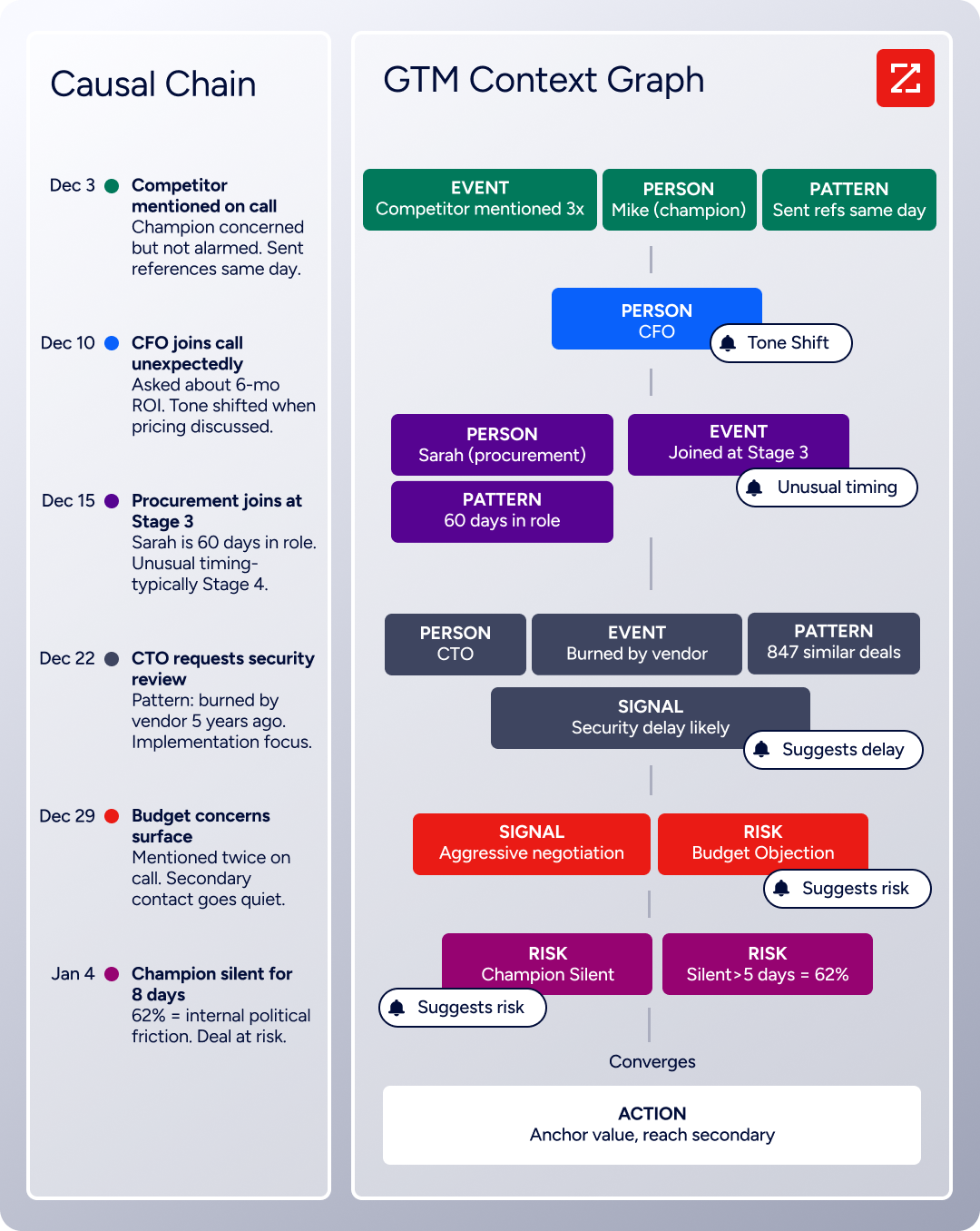
The 2 APIs sit at totally different layers of a go-to-market workflow. A developer constructing a pipeline that creates Movement duties based mostly on shopping for alerts, account modifications, or contact information would use ZoomInfo’s API because the upstream intelligence supply and Movement’s API because the downstream execution goal.
What the API Covers
ZoomInfo’s Enterprise API is a REST suite served from https://api.zoominfo.com/gtm, organized into 4 areas documented within the interactive API reference:
-
Knowledge API (Search & Enrich): Search endpoints cowl Contacts, Firms, Intent, Information, and Scoops, returning matched data with out consuming credit. Enrich endpoints return the total payload: enterprise emails, direct dials, employment historical past, company hierarchy, org charts, technographics, and hashtag alerts, as much as 25 data per name. The underlying dataset spans 500M contacts, 100M firms, 135M+ verified telephone numbers, and 200M+ verified enterprise e mail addresses.
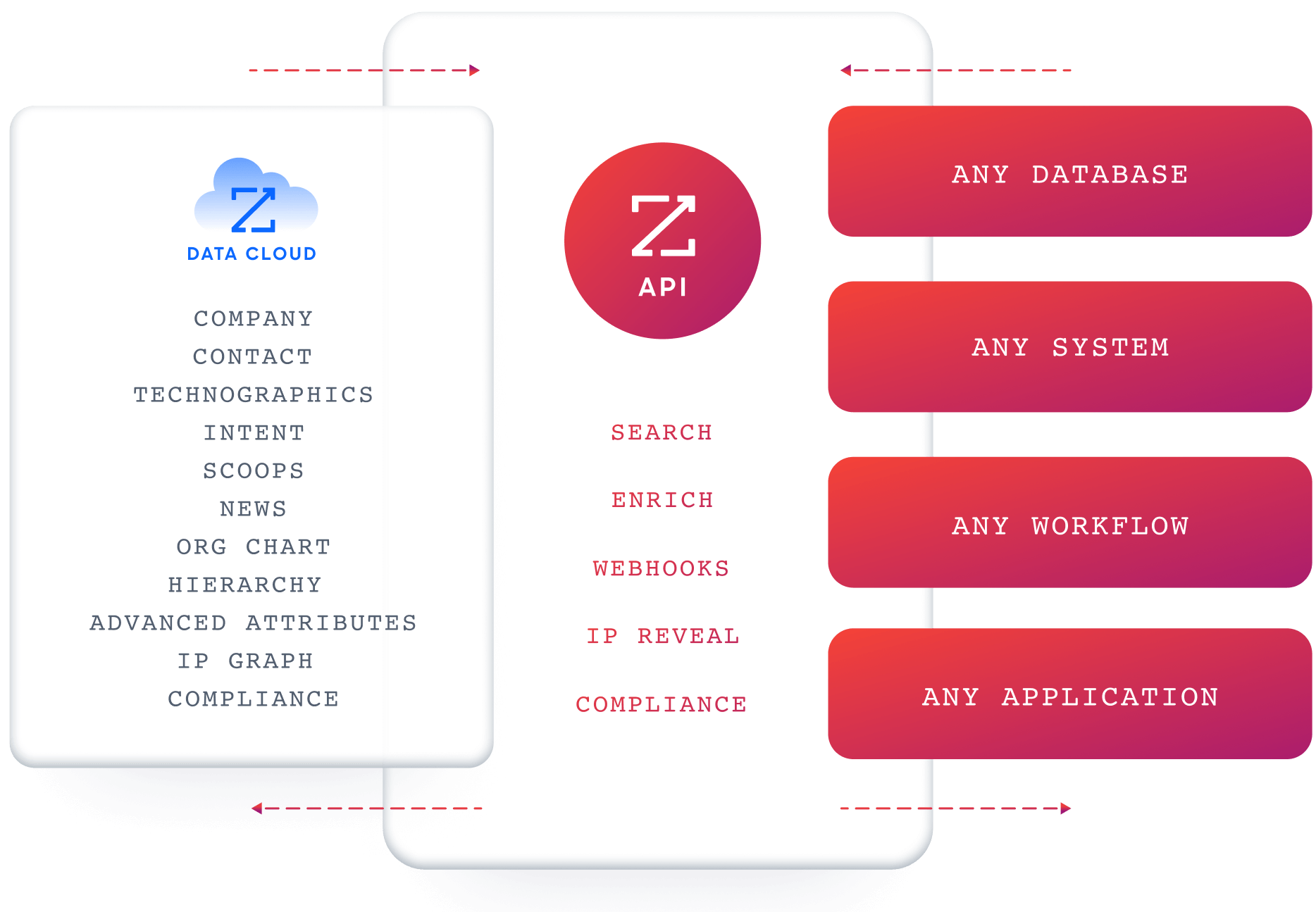
What you’ll construct with this alongside Movement: a workflow that queries ZoomInfo’s search endpoints for firms matching your ICP with energetic shopping for intent, enriches the contacts price pursuing, then makes use of Movement’s process API to create follow-up duties assigned to the suitable rep, with deadlines and priorities set for Movement’s auto-scheduler to put on their calendar.
Authentication & Entry
ZoomInfo makes use of OAuth 2.0 with PKCE through Okta, supporting three flows: Authorization Code with PKCE (net purposes), Consumer Credentials (server-to-server), and Refresh Token. Entry tokens are 24-hour Bearer tokens with rotating refresh tokens.
Groups register purposes by means of the ZoomInfo Developer Portal, the place they generate credentials, outline scopes, and take a look at endpoints.
This can be a totally different authentication mannequin from Movement’s static API key. OAuth 2.0 helps delegated entry, credential rotation, and scoped permissions, making it the suitable selection for multi-tenant integrations and environments with strict safety necessities.
Charge Limits, Credit & Developer Expertise
Charge limits are revealed by tier: Builder (5 req/sec), Commonplace (25 req/sec), and Scaling (35 req/sec), with per-hour and per-day sliding-window limits enforced concurrently. Each response consists of quota headers with remaining capability, and 429 responses embrace a Retry-After header with precise backoff timing.

Even the bottom ZoomInfo tier (5 req/sec, or 300 req/min) delivers 25x the throughput of Movement’s Group tier.
Credit comply with a rolling 12-month window: a file enriched for the primary time consumes one credit score; re-enriching the identical file throughout the 12 months is free. Search and lookup operations are free and don’t devour credit.
Webhooks can be found through the Brokers API, tied to ZoomInfo’s Agent Groups system. Occasion varieties cowl bulk enrichment jobs finishing, data altering, credit score utilization crossing thresholds, and new GTM alerts (scoops, funding occasions, intent spikes) changing into out there, with retry habits and throttling configurable per occasion sort.
For builders constructing AI brokers, ZoomInfo’s MCP server at https://mcp.zoominfo.com/mcp exposes search, enrich, and account analysis as native instruments for MCP-compatible assistants, presently supporting Claude and ChatGPT.
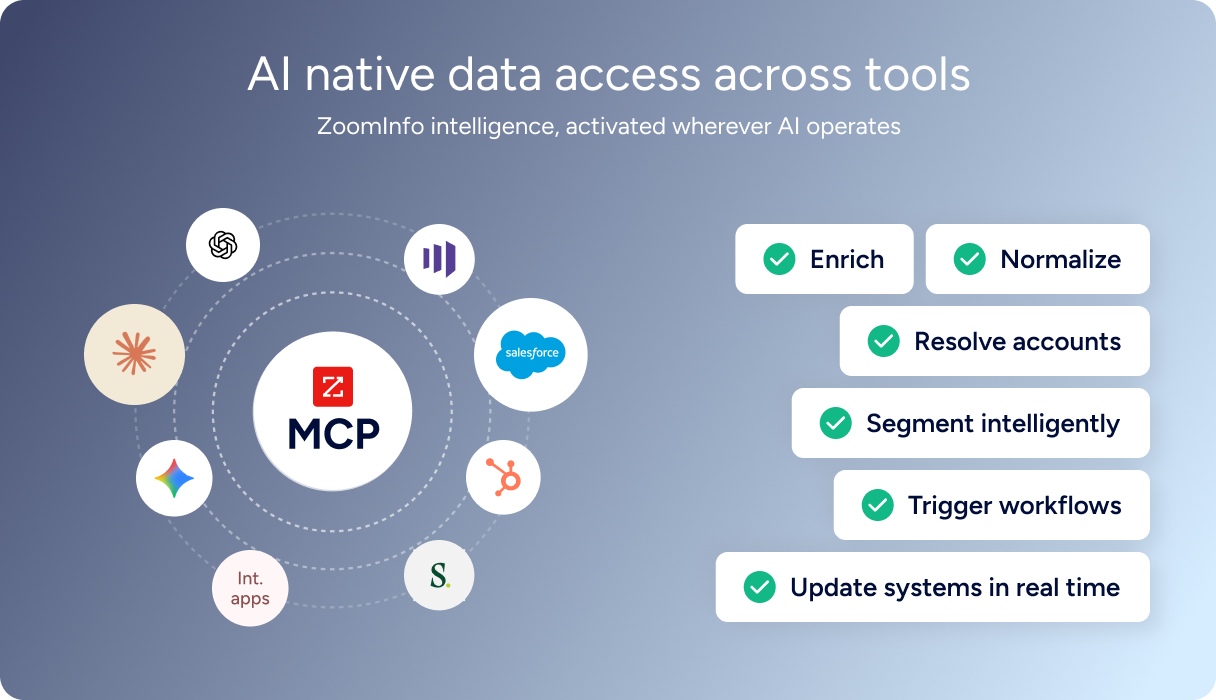
Documentation lives at docs.zoominfo.com with an interactive API reference and an llms.txt index for AI improvement instruments. ZoomInfo doesn’t publish official SDKs, so each platforms require direct HTTP integration. Pricing follows a consumption-based mannequin; ZoomInfo has prolonged API entry to all related plans.
BDO Canada reported an 87% discount in time spent on updates to inner information dashboards utilizing the ZoomInfo API, with one analyst describing the combination as plug-and-play throughout any course of. (ZoomInfo)
Last Verdict
Movement’s API is a slender, steady floor that does one job: programmatic CRUD over duties, tasks, and a handful of supporting assets.
For an integration that should push work gadgets into Movement from an exterior system and let the product’s auto-scheduler deal with the remainder, the API works and follows customary REST conventions. Entry is straightforward (any paid plan, no approval gate).
Select the Movement API if your integration is task-in, hands-off: creating duties, assigning them to tasks, attaching customized fields, and letting Movement’s scheduling engine resolve when and the place they land. The $19/month entry level with API entry included makes it accessible for light-weight integrations, and the Group tier at 120 req/min is workable for moderate-volume sync workflows.
Select the ZoomInfo API if your construct wants the intelligence upstream of process creation: deciding which accounts are price pursuing, which contacts to achieve, what their firms seem like, and whether or not they’re actively in-market.
The search-then-enrich sample (search is free, enrich consumes credit), the Copilot API’s AI endpoints, and the MCP server for AI-agent workflows cowl the information and reasoning {that a} process administration API was by no means designed to supply.
Discover the ZoomInfo Enterprise API or begin with the developer docs to see the endpoint floor instantly.
A developer whose pipeline wants neither ought to know this: Movement’s API doesn’t expose the product’s AI, calendar, or scheduling capabilities, and ZoomInfo’s API doesn’t handle duties or tasks. In case your construct wants each process execution and B2B intelligence, the 2 are complementary, every feeding a distinct a part of the workflow.
FAQ
Is the Movement API free?
API entry is included on all paid Movement plans, beginning at $19/seat/month for Professional AI. There are not any per-call fees or API-specific charges. Movement doesn’t supply a completely free plan; the trial requires a fee technique upfront. The actual value constraint is the plan tier: Particular person plans embrace API entry at 12 req/min, Group plans at 120 req/min, and Enterprise limits require contacting gross sales.
Does Movement have a GraphQL API?
No. Movement exposes a REST API (presently at v1) that communicates over HTTPS and returns JSON responses. Movement doesn’t doc a GraphQL endpoint. In the event you want GraphQL for process administration, you would wish to construct a wrapper on high of the REST API.
What’s the Movement API charge restrict?
Movement publishes tiered charge limits: 12 requests per minute on Particular person plans, 120 requests per minute on Group plans, and better limits out there on request for Enterprise. No per-day caps, burst allowances, or rate-limit response headers are documented. The Particular person tier at 12 req/min is notably restrictive for manufacturing integrations.
Are there official Movement SDKs?
No. Movement doesn’t publish official SDKs in any language. The developer documentation references no consumer libraries, GitHub repositories, or group wrappers. Builders combine instantly over HTTP utilizing customary libraries. The documentation gives endpoint-level reference however no language-specific code examples or interactive testing instruments.
Does the Movement API assist webhooks?
No. Movement paperwork no webhook functionality in its public developer documentation or assist middle. There are not any event-driven callbacks, no push notifications on process state modifications, and no subscription mechanism. Integrations that must react to modifications in Movement should ballot the API. The Zapier integration can also be one-directional: exterior occasions can create Movement duties, however Movement doesn’t push occasions again.
What does ZoomInfo’s API add to a Movement construct?
ZoomInfo’s API gives the B2B intelligence that Movement’s API doesn’t cowl: search throughout 500M contacts and 100M firms, enrichment with direct dials, org charts, technographics, and employment historical past, purchaser intent alerts, and AI-powered account analysis and buying-committee suggestions.
A sensible sample makes use of ZoomInfo’s search and intent endpoints to establish accounts price pursuing, enriches the suitable contacts, then makes use of Movement’s process API to create follow-up duties assigned to reps with deadlines for Movement’s auto-scheduler to put. ZoomInfo’s MCP server extends the identical information to AI-agent workflows, including a programmatic intelligence supply {that a} process administration API doesn’t cowl.

