Key Takeaways
- OpenAI launched 9 mathematical manuscripts on Nov. 24, adopted by six AI-generated analysis papers from Google on Nov. 25.
- Complexity theorist Scott Aaronson acknowledged listening to rumors of cryptographic breakthroughs, though their exact nature stays unconfirmed.
- Bitcoin depends on elliptic-curve cryptography fairly than RSA, that means an integer factorization breakthrough wouldn’t robotically compromise cryptocurrency wallets.
AI-Generated Mathematical Discoveries Gasoline Cryptographic Hypothesis
A succession of mathematical claims from among the world’s most superior synthetic intelligence laboratories has reignited a basic debate concerning the safety assumptions underpinning trendy computing. This week, developments at OpenAI and Google arrived alongside hypothesis that significantly extra consequential cryptographic discoveries could stay behind closed doorways.
On Nov. 24, the AI lab OpenAI added 9 manuscripts to its public arithmetic repository, together with a claimed answer establishing the exponent of sq. matrix multiplication at precisely 9/4. The invention, if independently validated, would resolve a computational downside that mathematicians have spent a long time investigating.
Matrix multiplication is prime to scientific computing, AI, engineering and quite a few cryptographic purposes. The beforehand established higher certain for its exponent stood at roughly 2.371, whereas OpenAI’s analysis claims each an higher and matching decrease certain of two.25.
One other manuscript claims to resolve Smale’s ninth downside by way of a deterministic, strongly polynomial algorithm for linear programming. Further analysis addresses circuit complexity, polytope geometry, Fourier transforms and integer multiplication, with chosen mathematical arguments accompanied by formalizations utilizing the Lean proof assistant.
The manuscripts stay at various phases of verification. Though machine-checked proofs supply higher mathematical assurance than typical AI-generated explanations, partial formalizations shouldn’t be mistaken for complete unbiased validation.
Google adopted on Nov. 25 with six analysis papers generated by Cogentic, a multi-agent system constructed on its Gemini 4 mannequin. Among the many most intriguing manuscripts is “Unconditional Integer Factorization in Time L_N[1/3, O(1)],” which describes a classical algorithm able to factoring integers with out counting on unproven mathematical hypotheses.
Nonetheless, Google’s discovery introduces an essential distinction between theoretical progress and sensible cryptanalysis. The algorithm improves upon mathematical ensures surrounding factorization however stays significantly slower than present sensible strategies. It doesn’t set up that integer factorization might be carried out in polynomial time or introduce an instantaneous menace to trendy RSA encryption.
Google’s accompanying analysis examines deterministic factorization, discrete logarithms, approximate Nash equilibria, communication complexity and graph reconstruction. The corporate says its mathematical proofs had been generated with out human intervention past the preliminary immediate.
Scott Aaronson Addresses Rumors of Cryptographic Bombshells
College of Texas at Austin professor and former OpenAI researcher Scott Aaronson has turn out to be a central determine within the dialogue after acknowledging hypothesis that frontier AI laboratories possess undisclosed cryptographic discoveries.
Responding to a reader on his Shtetl-Optimized weblog on Nov. 24, Aaronson revealed that he had encountered quite a few rumors suggesting OpenAI, Anthropic or each had found a polynomial-time algorithm for integer factorization.
The next day, on Wednesday, Aaronson described himself as “nearly sure, from a number of dependable sources” that the laboratories possessed consequential cryptographic findings. However, the complexity theorist expressed significantly much less confidence about their exact nature, cautioning that data could have turn out to be distorted because it circulated amongst researchers.
Aaronson additionally believes developments in mathematical reasoning may carry pc scientists nearer to resolving the well-known P versus NP downside. He anticipates that some algorithms rising from these analysis packages will ultimately compromise cryptographic techniques presently in operation.
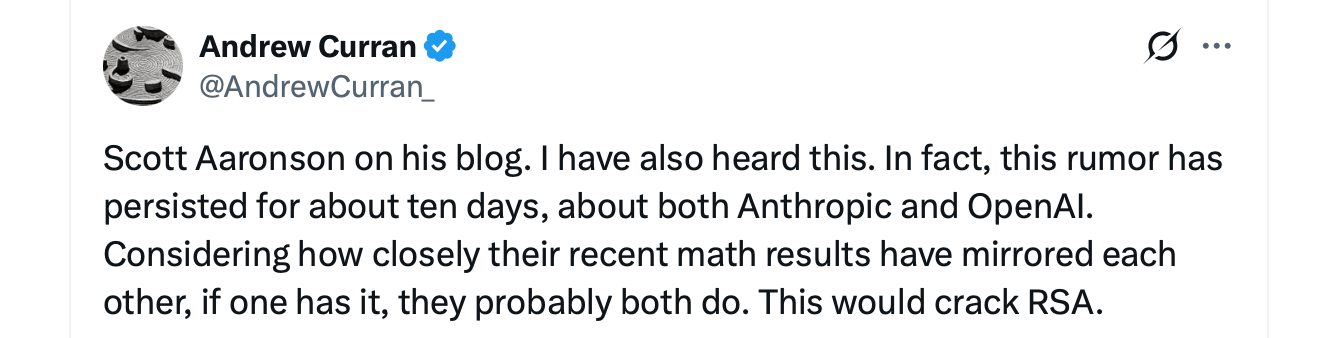
Expertise commentator Andrew Curran indicated that comparable rumors involving each laboratories had circulated for roughly 10 days. In the meantime, neither a publicly demonstrated assault towards a contemporary RSA key nor affirmation from OpenAI or Anthropic has substantiated the hypothesis.
Ledger CTO Weighs in on RSA and Elliptic-Curve Cryptography
Charles Guillemet, chief know-how officer (CTO) at cryptocurrency {hardware} pockets producer Ledger, addressed the rising hypothesis surrounding a number of basic cryptographic primitives.
Guillemet distinguished integer factorization from primality testing, which mathematicians established may very well be carried out in polynomial time in 2002. Figuring out whether or not a quantity is prime and discovering its constituent prime components are basically totally different computational challenges.
“If it had been in P, RSA would merely be damaged, and that will be big: a big a part of our techniques nonetheless depend on RSA,” Guillemet defined on Wednesday.
The Ledger government additionally addressed separate rumors regarding elliptic-curve cryptography (ECC) and Ring Studying With Errors (Ring-LWE), a mathematical downside underpinning sure post-quantum cryptographic constructions.
A sensible breakthrough towards elliptic curves may compromise broadly deployed digital signature and key change techniques, whereas weaknesses in Ring-LWE may complicate ongoing efforts emigrate towards quantum-resistant safety infrastructure.
However, Guillemet insisted he stays skeptical that frontier laboratories have utterly dismantled these cryptographic foundations. The Ledger CTO acknowledged:
“Personally, I don’t suppose findings like these are coming. I wouldn’t be shocked if a few of these primitives change into a bit weaker than we thought, however I’d be very shocked to see any of them crumble utterly.”
Guillemet additional famous that responsibly disclosing a discovery of such magnitude with out inadvertently facilitating widespread exploitation would current appreciable difficulties.
Expertise analyst Chubby equally mentioned the implications of a sensible RSA breakthrough, suggesting that the rumors, if correct, may doubtlessly clarify why some laboratories have withheld newer AI fashions.
The tech analyst wrote:
“If an algorithm like this truly works on actual key sizes, you wouldn’t even want a quantum pc to interrupt it.”
The commentator pointed to potential penalties involving compromised software program authentication, encrypted communications, and an accelerated migration away from RSA. The instructed connection between unpublished mathematical discoveries and delayed AI mannequin releases, nonetheless, stays extraordinarily speculative.
What AI Cryptographic Breakthroughs May Imply for Bitcoin
Regardless of the rising nervousness surrounding RSA, Bitcoin’s design doesn’t depend on integer factorization for its transaction authentication. As a substitute, the community makes use of the elliptic curve secp256k1, using the Elliptic Curve Digital Signature Algorithm (ECDSA) and Schnorr signatures to show possession and authorize transactions.
Consequently, an algorithm able to effectively factoring giant integers wouldn’t robotically allow an attacker to derive personal keys from public BTC keys, forge transactions, or spend one other particular person’s bitcoin.
A sensible answer to the elliptic-curve discrete logarithm downside, nonetheless, would introduce a wholly totally different predicament. Such a discovery may undermine the mathematical relationship between private and non-private keys, doubtlessly exposing cryptocurrency holdings related to revealed public keys.
Ethereum and quite a few various blockchain networks depend on comparable cryptographic assumptions. Cryptocurrency exchanges, cross-chain bridges, institutional custodians, multisignature wallets and blockchain-based monetary purposes may additionally face safety challenges if their underlying authentication mechanisms turned weak.
Bitcoin’s SHA-256 hashing algorithm, which is instrumental in proof-of-work (PoW) mining, represents one other distinct cryptographic primitive. Breaking RSA or elliptic-curve signatures wouldn’t essentially compromise SHA-256, illustrating why cryptographic breakthroughs should be evaluated individually fairly than interpreted as a common collapse of digital safety.
Even a polynomial-time algorithm wouldn’t essentially translate into an instantaneous sensible assault, since its computational necessities may stay prohibitively costly.
For cryptocurrency builders, the newest mathematical claims however introduce a brand new dimension to discussions surrounding cryptographic agility and quantum-resistant signatures. Migrating decentralized networks towards various authentication mechanisms may require substantial coordination amongst builders, node operators, pockets suppliers and asset holders.
As of Nov. 26, the excellence between revealed arithmetic and unconfirmed cryptographic discoveries stays paramount. Google’s factoring analysis doesn’t set up a sensible RSA assault, and no publicly demonstrated algorithm has invalidated present safety assumptions. What has modified is the obvious pace at which AI techniques can confront mathematical issues lengthy thought of exceptionally tough, forcing the cryptocurrency business to ponder whether or not its cryptographic defenses can evolve as shortly because the arithmetic difficult them.