

Does AI actually save hours on mission reporting? Two of the three distributors G2 surveyed report figures that say sure: Scoro, from 1 to three hours per week to underneath half-hour (beta testers), and monday.com, from 4 to six hours to 1 to three. The extra helpful discovering is what all three say holds outcomes again: the information across the AI.
Challenge managers typically spend a part of their week pulling information from disconnected instruments and writing summaries. AI mission reporting goals to take away that meeting work with automated information pulls, generated summaries, and danger flags earlier than they develop into delays.
Protection of AI mission standing reporting principally focuses on what the expertise guarantees. Far much less explains which capabilities have proof behind them, how deep adoption runs, and what stops organizations from going additional.
To search out out, G2 surveyed leaders at Scoro, monday.com, and Backlog by Nulab in 2026. I requested every what they observe with their clients: time financial savings, adoption, and the boundaries they hit within the area. This report covers what the three platforms see, the place outcomes are strongest, and the place constraints stay.
TL;DR: AI-powered mission reporting at a look
- Time financial savings are actual, however beginning factors differ: Scoro experiences reporting time fell from 1 to three hours to underneath half-hour per week. monday.com experiences a drop from 4 to six hours to 1 to three hours per week.
- Danger detection is essentially the most constantly validated AI functionality: All three distributors report AI identifies mission dangers sooner than handbook reporting 50% to 74% of the time.
- Utilization has surged throughout all three platforms over the previous yr: All three distributors report AI-powered reporting utilization elevated by greater than 50% in comparison with 12 months in the past.
- Qualitative context is what AI nonetheless can’t seize reliably: 2 of three distributors flag lacking essential particulars or overgeneralized summaries as the first person concern, and validating AI output stays the final handbook step for two of three platforms no matter how a lot they belief the output.
- The info basis, not the AI itself, is the binding constraint: All three distributors title information entry because the core ceiling. Every identifies a definite barrier: unrecorded context (Scoro), device fragmentation and lacking methodology (monday.com), and single-tool scope plus privateness boundaries (Backlog).
- Challenge managers are anticipated to spend much less time on administration: monday.com initiatives strategic planning rising from underneath 20% to over 70% of PM time. Backlog initiatives administrative work falling to five% to 10% of the position. Scoro describes AI as giving mission managers “a promotion.”
Who’re the three mission administration platforms shaping AI-powered reporting in 2026?
This report consists of insights from:
- Scoro (4.5/5 on G2): An expert providers automation platform constructed for companies and consultancies, presently introducing AI-powered reporting capabilities to beta customers, with a concentrate on surfacing mission well being and margin insights from consolidated operational information.
- monday.com (4.7/5 on G2): A multi-product work platform used throughout each main business, with 1-click AI reporting embedded as a core product characteristic and a person base that spans crew members, product managers, and exterior purchasers.
- Backlog by Nulab (4.6/5 on G2): A mission administration and collaboration device by Nulab, constructed primarily for expertise and SaaS groups, and distinguished by a privacy-first information philosophy that shapes each how its AI reporting works and what it may well entry.
Every vendor brings a definite buyer profile, product philosophy, and perspective on AI in automated mission standing. All three are actively constructing and deploying AI-powered reporting options throughout their buyer bases.
Methodology: How I gathered these insights
This report relies on a 28-question survey, collected in March 2026 from leaders on the three platforms above. Every vendor acquired the identical questions, so solutions are comparable throughout distributors. Many solutions are reported as ranges. All figures are self-reported by the distributors, and Scoro’s responses come from its beta stage. The survey centered on the next areas:
- Present AI adoption charges and reporting automation depth throughout platforms.
- Which levels of the mission reporting course of AI is actively dealing with.
- Time financial savings and stakeholder communication outcomes noticed within the area.
- Belief ranges, accuracy considerations, and the place handbook effort stays.
- Limitations constraining deeper AI reporting adoption at this time.
- Expectations for the way mission managers will redistribute their time as AI automates reporting.
The survey responses give an experience-backed view of the place AI mission reporting stands in 2026 and the place it’s headed. Class averages from the G2 Grid Report for Challenge Administration, Fall 2026, are added in separate, labeled sections as purchaser context.
What do G2 reviewers say about mission administration software program?
G2 reviewers give mission administration software program a median Web Promoter Rating of 58 and fee how properly it meets their necessities at 89% (G2 reviewer-reported, Fall 2026). The desk reveals the total set of class averages.
| G2 satisfaction measure | Class common |
|---|---|
| Probability to Suggest | 87% |
| Product Going within the Proper Route | 88% |
| Meets Necessities | 89% |
| Ease of Use | 88% |
| Ease of Setup | 87% |
| Ease of Admin | 88% |
| High quality of Assist | 89% |
| Ease of Doing Enterprise With | 91% |
| Web Promoter Rating (NPS) | 58 |
Supply: G2 Grid Report for Challenge Administration, Fall 2026. Primarily based on G2 reviewer-reported information. Web Promoter Rating ranges from -100 to +100.
These class averages are added as purchaser context. They sit alongside the vendor-reported findings in the remainder of this report.
AI reporting saves time. How a lot is determined by the place your crew stands at this time.
Scoro experiences weekly reporting time falling from 1 to three hours to underneath half-hour. monday.com experiences a drop from 4 to six hours to 1 to three hours. Backlog didn’t share time information. Each units of figures are vendor-reported, and Scoro’s come from beta testers.
“Saves time” can imply very various things. A minimize from 4 hours to twenty minutes and a minimize from half-hour to twenty minutes are each financial savings, however they carry completely different weight in a enterprise case. The desk reveals what every vendor experiences observing in its clients earlier than and after AI-powered reporting.
| Scoro | monday.com | Backlog | |
|---|---|---|---|
| Noticed in clients earlier than AI | 1–3 hrs/week | 4–6 hrs/week | Information not shared (privateness coverage) |
| Noticed in clients after AI | Below 30 min/week (75% discount, ~4x sooner) | 1–3 hrs/week (60% discount, ~2.5x sooner) | — |
| Annual Hours Recovered (per PM) | ~78 hrs | ~156 hrs | — |
| Annual Hours Recovered (5-person crew) | ~390 hrs | ~780 hrs | — |
*Share reductions, “x sooner” multiples, and annual hours recovered are my calculations from the midpoint of every reported vary, over 52 weeks. Midpoints used: Scoro 2 hours earlier than and 0.5 hours after; monday.com 5 hours earlier than and a pair of hours after. Scoro’s figures come from beta testers.
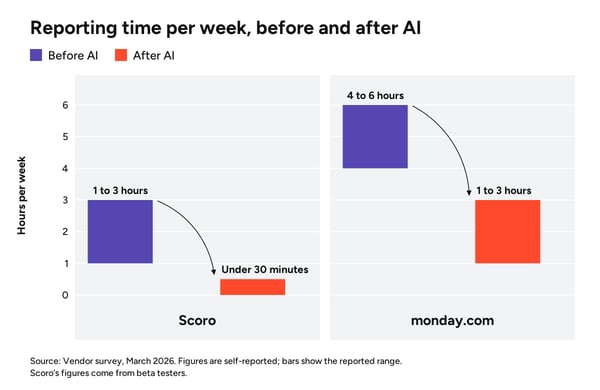
One element stands out: monday.com’s post-AI vary of 1 to three hours per week matches Scoro’s pre-AI vary. In my studying, this possible displays a distinction in reporting atmosphere. Scoro is a consolidated PSA platform constructed for companies and consultancies, the place mission, time, and monetary information already sit in a single place. monday.com serves a broader buyer base throughout industries, together with small companies, with extra assorted information constructions and external-facing reporting necessities.
In keeping with Scoro’s survey response, standing updates now take considerably much less time to place collectively, and extra time goes to dialogue. Scoro experiences that stakeholder conferences develop into shorter, sharper, and centered on “what will we do subsequent.”
For context, G2 reviewers fee mission monitoring options, which cowl KPIs, useful resource allocation, and exercise dashboards, at 85% to 88% satisfaction on common (G2 reviewer-reported, Fall 2026).
| G2 mission monitoring characteristic | Class common |
|---|---|
| Baselining / KPIs | 85% |
| Useful resource Allocation | 86% |
| Exercise Dashboard | 88% |
Supply: G2 Grid Report for Challenge Administration, Fall 2026. Primarily based on G2 reviewer-reported information.
What this implies for consumers:
- Measure your crew’s present weekly reporting hours earlier than evaluating instruments. Distributors report completely different beginning factors: 1 to three hours (Scoro) and 4 to six hours (monday.com).
- A better start line leaves extra hours to recuperate. On the midpoint, monday.com’s reported vary falls by about 3 hours per week and Scoro’s by about 1.5 hours (my calculation).
Danger detection is the place AI reporting earns its strategic worth
All three distributors report that AI identifies mission dangers sooner than handbook reporting in 50% to 74% of instances. Every selected “Continuously (50–74%)”, and none selected a better frequency band that the survey provided. All three additionally listing danger identification among the many points customers belief.
Time financial savings are measurable for 2 distributors. Earlier danger detection is a outcome all three report the identical manner, throughout completely different buyer bases and product approaches.
1. A structural benefit, not only a sooner model of handbook assessment
A mission supervisor operating a number of concurrent initiatives can’t maintain the total useful resource utilization image throughout all of them without delay. AI operating throughout all initiatives can floor systemic patterns that particular person mission views miss. In my opinion, that cross-project vantage level is a distinct type of functionality, not a sooner model of handbook assessment.
Scoro and Backlog additionally named the perception varieties AI catches that handbook reporting usually misses. Their solutions overlap on 4 of 5. monday.com stated perception varieties differ considerably by buyer tier and business.
| Perception kind | Scoro | Backlog |
|---|---|---|
| Useful resource overutilization patterns | ✓ | ✓ |
| Bottlenecks in workflows | ✓ | ✓ |
| Developments in activity completion charges | ✓ | ✓ |
| Cross-project efficiency patterns | ✓ | ✓ |
| Early indicators of mission delays | ✓ | — |
*Primarily based on vendor survey responses. Backlog’s response relies on person suggestions information. — = not chosen.
2. The place AI shifts from a reporting device to a choice assist layer
In my opinion, activity completion traits and cross-project efficiency patterns can act as lagging indicators. Handbook reporting typically notices such indicators solely after an issue has shaped. When AI surfaces them early, they will act as main indicators, so PM judgment is utilized to a forming drawback as a substitute of a disaster.
3. The dangers every platform prioritizes mirror who its clients are
Scoro chosen early indicators of mission delays, and Backlog didn’t. Scoro serves consulting {and professional} providers companies, the place, for my part, mission delays can have an effect on billing, consumer relationships, and margin. monday.com stated perception varieties differ by buyer tier and business, which can mirror its broad deployment throughout industries.
For context, G2 reviewers fee the options closest to those danger varieties (useful resource capability, scheduling, dependencies, problem monitoring, and significant path) at 84% to 88% satisfaction on common (G2 reviewer-reported, Fall 2026).
| G2 characteristic group | Characteristic | Class common |
|---|---|---|
| Useful resource Administration | Capability | 86% |
| Useful resource Administration | Scheduling | 88% |
| Duties | Dependencies | 86% |
| Tasks | Challenge Monitoring | 86% |
| Tasks | Essential Path | 84% |
Supply: G2 Grid Report for Challenge Administration, Fall 2026. Primarily based on G2 reviewer-reported information.
What this implies for consumers:
- Determine which dangers price your enterprise cash (billing, supply dates, capability) and verify these perception varieties first. The distributors surveyed title completely different ones.
- All three distributors report earlier detection in 50% to 74% of instances, so earlier detection is an affordable first use case to check.
What each AI reporting platform covers, and the place they half methods
Backlog automates 7 reporting duties, Scoro 6, and monday.com 4. Past that shared core, scope diverges by product philosophy, buyer kind, and what every platform treats because the boundary of reporting.
AI-generated experiences serve mission managers, executives, crew members, and in some instances exterior purchasers. The stakeholders a platform is constructed for form the format, depth, and framing of its AI output.
1. There’s a shared reporting core. Past it, the platforms diverge sharply
I mapped two survey questions throughout the platforms: which reporting duties every automates, and which levels of reporting profit most from AI. All three distributors chosen these levels:
- Report technology and formatting
- Figuring out mission dangers and delays
- Creating stakeholder-ready summaries
Scoro and monday.com additionally chosen information assortment from a number of instruments. Backlog didn’t. Backlog’s stage choices are primarily based on person suggestions information. The protection desk lists automated duties solely. monday.com chosen danger identification as a benefiting stage however not as an automatic activity, so its cell in that row reveals “—”.
Scoro and Backlog focus their automation on the mission supply reporting cycle: standing, well being, danger, and cross-project visibility. monday.com’s 4 duties break up between conventional mission reporting (dash and assembly summaries) and broader enterprise intelligence (competitor analysis, buyer discovery and interview summaries).
| Reporting activity | Scoro | monday.com | Backlog |
|---|---|---|---|
| Dash and milestone progress summaries | ✓ | ✓ | ✓ |
| Automated assembly summaries | — | ✓ | ✓ |
| Automated mission standing summaries | ✓ | — | ✓ |
| AI-generated government experiences | ✓ | — | ✓ |
| AI identification of mission dangers | ✓ | — | ✓ |
| Job completion development evaluation | ✓ | — | ✓ |
| Cross-project efficiency summaries | ✓ | — | ✓ |
| Competitor analysis summaries | — | ✓ | — |
| Buyer discovery and interview summaries | — | ✓ | — |
*Primarily based on vendor survey responses. — = not chosen.
2. Who the experiences attain is as differentiating as what they include
Scoro and Backlog report that AI-generated experiences are consumed primarily by inner stakeholders: mission managers, government management, division heads, and crew members. The reporting chain runs upward and laterally inside the group.
monday.com’s image is completely different. Its main report shoppers embrace exterior purchasers and companions alongside crew members and product managers. It’s the solely vendor on this survey to listing exterior purchasers and companions amongst its main shoppers. In my studying, its presence in client-services and company workflows could clarify this, since exterior reporting there’s typically a core deliverable.
The stakeholder lists reveal an additional distinction. Scoro’s consists of program and portfolio managers. monday.com’s consists of product managers. In my studying, Scoro’s listing factors to mission supply intelligence and monday.com’s to market and product intelligence, in keeping with the competitor analysis and buyer discovery summaries it automates.
3. Report codecs differ by platform
Govt summaries are the one format all three platforms generate. The format variations seem to mirror the viewers variations above.
| Format | Scoro | monday.com | Backlog |
|---|---|---|---|
| Govt summaries | ✓ | ✓ | ✓ |
| Weekly mission standing experiences | ✓ | — | ✓ |
| Challenge well being dashboards | ✓ | — | ✓ |
| Shopper-facing progress experiences | — | ✓ | ✓ |
| Dash assessment summaries | — | — | ✓ |
*Primarily based on vendor survey responses. — = not chosen.
Backlog generates client-facing progress experiences and lists speaking updates to stakeholders as an exercise that also requires essentially the most handbook effort. In my studying, a mission supervisor nonetheless handles the sending. Backlog additionally says AI helps mission managers discover the most effective strategies of presentation for his or her stakeholders, making communication extra frequent and clear.
4. Which industries are main adoption, and what that tells a purchaser
Every platform’s strongest reported demand section maps onto its buyer base:
- Scoro: Consulting {and professional} providers, the place, for my part, mission delays can have an effect on billing, consumer relationships, and margin.
- Backlog: Expertise and SaaS. In my opinion, dash cadences and launch cycles create recurring reporting stress.
- monday.com: Broad use throughout industries. Its survey response says AI reporting is “entrance and middle within the product (1-click reporting) so all industries use it commonly.”
The mixed stakeholder and business information surfaces one hole value naming. Throughout all three platforms, 7 distinct stakeholder varieties are served, and no single platform covers greater than 5. A purchaser with multi-stakeholder necessities spanning executives, portfolio managers, crew members, and exterior purchasers ought to map that hole earlier than committing to at least one platform.
For purchaser context, G2 evaluations present who evaluations mission administration software program. Among the many 16,027 permitted evaluations submitted in 2026, Laptop Software program (8.0%), Advertising and Promoting (7.5%), and Data Expertise and Companies (7.4%) are the three largest business teams. (G2 reviewer-reported, evaluations submitted January 1 to November 25, 2026).
| Reviewer business | Share of evaluations |
|---|---|
| Laptop Software program | 8.0% |
| Advertising and Promoting | 7.5% |
| Data Expertise and Companies | 7.4% |
| Monetary Companies | 2.3% |
| Development | 2.2% |
| Accounting | 2.0% |
| Non-Revenue Group Administration | 1.8% |
| Hospital & Well being Care | 1.8% |
| Schooling Administration | 1.6% |
| Different industries (every 1.5% or much less) | 34.0% |
| Business not specified | 31.5% |
Supply: G2 evaluations of Challenge Administration software program submitted January 1 to November 25, 2026 (permitted evaluations, n = 16,027). Primarily based on G2 reviewer-reported information. Business is chosen by the reviewer. Shares are rounded.
By firm dimension, 51% of G2 reviewers of mission administration software program are from small companies, 32% from mid-market firms, and 17% from enterprises (G2 reviewer-reported, Fall 2026).
| Firm dimension | Share of G2 reviewers |
|---|---|
| Small enterprise (50 or fewer workers) | 51% |
| Mid-market (51–1,000 workers) | 32% |
| Enterprise (greater than 1,000 workers) | 17% |
Supply: G2 Grid Report for Challenge Administration, Fall 2026. Primarily based on G2 reviewer-reported information.
What this implies for consumers:
- Record the stakeholder varieties your reporting chain serves (executives, portfolio managers, crew members, exterior purchasers) and verify which vendor’s listing covers them.
- Consumers in consulting or expertise could worth a platform whose buyer base matches their very own. monday.com experiences common use throughout all industries.
- These G2 figures present who evaluations mission administration software program. They don’t present who makes use of AI reporting.
Adoption of AI-powered reporting throughout the board
All three distributors report that utilization of AI-powered reporting options grew by greater than 50% in comparison with 12 months in the past. What number of groups use it and the way a lot it automates differ by vendor. Scoro experiences greater than 75% of groups amongst its beta testers, monday.com experiences 51% to 75% of groups, and Backlog didn’t share information.
Utilization development and automation depth are completely different measures. Attempting an AI reporting characteristic as soon as will not be the identical as automating 80% of reporting duties, however each can rely as adoption. These distributors agree on utilization development and diverge on depth.
1. AI reporting utilization development is unanimous throughout the distributors
The expansion determine is identical for all three distributors. The share of groups actively utilizing AI-generated reporting differs:
| Platform | Proportion of groups utilizing AI reporting | Observe |
|---|---|---|
| Scoro | Greater than 75% | Beta testers solely, not full person base |
| monday.com | 51% to 75% | Drawn from broader energetic person inhabitants |
| Backlog | Information not shared | Privateness coverage |
*Primarily based on vendor survey responses.
monday.com’s determine is drawn from its broader energetic person inhabitants. Scoro’s is measured amongst present beta testers, who’re early customers of the characteristic. Backlog didn’t share information, citing safety and privateness causes.
2. Depth of automation tells a extra sophisticated story
The survey requested two associated questions: what share of standing experiences are AI-assisted, and what share of reporting duties the platform automates. Backlog didn’t share information for both.
| Platform | Share of standing experiences which might be AI-assisted | Share of reporting duties automated |
|---|---|---|
| Scoro | 26% to 50% | Greater than 80% |
| monday.com | 11% to 25% | 21% to 40% |
| Backlog | Information not shared | Information not shared |
*Primarily based on vendor survey responses. Scoro is in energetic beta, so its automation determine could describe platform functionality and should differ from utilization throughout its full buyer base.
Scoro experiences a 26% to 50% AI-assisted share, moreover greater than 80% of reporting duties automated. In my studying, its beta stage could clarify a part of that hole. The distinction between Scoro and monday.com on automation (greater than 80% versus 21% to 40%) possible displays platform structure greater than AI functionality. Scoro is constructed round consolidated information protecting initiatives, time, finance, and useful resource planning, so automating the reporting layer is a shorter step. monday.com serves a broader buyer base with extra assorted information constructions and reporting workflows, which can restrict how far automation reaches inside a single deployment.
3. What is definitely driving the uptake?
All three distributors cite lowering administrative workload as a main driver of adoption.
| Driver | Scoro | monday.com | Backlog |
|---|---|---|---|
| Decreasing administrative workload | ✓ | ✓ | ✓ |
| Quicker stakeholder communication | ✓ | — | ✓ |
| Improved visibility into mission efficiency | ✓ | ✓ | — |
| Actual-time reporting expectations | — | ✓ | ✓ |
*Primarily based on vendor survey responses. — = not chosen.
Past that shared driver, the opposite components possible mirror every platform’s buyer base, for my part. Quicker stakeholder communication is cited by Scoro and Backlog, real-time reporting expectations by monday.com and Backlog, and improved visibility into mission efficiency by Scoro and monday.com.
For context, G2 reviewers report a median person adoption of 70% throughout mission administration merchandise (G2 reviewer-reported, Fall 2026). It is a completely different measure from the vendor-reported share of groups utilizing AI reporting proven above.
Supply: G2 Grid Report for Challenge Administration, Fall 2026. Primarily based on G2 reviewer-reported information.
What this implies for consumers:
- Ask distributors two questions: what number of groups use the AI reporting characteristic, and the way a lot of the reporting work it automates. The distributors right here report completely different solutions to every.
- Scoro’s adoption and automation figures describe beta testers, not its full buyer base.
The place does person belief in AI reporting break down, and why?
Even with Scoro’s platform, which is enabling greater than 80% of reporting duties to be automated, the before-and-after information doesn’t attain zero. The residual is the assessment, validation, and ship step that persists no matter how a lot is automated upstream. Understanding why that step stays, and what it reveals about the place belief truly sits, is the extra helpful query for anybody planning a deployment.
1. What AI reporting has earned belief on
Earlier than analyzing the place belief breaks down, it’s value establishing what AI reporting has truly earned from customers. The reply is extra particular than the final narrative suggests.
| Trusted side | Scoro | monday.com | Backlog |
|---|---|---|---|
| Challenge well being indicators | ✓ | ✓ | ✓ |
| Danger identification | ✓ | ✓ | ✓ |
| Timeline evaluation | ✓ | ✓ | ✓ |
| Information aggregation and metrics | ✓ | ✓ | |
| Workload evaluation | ✓ | ✓ |
*Scoro and monday.com responses mirror platform-level observations. Backlog’s responses are primarily based on person suggestions information.
Throughout platforms, AI reporting is trusted for mission well being indicators, danger identification, and timeline evaluation.
The place AI is working with structured and quantifiable inputs, customers belief the output. The belief is excessive sufficient to have a measurable consequence on Scoro’s platform. Scoro experiences greater than 80% of AI-generated mission experiences are shared with stakeholders with out main revisions. For Scoro’s customers, AI output has reached a stage of belief the place most experiences exit with solely minor edits.
2. The place the belief breaks down
Throughout all three platforms, belief in AI reporting breaks down on the similar level. AI handles structured, quantifiable information properly. Belief drops the place the output requires qualitative judgment or unrecorded context.
| Main person concern | Scoro | monday.com | Backlog |
|---|---|---|---|
| Lacking essential qualitative particulars | ✓ | ✓ | |
| Overgeneralized summaries | ✓ | ||
| Information privateness considerations | ✓ |
*Scoro and monday.com responses mirror platform-level commentary. Backlog’s responses are primarily based on person suggestions information. Backlog can also be the one platform to call information privateness as an energetic person concern slightly than a coverage constraint.
Throughout platforms, AI handles the information layer reliably. Human effort stays targeting interpretation and communication. Scoro and Backlog customers flag lacking qualitative context as their main concern. For illustration, qualitative context can embrace relationship rigidity in a consumer account, a crew member quietly underwater, or a deadline that appears achievable on paper.
monday.com customers flag overgeneralized summaries throughout their various buyer environments. The handbook effort information confirms the identical hole. Scoro and monday.com customers determine validating AI-generated summaries as their highest handbook effort activity. Backlog customers proceed doing stakeholder communication and cross-tool information integration by hand. The human assessment step has not been eradicated on any platform on this survey.
3. Why belief has a ceiling and no platform has eradicated the human assessment step
In my studying, the ceiling on AI reporting sits within the information and tooling across the mannequin. When requested in regards to the largest limitation, every vendor pointed to the information and tooling across the AI. Scoro named unrecorded mission context. Backlog named a privacy-driven restrict on information entry. monday.com named device overload and a lacking methodology.
Scoro frames the limitation as a seize drawback on the shopper facet. In most organizations, mission context that was by no means recorded can’t be analyzed, no matter how succesful the AI layer is.
“The most important limitation is the information AI has to work with. AI can solely analyze what’s been captured, and in most organizations an enormous quantity of mission context lives in individuals’s heads, and hallway conversations that by no means make it into the system. Irrespective of how good the mannequin is, it may well’t report on what it may well’t see.”
Karin Kanamäe
Paid Advertising Supervisor, Scoro
Backlog frames the limitation as a platform-level constraint. By design, Backlog’s AI can solely work with information saved inside the device itself. Pulling from exterior techniques would require broader information entry, which conflicts with their privacy-first structure.
“AI (in our case) can solely generate experiences primarily based on the information saved inside the device. Accessing data throughout a number of instruments would require broader information entry, which may increase safety and privateness considerations.”
monday.com describes the limitation as device overload and a lacking methodology on the shopper facet.
“Too many instruments out there, which creates ‘AI chaos’: customers do not have a battle examined methodology to get essentially the most out of AI.”
Sarah Clean
Advertising & Strategic Partnerships Supervisor, monday.com
A company with fragmented instruments and unrecorded mission context will hit the ceiling sooner and decrease than one with a consolidated information basis, no matter which platform they select. The device you select issues lower than the inspiration you construct earlier than deploying it.
4. The place to start out
I requested the distributors what implementation practices have confirmed simplest. Scoro was the one vendor to reply.
Scoro’s recommendation is to start out with information earlier than beginning with AI. In keeping with Scoro, organizations that first consolidate their instruments and set up constant information practices see much better outcomes. As soon as the information is so as, Scoro recommends beginning small with one or two high-impact use instances, corresponding to automated mission well being summaries or margin forecasting. Scoro provides that groups ought to construct belief within the outputs earlier than increasing. In my opinion, deploying AI reporting earlier than fixing the information basis is prone to produce weaker outcomes.
The subsequent functionality leap: what all three platforms are constructing towards
On how AI-powered reporting will evolve over the subsequent 12 to 24 months, the three platforms land in three completely different locations:
- Scoro: AI reporting turns into an ordinary characteristic throughout most mission administration instruments. The main focus shifts towards deeper information integration, shifting from onerous operational information towards softer foundational inputs.
- monday.com: AI strikes from producing insights to performing on them instantly. The ceiling will not be what AI can analyze however whether or not it may well execute with out ready for a human to behave on the discovering.
- Backlog: Gradual development with incremental enhancements, constructing on current capabilities slightly than a step change.
In my opinion, every imaginative and prescient displays the constraints and buyer base of the platform holding it.
The survey additionally requested what new insights AI reporting may generate sooner or later. Backlog sees room for extra proactive summaries and workload evaluation, corresponding to predicting outcomes and highlighting crew members who can be found primarily based on workload and experience.
monday.com expects the long run to middle on the power to behave autonomously on insights. Scoro expects AI to attach exterior indicators, corresponding to financial shifts or business traits, to a mission portfolio, in order that reporting evolves from dashboards towards a strategic advisor.
How distributors anticipate the mission supervisor position to vary
The survey requested every vendor how mission managers will redistribute their time as AI automates extra reporting and administrative work. The three solutions differ intimately and share one route: much less administration.
Scoro answered in qualitative phrases. In its phrases, “In a manner, AI is giving mission managers a promotion.” Scoro expects AI to deal with a lot of the information pulling, report compiling, and handbook danger evaluation. Challenge managers then concentrate on strategic steering and stakeholder relationships.
Scoro additionally expects mission managers to handle extra initiatives on the similar time, since operational overhead per mission drops considerably. A brand new duty will emerge: coordinating and overseeing AI brokers, and checking that the brokers work with the suitable information on the suitable duties.
monday.com gave essentially the most particular figures. It initiatives strategic planning rising from underneath 20% of mission supervisor time at this time to over 70%. It expects communication, danger administration, and coordination to be largely automated.
Backlog shared a full breakdown of anticipated time allocation:
- Stakeholder communication: 30% to 35%
- Strategic planning: 20% to 25%
- Danger administration: 15% to twenty%
- Staff coordination: 15% to twenty%
- Administrative work: 5% to 10%
Backlog provides that administrative work decreases essentially the most, which supplies groups extra time for strategic planning and environment friendly workflows.
The three solutions agree that administrative work shrinks. They differ on the place the freed time goes. monday.com sees strategic planning taking up a lot of the position. Backlog retains stakeholder communication as the most important share. Scoro factors towards strategic steering, stakeholder relationships, and oversight of AI brokers. All figures on this part are vendor expectations.
AI mission reporting: what to do subsequent
The three distributors describe two outcomes most constantly: earlier danger detection and fewer administrative work. Every additionally names the restrict as the information and tooling across the AI, not the mannequin itself. In my opinion, the sensible query on your crew will not be which platform to select first. It’s whether or not the context behind your mission choices is recorded anyplace a device can learn it.
What this implies for you: Choose one stay mission this week. Observe the hours spent on its standing reporting and the place the context behind your danger calls lives. That provides you a baseline and reveals whether or not an AI layer would have something to work with.
To go deeper on the instruments behind AI-powered mission administration, discover the most effective AI mission administration instruments rated by actual G2 customers.

