

Function-based entry management (RBAC) tells a system who could log in and which objects a task can see. AI agent authorization decides what an agent could do, for which activity, proper now, and on whose behalf—a more durable query than RBAC was constructed to reply. RBAC stays the inspiration, however it was designed for individuals who ask occasional questions, not for brokers that situation a whole bunch of requests and act on the outcomes.
The hole reveals up rapidly in manufacturing. Brokers typically run below shared service accounts or inherit a person’s full position, so that they maintain extra entry than any single activity wants. The OWASP Prime 10 for LLM Purposes 2026 calls this threat Extreme Company (LLM03:2026), strikes it from sixth to 3rd place, and names extreme performance, extreme permissions, and extreme autonomy as its root causes.
Closing the hole in AI agent authorization doesn’t imply changing RBAC. It means including task-scoped, time-bound, revocable grants on high of it, imposing them within the layer that serves knowledge fairly than within the immediate, and recording each step an agent takes.
Key takeaways
- RBAC solutions “who can entry this technique”; AI agent authorization solutions “what can this agent do for this activity, now.”
- Preserve RBAC because the ceiling: an agent appearing for a person ought to by no means see greater than that person can.
- Scope every grant to 1 activity, give it an expiry, and make it revocable with out redeploying the agent.
- Implement AI agent authorization within the ruled knowledge layer, not in prompts or agent code.
- Log each knowledge request, device name, and motion so you possibly can reconstruct what an agent did and why.
- Move the tip person’s identification via to the info layer; a shared service account offers each person of the agent the identical entry.
What’s AI agent authorization?
AI agent authorization is the algorithm that decides which knowledge, metrics, instruments, and actions an AI agent could use whereas it performs a particular activity. Authentication proves which agent is looking. Authorization decides what that decision could contact. For brokers, the choice will depend on three inputs that RBAC doesn’t carry: the principal the agent acts for, the duty it performs, and the second it performs it.
Suppose somebody asks a gross sales assistant, “Why did EMEA income drop final quarter?” The person’s position could permit entry to all regional income, buyer lists, and low cost approvals. The duty wants solely aggregated EMEA income by product and month. Agent authorization narrows the grant to what the query requires, though the position would allow much more.
Why does RBAC break down for AI brokers?
RBAC for AI brokers breaks down as a result of brokers multiply the entry a task grants and take away the human judgment that used to restrict it. 4 patterns trigger many of the issues.
- Over-permissioned service accounts. Groups typically join an agent via one technical account with broad learn entry, so each person of that agent successfully receives the identical large permissions.
- Delegation chains. An agent calls a device, the device calls one other agent, and that agent queries a database. With no clear report of the unique principal, permissions widen at each hop.
- Machine-scale requests. One enterprise query can set off dozens of small queries. A broad position that’s tolerable at human quantity exposes much more knowledge at agent quantity.
- Immediate injection. When an agent’s permissions exceed its activity, a malicious instruction hidden in a doc or ticket can steer it towards knowledge or actions the person by no means meant. Slim permissions restrict the injury.
None of those patterns makes RBAC mistaken. RBAC units the outer boundary, and one thing inside that boundary has to resolve what every activity receives.
What does agent authority add to RBAC?
Agent authority provides activity scope, an expiry, and fast revocation to the entry RBAC grants. RBAC grants sturdy entry to a task. Agent authority grants bounded entry to a activity. The variations present up in virtually each dimension of entry management.
| Dimension | RBAC (constructed for individuals) | Agent authority (constructed for brokers) |
|---|---|---|
| Topic | A recognized person or utility | An agent appearing for a person, utility, workforce, or course of |
| Scope | Every part the position permits | Solely the info, metrics, instruments, and actions the duty wants |
| Length | Till an admin modifications the position | Till the duty ends or the grant expires |
| Revocation | Handbook, via position modifications | Quick, per agent or per activity |
| Visitors | Occasional human queries | Steady, high-concurrency machine requests |
| Failure | An individual notices an odd end result | The system rejects the request explicitly and says why |
| Audit | Login and entry logs | Each step: knowledge accessed, instruments known as, coverage selections made, and actions taken |
Scope and failure matter most. An individual who sees a complicated quantity stops and asks. An agent that receives a partial or mistaken reply retains reasoning on high of it, so the platform should refuse out-of-scope requests clearly as an alternative of returning regardless of the position occurs to permit.
The place ought to agent authorization be enforced?
Agent authorization must be enforced within the ruled layer that serves knowledge to brokers, not in prompts, system directions, or agent code. A immediate can inform a mannequin to not learn wage knowledge, however a immediate isn’t a management: fashions can ignore it, and injected textual content can override it. A permission test within the knowledge layer applies it doesn’t matter what the mannequin generates. It additionally has to sit down in a single place: if each dashboard, app, and agent checks entry its personal manner, every new AI device provides one other coverage to keep up and one other hole to overlook.
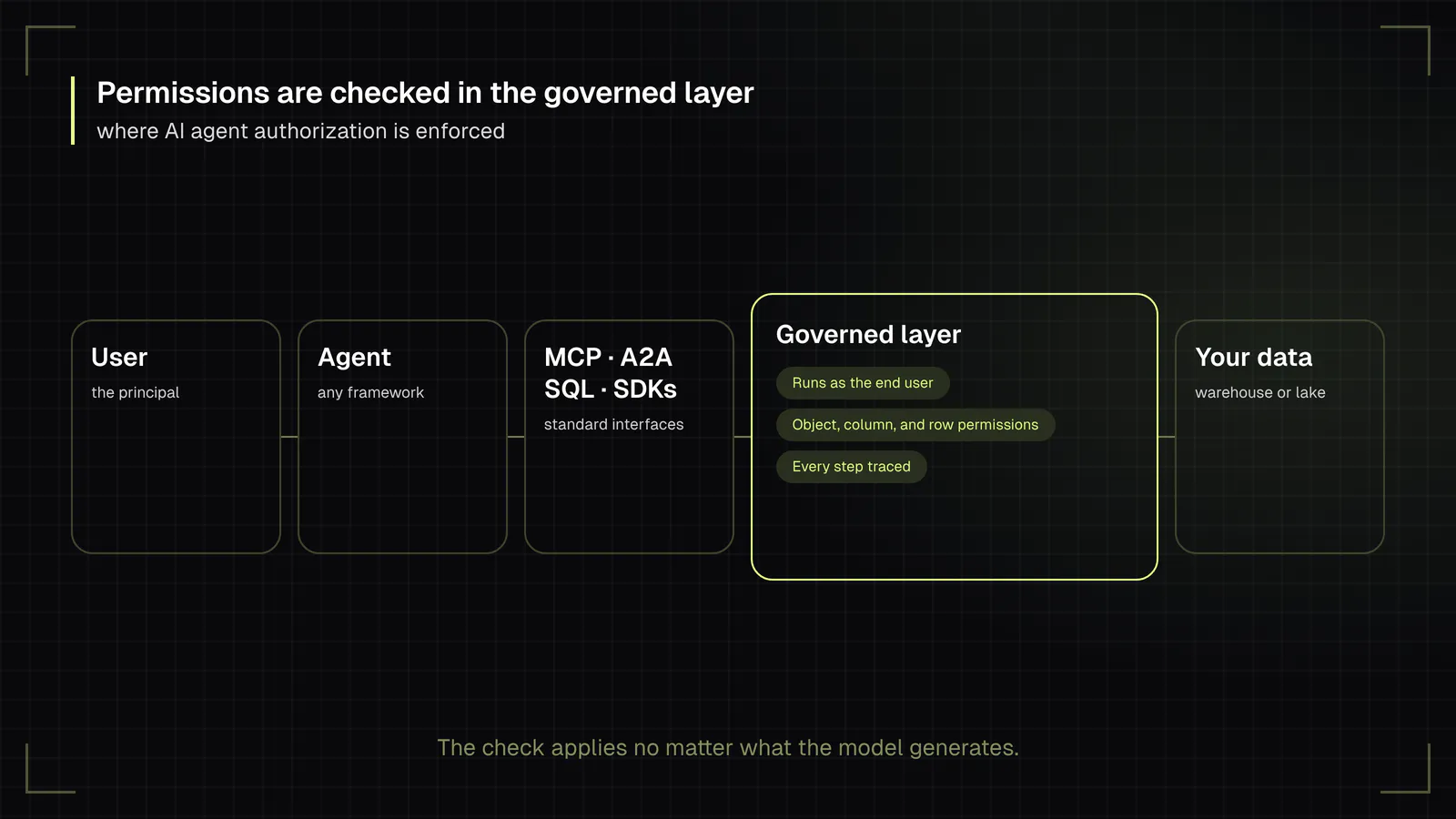
AI agent authorization enforced within the ruled knowledge layer
How GoodData.AI enforces AI agent authorization
GoodData.AI places authorization for brokers within the ruled layer beneath BI, apps, brokers, and MCP shoppers. Metrics, enterprise definitions, and entry guidelines are outlined as soon as, and the identical permissions apply to each question, so an agent can’t get a unique reply, or a wider view of the info, than a dashboard person with the identical rights. That’s the concept behind the Agentic Serving Airplane: a ruled execution layer between enterprise knowledge platforms and the dashboards, functions, assistants, and brokers that devour them.
Identification begins with how an agent connects. When an agent makes use of the GoodData.AI MCP Server via firm single sign-on (SSO), a signed JSON Net Token (JWT), or a per-user API token, each name runs as that person and may attain solely the workspaces, datasets, and objects that person could entry. A shared token runs each request below one identification, which is why GoodData.AI’s documentation reserves it for prototypes and demos. Agent-to-agent (A2A) requests authenticate with OAuth 2.0 or OpenID Join and run with the calling person’s permissions.
Inside these boundaries, object-level permissions management who can view, share, and edit particular person columns, metrics, and saved visualizations; content material constructed on a restricted column is blocked for anybody with out entry. The identical permission mannequin applies to dashboards, the AI Assistant, Sensible Search, and the MCP Server.
Brokers themselves are scoped too. In Agent Builder, directors select every agent’s expertise and which person teams can use it, and an agent solutions solely with knowledge the person is allowed to entry. Its character instruction can’t grant knowledge entry or override permissions and knowledge filters, as a result of these controls are configured individually. By the MCP Server, brokers can even construct and run analytics belongings resembling metrics, dashboards, and alerts, below the identical permissions because the person they act for.
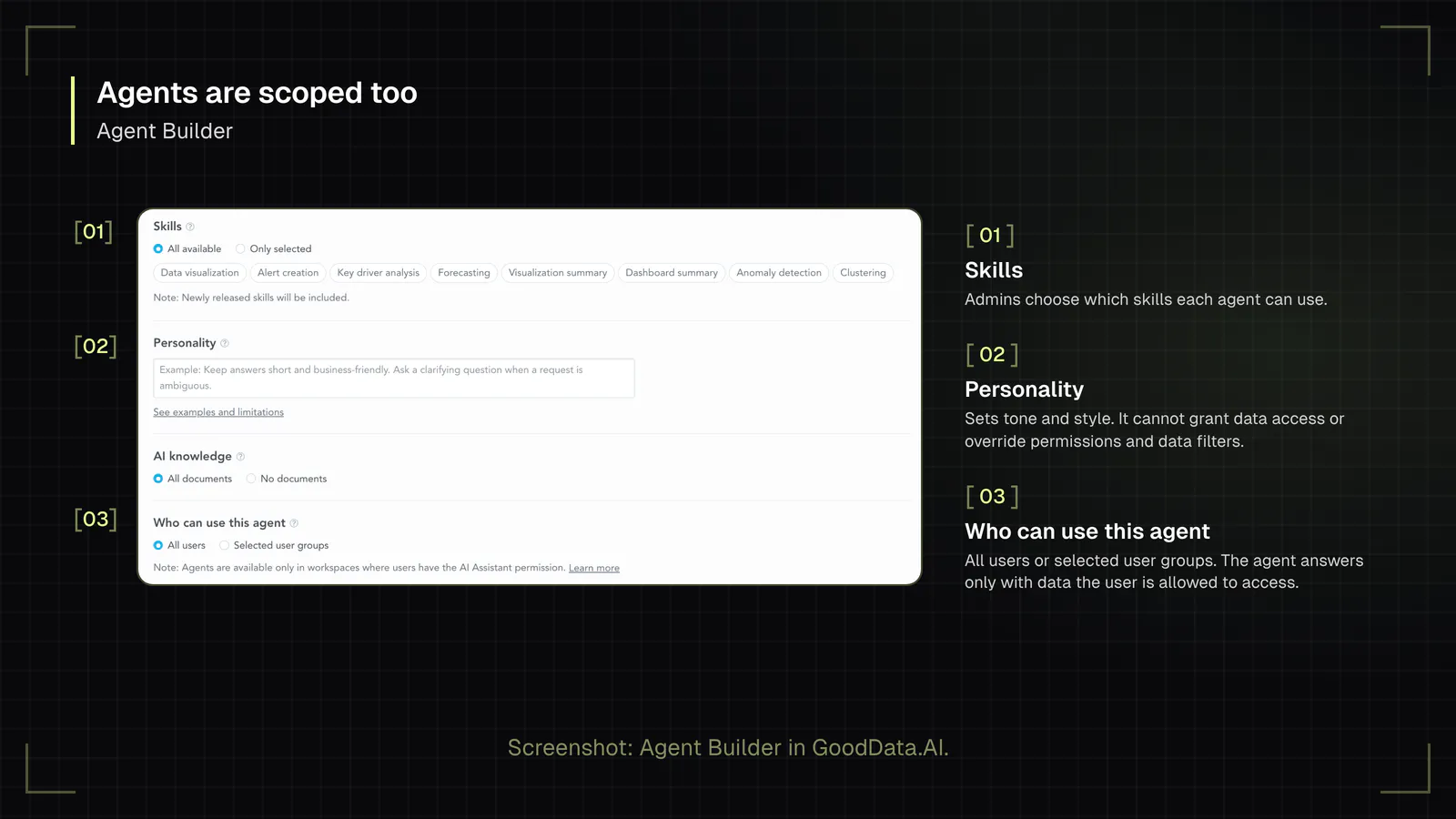
Three rules for data-layer enforcement
The identical strategy works on any platform. Three architectural rules make AI agent authorization maintain within the knowledge layer:
-
The person’s permissions are the ceiling.
When an agent acts for an individual, it inherits that particular person’s object-, column-, and row-level permissions and by no means exceeds them. A activity grant, a type of delegated authority, can slim the agent’s entry additional however can’t widen it.
-
The mannequin proposes, the engine decides.
The language mannequin produces a structured question definition in opposition to ruled metrics. A deterministic question engine checks permissions and runs it. On this design, the mannequin doesn’t have to learn uncooked tables in any respect.
-
One interface, many purchasers.
Brokers constructed on any framework join via commonplace interfaces resembling SQL, MCP, A2A, or SDKs. Each path passes via the identical checks, so the safety mannequin doesn’t rely on which agent framework a workforce picks.
Find out how to implement task-scoped entry management for AI brokers
Activity-scoped AI agent entry management begins from the permissions you have already got and narrows them per agent and per activity. The sequence beneath works whether or not you run one assistant or dozens of autonomous brokers.
-
Stock your brokers and their principals.
Record each agent, who or what it acts for, and which knowledge and instruments it might attain at present, so you might have a baseline of AI agent permissions. Brokers linked via private API keys belong on the record too.
-
Exchange shared service accounts with delegated identification.
Every request ought to carry the identification of the person, utility, or course of the agent represents, so current RBAC and object-level safety guidelines apply routinely.
-
Outline activity scopes.
For every recurring activity, specify the datasets, metrics, instruments, and actions it wants. A forecasting activity wants learn entry to historic income; it doesn’t want write entry to CRM data.
-
Set expiry and revocation.
A grant ought to finish when its activity ends, and directors want a technique to revoke an agent’s authority instantly, with out redeploying it. This is applicable the zero belief precept of NIST SP 800-207: no entry is trusted implicitly, and every grant is evaluated dynamically in opposition to coverage.
-
Require approval for actions.
Studying knowledge and altering knowledge carry totally different dangers. Route write operations, outbound messages, and something irreversible via express human approval till an agent has a confirmed monitor report.
-
Fail explicitly.
When a request exceeds the grant, return a transparent refusal the agent can report, not an empty or partial end result it’d misinterpret.
What ought to an AI agent audit path report?
An AI agent audit path ought to report sufficient to reconstruct each resolution an agent makes: the principal it acted for, the duty, every knowledge request with the coverage resolution utilized to it, every device name, the mannequin used, and each motion taken or blocked. Logging solely the ultimate reply isn’t sufficient, as a result of the danger sits within the intermediate steps. The NIST AI Threat Administration Framework treats this sort of traceability as a part of governing AI methods.
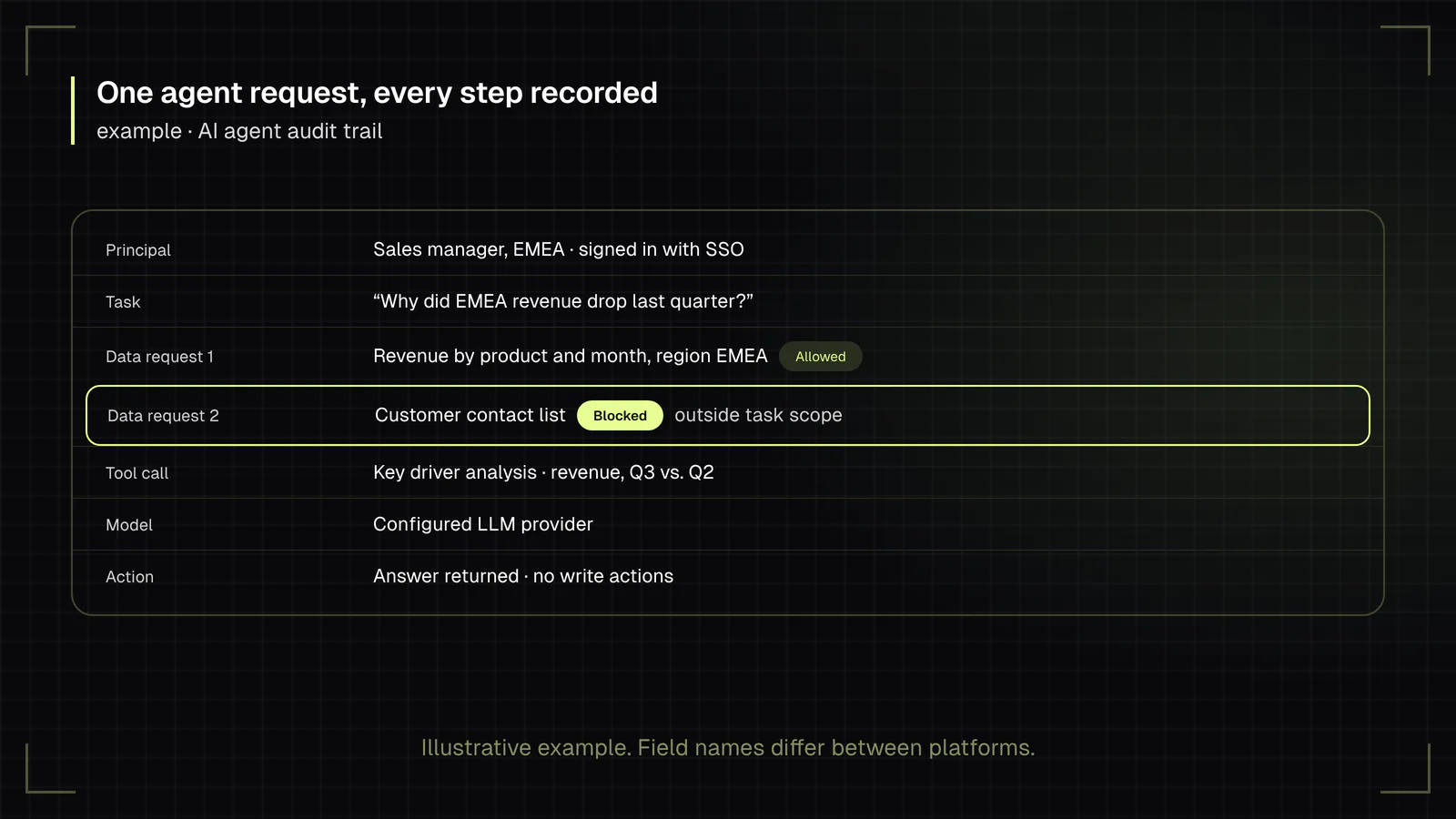
In GoodData.AI, AI Observability reveals how AI is used throughout the group. Agent authors can even examine the steps behind a response, resembling ability routing, information search, reminiscence use, metric queries, and reply composition, to debug and enhance solutions. GoodData.AI retains AI Assistant troubleshooting knowledge for one year by default, and organizations with stricter data-minimization guidelines can shorten that interval.
Audit knowledge additionally solutions the primary query most safety groups ask: which brokers are working, for whom, and at what value. For that start line, see AI Governance Begins with Utilization Visibility.
See how ruled brokers work in apply
Permissions are one a part of a ruled agent; expertise, enterprise context, and guardrails are the others. To see how they match collectively on a shared semantic layer, watch How Ruled AI Brokers Work: Abilities, Context, and Guardrails, or discover how groups construct and handle brokers in Agent Builder.
Continuously Requested Questions
Sure. RBAC defines the utmost entry any agent appearing for a person or utility can have. Agent authorization works inside that boundary, narrowing entry to what a particular activity wants. Eradicating RBAC would go away activity grants with nothing to restrict them.
An agent ought to have its personal identifier for logging and revocation, however its permissions ought to come from the principal it acts for. Giving an agent a separate identification with its personal broad permissions recreates the over-permissioned service account drawback.
Least privilege for AI brokers means an agent receives solely the info, instruments, and actions its present activity requires, and solely for so long as the duty runs. It extends the longstanding precept for human customers with two new limits: activity scope and time.
Attribute-based entry management (ABAC) evaluates attributes resembling division, area, knowledge sensitivity, or time when every request arrives. ABAC fits brokers higher than static roles as a result of activity and context can change into attributes. It nonetheless wants an outer RBAC boundary and a ruled place to implement the coverage.
Revoke the agent’s grant within the layer that serves knowledge, not within the agent’s personal configuration. Revocation within the knowledge layer takes impact on the subsequent request, no matter which framework or mannequin the agent makes use of.
MCP standardizes how brokers name instruments and knowledge, which makes the MCP server a pure enforcement level for AI agent authorization. Authorization nonetheless has to occur behind the server: the MCP server ought to move the person’s identification via so the info layer can apply the appropriate permissions.

