

The query behind an Adobe Expertise Platform API integration is just not whether or not the floor space exists, however whether or not your construct can soak up the architectural dedication that comes with it.
Adobe Expertise Platform’s API is among the most intensive in enterprise advertising expertise. Constructed on an specific “API first” philosophy the place each UI functionality can be accessible by way of REST, the developer documentation spans Expertise League, a devoted API developer hub, interactive reference pages with stay “Attempt it” blocks, and Postman collections. The platform powers one trillion experiences per yr throughout the manufacturers working on it.
However breadth of floor and health on your particular construct are totally different questions.
Adobe Expertise Platform’s API handles buyer knowledge operations: ingesting knowledge from any supply (batch and streaming), resolving identities into unified real-time profiles, constructing and evaluating viewers segments throughout streaming, batch, and edge modes, activating these audiences to tons of of downstream locations, imposing knowledge governance insurance policies on the level of activation, and working SQL analytics in opposition to the information lake. What it doesn’t do is generate B2B intelligence. There are not any endpoints for contact discovery, firm enrichment, org chart traversal, technographic lookup, purchaser intent detection, or verified cellphone quantity retrieval. AEP unifies and prompts knowledge you convey to it; it doesn’t produce the B2B intelligence knowledge itself.
That is the place ZoomInfo enters the image. ZoomInfo is a GTM platform whose Enterprise API is a REST suite protecting search, enrichment, and AI intelligence throughout 500M contacts, 100M firms, 135M+ verified cellphone numbers, and 200M+ verified enterprise e-mail addresses. With OAuth 2.0 authentication, tiered charge limits as much as 35 req/sec, and an MCP server for AI-agent workflows, ZoomInfo’s API offers the B2B intelligence layer that AEP’s buyer knowledge platform is just not designed to supply.
This overview covers the Adobe Expertise Platform API in full technical depth first, then opinions ZoomInfo’s API because the intelligence layer that provides what AEP can’t.
Adobe Expertise Platform API at a Look
Adobe Expertise Platform API: What Works Nicely & What to Plan Round
Adobe Expertise Platform API: Authentication & Getting Began
Supply: Adobe
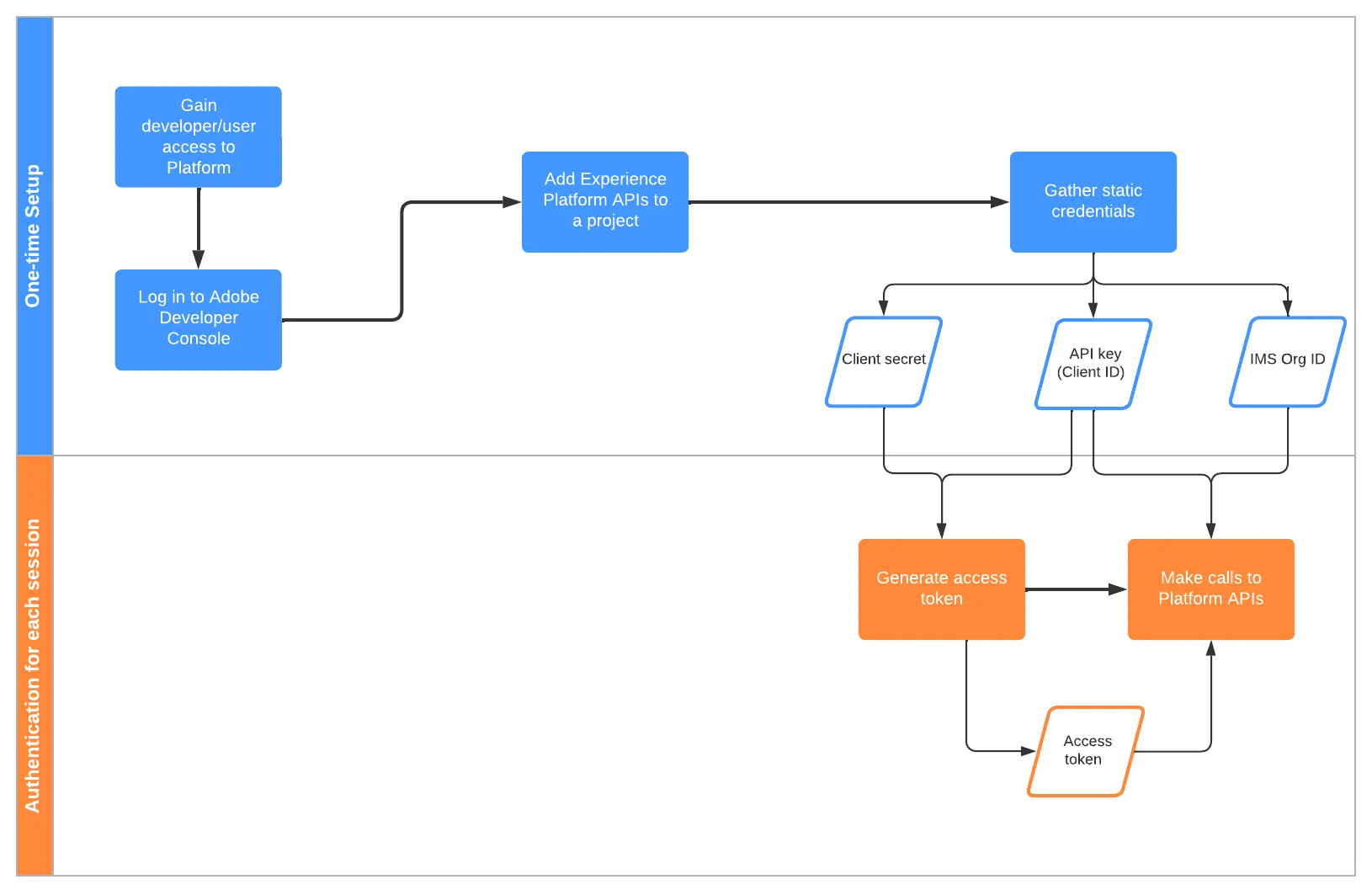
API entry begins with a licensed Adobe Expertise Platform subscription. There isn’t any free tier, no self-serve developer signup, and no public trial that features API entry. An administrator should assign developer and consumer roles to an Expertise Platform product profile in Adobe Admin Console earlier than a developer can create API integrations.
You get hold of credentials by making a mission in Adobe Developer Console, including the Expertise Platform API, and choosing the OAuth Server-to-Server authentication sort. The beforehand supported Service Account (JWT) technique was deprecated, and current JWT integrations have been required emigrate by June 30, 2025.
Each API name requires three headers:
Most API calls additionally require an x-sandbox-name header to focus on the right sandbox setting. A fundamental authenticated request follows this sample:
curl -X GET “{API_ENDPOINT}”
-H “Authorization: Bearer YOUR_ACCESS_TOKEN”
-H “x-api-key: YOUR_API_KEY”
-H “x-gw-ims-org-id: YOUR_ORG_ID”
-H “x-sandbox-name: prod”
For the reason that November 2024 launch, you may also generate credentials instantly from API reference pages by signing in and choosing “Create new credential.” This offers a “Attempt it” interactive block for stay API calls with out leaving the documentation. Postman collections can be found for testing.
Two companies use separate credential flows from the principle platform APIs: the Privateness Service API and the Reactor (Tags) API. Plan for a devoted credential setup in case your construct touches both.
Adobe Expertise Platform API: Core Endpoints & Capabilities
The API developer hub lists 15+ service-specific APIs, every with its personal reference.
All use the identical three-header authentication mannequin, assist JSON Pointer and JSON Patch (RFC 6901/6902) for addressing and partial updates, and require knowledge to adapt to the Expertise Information Mannequin (XDM) commonplace. Sandbox scoping applies to most calls.
Information Ingestion & Sources
The ingestion layer accepts knowledge in two modes, each feeding right into a shared XDM-compliant Information Lake.
Batch ingestion handles bulk historic hundreds and scheduled pulls. The Batch Ingestion API accepts information (CSV, JSON, Parquet) instantly, with a most batch dimension of 100 GB and as much as 20 GB/hour throughput by way of API. Supply connectors by way of the Circulate Service API pull from 70+ exterior methods on a schedule, with batch sources supporting as much as 200 GB/hour.
A Information Touchdown Zone (Adobe-provisioned cloud storage, 7-day file retention) helps push-then-ingest workflows.
Streaming ingestion pushes knowledge in actual time by way of the Net SDK, Cellular SDK, or HTTP API, routed via the Edge Community utilizing datastream configuration objects. Throughput: 4,000-5,000 req/sec to the information lake, 1,500 req/sec to profile, with a beneficial file dimension of 10 KB.
Supporting APIs deal with the information pipeline between supply and lake:
Supply connectors span Adobe purposes (Analytics, Viewers Supervisor, Marketo Have interaction, Marketing campaign, Commerce), cloud storage (Amazon S3, Azure Blob, SFTP), CRM (Salesforce, Microsoft Dynamics), databases (Snowflake, BigQuery, PostgreSQL), and streaming platforms (Amazon Kinesis, Azure Occasion Hubs, Google PubSub).
Superior Enterprise Sources (Kinesis, Occasion Hubs, BigQuery, Snowflake streaming, Databricks) require Actual-Time CDP Final licensing.
What you’ll construct with this: a pipeline that streams internet and cellular occasions by way of a single SDK name, batch-imports CRM information from Salesforce nightly by way of a scheduled supply connector, and transforms each into unified XDM profiles with out {custom} ETL middleware.
Actual-Time Buyer Profile & Id Decision
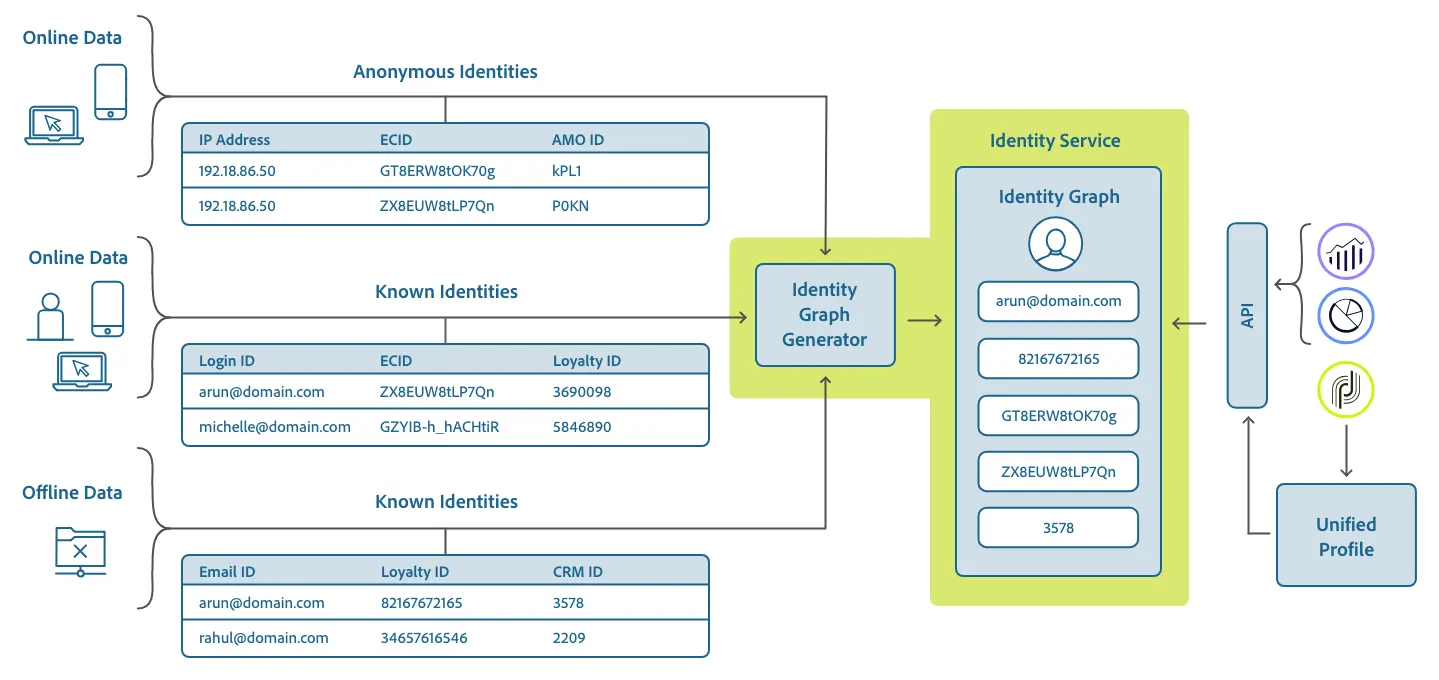
The Id Service API manages identities, namespaces, and identification graph clusters.
It hyperlinks totally different identifiers (CRM IDs, machine IDs, e-mail addresses, cookies) deterministically based mostly on noticed co-occurrences, constructing a per-organization identification graph with a tough restrict of 50 identities per graph. Organizations can create {custom} namespaces for proprietary identifier schemes.
Supply: Adobe
Actual-Time Buyer Profile merges identity-linked knowledge fragments right into a single profile per buyer. Profile knowledge is available in two varieties:
-
Document knowledge: attributes (identify, e-mail, demographics) modeled on the XDM Particular person Profile class.
Merge insurance policies management how the platform resolves conflicting attribute values from a number of datasets, configurable by way of API or UI (as much as 3 per sandbox). The union schema offers a merged view throughout all Profile-enabled datasets. B2B entity assist extends the profile mannequin to accounts and alternatives linked to individual profiles via schema relationships.
What you’ll construct with this: an identification decision layer that stitches nameless internet periods (by cookie ID) to identified CRM contacts (by e-mail), making a single addressable profile that updates in actual time as new occasions arrive.
Segmentation & Audiences
The Segmentation Service API creates and manages viewers definitions compiled into Profile Question Language (PQL), Adobe’s declarative language for profile retrieval. Three analysis modes cowl the latency spectrum:
-
Edge segmentation: analysis on Adobe’s Edge Community in the mean time of an online or cellular request, enabling same-page personalization with sub-millisecond latency.
Viewers Composition offers workflows for combining, enriching, and splitting current audiences. Federated Viewers Composition queries enterprise knowledge warehouses (Snowflake, Databricks, Redshift) to construct audiences with out copying knowledge into AEP. Exterior viewers import helps audiences constructed by knowledge science fashions or third-party instruments.
What you’ll construct with this: a real-time viewers that qualifies prospects who seen a product web page however didn’t buy inside 24 hours, evaluated repeatedly by way of streaming segmentation and activated instantly to a retargeting vacation spot.
Locations & Activation
The Circulate Service API for Locations connects AEP to downstream platforms. Vacation spot varieties embody:
-
Streaming viewers export: near-real-time viewers membership occasions by way of API to platforms like Fb, Google Adverts, and Google Show & Video 360.
-
Superior enterprise streaming: steady knowledge streams to Amazon Kinesis, Azure Occasion Hubs, HTTP API, and Snowflake (Actual-Time CDP Final solely).
The Vacation spot SDK lets expertise companions and Actual-Time CDP Final prospects construct and publish {custom} vacation spot connectors. Actual-Time CDP Final prospects may also construct non-public {custom} locations for inside methods.
Information governance enforcement evaluates knowledge utilization labels and advertising motion insurance policies in the mean time of activation, blocking policy-violating exports earlier than any knowledge leaves. Attribute-based entry management restricts field-level export rights, so customers can’t export fields they lack entry to even when the vacation spot is in any other case permitted.
Information Governance, Privateness & Platform Operations
The Dataset Service API manages knowledge utilization labels on the schema subject stage, categorized into Contract, Id, and Delicate classes. Labels propagate robotically to all datasets utilizing that schema and downstream to any derived segments or profiles. Customized labels can lengthen the framework to organization-specific wants.
The Privateness Service API automates GDPR and CCPA knowledge topic entry and deletion requests throughout Adobe Expertise Cloud purposes from a single interface. The Information Hygiene API schedules dataset expirations and record-level deletions. Audit logs (queryable by way of the Audit Question API) file who did what and when throughout all platform sources.
Further platform operations APIs:
-
Sandbox API: create, learn, replace, and reset sandbox environments programmatically.
Question Service & Analytics
The Question Service API exposes each dataset within the AEP knowledge lake via commonplace ANSI SQL, with out requiring knowledge motion. Interactive queries return as much as 50,000 rows inside a 10-minute timeout. Adobe-defined features (ADFs) lengthen commonplace SQL with XDM-native constructs for sessionization, occasion pathing, and time-gap evaluation.
A number of shopper paths work: the browser-based Question Editor, a PostgreSQL-compatible PSQL shopper, BI instruments (Tableau, Energy BI, Looker) over the Postgres wire protocol, and the REST API.
The Information Distiller add-on unlocks write-back queries (CTAS) that persist outcomes as new datasets, scheduled batch transformation jobs, and derived datasets that feed again into Actual-Time Buyer Profile. It turns Question Service right into a SQL-based transformation engine inside AEP, with compute-hour metering in opposition to license entitlements.
What you’ll construct with this: a each day SQL job that computes churn propensity scores from occasion knowledge, writes outcomes again as a derived dataset, and feeds these scores into Actual-Time Buyer Profile for speedy viewers qualification and activation.
Adobe Expertise Platform API: Webhooks & Occasions
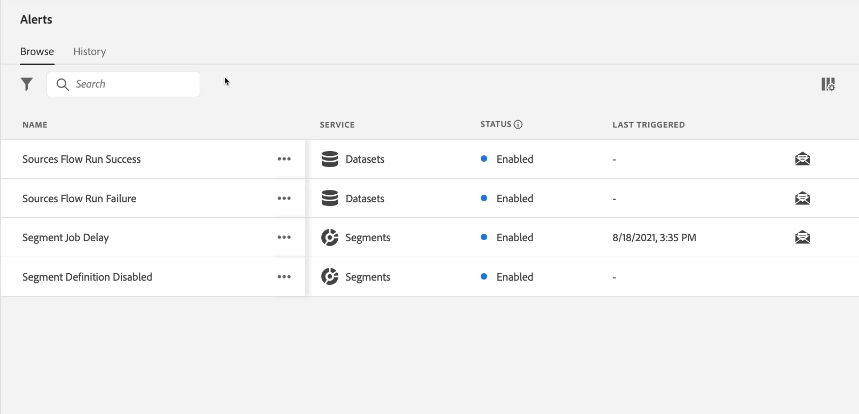
Adobe Expertise Platform doesn’t expose direct outbound webhooks. Occasion notifications arrive via Adobe I/O Occasions. Builders register a webhook endpoint in Adobe Developer Console; when an alert situation fires, the system sends a message to that endpoint.
Alert varieties fall into two classes:
One-time alerts cowl discrete occasions:
Repeating alerts cowl persistent anomaly states:
Supply: Adobe
Alert circumstances are based mostly on Observability Insights metrics (resembling timeseries.ingestion.dataset.batchfailed.depend). Every rule can embody a time window and repeat frequency. Alerts additionally seem within the platform UI by way of a notification bell icon and may be forwarded to Slack via an App Builder proxy.
Two issues to plan round:
-
In case your pipeline wants fine-grained, resource-level occasion streaming, the superior enterprise locations (Amazon Kinesis, Azure Occasion Hubs) on the Actual-Time CDP Final tier present steady knowledge streams, however these are activation channels, not a general-purpose occasion bus.
Adobe Expertise Platform API: SDKs, Docs & Price Limits
SDKs & Libraries
Adobe offers first-party SDKs for client-side knowledge assortment, not for server-side API interactions:
-
Expertise Platform Net SDK: JavaScript SDK for browser-based knowledge assortment by way of the Edge Community. Replaces a number of per-product tags with a single implementation that feeds AEP, Adobe Analytics, Adobe Goal, and different companies concurrently.
For platform API interactions (ingestion, profile administration, segmentation, locations, governance), there are not any server-side SDK packages in any language. Builders name the REST APIs instantly utilizing commonplace HTTP shoppers. Adobe offers Postman collections and interactive “Attempt it” blocks on API reference pages, however you personal the authentication layer, token refresh logic, retry dealing with, and request serialization in manufacturing.
Two extension frameworks exist for constructing connectors: the Sources SDK (batch and streaming variants) lets companions construct and register supply connectors, and the Vacation spot SDK lets companions construct vacation spot connectors. These are extension APIs for the connector catalog, not shopper libraries for consuming the platform APIs.
Documentation & Developer Expertise
Adobe Expertise Platform has one of the vital thorough documentation ecosystems in enterprise software program:
-
Adobe Expertise League: the first hub, organized by product space with guides, tutorials, and embedded video walkthroughs.
-
Interactive API explorer: accessible since November 2024 on API reference pages, letting builders register, generate credentials, and make stay API calls instantly within the docs.
Developer assist runs via Adobe buyer care representatives. Sandboxes (1 manufacturing + as much as 4 non-production at base entitlement) let builders take a look at integrations with out affecting manufacturing knowledge.
The documentation is thorough and developer-oriented, however the scope creates its personal problem.
Navigating 15+ service-specific API references, every with its personal endpoint catalogue, authentication nuances, and guardrails, takes vital orientation time. Customers on SelectHub be aware that “integrating with non-Adobe software program can really feel troublesome and documentation may be complicated.”
Price Limits & Constraints
Adobe publishes ingestion guardrails on the group stage (not per sandbox, besides the place famous):
Batch ingestion by way of API:
Batch ingestion by way of supply connectors (S3, Blob, SFTP):
Streaming ingestion:
Profile exhausting limits:
-
Identities per graph: 50 (profiles exceeding this are excluded from segmentation, exports, and lookups)
Question Service:
Adobe notes that these guardrails are topic to license entitlements laid out in every buyer’s Gross sales Order. Prospects who persistently exceed mushy limits can license extra capability. The License Utilization Dashboard offers each day metric snapshots and a six-week rolling utilization forecast up to date weekly.
Adobe Expertise Platform API Pricing & Entry Prices
Adobe Expertise Platform doesn’t publish pricing. There isn’t any pricing web page, no self-serve signup, and no public charge card. All offers undergo Adobe’s enterprise gross sales crew by way of {custom} quote.
Pricing is usage-based, metered in opposition to two dimensions:
-
Addressable Viewers: the entire variety of buyer profiles (identified and pseudonymous) the group can retailer, per Adobe’s license documentation.
-
Whole Information Quantity: calculated as Addressable Viewers multiplied by Common Profile Richness, representing whole knowledge accessible for profile workflows, per Adobe’s metric documentation. Information Lake storage is excluded from this calculation.
The unit of sale is per 1,000 Profiles. There isn’t any flat-fee or per-seat pricing mannequin.
The first business automobile is Actual-Time CDP, bought in three viewers editions (B2C, B2B, B2P), every with two bundle tiers: Prime and Final. The tier distinction issues for API builders:
-
Final unlocks: Superior Enterprise Supply and Vacation spot Connectors, Profile API Calls (5 per profile/yr for B2C, 8 for B2B), Vacation spot SDK for {custom} connectors, and better knowledge export limits (700 KB/profile/yr vs. 500 KB).
Baseline entitlements included with all editions:
A big catalog of purchasable add-ons exists, every priced individually: extra advert hoc question customers (per pack of 5), additional sandboxes (per 10-pack), streaming segmentation capability, computed attributes, Buyer AI, Federated Viewers Composition, Healthcare Defend (HIPAA compliance), Privateness and Safety Defend, Profile Richness packs (+25 KB per profile), Information Distiller, and the Agent Orchestrator.
Overage coverage: overusage is calculated each day, with a Grace Interval of as much as 7 consecutive days earlier than charges kick in.
For a developer sizing this: there is no such thing as a technique to consider or prototype in opposition to the API with out an enterprise contract. The Preliminary Implementation Interval provides restricted complimentary entry earlier than the license time period begins, however solely after a purchase order settlement is signed. Non-production sandboxes assist as much as 10% of the licensed profile dedication for growth and testing.
The place the Adobe Expertise Platform API Falls Quick
These are the sensible limits a developer ought to plan round, a number of of which mirror AEP’s enterprise positioning.
No free tier, no self-serve, no technique to prototype earlier than signing.
Each competing CDP and knowledge platform provides some type of developer sandbox, free tier, or self-serve trial. AEP requires an enterprise contract earlier than a developer could make a single API name. Groups evaluating the platform should make architectural selections on documentation overview alone.
No server-side SDKs for platform API interactions.
The Net SDK and Cellular SDK deal with client-side knowledge assortment, however for server-side integrations (ingestion, profile administration, segmentation, governance), builders work with uncooked HTTP calls.
You personal the token rotation (each 24 hours), the retry logic, the error dealing with, and the three-header authentication on each request. Postman collections assist with prototyping, however there is no such thing as a maintained Python, Node.js, or Java shopper library to soak up that overhead in manufacturing.
Three-header authentication on each name.
Bearer token, API key, and org ID should accompany each request, plus a sandbox header for many calls. The entry token’s 24-hour expiry means each long-running integration wants a dependable token refresh mechanism. That is extra friction than most trendy APIs impose.
Superior connectors require Final licensing.
The superior enterprise connectors (Amazon Kinesis, Azure Occasion Hubs, Snowflake streaming, Google BigQuery, Azure Databricks) and Superior Enterprise Vacation spot Connectors are unique to Actual-Time CDP Final. A developer constructing on the Prime tier discovers that their most well-liked knowledge warehouse connector sits behind a tier gate.
Alert-based occasions, not resource-level webhooks.
The Adobe I/O Occasions system delivers alerts on well being metrics and job completions, however it isn’t a general-purpose occasion system. There isn’t any “hearth a webhook when a profile enters an viewers” or “notify on each new identification hyperlink.”
Builders who want real-time, event-driven architectures should use the superior enterprise streaming locations (Kinesis, Occasion Hubs) on the Final tier, that are activation channels, not webhook infrastructure.
No B2B intelligence endpoints.
AEP ingests, unifies, and prompts knowledge. It doesn’t generate it. There are not any endpoints for contact discovery, firm enrichment, technographic lookup, purchaser intent indicators, org chart traversal, or verified cellphone quantity retrieval. In case your buyer knowledge pipeline wants B2B intelligence as an enter, that knowledge should come from an exterior supply.
Implementation complexity is structural, not incidental.
All knowledge should conform to XDM schemas earlier than ingestion. Schema design, identification namespace planning, and merge coverage configuration are stipulations earlier than the primary file enters the system. TrustRadius reviewers describe the platform as one the place “it’s essential to be properly skilled and resourced to make use of the product,” and implementation timelines of 6 to 18 months are typical for enterprise deployments.
ZoomInfo API: The B2B Intelligence Layer AEP Does Not Generate
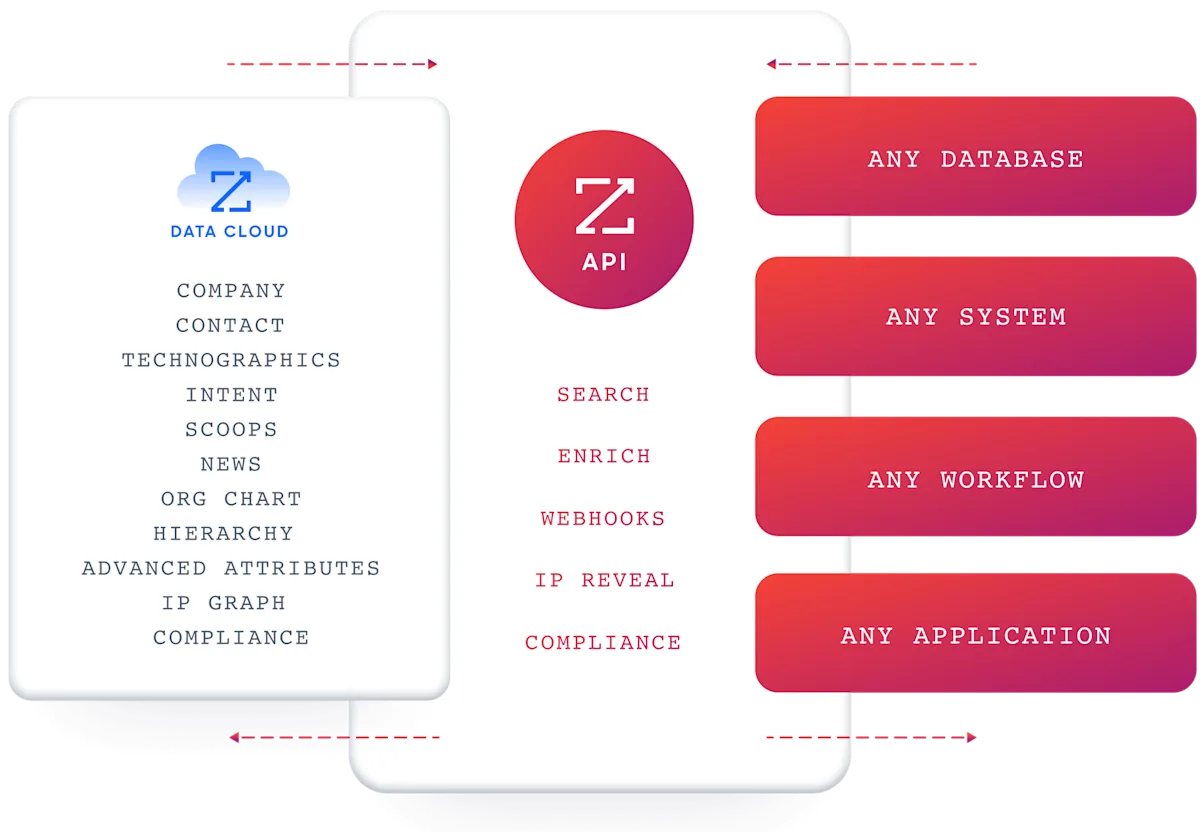
AEP’s API manages the shopper knowledge platform: ingesting, unifying, segmenting, and activating knowledge from any supply. What it doesn’t produce is the B2B intelligence knowledge that feeds these operations.
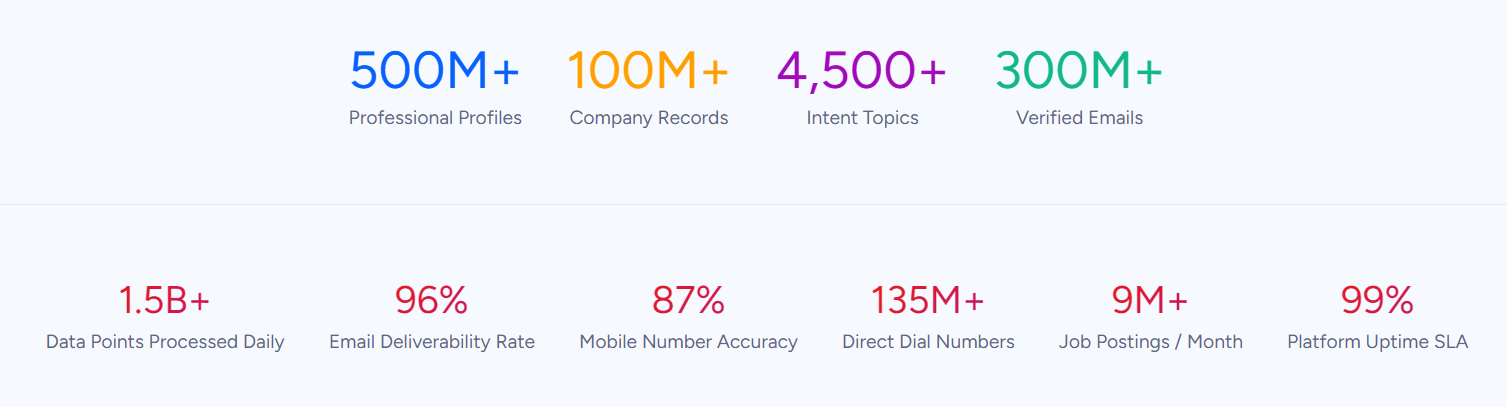
ZoomInfo’s API covers that layer: contact discovery, firm enrichment, intent indicators, org charts, and technographics, all accessible programmatically. Powering these endpoints is the GTM Context Graph, which processes 1.5B+ knowledge factors each day by fusing ZoomInfo’s B2B knowledge together with your first-party knowledge to indicate not simply what occurred, however why.
Supply: ZoomInfo
For a developer constructing a B2B pipeline on AEP, ZoomInfo’s API is the intelligence supply upstream of ingestion. The workflow: seek for contacts matching your ICP (free, no credit consumed), enrich with verified emails, direct dials, and firm knowledge (1 credit score per new file), then push the outcomes into AEP by way of a supply connector or the Batch Ingestion API for unification and activation.
What the API Covers: Search, Enrichment & AI Intelligence
ZoomInfo’s Enterprise API is a REST suite served from https://api.zoominfo.com/gtm, organized into 4 areas documented within the interactive API reference:
Information API (Search & Enrich): Search endpoints cowl Contacts, Firms, Intent, Information, and Scoops, returning matched information with out consuming credit. Enrich endpoints unlock full payloads: enterprise emails, direct dials, employment historical past, company hierarchy, org charts, technographics, and hashtag indicators, accepting as much as 25 information per name.
The underlying dataset spans 500M contacts, 100M firms, 135M+ verified cellphone numbers, and 200M+ verified enterprise e-mail addresses. The search-then-enrich sample means you filter freely, then pay just for information you decide to.
Supply: ZoomInfo
Copilot API (AI Intelligence): Exposes AI capabilities from GTM Workspace programmatically.
Account Abstract returns structured account intelligence with a free-form Q&A endpoint. Discover Related Firms performs lookalike growth from a seed account. Contact Suggestions returns AI-ranked buying-committee ideas by movement (prospecting, deal acceleration, renewals). This floor requires an Enterprise API or Copilot bundle subscription.
Advertising and marketing API: CRUD endpoints for programmatic viewers administration, enabling automated viewers refresh instantly from pipeline methods.
Platform API (Engagements, Beta): Bidirectional engagement knowledge by way of the Engagements API.
What you’ll construct with this in an AEP pipeline: a pre-ingestion enrichment service that queries ZoomInfo for contacts matching your ICP, enriches matches with verified emails and firm knowledge, then batch-ingests the enriched information into AEP the place they be a part of the unified buyer profile for segmentation and activation.
Authentication, Price Limits & Credit
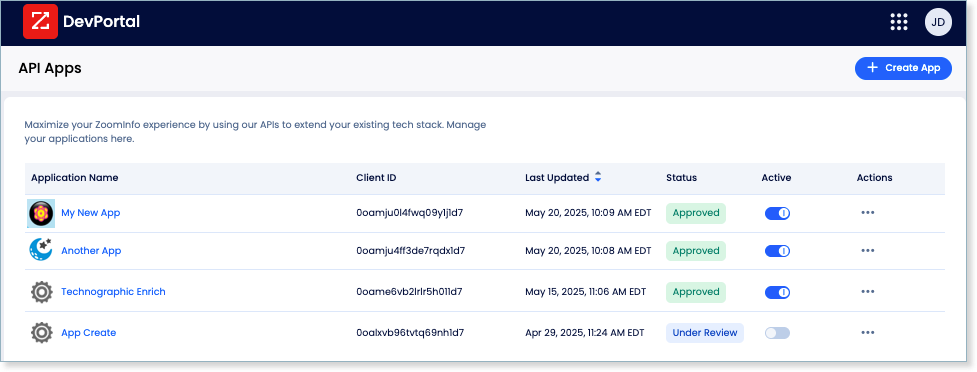
Authentication makes use of OAuth 2.0 with PKCE by way of Okta, issuing 24-hour entry tokens with rotating refresh tokens. Three flows are supported: Authorization Code with PKCE (internet purposes), Consumer Credentials (server-to-server), and Refresh Token. Groups register purposes via the ZoomInfo Developer Portal, the place they generate credentials, outline scopes, and take a look at endpoints.
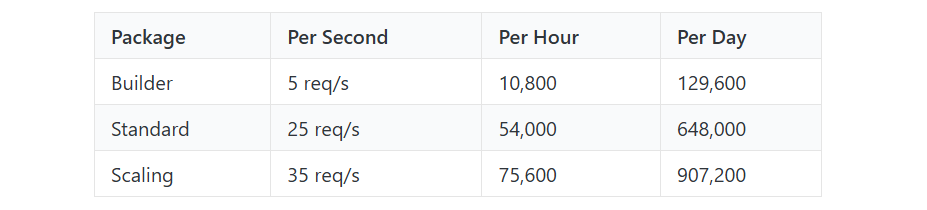
Price limits are printed by tier: Builder (5 req/sec, 10,800/hour, 129,600/day), Customary (25 req/sec, 54,000/hour, 648,000/day), and Scaling (35 req/sec, 75,600/hour, 907,200/day).
All three home windows (per-second, per-hour, per-day) are enforced concurrently utilizing a sliding window counter algorithm. Each response consists of quota headers with remaining capability, and 429 responses embody a Retry-After header with actual backoff timing and an X-RateLimit-Rejected-Bucket header figuring out which window was exhausted.
Supply: ZoomInfo
Credit observe a rolling 12-month window: enriching a file for the primary time consumes one credit score; re-enriching the identical file inside the yr is free. Search, lookup, and similarity operations are free and don’t eat credit. ZoomInfo makes use of consumption-based pricing, custom-quoted per group; ZoomInfo has added API entry to all related plans.
MCP, Webhooks & Developer Expertise
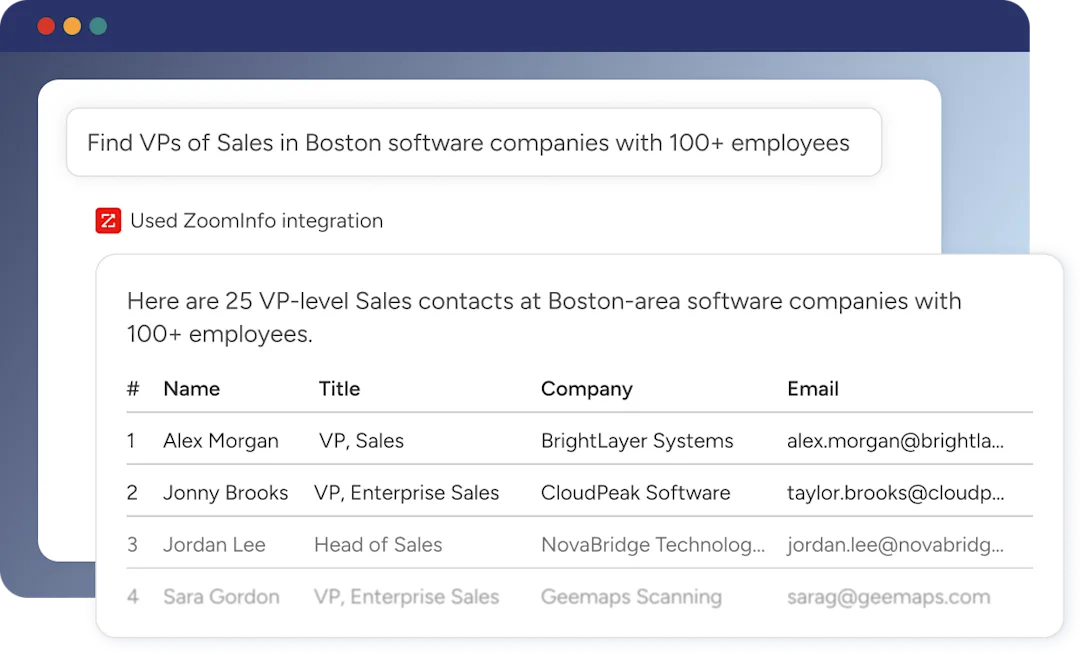
For builders constructing AI brokers, ZoomInfo’s MCP server at https://mcp.zoominfo.com/mcp exposes search, enrich, and account analysis as native instruments for MCP-compatible assistants, at present supporting Claude and ChatGPT. The credit score mannequin carries over from the REST API. A separate Docs MCP server lets AI growth instruments generate integration code in opposition to the ZoomInfo API spec.
Supply: ZoomInfo
Webhooks are accessible by way of the Brokers API, tied to ZoomInfo’s Agent Groups system. Occasion varieties cowl bulk enrichment jobs finishing, information altering, credit score utilization crossing thresholds, and new GTM indicators (scoops, funding occasions, intent spikes) turning into accessible, with retry and throttling configurable per occasion sort.
Documentation lives at docs.zoominfo.com with an interactive API reference, OAuth recipes in 5 languages (Shell, Node, Ruby, PHP, Python), and an llms.txt index for AI growth instruments. ZoomInfo doesn’t publish official SDKs both, so each ZoomInfo and AEP require direct HTTP integration. The interactive playground helps stay testing with OAuth2 Bearer token authentication.
BDO Canada reported an 87% discount in time spent updating inside knowledge dashboards utilizing the ZoomInfo API, with one analyst describing the mixing as plug-and-play throughout any course of. (ZoomInfo)
Ultimate Verdict
Adobe Expertise Platform’s API is essentially the most thorough programmatic floor within the enterprise buyer knowledge platform class.
Fifteen-plus service-specific APIs cowl each stage of the shopper knowledge lifecycle: ingestion via identification decision, segmentation throughout streaming, batch, and edge modes, activation to tons of of locations with inline governance enforcement, and SQL analytics in opposition to a stay knowledge lake. The documentation is thorough, the guardrails are printed, and the interactive API explorer lets a developer affirm response shapes with out writing code.
Its limits are limits of positioning: enterprise-only entry, no server-side SDKs, three-header authentication, and a scope that stops at knowledge operations.
Select the Adobe Expertise Platform API if you’re constructing buyer knowledge infrastructure at enterprise scale: ingesting from dozens of sources into unified real-time profiles, segmenting throughout three analysis modes, activating to tons of of locations with knowledge governance enforcement constructed into the activation layer, and working SQL analytics in opposition to a stay knowledge lake.
AEP’s API is the proper basis when the construct is buyer expertise orchestration and the group is dedicated to the Adobe ecosystem.
Select ZoomInfo’s API when your pipeline wants B2B intelligence as an enter to that buyer knowledge layer: contact discovery, firm enrichment, org charts, technographics, and purchaser intent indicators.
ZoomInfo’s search-then-enrich sample (search is free, enrich consumes credit), its AI intelligence endpoints, and its MCP server give a developer the information AEP’s API is just not designed to supply. The 2 APIs sit at totally different layers of the identical pipeline, and the construct that wants each is extra widespread than the construct that wants just one.
Begin with the ZoomInfo Enterprise API or discover the developer docs to see the endpoint floor instantly.
A developer who wants a buyer knowledge platform however can’t decide to AEP’s enterprise licensing ought to know that AEP has no lighter-weight API entry tier. The platform is constructed for organizations already within the Adobe ecosystem with the finances and engineering sources to match.
FAQ
Is the Adobe Expertise Platform API free?
No. API entry requires a licensed Adobe Expertise Platform subscription, bought via enterprise agreements with {custom} pricing. There isn’t any free tier, no self-serve signup, and no public trial that features API entry.
New prospects obtain an Preliminary Implementation Interval for testing earlier than the license time period begins, however solely after signing a purchase order settlement. The bottom entitlement consists of 5 sandboxes, 1 concurrent Question Service consumer, and three Profile Merge Insurance policies, with all the pieces else (extra question customers, sandboxes, streaming segmentation, Information Distiller) accessible as paid add-ons.
Does Adobe Expertise Platform have a GraphQL API?
No. All Adobe Expertise Platform APIs are RESTful, supporting CRUD operations over HTTPS with JSON responses. The platform makes use of JSON Pointer (RFC 6901) and JSON Patch (RFC 6902) for partial updates and useful resource mutations.
Question Service helps commonplace ANSI SQL in opposition to the information lake (with Adobe-defined features for XDM-native constructs like sessionization and occasion pathing), however there is no such thing as a GraphQL endpoint.
What are the Adobe Expertise Platform API charge limits?
Price limits range by service.
Streaming ingestion helps 4,000-5,000 requests/second to the information lake and 1,500 requests/second to profile. Batch ingestion by way of API handles as much as 20 GB/hour (200 GB/hour by way of supply connectors). Profile guardrails implement exhausting limits: 10 KB for ExperienceEvent information, 100 KB for file class information, and 50 identities per identification graph. Question Service permits 1 concurrent consumer and 1 concurrent advert hoc question at base entitlement.
Most limits apply on the group stage and are topic to license entitlements specified within the buyer’s Gross sales Order.
Are there official server-side SDKs for the Adobe Expertise Platform API?
No. Adobe offers the Net SDK (JavaScript) and Cellular SDK (iOS/Android) for client-side knowledge assortment, plus the Edge Community Server API for server-side knowledge assortment.
For platform API interactions (ingestion, profile administration, segmentation, governance, locations), there are not any maintained server-side SDK packages in any language. Builders name REST APIs instantly utilizing commonplace HTTP shoppers. Postman collections and interactive “Attempt it” blocks on API reference pages assist with prototyping, however manufacturing integrations require constructing your personal authentication, retry, and request-handling layer.
Does the Adobe Expertise Platform API assist webhooks?
Not within the conventional sense. Occasion notifications arrive via Adobe I/O Occasions, the place builders register a webhook endpoint in Adobe Developer Console.
Alerts hearth on well being metrics and job completions (ingestion succeeded, question completed, knowledge deleted, error charge above threshold), however there is no such thing as a resource-level occasion system for fine-grained notifications like “a profile entered an viewers” or “a brand new identification hyperlink was created.”
Builders who want real-time occasion streaming usually use the superior enterprise streaming locations (Amazon Kinesis, Azure Occasion Hubs) on the Actual-Time CDP Final tier.
How does ZoomInfo’s API complement the Adobe Expertise Platform API?
ZoomInfo’s API offers the B2B intelligence knowledge that AEP’s API doesn’t generate. AEP ingests, unifies, and prompts buyer knowledge, but it surely has no endpoints for contact discovery, firm enrichment, org chart traversal, technographic lookup, or purchaser intent detection.
ZoomInfo’s search endpoints allow you to discover contacts matching your very best buyer profile with out consuming credit, enrich with verified emails, direct dials, and firm knowledge at 1 credit score per new file, and detect intent indicators throughout accounts. The enriched knowledge can then move into AEP by way of a supply connector or the Batch Ingestion API, the place it joins the unified buyer profile for segmentation and activation.
The 2 APIs use totally different authentication fashions (three-header OAuth Server-to-Server vs. commonplace OAuth 2.0 with PKCE) and totally different pricing buildings (enterprise license vs. credit-based), so plan your integration layer to deal with each. ZoomInfo’s MCP server extends the identical intelligence to AI-agent workflows, including a programmatic floor AEP doesn’t at present provide.

