

IP telephony providers enable companies to make and obtain cellphone calls over the web as a substitute of conventional phone strains. These providers use Web Protocol (IP) to transmit voice knowledge and help options like name routing, video conferencing, voicemail, and messaging. They assist companies cut back communication prices, enhance accessibility, and scale their cellphone methods.
For many years, companies relied on conventional cellphone methods to remain linked. Right now, IP telephony has grow to be the muse of contemporary enterprise communications, bringing collectively voice, video, messaging, and conferencing on a single platform.
The main focus right now isn’t just on adopting IP telephony however on maximizing it. Companies at the moment are exploring how superior VoIP cellphone methods, unified communications, and AI instruments can enhance operational effectivity and buyer interactions.
This information explains how IP telephony works, what it prices, and the way to decide on the proper service supplier for what you are promoting.
What Is IP Telephony?
IP telephony (Web Protocol telephony) refers to any cellphone system that makes use of an web connection to ship and obtain voice knowledge. In contrast to a daily phone that makes use of landlines to transmit analog alerts, IP telephones connect with the web through a router and modem.
Industrial web calling software program emerged as early as 1995. However in comparison with an ordinary cellphone system, it had low audio high quality and was prohibitively costly.
Since then, internet-based cellphone expertise has improved by leaps and bounds. IP telephony now provides HD voice high quality, cheaper operating prices, and superior enterprise cellphone options. Cloud-based IP telephony additionally reduces the necessity for upfront {hardware} funding.
IP telephony doesn’t cease at voice calls. Listed below are some extra of its use circumstances.
- Video calling
- Audio and video conferencing
- Textual content messaging
- Prompt messaging
- Faxing
Watch this brief video for a easy, animated breakdown of how IP telephony sends voice over the web.

What Is an IP Telephone?
An IP cellphone is a phone system that makes and receives calls over an Web Protocol community as a substitute of a conventional phone line. It converts your voice into digital knowledge and sends it to the recipient over the community.
There are two widespread methods to make IP cellphone calls:
- {Hardware}-based IP telephones: Bodily desk telephones that connect with a community by way of Ethernet or, on suitable fashions, Wi-Fi.
- Software program-based IP telephones: Also referred to as softphones, these are purposes that enable customers to make and obtain calls from computer systems, smartphones, or tablets.
Relying on the system and repair supplier, IP telephones additionally help name transfers, voicemail, convention calling, and HD audio.
What Is an IP Telephone System?
An IP cellphone system is a communication system that enables companies to make and obtain calls over an IP community as a substitute of conventional phone strains. In contrast to a person IP cellphone, it connects a number of customers, units, and cellphone numbers by way of a centralized system.
It additionally helps superior options comparable to name routing, voicemail, auto attendants, and name forwarding, making it simpler for companies to handle their each day communications.
How Does an IP Telephony System Work?
An IP telephony system works by changing voice alerts into digital knowledge packets and transmitting them over an IP community. The receiving system converts these packets again into audio, permitting each events to speak in actual time.
IP telephony digitizes analog voice alerts into knowledge packets which might be then transmitted utilizing the Web Protocol. As knowledge packets traverse networks, they encounter units comparable to routers that learn packet headers and ahead them to their locations.
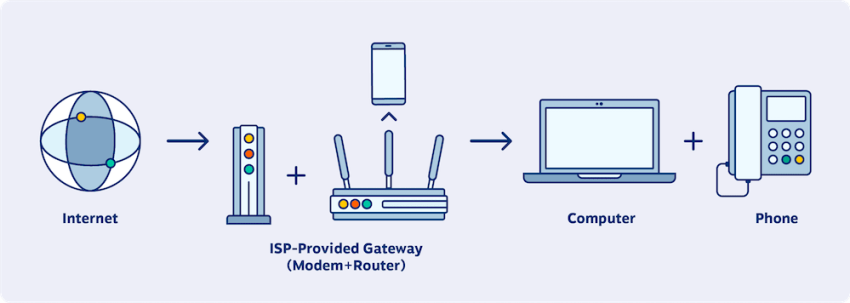
When packets full their journey, the software program reassembles them within the right order to reconstruct the voice stream.
For those who use an IP PBX system, voice knowledge is transferred digitally over a neighborhood space community (LAN). When a name connects to the Public Switched Phone Community (PSTN), a gateway or service supplier handles the connection between the 2 networks.
Nonetheless, due to the {hardware} and set up prices related to on-premises IP PBX methods, many companies now choose hosted VoIP. It lets companies benefit from superior PBX options with out {hardware} put in on-site.
Right here’s a breakdown of how the VoIP system works:
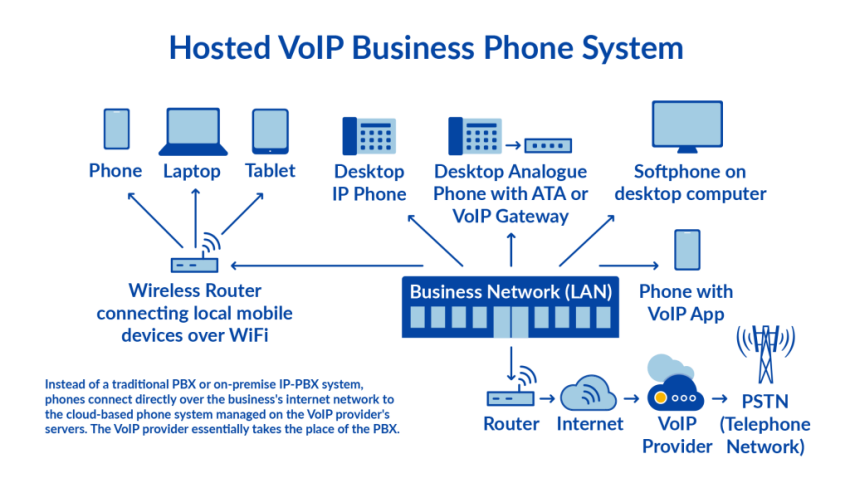
With hosted VoIP, your IP cellphone sends knowledge (within the type of digital alerts) over the web to your supplier. Your supplier handles the routing of calls, name queues, and all the things else within the cloud. It’s also possible to use SIP trunking to attach a legacy IP PBX to a contemporary VoIP supplier to benefit from lacking options.
IP Telephony Protocols
IP telephony protocols are a set of communication guidelines that enable units and cellphone methods to determine, handle, and transmit calls over IP networks. The most important protocols that allow IP telephony embody:
| Protocol | What it does |
|---|---|
| Session Initiation Protocol (SIP) | Establishes, manages, and ends communication periods. |
| Actual-Time Transport Protocol (RTP) | Carries voice and video knowledge over IP networks. |
| Actual-Time Transport Management Protocol (RTCP) | Screens media transmission high quality and gives efficiency suggestions. |
| H.323 | Helps voice and multimedia communication over IP networks. |
| Transport Layer Safety (TLS) | Helps shield name signaling from unauthorized entry. |
| Safe Actual-Time Transport Protocol (SRTP) | Encrypts voice and video media streams to guard their contents. |
Collectively, these protocols assist cellphone methods set up connections, transmit voice knowledge, monitor name high quality, and shield communications.
IP Telephony vs. VoIP
IP and VoIP telephony are sometimes used interchangeably, however there’s a refined distinction between them. IP telephony is the broad idea, whereas VoIP is the precise expertise that permits voice calls.
| Function | IP telephony (the broad idea) | VoIP (the precise expertise) |
|---|---|---|
| Scope | Refers to any cellphone system utilizing the Web Protocol (IP) to transmit communication. | A subset of IP telephony that particularly handles the transmission of voice. |
| Analogy | The complete freeway system (carries all knowledge). | The vehicles on the freeway (carrying simply the voice packets). |
| Instance | A unified system together with VoIP calls, IP faxing, video conferencing, and immediate messaging. | The precise expertise that allows you to make a cellphone name over the web. |
In observe, IP telephony and VoIP are sometimes used interchangeably. Nonetheless, IP telephony can describe a broader communication system, whereas VoIP particularly refers back to the expertise used to transmit voice over IP networks.
Key Parts of IP Phone Programs
IP phone methods depend on a number of {hardware} and software program elements to handle calls over IP networks. These embody an IP PBX, IP telephones or softphones, gateways, safety controls, and communication protocols.
| Part | What it does |
|---|---|
| IP PBX | The “mind” of the cellphone system. Manages name routing, voicemail, and options. Could be on-premises {hardware} or hosted within the cloud. |
| IP telephones or softphones | The “system” you employ. This could be a bodily desk cellphone (IP cellphone) or a software-based app in your pc or cell (softphone). |
| VoIP gateway | The “bridge” to the normal cellphone methods. This {hardware} connects your fashionable IP system to the normal PSTN for calls to landlines. |
| Session border controllers (SBCs) | The “safety guard.” Acts as a firewall particularly to your voice visitors, defending towards assaults, managing connections, and making certain name high quality. |
| Protocols (SIP and RTP) | The “guidelines” of the decision. SIP is the “sign” that begins, maintains, and ends the decision. RTP carries the precise voice knowledge packets. |
IP Telephony Companies: Hosted, On-Premises, and Hybrid
IP telephony providers can be found in three fundamental deployment fashions: hosted, on-premises, and hybrid. The suitable possibility is dependent upon your present infrastructure, funds, IT sources, and communication wants.
| Deployment mannequin | The way it works | Finest for |
|---|---|---|
| Hosted IP telephony | A 3rd-party supplier hosts and manages the cellphone system within the cloud. | Companies searching for flexibility and minimal IT upkeep. |
| On-premises IP telephony | The enterprise installs and manages its personal IP PBX infrastructure. | Organizations that require larger management over their cellphone methods. |
| Hybrid IP telephony | Combines present on-premises infrastructure with cloud-based providers. | Companies transitioning to the cloud or retaining present gear. |
How A lot Do IP Telephony Companies Price?
Hosted IP telephony providers usually cost a month-to-month subscription per consumer. On-premises methods contain extra bills for {hardware}, set up, upkeep, and IT help.
For example, Nextiva’s enterprise cellphone plans begin on the following costs:
| Present plan | Annual billing (per consumer/month) | Month-to-month billing (per consumer/month) |
|---|---|---|
| Go | $10 | $15 |
| Enterprise | $25 | $35 |
| CX | $75 | $100 |
Further prices might embody desk telephones, premium options, integrations, worldwide calling, and add-ons.
Tips on how to Select an IP Telephony Service Supplier
Earlier than selecting a supplier, take into account the next:
- Reliability: Examine the supplier’s uptime document, community infrastructure, and enterprise continuity options.
- Options: Make sure that the service consists of the calling and communication options your workforce wants.
- Scalability: Search for an answer that allows you to add customers, cellphone numbers, and options as what you are promoting grows.
- Safety: Examine for encryption, entry controls, and related compliance capabilities.
- Buyer help: Contemplate the provision and high quality of technical help.
- Complete value: Evaluate subscription charges, {hardware} prices, add-ons, and contract phrases.
The perfect service isn’t essentially the one with the bottom month-to-month value. It’s the one which meets your present communication wants with out limiting future enterprise progress.
Advantages of IP Telephony
IP telephony providers assist companies cut back communication prices, entry superior calling options, and help staff throughout completely different areas. Additionally they make it simpler to handle enterprise communications by way of a unified platform.
Why are so many companies making the swap?
1. Diminished prices
Voice over IP will be more cost effective than conventional enterprise cellphone methods. Switching to a hosted VoIP plan may help companies cut back {hardware}, upkeep, and calling bills.
Nextiva’s Go plan, as an illustration, begins at $10 per consumer monthly with annual billing and consists of limitless calling throughout the US and Canada. Consolidating voice and knowledge networks also can assist companies cut back total communication prices.
IP telephony provides entry to options like superior name routing, name recording, immediate messaging, and video conferencing with out having to put money into extra on-site cellphone system infrastructure.
Nextiva allows you to select superior enterprise plans that embody all key VoIP options. Companies also can improve and enrich their plans with completely different add-ons or add extra customers as they develop. This provides IP telephony sturdy scalability to help enterprise progress.
3. Elevated accessibility
With IP telephony, you may make and obtain calls from completely different areas so long as you may have a dependable web connection and entry to your VoIP service. Customers could make and obtain calls from their computer systems, cell phones, or any system with a softphone or VoIP app put in. This mobility is especially helpful for companies with distant or cell staff.
4. Unified communications
VoIP additionally makes it lots simpler to combine voice communications along with your CRM and different enterprise instruments. Centralizing knowledge and offering constant customer support throughout a number of channels (at a lower cost) makes IP telephony and VoIP a no brainer for a lot of companies.
Options of IP Telephony Options
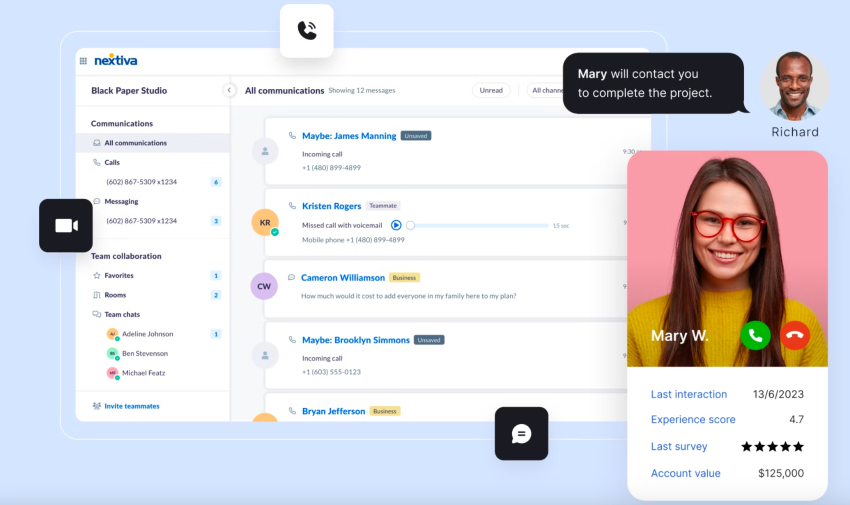
IP telephony options supply superior calling and communication options that assist companies handle buyer interactions and enhance workforce collaboration. Relying on the supplier and plan, IP telephony providers can embody the next options:
- Name routing: Directs incoming calls to the suitable worker or division.
- Auto attendant: Greets callers and helps them attain the proper individual.
- Name forwarding: Redirects calls to a different cellphone quantity or system.
- Name recording: Data conversations for coaching and high quality monitoring.
- Name analytics: Gives insights into name volumes and workforce efficiency.
- CRM integration: Connects buyer conversations with present buyer data.
- Unified communications: Combines voice, video, and messaging in a single platform.
Widespread Challenges With IP Telephony and Fashionable Options
Early variations of the IP cellphone system confronted reliability and efficiency points. However IP telephony service suppliers right now have addressed many of those challenges by way of higher bandwidth, expertise, stronger infrastructure, and smarter telephony community administration.
Poor name high quality (jitter and latency)
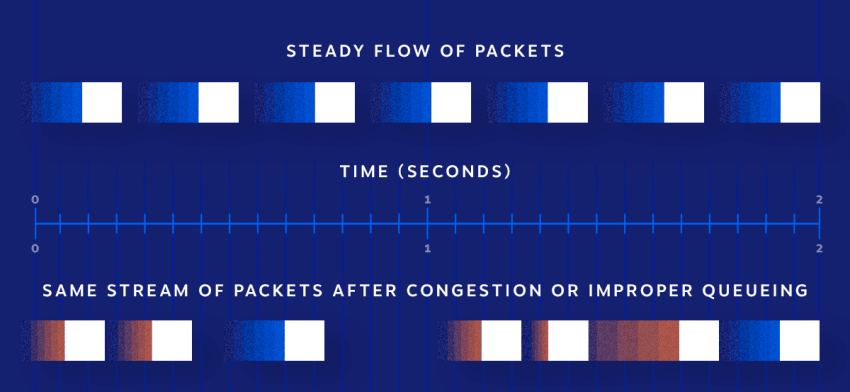
Relying on the bandwidth and stability of your web connection, VoIP methods can expertise unstable connections, uneven audio high quality, or dropped calls. You ideally want high-speed web and a good web cellphone service to make optimum IP calls.
It’s beneficial to configure your router’s QoS (High quality of Service) settings to prioritize voice packets over different web visitors. Main VoIP suppliers like Nextiva function geo-redundant infrastructure to assist preserve HD voice high quality, reduce latency, and enhance service reliability.
Safety vulnerabilities
As a result of IP calls are transmitted over the web, VoIP cellphone methods will be weak to eavesdropping with out sufficient safety measures.
Safe IP telephony methods use protocols comparable to TLS and SRTP to guard communications. TLS helps safe name signaling, whereas SRTP encrypts voice and video knowledge to guard it from unauthorized entry.
Reliability and web outages
“What occurs throughout an web outage?” or “Is IP telephony dependable?” These questions come up time and again, as cloud-based IP cellphone methods depend on an web connection.
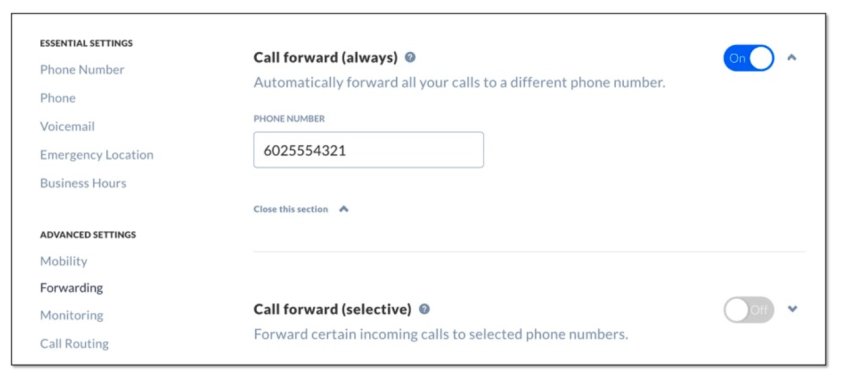
A failure can simply trigger panic, with fears of dropped calls, missed calls, and communication gaps. The excellent news: Cloud-based IP cellphone methods supply options like computerized name forwarding and fail-safe operation.
If the facility or web connection fails within the workplace, incoming calls will be redirected to cell units or various areas when failover guidelines are configured. This helps reduce communication disruptions and preserve enterprise continuity.
Community, QoS, and Safety Necessities for Dependable IP Telephony
A dependable IP telephony system wants ample bandwidth, a secure community connection, and applicable safety settings. Earlier than investing in IP telephony providers, be certain your present community infrastructure can help your anticipated name quantity.
Listed below are some key necessities:
| Requirement | Beneficial observe |
|---|---|
| Web bandwidth | Enable ample add and obtain bandwidth for simultaneous calls. Nextiva recommends 100 Kbps in every route per standard-quality name. |
| High quality of Service (QoS) | Prioritize voice visitors over much less time-sensitive community exercise the place supported. |
| Community stability | Monitor latency, jitter, and packet loss to establish name high quality points. |
| Safety | Use supported encryption protocols, sturdy passwords, and applicable entry controls. |
| Backup connectivity | Contemplate a secondary web connection, cell entry, or failover routing. |
| Emergency calling | Configure and preserve correct emergency service location data for relevant customers and units. |
Overview your service supplier’s community necessities earlier than set up. A well-configured community helps what you are promoting preserve constant name high quality as your communication wants develop.
Transfer Your Enterprise Communications to the Cloud
Need important value financial savings and a brand new and extra multi-line cellphone system with superior PBX options?
IP telephony providers are the muse of a contemporary, versatile, and cost-effective communication system. Nextiva’s platform scales to fulfill what you are promoting wants.
- Get dependable enterprise calling, video, and workforce chat with our small enterprise VoIP answer.
- Entry superior name recording, analytics, and internet chat with eligible plans and add-ons.
- Unify your communications with AI-powered transcription, reporting, and automation capabilities.
Our Wonderful Service workforce will probably be with you each step of the best way and make sure that the swap to VoIP is seamless. Communicate to an knowledgeable right now to search out the proper plan for what you are promoting.
Transfer your cellphone system to the cloud.
Simplify enterprise communications with Nextiva’s dependable IP telephony providers. Trusted by 100,000+ companies.
Regularly Requested Questions About IP Telephony
An IP cellphone is the {hardware} (like a desk cellphone) used to make and obtain calls over an IP community. In contrast to a conventional cellphone, an IP cellphone is a mini-computer that connects to your web router through an Ethernet cable and works with a headset for hands-free use. It’s used to deal with HD voice calls, handle name transfers, conduct video conferences (on superior fashions), and verify colleague availability (presence).
Widespread examples of VoIP embody enterprise cellphone methods like Nextiva, calling purposes like WhatsApp, and residential web cellphone providers. These options enable customers to make and obtain calls over IP networks as a substitute of conventional phone strains. Enterprise VoIP methods additionally supply superior options comparable to name routing, voicemail, name recording, and CRM integrations.
Voice over Web Protocol (VoIP) is a expertise that enables customers to make and obtain cellphone calls over an IP community. Once you make a VoIP name, the system converts your voice into digital knowledge packets and transmits them over the community. The receiving system converts these packets again into audio, permitting each events to speak in actual time.
A residential VoIP cellphone service permits owners to make and obtain calls over a broadband web connection as a substitute of a conventional landline. Customers can join their present phone to a VoIP adapter or use a suitable IP cellphone. These providers usually supply options comparable to caller ID, voicemail, name ready, and name forwarding at aggressive costs.
VoIP is used for private and enterprise calling, distant communication, buyer help, convention calls, and call middle operations. Companies additionally use it to interchange conventional landlines and combine voice communications with different enterprise instruments.
IP cellphone stands for Web Protocol cellphone. It’s a phone system that transmits voice communications over an IP community.
Some VoIP purposes supply free voice and video calls between customers on the identical platform. Nonetheless, enterprise VoIP providers usually require a month-to-month or annual subscription. Paid plans present entry to devoted enterprise cellphone numbers, superior calling options, reporting, and technical help. Further prices might apply for worldwide calling, premium options, and add-ons.
A VoIP utility is software program that lets customers make and obtain calls over an web connection. These purposes can run on smartphones, computer systems, and tablets with out requiring a devoted desk cellphone.

