

Normal info solely, not authorized recommendation. See the necessary discover on the finish of this information. Need assistance with a GDPR breach response plan? Get in contact at Advoqua.
Key Takeaways
- You could have 72 hours from turning into conscious of a breach to inform your information safety authority, and weekends rely. In case you’re late, file anyway and clarify why.
- The place you file depends upon whether or not you’ve an EU institution. In case you do, you file as soon as, along with your lead authority. If like most crypto firms, you don’t, you’re presupposed to file in each nation the place affected customers stay. The UK and Switzerland want separate filings.
- In case you can’t submit filings inside 72 hours in each nation the place customers are affected, prioritize the nations with the very best variety of affected customers, then work via the remaining nations. Submit transient preliminary filings and complement them later.
- Looking for a lenient regulator largely doesn’t work.
- In crypto, leaked information turns into phishing and bodily threats. Inform customers quick, and inform them precisely what to do. This may prevent main complications sooner or later.
- In case you’re MiCA regulated and/or based mostly within the EU, verify whether or not DORA or NIS2 additionally apply. They run on their very own clocks.
Each chief I speak to has a safety plan. Only a few have a breach plan. These should not the identical factor.
A safety plan retains attackers out. A breach plan is what you do within the 72 hours after they received in anyway. Your engineers are nonetheless arguing about scope. Your legal professionals are asking whether or not it’s “actually” a breach. And a regulator someplace in Europe is already owed a cellphone name, whether or not it or not.
That hole issues extra now than ever. Attackers more and more run campaigns with AI brokers that scan, exploit and exfiltrate at machine pace. The European paperwork window has not moved: 72 hours. And in the event you run a platform with actual customers, a few of them are within the EU, and the Normal Information Safety Regulation (GDPR) virtually actually follows them to your servers.
What follows is the plan I might need on my desk. It doesn’t attempt to observe GDPR to the letter. It covers the fundamentals, so as, so that you keep on the proper aspect of your regulator and, extra importantly, so your customers don’t pay to your unhealthy week.
Why this issues now (skip in the event you don’t need context)
DLA Piper’s January 2026 survey recorded 443 breach notifications a day to European regulators, and that counts solely the businesses that selected to report.
The survey discovered each day notifications rose 22% in a yr, from 363 to 443, the primary time above 400 since GDPR took impact in 2018. It additionally put fines at about €1.2 billion in 2025 and €7.1 billion since 2018.
The headlines match the numbers. TechCrunch’s operating checklist of 2026’s worst hacks consists of information on greater than 30 million college students and workers stolen from Instructure’s Canvas platform, and 15 million individuals’s well being information taken from insurer DentaQuest. One vendor, Klue, was breached via a credential it had issued in 2022 for a restricted pilot. The stolen information, together with keys to clients’ cloud providers, touched near 200 firms.
Now add AI brokers to the image. In November 2025, Anthropic reported a state-sponsored group that used its Claude Code software to assault about 30 organizations. By Anthropic’s estimate, the AI did 80 to 90% of the work, at peak firing off a number of requests per second. People stepped in at solely a handful of determination factors.
The brokers inside your individual firm, and the methods round them, are assault floor too. In spring 2026, attackers exploited an account-verification flaw in Instagram’s AI-assisted restoration course of, doubtlessly affecting greater than 20,000 accounts. In August 2025, attackers used stolen OAuth tokens from the Salesloft Drift chat integration to export information from quite a few Salesforce situations. Each agent, bot and integration holding a key to your information is a possible insider, and so is each verify constructed round it.
And sure, that is your drawback even when you’ve got no workplace in Europe. Beneath Article 3(2), GDPR applies to any firm that gives items or providers to individuals within the EU, or screens their behaviour there. A crypto alternate, a pockets app or a information website operating analytics on EU readers may be very possible in scope.
Step 1: The primary hours. Include, protect, begin the clock
The 72-hour clock below Article 33 begins once you change into conscious of a private information breach, not when your investigation is completed.
I don’t recommend making an attempt to get good with what “conscious” means. European regulators deal with you as “conscious” as soon as you might be fairly sure {that a} safety incident has compromised private information. You get a brief window to research. You don’t get to disregard an alert, look ahead to Monday or maintain out for a forensic report. Weekends and holidays rely. Sadly I’ve seen consciousness of information breaches taking place on a Friday afternoon. Guess what, in the event you’re a stakeholder you’re working continuous on this for the subsequent 72 hours.
Here’s what has to occur earlier than anybody debates whether or not it’s “actually” a breach:
- Include. Revoke the compromised passwords, API keys and OAuth tokens. Disable or sandbox each AI agent, bot and integration that touched the affected methods. Isolate contaminated machines, however don’t wipe them.
- Protect proof. Snapshot entry logs, cloud audit logs and your brokers’ immediate and tool-call histories. You can not inform a regulator what was taken in the event you erased the path.
- Assemble the crew. You want an incident lead with actual authority (I recommend your Head of Engineering), your compliance officer (or information safety officer when you’ve got one), outdoors privateness counsel ASAP (might be completely a recreation changer in serving to with filings), advertising or communications lead, and one govt who can signal a regulator submitting at 2 a.m. Title backups for every.
- Open the breach log. Write down the second you turned conscious, and each determination after it with the explanation. Article 33(5) requires this report for each breach, even ones you by no means report.
- Name your distributors and your insurer. A processor that turns into conscious of a breach affecting private information it processes for it’s essential to notify you with out undue delay below Article 33(2), whether or not or not it brought about the incident. Most cyber insurance coverage insurance policies additionally require immediate discover and use pre-approved responders.
- Lock down communications. One spokesperson, no hypothesis. And no person touches a ransom demand with out counsel and regulation enforcement within the room.
The agentic-era addition is straightforward: know what your brokers can attain earlier than the unhealthy day comes. Preserve a stay stock of each AI agent and integration, the info it will probably learn and the keys it holds, and a examined option to change each off in minutes.
Step 2: Determine what you owe, and to whom
GDPR units two totally different bars: inform the regulator until the breach is unlikely to place anybody in danger, and inform the individuals themselves when the danger is excessive.
First, verify it’s a private information breach. Article 4(12) covers any safety failure that results in private information being destroyed, misplaced, altered, disclosed or accessed with out authorization. That features ransomware that locks information with out stealing it. Dropping entry is a breach too.
| Who you inform | When it’s essential to | Deadline | Article |
|---|---|---|---|
| Your lead or native information safety authority | Until the breach is “unlikely to end in a threat” to individuals | Inside 72 hours of consciousness. If later, clarify why. Particulars can observe in phases | 33(1), 33(4) |
| The affected customers | When the breach is “prone to end in a excessive threat” to them | With out undue delay | 34(1) |
| Your inner breach register | Each breach, reportable or not | Because it occurs | 33(5) |
To evaluate the danger, have a look at what leaked and whose it was. Delicate information, massive volumes, information that simply identifies individuals and weak customers all push the danger up. For a crypto platform, identification paperwork plus dwelling addresses plus account balances is a goal checklist. Deal with that as excessive threat by default.
You may skip telling customers in three circumstances below Article 34(3). The information was strongly encrypted and the secret’s protected. You could have already acted so the excessive threat is now not possible. Or particular person discover would take disproportionate effort, through which case a public discover replaces it.
When the reporting threshold is genuinely unsure, assess promptly and doc the choice both method. Failing to inform when you must have can price a advantageous of as much as €10 million or 2% of worldwide annual turnover below Article 83(4). If the underlying safety failure breaks GDPR’s core ideas, the ceiling rises to €20 million or 4%.
Regulators do advantageous for the paperwork alone. Eire’s Information Safety Fee fined Twitter €450,000 in 2020 for notifying late and documenting poorly. The Dutch authority fined Reserving.com €475,000 in 2021 for reporting a breach weeks after it discovered of it. And in Meta’s €251 million breach determination in December 2024, €11 million was for an incomplete notification and a skinny breach report.
At 72 hours, file what : what occurred, roughly how many individuals and data, the possible penalties, what you might be doing about it, and a contact. Say clearly that extra info will observe. A partial submitting on time beats an ideal one late.
Step 3: Work out the place to file
The place you file depends upon the place you might be established in Europe, not on the place your headquarters sits or the place most of your customers stay.
When you’ve got a “essential institution” within the EU, the one-stop-shop rule in Article 56 provides you a single lead supervisory authority. That’s the regulator within the nation the place your EU selections about private information are literally made. A letterbox workplace doesn’t rely.
When you’ve got no EU institution, which describes many offshore crypto platforms, there isn’t a one-stop store. For the reason that European Information Safety Board up to date its breach notification pointers in March 2023, a non-EU firm should notify the authority in each member state the place affected customers stay. Appointing an EU consultant below Article 27 doesn’t change that.
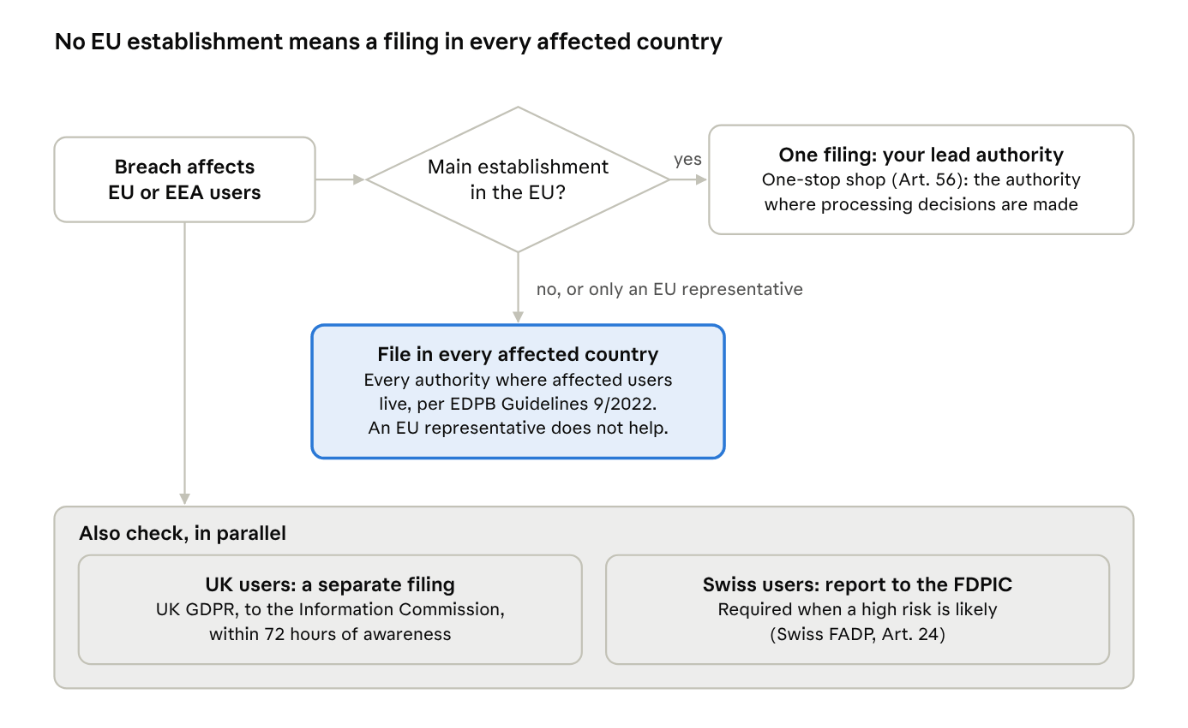
In apply, a breach that touches customers in 12 EU nations means 12 filings, plus one within the UK. Right here is the right way to hold that from consuming your 72 hours:
- Construct a residency map now. Depend your customers by nation from KYC, billing and IP information, and refresh it month-to-month. Throughout a breach you want affected-user counts per nation in hours, not days.
- Know your German authority. Germany has a federal commissioner plus 17 state authorities throughout its 16 states (Bavaria has two), and for many personal firms the state authority is the one which counts. The federal workplace retains a checklist of the state authorities.
- Pre-translate your submitting. Most authorities take notifications via an internet kind, usually within the nationwide language. Draft a template as soon as, translate it, and hold it along with your runbook.
- Bookmark the portals. The appendix on the finish of this piece lists each EU, EEA, UK and Swiss authority with its web site.
The UK: identical guidelines, separate submitting
If the breach touches UK customers, you owe a second, separate notification below UK GDPR, on the identical 72-hour clock.
After Brexit, the UK stored a replica of GDPR, now referred to as UK GDPR, alongside its Information Safety Act 2018. The foundations mirror the EU’s, however enforcement is fully separate. An EU submitting doesn’t cowl the UK, and a UK submitting doesn’t cowl the EU. An organization outdoors the UK that serves UK customers is in scope, and normally wants a UK consultant too.
The regulator has additionally modified its title. Beneath the Information (Use and Entry) Act 2025, the workplace of the Data Commissioner was abolished on 30 September 2026 and changed by a physique referred to as the Data Fee. The Act didn’t change the 72-hour rule for UK GDPR breaches. Telecoms and web suppliers have their very own breach guidelines below the separate PECR regime.
UK fines attain £17.5 million or 4% of worldwide turnover on the prime tier. Notification failures sit within the decrease tier: £8.7 million or 2%.
Don’t mistake the UK for a tender contact. DLA Piper describes UK enforcement as restricted in contrast with the EU, and in November 2025 greater than 70 teams signed an open letter calling for an inquiry right into a “collapse in enforcement exercise”. However safety breaches are the exception. In October 2025 the regulator fined Capita £14 million over a 2023 assault that uncovered information on about 6.6 million individuals. A high-priority alert fired inside 10 minutes. The contaminated machine was not quarantined for 58 hours, in opposition to Capita’s personal one-hour goal.
Two different neighbours are value a line in your runbook. Norway, Iceland and Liechtenstein apply EU GDPR in full via the European Financial Space, so deal with them as EU nations. Switzerland has its personal revised Federal Act on Information Safety. Beneath its Article 24, it’s essential to report a breach to the Swiss regulator, the FDPIC, when it’s prone to trigger a excessive threat, and achieve this as quickly as potential.
From expertise: when 72 hours shouldn’t be sufficient
For a small crew, submitting with each affected authority inside 72 hours is near inconceivable, and in my expertise the regulators realize it.
Bear in mind, this information shouldn’t be authorized recommendation, particularly this half. It’s what I’ve discovered from doing it. Every submitting takes actual time. Each authority has its personal portal, its personal kind and sometimes its personal language. Even with paperwork ready prematurely, you find yourself copying and pasting the identical details, discipline by discipline, right into a dozen clunky internet varieties, whereas your engineers are nonetheless containing the incident. And sure, some reporting websites don’t even work at instances.
So prioritize. Right here is the method I might take:
- File first the place most of your affected customers stay. Rank nations by affected customers utilizing your residency map, and work down the checklist. When you’ve got a lead authority, it comes first. Prioritize by customers, by no means by which regulator appears friendliest.
- Preserve going after hour 72. The deadline passing shouldn’t be a motive to cease. End each remaining nation as quick as you fairly can.
- Clarify the delay in each late submitting. Article 33(1) expects causes when you find yourself late. Say plainly that the 72 hours have handed, that you just have been submitting in a number of nations without delay and began the place most customers have been affected, and that you’re finishing the remaining in good religion.
- Use phased notification. Article 33(4) permits you to file what now and add particulars later. A brief first submitting in every remaining nation beats a whole one every week late.
- Put together the copy-paste package now. Write one grasp incident abstract that maps to the fields most varieties ask for: what occurred, information classes, approximate numbers, possible penalties, measures taken and a contact. Translate it into your customers’ essential languages earlier than you ever want it.
Perfection shouldn’t be what regulators count on. What they count on is that you just report, actually and in good religion. The businesses that land in actual bother are those that by no means file in any respect.
Regulatory arbitrage: what’s actual and what’s a fable
Though it might be tempting (and fairly frankly logical), you can not decide a friendlier regulator after a breach, and the regulator with the gentlest status (Eire) seems to account for a lot of the worth of Europe’s GDPR fines.
Arbitrage is actual in precisely one place: the place you arrange your EU essential institution. Huge Tech selected Eire, and for years critics referred to as Dublin a tender contact. Then different EU regulators began overruling it via the European Information Safety Board, which pushed selections just like the report €1.2 billion advantageous on Meta in 2023.
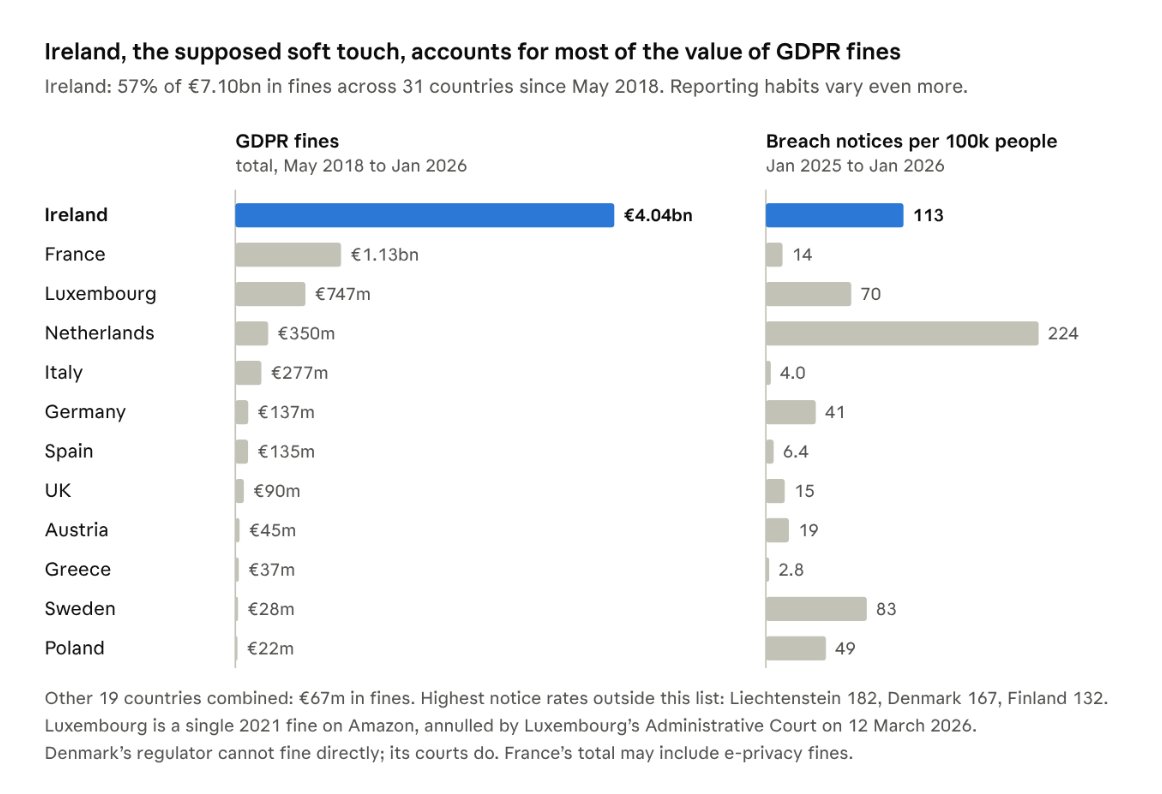
DLA Piper GDPR Fines and Information Breach Survey, January 2026 · 31 EU, EEA and UK authorities; prime 12 by fines proven
The chart reveals two methods regulators differ. On fines, Eire stands alone as a result of it supervises most of Huge Tech. Massive totals alone don’t show a regulator is strict throughout its entire caseload, however they do finish the thought of a protected haven. On breach reporting, the hole is big: the Netherlands logs 224 notices per 100,000 individuals a yr, Italy 4. No one believes Dutch firms get hacked 55 instances extra usually than Italian ones. The extra possible story is that reporting tradition, thresholds and enforcement stress range by nation, and that an ideal many breaches by no means get reported in any respect.
Types differ too. Spain’s regulator points probably the most fines by rely, 1,048 by CMS’s tally, however most are small, so smaller firms really feel it. Italy’s Garante is Europe’s most aggressive on AI: it briefly blocked ChatGPT in 2023 and fined the maker of the Replika chatbot €5 million in 2025. The UK fines not often, however onerous, when safety fails.
So the place does that depart a frontrunner?
- The reliable play is structural. When you’ve got actual EU operations, and a MiCA crypto licence already requires them, put your essential institution the place your selections are actually made. Select for predictability and competence, not leniency.
- There isn’t a arbitrage in notification. When you’ve got no EU institution, you file all over the place affected customers stay. Submitting with the friendliest authority and skipping the remaining is solely non-compliance.
- The window is closing anyway. The EU’s new GDPR procedural regulation harmonizes how cross-border circumstances are run from 2 April 2027, which leaves even much less room between regulators.
Step 4: Inform your customers, and shield them
Your customers pay for a breach lengthy after the regulator closes the file, so the discover to them issues greater than the one to the authority.
In crypto, leaked buyer information doesn’t keep on a discussion board. It turns into phishing calls, faux assist brokers and, more and more, bodily threats. In Might 2025, criminals bribed abroad assist brokers at Coinbase to repeat buyer data: names, addresses, cellphone numbers, authorities ID photographs and stability snapshots. They then demanded $20 million. Coinbase refused, supplied a $20 million bounty as an alternative and dedicated to reimburse eligible clients who have been tricked into sending funds to the scammers.
The bodily aspect is worse. France’s inside minister reported 77 crypto-linked kidnapping and extortion incidents within the first half of 2026, up from 45 in all of 2025. In January 2025, Ledger co-founder David Balland was kidnapped from his dwelling and held for ransom. Ledger’s personal 2020 leak of greater than 270,000 buyer data nonetheless fuels scams at present. A house handle sitting subsequent to an account stability is a security challenge, and that’s “excessive threat” below Article 34 by any studying.
A very good person discover is apparent, particular and quick. It ought to cowl:
- What occurred and when, in plain language, not authorized prose.
- Precisely what was uncovered, and what was not. If passwords, personal keys and funds have been untouched, say so clearly.
- The possible penalties. Clarify what the publicity might imply for them in apply.
- What you’ve accomplished, and can do. Describe the steps you’ve taken or plan to take to take care of the breach and scale back the hurt.
- What scammers will attempt subsequent. State that you’ll by no means name to ask them to maneuver funds, share a seed phrase or set up software program.
- What to do now. Change passwords, change to app-based or {hardware} two-factor authentication, and ask their cell service to lock their quantity in opposition to SIM swaps.
- Protecting steps tailor-made to what was uncovered. The place identification, dwelling addresses or holdings are concerned, give particular account-security and personal-safety steering. Any instruction about transferring property must be verified independently via trusted channels.
- The place to get assist. A devoted web page, a assist line staffed by people and a contact to your information safety officer.
Don’t write “no proof of misuse” until you’ve really regarded. Don’t bury the discover in a Friday-night weblog publish. Publish one dated web page and hold updating it, however deal with it as assist to your direct notices: the place particular person discover is required, a webpage alone ordinarily doesn’t fulfill it. Attackers now use AI to write down convincing phishing from leaked information at scale, so your customers want to listen to from you earlier than they hear from them.
Different clocks to verify
GDPR is probably not your solely reporting obligation. Monetary corporations, together with MiCA-licensed crypto corporations, ought to verify DORA, and operators of important or necessary digital providers ought to verify NIS2. Each run on their very own deadlines, some shorter than 72 hours, so have counsel map them earlier than an incident.
Reform is on the way in which too. The EU’s proposed Digital Omnibus would give firms 96 hours and require discover just for high-risk breaches, however it’s not regulation but. Plan for 72 hours till the Official Journal says in any other case.
Step 5: After the fireplace
The regulator’s file stays open lengthy after the incident is contained, and it’ll decide you on what you wrote down within the first hours.
- End the breach register. Article 33(5) requires the details, the results and what you probably did about them. Meta paid €3 million for a skinny report alone.
- Ship follow-ups as you be taught extra. Article 33(4) permits info in phases. Right your early estimates overtly, and inform each authority the identical story. Twelve barely totally different variations of 1 incident is its personal drawback.
- Run a post-incident evaluate inside 30 days. Discover the foundation trigger, and measure the hole between first alert and containment. Capita’s 58-hour hole was one of many failings the regulator cited.
- Repair the agent layer. Give AI brokers the least entry they want, short-lived credentials and logged software calls. Require a human to approve bulk exports. Take a look at them in opposition to immediate injection the way in which you check internet apps.
- Assessment your distributors. Processors are instantly chargeable for safety below GDPR. Require notification with out undue delay, with a transparent contractual most measured in hours.
- Rehearse. Run a tabletop train a minimum of twice a yr. Make one in every of them begin at 2 a.m. on a Saturday, with customers in 12 nations and a ransom word within the inbox.
The underside line
A breach can expose weaknesses in each your safety and your response. Immediate reporting, clear data and efficient remediation matter, however they don’t erase failures in how the system was designed or protected.
Within the agentic period, a breach is a query of when, not if. Attackers run at machine pace, and your individual brokers widen the door. What you management is the primary 72 hours. Right here is the plan to pin to the wall:
- Earlier than something occurs: map your customers by nation, bookmark each regulator’s portal, pre-translate your submitting template, stock each AI agent with a kill change, and hold one notification matrix protecting each regime that applies to you.
- Hour 0: log the second you turned conscious. Include, protect proof and assemble the crew.
- Hours 0 to 24: assess the danger, and verify whether or not DORA or NIS2 additionally apply.
- By hour 72: file along with your lead authority. With no EU institution, begin the place most affected customers stay, and hold submitting previous hour 72 with causes for the delay. File individually within the UK.
- As quickly as potential, for Switzerland: if the breach is prone to trigger Swiss customers a excessive threat, report it to the FDPIC. Swiss regulation units no mounted 72-hour window.
- With out undue delay: inform affected customers in plain language, with concrete steps to guard themselves.
- After: ship follow-ups, full the breach register, repair the foundation trigger and rehearse once more.
Your customers trusted you with their information. In crypto, they could have trusted you with their security too. Being prepared is the way you honor that.
Necessary discover
- Not authorized recommendation. This information provides normal details about EU, and UK information safety guidelines as they stood on 18 November 2026. It isn’t authorized recommendation and should not be relied on as such. Breach obligations activate the details and on the legal guidelines of every nation concerned, so get recommendation from certified counsel in each related jurisdiction earlier than you act.
- No lawyer-client relationship. Studying this information, or contacting the writer or Advoqua via it, doesn’t create a lawyer-client relationship. Don’t ship confidential info till an engagement has been agreed in writing.
- Private views. The views expressed are the writer’s personal. They don’t essentially mirror the views of Bitcoin.com, its associates or any consumer.
- Accuracy and foreign money. Legal guidelines, regulatory steering and enforcement apply change usually. No illustration or guarantee is on condition that this information is correct, full or present, and it is probably not up to date.
- Examples and third-party sources. Incidents, fines and figures come from public sources and are cited solely as an instance normal factors. They describe what these sources report and indicate nothing additional about any firm named. Hyperlinks to third-party web sites are offered for comfort, and their homeowners are liable for their content material.
- Logos. Firm and product names are the logos of their respective homeowners. Their point out doesn’t indicate endorsement or affiliation.
Appendix: the place to file
These are the info safety authorities for all 27 EU states, the three EEA states, the UK and Switzerland, with web sites as listed by the European Information Safety Board.
Three direct breach-notification portals value bookmarking: Eire’s DPC kind, France’s CNIL notification service and Switzerland’s FDPIC DataBreach portal.
Normal info solely, not authorized recommendation.

