

A Bitcoin Core pockets could be tied to the web tackle of the node working it for about 19 cents, in accordance with analysis a Bitcoin Core contributor printed on November 25.
Abubakar Sadiq Ismail laid out the method on Delving Bitcoin, the developer discussion board the place Bitcoin’s protocol work is debated within the open.
In his lab, the tactic discovered the precise node 30 instances out of 30.
No cash could be stolen this fashion. This can be a privateness leak, not a theft vector, and it has not been measured on the stay community.
The larger query is how rapidly Bitcoin Core closes a niche that was first reported again in 2014, and three open pull requests counsel that work is already underneath means.
How the Bitcoin Core Pockets Offers Itself Away
The leak comes from a useful behavior.
When a transaction despatched or obtained by a Bitcoin Core pockets stays unconfirmed for roughly 12 to 36 hours, the pockets pronounces it to its friends once more so it doesn’t get misplaced.
Most funds verify lengthy earlier than that, so the conduct hardly ever issues in each day use.
Ismail’s level is that an attacker can set off it on objective.

ADVERTISEMENT
The attacker sends a tiny cost, paying the community’s 0.1 sat/vB minimal relay price, to an tackle that has already been used. As a result of the price is so low, the cost tends to sit down within the mempool.
A day or so later, the one node that re-announces it’s the one whose pockets tracks that tackle. A spy that connects to candidate nodes merely waits to see which one speaks up.
That offers an address-to-IP hyperlink, and an IP tackle can level to an web supplier, a metropolis and generally a house.
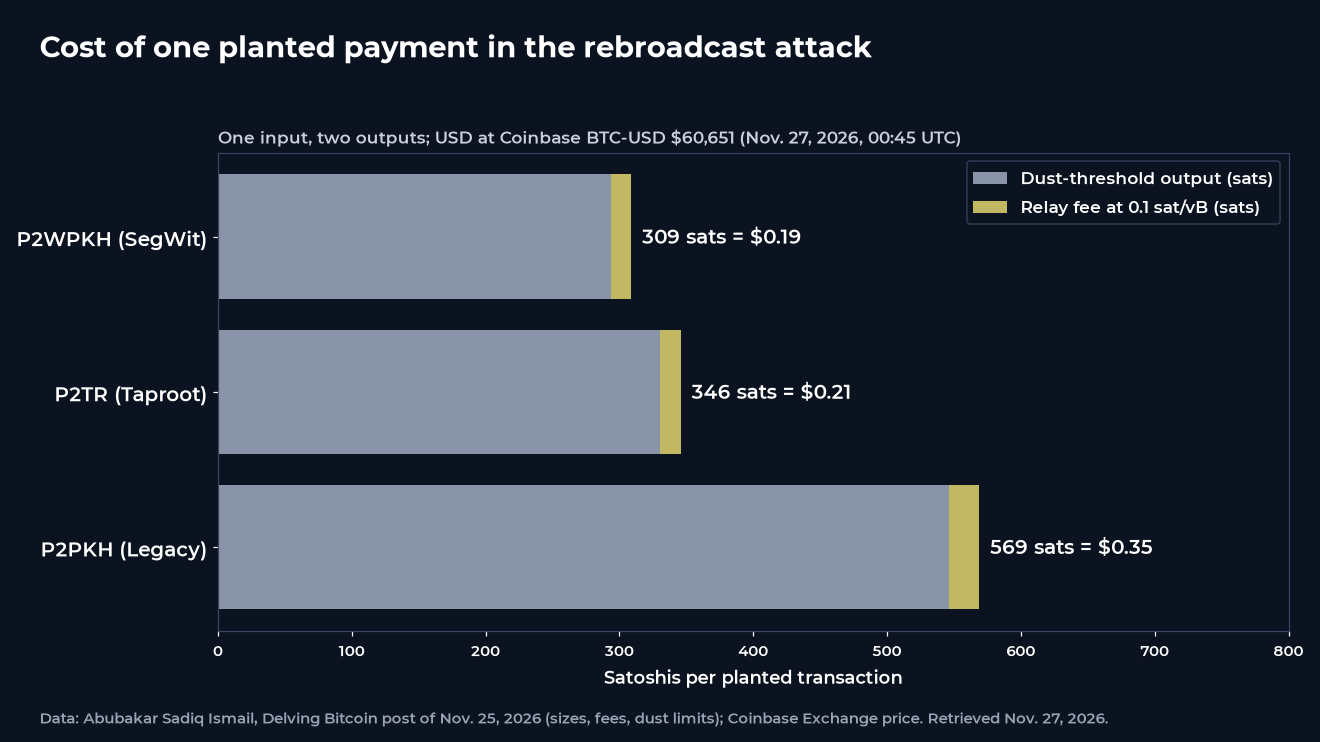
At Bitcoin’s present value close to $60,650 on Coinbase, a planted cost prices about 309 sats ($0.19) to a SegWit tackle, 346 sats ($0.21) to a Taproot tackle and 569 sats ($0.35) to a legacy tackle.
Thirty Hits in Thirty Tries, With Caveats
Ismail examined the concept on regtest, a non-public take a look at community constructed from inventory Dockerized Bitcoin Core nodes.
A hub node planted one low-fee cost into every of 5 goal wallets, over six trials. A recent spy linked the tackle to the right node in all 30 attributions.
Watch-only wallets behave the identical means, he wrote, so the assault identifies the node that tracks an tackle. That is probably not the one that controls the cash.
The stay community has not been measured. The attacker additionally wants infrastructure to connect with every reachable node, and nodes that don’t settle for inbound connections can solely be noticed in the event that they occur to dial out to the attacker.
A separate simulation discovered that the primary node heard after the supply was a direct neighbour about 90% of the time. Ismail confused that this got here from an artificial mannequin underneath beneficial assumptions, not from actual community information.
Why Tor Alone Does Not Shut the Hole
Bitcoin’s node operators have leaned closely into privateness networks.
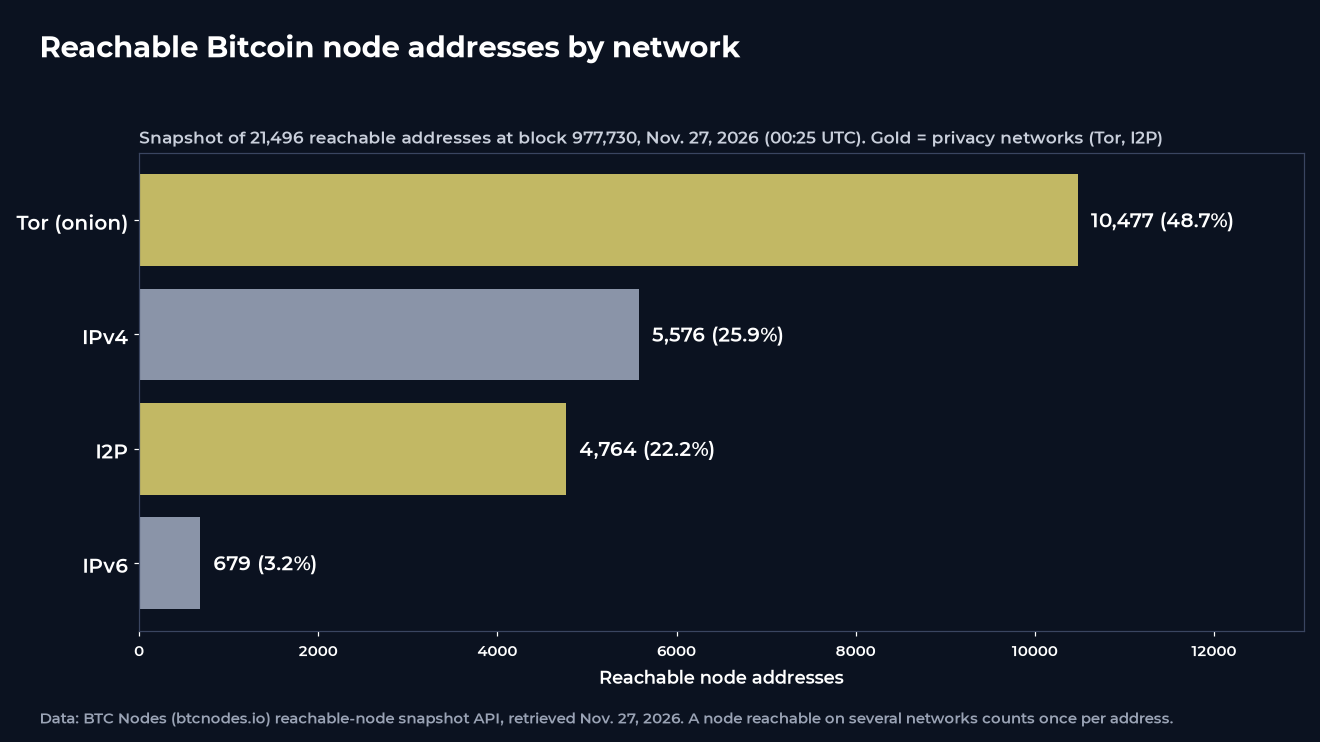
Of 21,496 reachable node addresses within the BTC Nodes snapshot taken early on November 27, 10,477 have been Tor onion addresses and 4,764 have been on I2P. Collectively that’s about 71%.
That may be a wholesome signal, however Ismail discovered a catch.
The rebroadcast goes to each peer with no community filter. A node that makes use of Tor or I2P but additionally retains abnormal clearnet friends will re-announce the planted cost over clearnet as nicely, exposing its actual IP.
Solely a node restricted to privateness networks, for instance with -onlynet=onion, avoids that. Even then, the tackle can nonetheless be linked to the node’s onion identification.
The publicity additionally reaches software program constructed on Core’s pockets. Ismail lists Sparrow in its Bitcoin Core mode, Specter Desktop, Liana with a bitcoind backend, JoinMarket and Jam, Electrum Private Server and Eclair amongst probably affected instruments.
As we famous when an AI-flagged Bitcoin Core vulnerability was patched this month, many node runners are gradual to improve, so any repair will take time to unfold.
Three Pull Requests and a 12-Yr-Outdated Difficulty
The underlying leak shouldn’t be new.
GitHub concern #3828, titled “Purchasers leak IPs if they’re recipients of a transaction,” was opened in March 2014 and remains to be open.
What has modified is the tempo of labor. Core maintainer Ava Chow opened pull request #36482 on October 8. It could solely rebroadcast transactions that have been newly added to the mempool, which removes the sign from a planted cost that simply sits there.
Fellow contributor Martin Zumsande pushed again on the discussion board. He wrote that #36482 “solely raises the price of the lively assault barely, it doesn’t stop it,” and described a replace-by-fee variant that also works.
His most well-liked path pairs his personal #36398, which limits rebroadcasting to transactions that originate from the pockets, with Chow’s #36481, which lets customers rebroadcast a transaction manually.
Ismail replied that he would go additional and make rebroadcasting opt-in by default.
All three pull requests stay open and unmerged.
What Node Runners Can Do Now
For anybody working a Bitcoin node with a pockets loaded, the choices are concrete.
- Setting -walletbroadcast=0 kills the rebroadcast sign, however the pockets then stops broadcasting your individual sends too, so that you push them with sendrawtransaction.
- Operating with -onlynet=onion or -onlynet=i2p stops clearnet IP publicity, even when rebroadcast stays on.
We imagine the larger story is how this was dealt with.
A contributor discovered the weak spot, printed the tactic, the code and the boundaries of his personal outcomes, and different builders challenged the proposed repair inside hours. That’s the open assessment course of that retains Bitcoin’s full node software program reliable.
Bitcoin privateness has by no means been automated, and this analysis makes the trade-offs clearer for each node operator.
The approaching weeks will present which of the three approaches Bitcoin Core adopts, and the way rapidly wallets constructed on it comply with.
DC Forecasts is a pacesetter in lots of crypto information classes, striving for the very best journalistic requirements and abiding by a strict set of editorial insurance policies. If you’re to supply your experience or contribute to our information web site, be at liberty to contact us at [email protected]

