

Tax Basis Europe’s Opinion on the Draft Act on a Compensatory Tax on Sure Companies (UD385)
In reference to the draft Act on a Compensatory Tax on Sure Companies (UD385), introduced by the Ministry of Digital Affairs and generally known as the “digital tax,” Tax Basis Europe hereby submits its place on the proposal.
Tax Basis Europe is a suppose tank that conducts analysis and evaluation on taxation and advocates for tax coverage grounded in 4 core ideas: simplicity, neutrality, transparency, and stability. In mild of those ideas, and with regard to the draft Act on a Compensatory Tax on Sure Companies, Tax Basis Europe needs to attract consideration to the next points and their potential financial implications.
1. Income-Based mostly Taxation Disregards Profitability
In contrast to the company earnings taxA company earnings tax (CIT) is levied by federal and state governments on enterprise earnings. Many firms are usually not topic to the CIT as a result of they’re taxed as pass-through companies, with earnings reportable below the person earnings tax. (CIT), a digital providers tax is levied on income slightly than earnings, which means that it doesn’t have in mind an organization’s profitability (revenue margin). Consequently, an apparently modest tax charge (3%) can translate into a considerable efficient tax burden in observe.
For instance, if an organization generates PLN 100 in income and incurs PLN 85 in prices, its revenue quantities to PLN 15 (a 15% revenue margin). Underneath a 3% digital providers tax, the corporate would pay PLN 3 in tax (3% of PLN 100 in income), leading to an efficient tax charge on revenue of 20% (PLN 3 in tax relative to PLN 15 in revenue).
The chart beneath illustrates how completely different revenue margins translate into markedly completely different efficient tax burdens, assuming the identical income of PLN 100. At a revenue margin of 25%, the efficient tax burden is 12%, whereas at a revenue margin of 5%, the efficient tax charge rises to 60%.
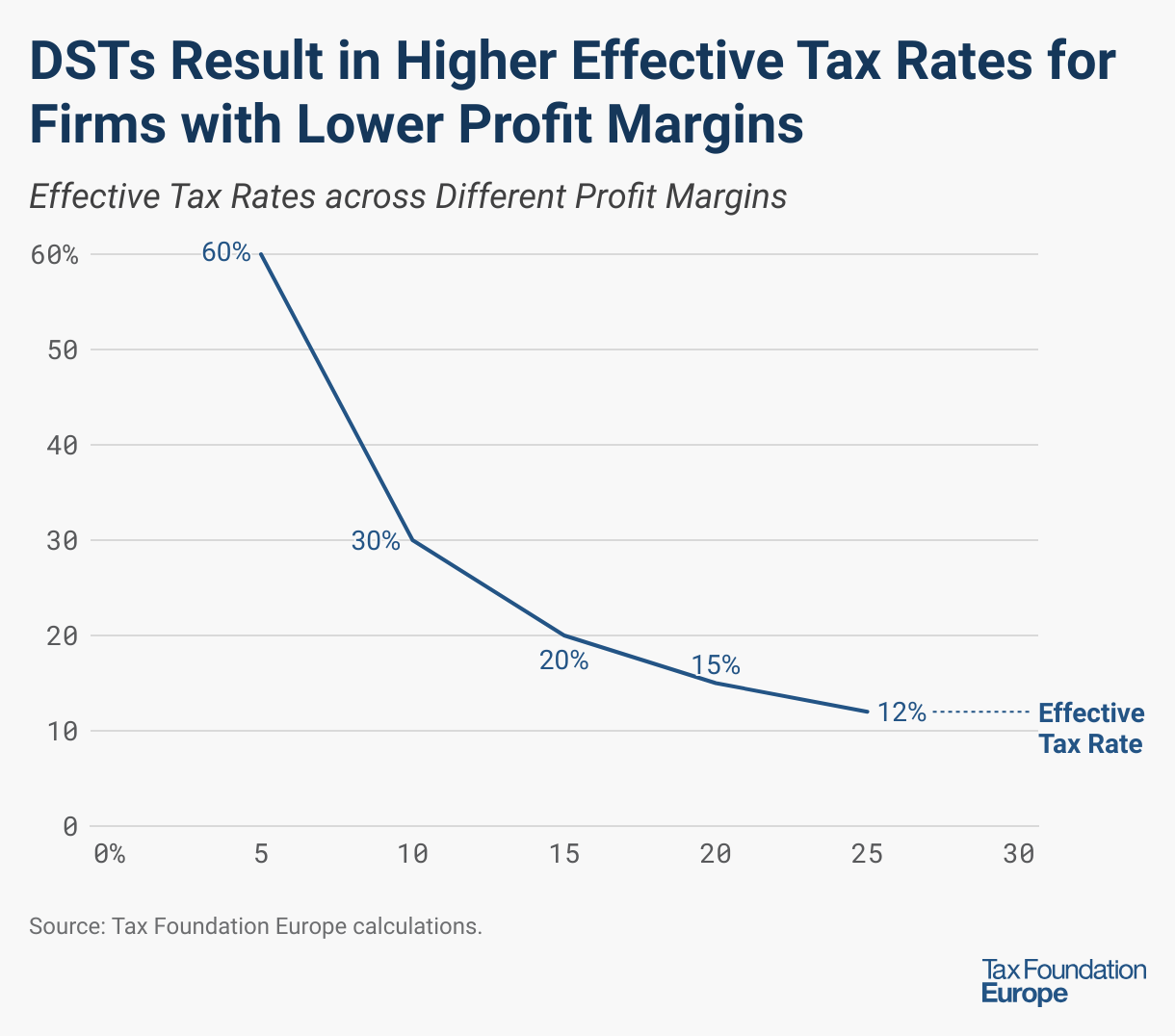
Underneath a revenue-based tax, firms producing the identical degree of income could face considerably completely different efficient tax burdens relying on their value constructions and revenue margins. Consequently, companies with comparatively low revenue margins could bear a disproportionately excessive tax burden in comparison with extra worthwhile companies.
2. The Financial Burden of the Digital Tax Might Be Handed on to Customers
Current analysis suggests that taxing digital platforms could fail to attain its meant aims if the financial burden of the tax is in the end handed on to shoppers. Such results are significantly probably within the case of providers that customers understand as extremely helpful and which might be supplied in a small, open financial system reminiscent of Poland, the place home substitutes are sometimes restricted.
For instance, Google explicitly states that in international locations which have launched digital providers taxes, an extra charge reflecting the quantity of the digital providers tax is added to the worth of promoting providers.
3. There Is a Threat of Commerce Retaliation
Digital providers taxes, which in some respects function equally to tariffs imposed on particular providers, are inherently discriminatory as a result of they aim specific sectors dominated by U.S. firms. The United States authorities has opposed digital providers taxes for greater than a decade. Throughout President Trump’s first time period, the Administration challenged such measures by means of investigations carried out below Part 301, whereas extra not too long ago the U.S. Congress thought of retaliatory motion by means of the tax measures proposed in Part 899. Though Part 899 was in the end faraway from the One Huge Stunning Invoice Act, digital providers taxes stay a delicate concern in bilateral political and financial relations.
Till a global consensus is reached on the taxation of the trendy digital financial system, any retaliatory measures adopted in response to digital providers taxes are more likely to end in hostile financial penalties for all events concerned.
4. Digital Taxes Have a Comparatively Low Income Potential
Experiences throughout European international locations point out that digital providers taxes sometimes generate comparatively modest quantities of income. In the newest 12 months for which information can be found, revenues from these taxes in Austria, France, Italy, Spain, Turkey, and the United Kingdom ranged from €137 million in Austria to €1.04 billion in the UK. Turkey’s digital providers tax, levied at a charge of 5% (7.5% in 2024 and 2025), generates the best degree of income relative to whole authorities receipts, amounting to roughly 0.24% of presidency income.
Even when Poland have been to attain the projected income from the proposed digital tax, the ensuing proceeds would account for lower than 1% of whole authorities income.
Desk 1. Revenues from Digital Companies Taxes in Chosen International locations, Based mostly on the Newest Accessible Information
| Nation | Most Current Yr for Official DST Income Reported | DST Income (native forex) in Thousands and thousands | DST Income (in EUR) in Thousands and thousands | DST Income as Proportion of Complete Income |
|---|---|---|---|---|
| Austria | 2025 | € 137 | 0.06% | |
| France | 2025 | € 891 | 0.06% | |
| Italy | 2024 | € 455 | 0.05% | |
| Spain | 2025 | € 410 | 0.07% | |
| Turkey | 2024 | ₺ 20,985 | € 395 | 0.24% |
| United Kingdom | 2025 | £900 | € 1,042 | 0.10% |
Be aware: International locations have been chosen primarily based on the provision of knowledge on digital providers tax revenues reported as a separate budgetary merchandise.
Supply: Tax Basis Europe, primarily based on nationwide funds paperwork and official authorities communications.
In line with simulations carried out by Tax Basis Europe, Belgium’s proposed digital providers tax would generate comparatively restricted budgetary income whereas on the identical time producing hostile financial results. The estimates are primarily based on a 3 % digital providers tax, corresponding to the proposal put ahead in Belgium in April 2026. Underneath this state of affairs, annual tax revenues would quantity to roughly €148 million, representing lower than 0.06 % of Belgium’s whole tax revenues. On the identical time, Belgium’s GDP would decline by round 0.056 %, equal to roughly €342 million per 12 months. Funding would fall by 0.073 %, whereas wages and employment (or, alternatively, hours labored) would lower by 0.03 %, and whole labor earnings would decline by 0.053 %.
These results mirror the tendency for taxes imposed on digital actions to be handed on to different financial actors, lowering incentives to take a position and in the end affecting employees by means of decrease wages and decreased employment.
Most significantly, the financial prices of the proposed measure could outweigh its direct fiscal advantages. Tax Basis Europe’s simulations point out that the financial distortions related to the proposed digital providers tax might exceed the anticipated budgetary positive factors. The estimated discount in financial output of roughly €342 million is round 2.3 occasions larger than the projected annual tax income of €148 million. This means that the ensuing contraction of the tax baseThe tax base is the whole quantity of earnings, property, belongings, consumption, transactions, or different financial exercise topic to taxation by a tax authority. A slender tax base is non-neutral and inefficient. A broad tax base reduces tax administration prices and permits extra income to be raised at decrease charges. might offset a major share of the extra income generated by the tax and, as soon as decrease receipts from different taxes are taken into consideration, might in the end result in a detrimental internet fiscal impact.
5. Tax Income Can Be Raised Extra Effectively By way of Much less Distortive Taxes
You will need to design the tax system in a manner that raises authorities income as effectively as attainable whereas minimizing the non-tax prices related to financial progress. In financial literature, consumption taxation is usually thought to be a much less distortive type of taxation. OECD analysis means that there stays scope for reform on this space throughout the Polish tax system.
For instance, Poland ranks fourth in Europe by way of foregone VAT income ensuing from decreased charges and exemptions. Estimates point out that broadening the VAT base by eliminating decreased charges and exemptions might generate practically PLN 220 billion (€50.4 billion) in extra authorities income. Even a small fraction of this quantity would exceed the income that might realistically be generated by a digital providers tax.
In contrast with digital providers taxes, VAT presents a number of essential financial benefits, together with tax neutrality, a broad tax base, the absence of tax cascading, consistency with worldwide tax frameworks, and larger revenue-raising capability.
6. Advice
Bearing in mind the shortcomings of the digital tax mentioned above, in addition to its potential hostile financial results, Tax Basis Europe recommends abandoning this proposal.
Keep knowledgeable on the tax insurance policies impacting you.
Subscribe to our free e-newsletter to get the newest tax information, information and evaluation.

