

Key Takeaways
- Stanford and Byzantine Analysis launched Praxis on Nov. 23, 2026, addressing a cryptographic problem relationship again to 2013.
- Praxis reduces ciphertext measurement and encryption prices by greater than ten orders of magnitude in contrast with an earlier development.
- The know-how may allow Bitcoin bridges with out operators or challengers, though impartial scrutiny and technical limitations stay.
Praxis Brings a 13-Yr-Previous Cryptographic Ambition Inside Attain
A longstanding ambition in cryptography may open a wholly new chapter for Bitcoin, permitting advanced spending situations to be enforced with out asking the community itself to confirm them.
On Monday, Nov. 23, Stanford College professor and Babylon Bitcoin staking protocol co-founder David Tse, alongside Byzantine Analysis colleagues Nikhil Vanjani and Psi Vesely, launched a analysis paper titled “Praxis: Sensible Witness Encryption for NP.”
The paper was revealed by means of the Worldwide Affiliation for Cryptologic Analysis (IACR). The researchers describe Praxis as the primary witness encryption development for common nondeterministic polynomial-time (NP) statements that mixes broad applicability, sensible computational prices, and mathematical safety ensures underneath specified assumptions.
First launched in 2013 by Sanjam Garg, Craig Gentry, Amit Sahai, and Brent Waters, witness encryption reverses the standard relationship between encrypted data and cryptographic keys. Relatively than encrypting a message for somebody who already possesses a specific key, the sender encrypts data in opposition to a mathematical assertion.
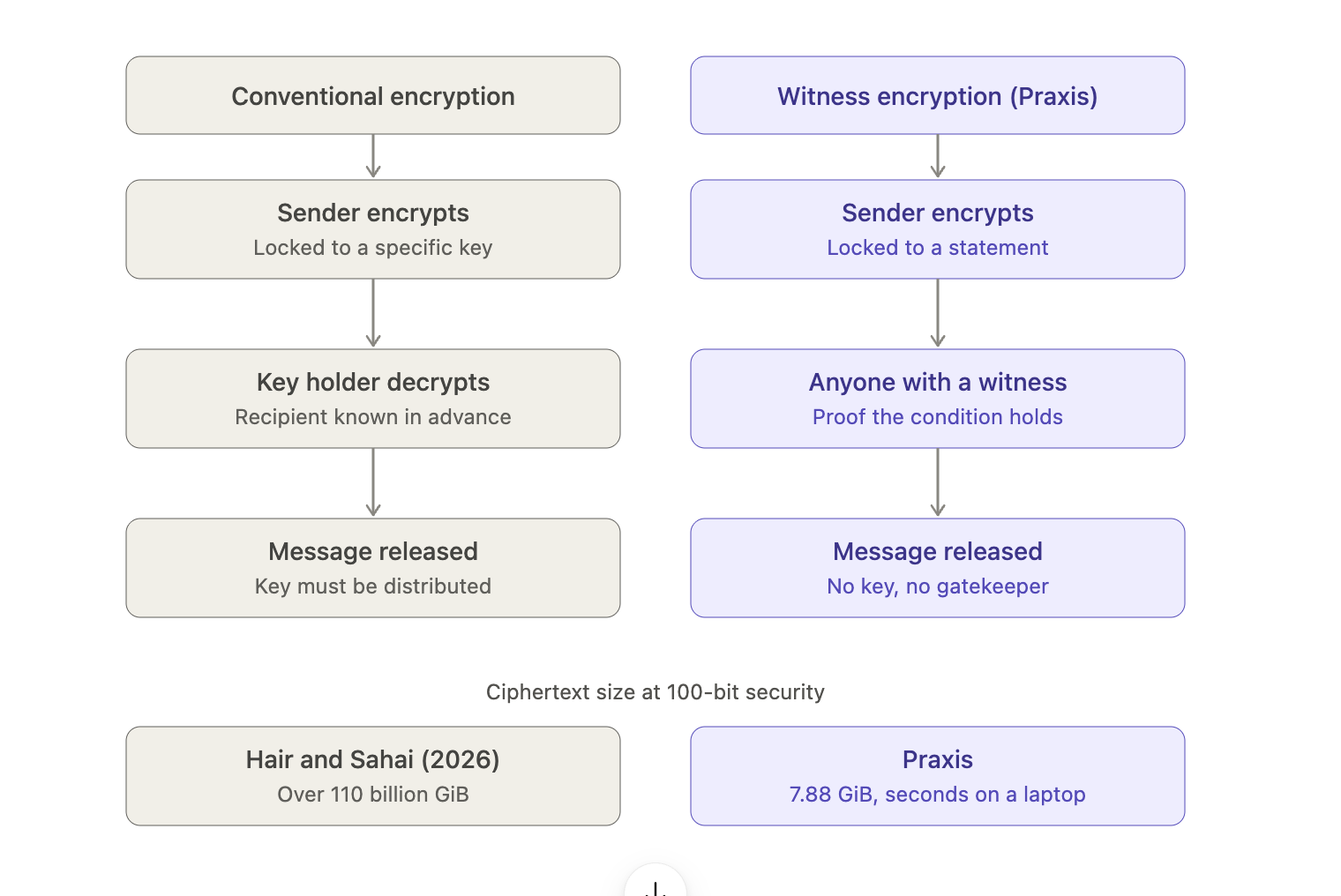
Anybody possessing proof that satisfies the assertion can decrypt the message. That proof, recognized in cryptography as a witness, may set up {that a} cost occurred, a computation was executed accurately, or a blockchain reached a predetermined size.
The particular person encrypting the message needn’t know who will finally decrypt it, nor should that particular person stay accessible to authorize its launch. “A ciphertext carries its personal launch situation, with no key to distribute and no celebration trusted to launch the message,” the researchers clarify.
Traditionally, nevertheless, general-purpose witness encryption has confronted a cussed mathematical impediment. Earlier constructions had been both prohibitively costly, restricted to specific functions, or depending on cryptographic assumptions that subsequently got here underneath assault.
For greater than a decade, cryptographers struggled to reconcile three important traits: common applicability, mathematical safety ensures, and sensible computational necessities. Praxis is introduced as the primary development to carry all three collectively.
From 110 Billion GiB to Simply 7.88 GiB
Praxis dramatically narrows the space between theoretical cryptography and sensible engineering. On the 100-bit safety degree, the researchers’ development produces a ciphertext measuring 7.88 gibibytes (GiB). Encryption requires roughly 20 billion base-field multiplications, whereas decryption with a legitimate proof requires a median of 8.6 billion.
Though these numbers seem substantial, the researchers estimate that each processes may be executed inside seconds on a laptop computer. Encryption requires roughly 12 GB of reminiscence, whereas decryption requires about 5 GB when the ciphertext is streamed moderately than saved completely in reminiscence.
By comparability, an earlier witness encryption development revealed by researchers Hair and Sahai in 2026 requires greater than 110 billion GiB for a comparable process. Praxis reduces ciphertext measurement and encryption prices by greater than ten orders of magnitude, whereas decreasing decryption prices by greater than six orders of magnitude, in accordance with the paper’s comparative evaluation.
The development achieves these enhancements partly by restructuring how mathematical data is represented, changing huge matrices with considerably smaller parts that may be mixed by means of cryptographic pairings.
Praxis additionally intentionally trades typical polynomial-time decryption for a bounded search that is still computationally manageable on the chosen safety parameters. The researchers set up safety throughout the bilinear generic group and random oracle fashions underneath a lattice-based mathematical assumption often known as Module-SIS.
Furthermore, the group gives machine-checked mathematical proofs written in Lean 4, a proper verification system, masking correctness and extraction on the development’s specified parameters.
Praxis employs Groth16, a succinct cryptographic proof system, alongside the BN254 elliptic curve. One mounted verification key accommodates each NP relation, permitting more and more elaborate launch situations to be expressed with out rising the ciphertext measurement underneath the proposed implementation.
The researchers clarify that customers may even encrypt data in opposition to situations expressed by means of applications written in Rust.
Why Witness Encryption May Essentially Change Bitcoin Bridges
For Bitcoin, the importance of Praxis lies in what the community may doubtlessly accomplish with out increasing its native scripting capabilities.
Bitcoin’s scripting language is intentionally restricted, making the direct verification of subtle cryptographic proofs tough. Builders in search of to introduce extra expressive functions have consequently explored various mechanisms for verifying computations carried out outdoors the blockchain.
BitVM, launched by Robin Linus in 2023 and now in model 2, opened one such avenue. BitVM-style constructions make use of interactive verification mechanisms by means of which dishonest computations may be challenged. Such preparations usually rely upon no less than one sincere participant being accessible to contest fraudulent exercise.
Witness encryption introduces a essentially totally different proposition. Relatively than requiring Bitcoin to confirm a posh computation, builders may encrypt the cryptographic materials essential to spend bitcoin in opposition to an announcement establishing that the computation was accomplished accurately.
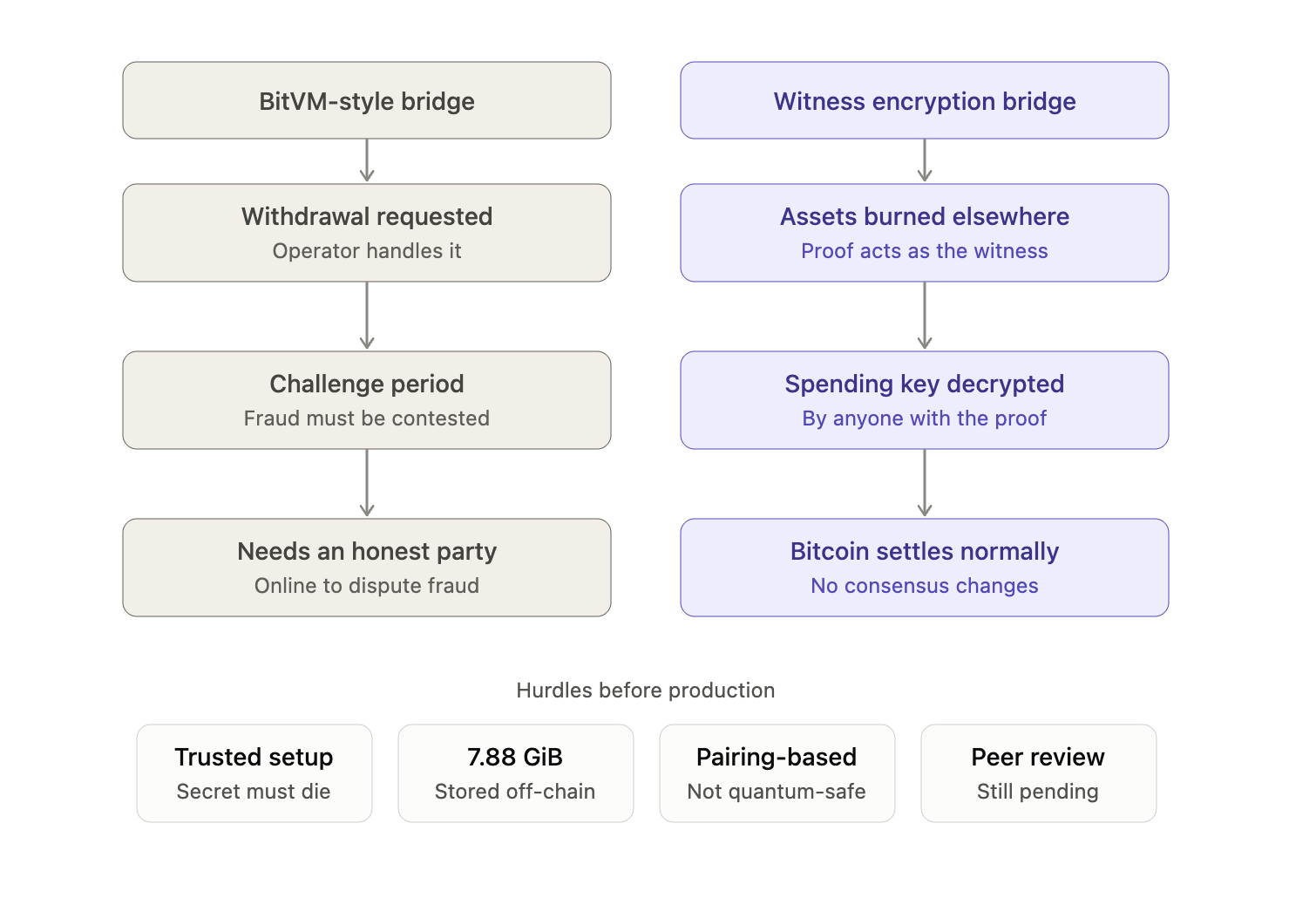
Contemplate a Bitcoin bridge connecting the community to a different blockchain. A withdrawal might be conditioned on the existence of a legitimate cryptographic proof establishing that the corresponding property had been correctly withdrawn or destroyed on the opposite community.
A participant possessing the mandatory proof may decrypt the spending materials. Bitcoin would then course of the ensuing transaction utilizing its present consensus guidelines, with out instantly evaluating the underlying computation.
Linus, responding to the analysis, mentioned that if the development withstands impartial peer overview, then it “will essentially enhance Bitcoin bridges. Eliminating the necessity for operators and making deposits and withdrawals non-interactive.”
Crypto researcher Eric Wall supplied an equally enthusiastic, albeit conditional, evaluation, suggesting that “Bitcoin could be technologically saved in spite of everything.”
Potential functions prolong significantly past blockchain bridges. Witness encryption may facilitate cross-chain atomic swaps, personal auctions, time-locked funds, and Bitcoin covenants, which impose restrictions on how funds could subsequently be spent.
For instance, entry to a bitcoin cost might be restricted to somebody able to proving {that a} corresponding stablecoin cost occurred. The discharge situation could be enforced by means of cryptography moderately than by means of an middleman overseeing the change.
Such mechanisms may furnish builders with significantly higher flexibility when designing Bitcoin functions, notably those who depend on elaborate situations the community’s present scripting language can not instantly consider.
Praxis Nonetheless Faces Trusted Setup and Storage Hurdles
Regardless of the appreciable effectivity positive aspects, Praxis stays a analysis development moderately than a production-ready answer. The Groth16 implementation requires an sincere trusted setup. If the key randomness generated throughout that setup is retained, somebody possessing it may fabricate proofs and decrypt ciphertexts related to the corresponding verification key.
Consequently, eliminating ongoing bridge operators doesn’t mechanically remove each aspect of belief from the broader system. The 7.88 GiB ciphertext additionally presents sensible challenges. Though manageable for contemporary computer systems, it stays unsuitable for direct inclusion in Bitcoin transactions. Purposes would require reliable off-chain storage, distribution mechanisms, and assurances that encrypted data stays accessible when contributors want it.
Nor ought to Praxis be confused with a quantum-resistant encryption system. Though Module-SIS belongs to a household of lattice-based issues studied in post-quantum cryptography, the development additionally is determined by pairing-based cryptography and its related classical safety assumptions.
The newly revealed paper has but to bear formal peer overview, and its concrete safety parameters, computational estimates, and implementation necessities warrant additional impartial examination.
However, Praxis presents Bitcoin builders with an intriguing architectural risk: increasing what bitcoin funds can accomplish with out increasing what Bitcoin nodes should compute. If the development survives impartial scrutiny and its engineering limitations show manageable, then witness encryption may furnish Bitcoin with capabilities beforehand pursued by means of consensus modifications or intermediary-dependent infrastructure. Essentially the most consequential innovation could finally reside outdoors the blockchain itself.


