

Key takeaways
- An exploit at BNB Chain protocol POTS Cash drained about $5.7 million in USDT from the IBS/USDT liquidity pool on PancakeSwap.
- Blockaid says a privileged governance account minted one billion new IBS tokens, which have been then offered into the pool.
- IBS, designed to carry a minimal worth of $1, fell to roughly $0.00000008 inside an hour.
- Locked liquidity didn’t assist: it stops LP withdrawals, not trades in opposition to the pool with newly minted tokens.
- How the account was accessed is unclear, and no verified reimbursement plan has been printed.
The POTS Cash exploit has drained roughly $5.7 million in USDT from a liquidity pool on BNB Chain, sending the protocol’s IBS token plunging to close zero.
Blockchain safety agency Blockaid flagged the incident early Sunday, November 29, after figuring out uncommon token issuance involving an account with elevated governance permissions. The newly created tokens have been exchanged for USDT held within the protocol’s liquidity pool.
The incident follows the current Kava Lend exploit, which uncovered a separate vulnerability in DeFi collateral accounting.
For IBS holders, the collapse raises an uncomfortable query a couple of token that was designed to take care of a minimal worth of $1: what occurs when the system chargeable for managing its provide turns into the supply of the issue?
One Billion New Tokens and Hundreds of thousands in Lacking Liquidity
Blockaid recognized the incident at 04:59 UTC, reporting {that a} “privileged governance account” had been used to create one billion IBS tokens.
On-chain monitoring platform Lookonchain subsequently reported roughly $5.71 million in USDT proceeds, linking the exercise to a transaction on BscScan.
The harm was concentrated within the IBS/USDT market on PancakeSwap. Reasonably than merely stealing present IBS from buyers’ wallets, the reported exploit concerned creating new provide and exchanging it for stablecoins already held within the pool.
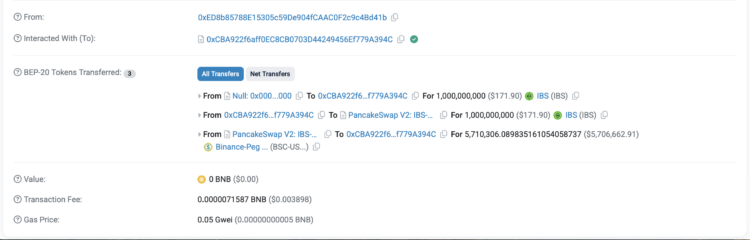
The excellence issues as a result of the worth misplaced will not be restricted to the tokens created through the incident. Present holders have been left with an asset whose essential supply of buying and selling liquidity had been severely depleted.
IBS was buying and selling at roughly $0.00000008 at 05:48 UTC on Sunday.
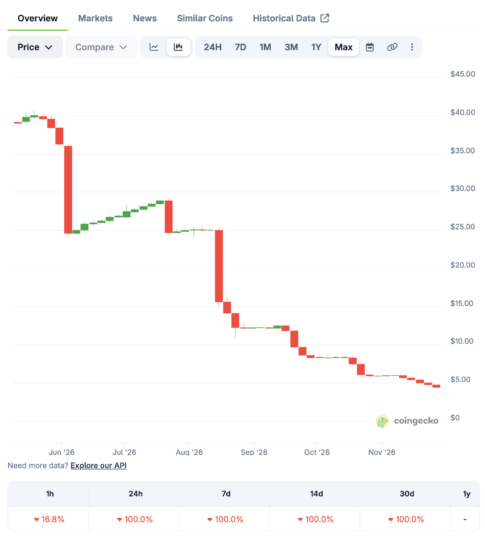
| Time | What occurred |
|---|---|
| 04:59 UTC | Blockaid flags a privileged governance account minting one billion IBS tokens |
| Shortly after | New IBS is offered into the IBS/USDT pool on PancakeSwap for about $5.71M in USDT |
| 05:48 UTC | IBS trades at roughly $0.00000008 |
Timeline of the POTS Cash exploit on Sunday, November 29, primarily based on early studies. Knowledge: Blockaid, Lookonchain, CoinGecko. Visualization: NewsBTC.
Why Locked Liquidity Couldn’t Shield IBS
POTS Cash describes itself as a decentralized bond issuance protocol. IBS, its algorithmic token, was designed round collateral reserves and a mechanism meant to assist a minimal worth.
The incident exposes a limitation that’s simple to miss when assessing DeFi initiatives.
Locking liquidity can stop the proprietor of liquidity supplier tokens from straight withdrawing the underlying reserves. It doesn’t, nevertheless, stop these reserves from being exchanged via regular buying and selling exercise.
When a token’s provide expands dramatically with out corresponding financial backing, the value assist that buyers thought that they had can disappear.
A token can have thousands and thousands of {dollars} in locked liquidity and nonetheless be susceptible if the principles governing its issuance usually are not adequately protected. The energy of the liquidity lock is simply a part of the safety equation.
NewsBTC lined a associated danger earlier this month when the Fusionist ACE bridge exploit concerned the issuance of unbacked tokens. Whereas the underlying techniques differ, each incidents illustrate the monetary penalties of extreme minting privileges.
Safety Audit Flagged Minting Dangers Months Earlier than the Exploit
A historic report from blockchain safety auditor CertiK listed an audit of POTS Cash as being in progress, with findings present process remediation.
Extra importantly, the dangers related to privileged accounts had been recognized months earlier than Sunday’s incident. A safety audit by ScaleBit dated March 23 flagged centralization considerations, together with limitless minting permissions, and really helpful introducing multisignature controls and a timelock.
The discovering was marked as partially mounted.
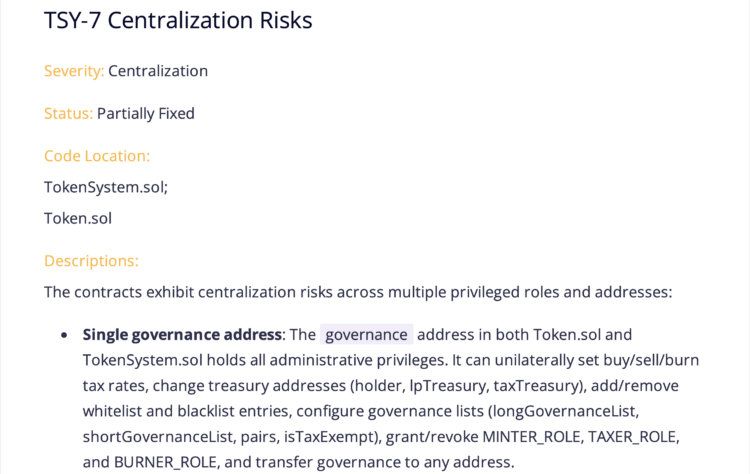
ScaleBit recognized partially resolved centralization dangers involving privileged accounts and token minting permissions. Supply: ScaleBit, March 2026.
An audit might cowl the implementation of a wise contract with out eliminating each danger related to the accounts approved to function it. Non-public key safety, governance controls and restrictions on token issuance stay vital even when the underlying code has been reviewed.
Whether or not the identical permissions flagged by ScaleBit have been concerned in Sunday’s exploit stays unconfirmed. Additionally it is unclear how the privileged account was accessed or whether or not one other failure inside the protocol was accountable.
Can IBS Holders Get better Their Funds?
Safety researchers have reportedly recognized a pockets related to the extracted USDT, however figuring out funds on a blockchain will not be the identical as recovering them.
A reputable restoration plan would wish to ascertain how a lot collateral stays obtainable, whether or not the affected minting permissions have been disabled and the way legit IBS balances might be handled.
The complete monetary impression on particular person buyers additionally stays unknown. The quantity faraway from a liquidity pool shouldn’t routinely be handled because the sum of all buyer losses.
No verified reimbursement plan was obtainable within the sources reviewed for this report.
For IBS holders, the speedy precedence is to keep away from unofficial compensation and restoration hyperlinks whereas awaiting authenticated info from the mission.
Restoring a token’s quoted market worth could also be attainable. Restoring confidence within the guidelines governing its provide is prone to be a significantly more durable job.

