

The Coldcard vulnerability now has an official paper path. Coinkite has printed an 18-page postmortem on the seed-generation flaw that allow attackers drain Bitcoin from a few of its {hardware} wallets.
The report, dated November 23 and launched on the corporate weblog on November 24, says Coinkite has logged about 300 loss-related help tickets tied to 242 buyer accounts.
That’s roughly 0.21% of its estimated person base. However three of its 15 security suggestions are nonetheless open, together with any determination on compensation.
For Bitcoin holders, probably the most helpful half is what the doc guidelines out. Bitcoin’s cryptography was by no means damaged, and no machine was taken over remotely.
The larger query is whether or not self-custody instruments can now show the place their randomness comes from, slightly than merely trusting that it’s there.
What the Coldcard Postmortem Provides
Coinkite modeled the doc on an NTSB accident report. Info sit in a single part, its personal evaluation in one other, then findings and suggestions.
The core details match what we reported in our earlier take a look at the Coldcard exploit and the 15 opinions that missed it.
From March 29, 2021, to July 30, 2026, Coldcard firmware created seeds with MicroPython’s Yasmarang software program generator as a substitute of the machine’s STM32 {hardware} random-number generator.
The brand new element is the exact root trigger. Coinkite says nothing in its launch course of verified which random-number implementation the transport seed-generation code really reached.

ADVERTISEMENT
The {hardware} code was current within the firmware. Assessments confirmed it existed and that seed phrases got here out effectively shaped. They by no means confirmed the seed path used it.
The report provides that the statistical well being checks reviewed by auditor Keylabs couldn’t inform the weak generator aside from a correctly seeded one.
How Many Coldcard Customers Have been Hit?
No person is aware of for certain, and the postmortem says so plainly. It lists 4 counts that measure various things.
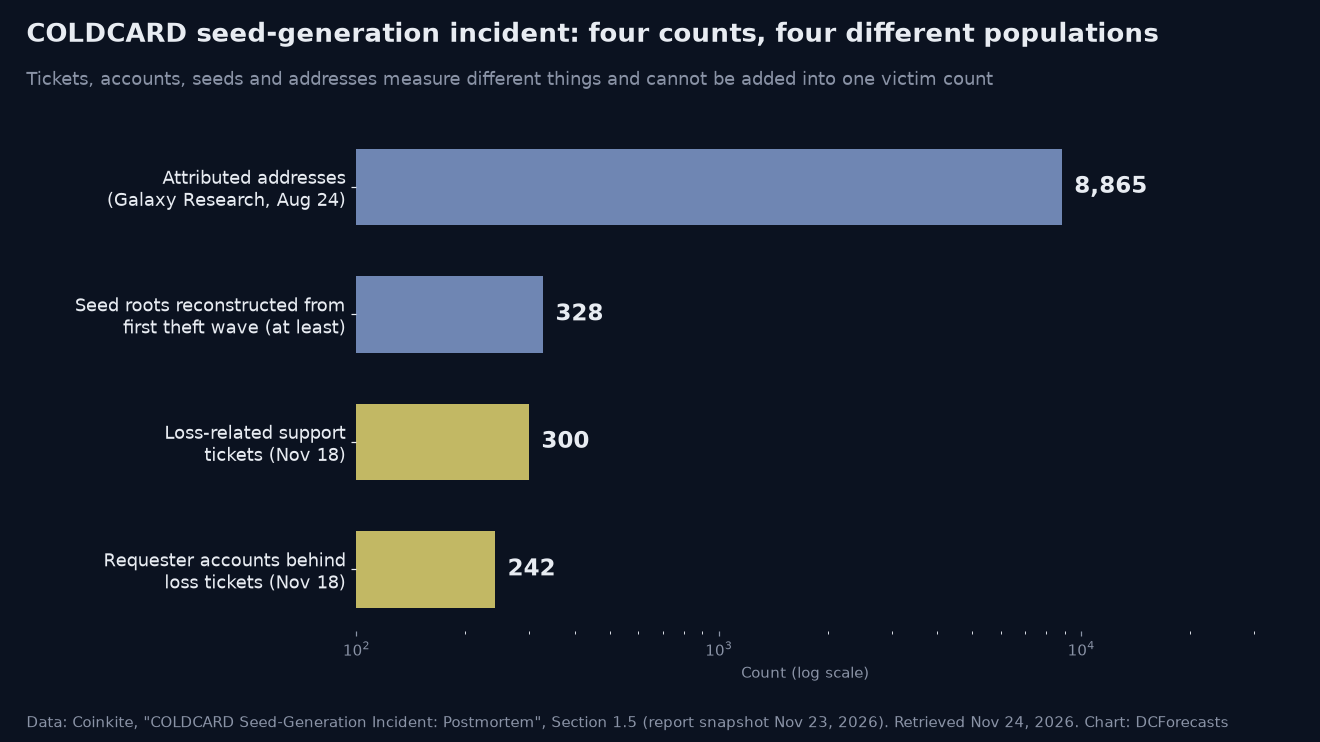
Coinkite’s help evaluate discovered 300 tickets from 242 requester accounts as of November 18. Its weblog publish asserting the report provides a barely decrease 236 accounts.
A public evaluation of the primary theft wave rebuilt a minimum of 328 seed roots. Galaxy Analysis attributed 8,865 addresses as of August 24.
Galaxy Analysis had earlier estimated 1,778.84 BTC stolen. At Bitcoin’s value close to $59,800 on Coinbase on November 24, that’s roughly $106 million.
Coinkite warns that the true variety of victims is probably going larger, as a result of not each loss will get reported. Coldcard is non-custodial, so it will probably solely rely what prospects inform it.
Why the Coldcard Vulnerability Stayed Hidden for 5 Years
The report lists a minimum of 15 evaluate and analysis efforts between 2021 and 2026, together with paid third-party opinions in 2022 and 2024. The firmware supply was public, with 54 contributors.
A evaluate by Nick Farrow dated June 17, 2026, explicitly lined weak randomness and concluded the trail was sound. An AI-assisted evaluate by Rob Hamilton from Might to June produced 85 candidate findings however missed this one.
Coinkite additionally notes that developer James O’Beirne raised basic high quality issues in regards to the libNgU library in Might 2025, with out figuring out the particular defect.
Essentially the most hanging passage issues timing. Kimi K3’s full mannequin weights have been launched on July 27. The primary thefts started two days later.
Coinkite calls AI-assisted discovery “a believable speculation,” not an attribution. Who discovered and exploited the flaw stays unknown, and regulation enforcement is investigating.
The Canadian Centre for Cyber Safety additionally has a separate open case, in accordance with the report.
A Repair in One Day, and an Audit That Adopted
Right here is the place the report is extra encouraging. Coinkite recognized the defect on July 30, the day thefts have been reported, and shipped mounted firmware on all supported tracks on July 31.
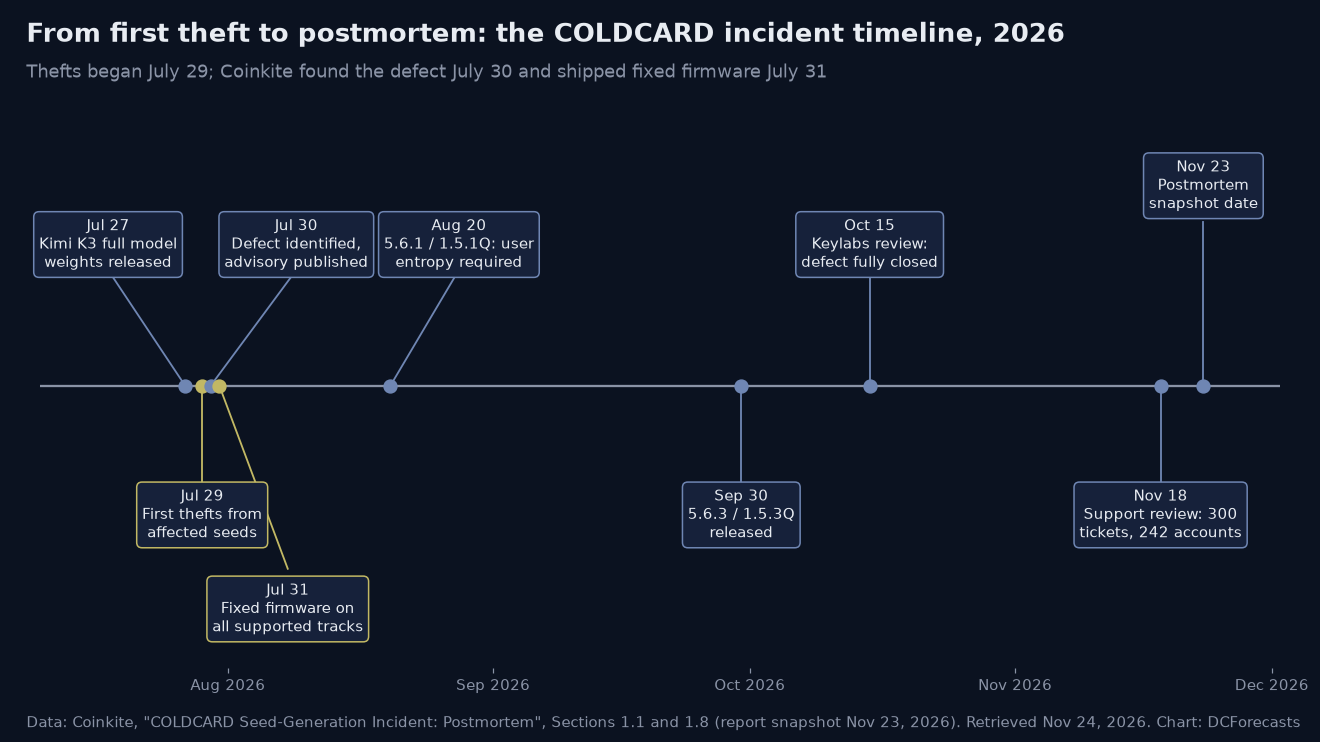
Firmware 5.6.1 in August went additional. Each new seed now requires person enter, akin to 50 cube rolls, 128 coin flips or 65 timed key presses.
That enter is blended with output from the {hardware} generator and each safe components. At boot, the machine additionally checks that it’s calling the right {hardware} path, and stops if it isn’t.
Keylabs printed an unbiased evaluate on October 15. Inside its acknowledged scope, it discovered the July defect absolutely closed in Mk5 5.6.3 and 5.6.2 and Q 1.5.3Q and 1.5.2Q.
Edge releases have been outdoors that evaluate. Commissioning additional artifact-specific audits stays one of many three open gadgets, alongside restoring management of the corporate’s X account and deciding on compensation.
What Coldcard Homeowners and Bitcoin Holders Ought to Take Away
A very powerful line for affected customers is blunt: a firmware replace doesn’t restore a seed created on affected firmware. These funds want to maneuver to a brand new seed.
Seeds generated with a minimum of 50 truthful, non-public cube rolls weren’t weakened. Coinkite additionally factors to robust BIP-39 passphrases and multisig as further safety for materials quantities.
We imagine that is the actual lesson. The failure sat in a single vendor’s construct course of, not in Bitcoin itself. The postmortem states that libsecp256k1, the cryptographic library from Bitcoin Core, was not concerned.
A 128-bit seed stays far past brute drive. The assault labored solely as a result of affected seeds had about 40 bits of actual entropy on Mk2 and Mk3 gadgets, and an estimated 72 bits on newer fashions.
We additionally see a wider upside. After disclosure, the Bitcoin Pink Workforce ran a 108-hour, multi-model evaluate that produced 7,958 candidate findings throughout 501 tasks, with 24.7% backed by reproducible proofs of idea.
For us, that strain is wholesome. As we famous when Ledger Flex drains hit customers in Berlin and Dubai, pockets safety is being examined tougher than ever.
Verified randomness, user-supplied entropy and printed audits have gotten the usual. The approaching months will present whether or not Coinkite closes its final three suggestions, and whether or not the stolen cash ever transfer.
DC Forecasts is a frontrunner in lots of crypto information classes, striving for the best journalistic requirements and abiding by a strict set of editorial insurance policies. In case you are to supply your experience or contribute to our information web site, be happy to contact us at [email protected]

