Key Takeaways
- CIRG brings collectively roughly 21 cryptography consultants to deal with potential mathematical breakthroughs and coordinate accountable disclosure.
- Coinbase mentioned on Nov. 28 that it has seen no actionable proof of a sensible break affecting main blockchain signature schemes.
- The $1 million P versus NP drawback stays unresolved, regardless of rising hypothesis surrounding AI-assisted mathematical discoveries.
Cryptographers Set up as AI Rumors Intensify
The newly established Cryptography Incident Evaluation Group has emerged at an unusually tense second for pc scientists, mathematicians, and digital asset advocates. The group’s newly launched web site describes its mission as an effort “to assessment and assist navigate cryptanalytic advances,” providing steering on disclosing cryptographic breaks, speaking with affected events, and making ready technological safeguards.
The group’s membership reads like a who’s who of recent cryptography. Members embody Stanford College’s Dan Boneh, Massachusetts Institute of Expertise (MIT) researchers Yael Tauman Kalai and Vinod Vaikuntanathan, Johns Hopkins College’s Matthew Inexperienced and College of Michigan professor Chris Peikert.
Different members embody Nadia Heninger, Daniele Micciancio, Alessandro Chiesa, Vadim Lyubashevsky, Justin Thaler, Phong Nguyen, Eran Tromer, and Ryan Williams. Members take part in a private capability quite than formally representing their respective establishments.
Anthropic cryptography engineer Steve Weis publicly launched the initiative on X, attracting consideration from researchers and expertise executives. The group has indicated {that a} assertion is forthcoming, though it has not recognized a particular cryptographic incident or introduced a confirmed vulnerability.
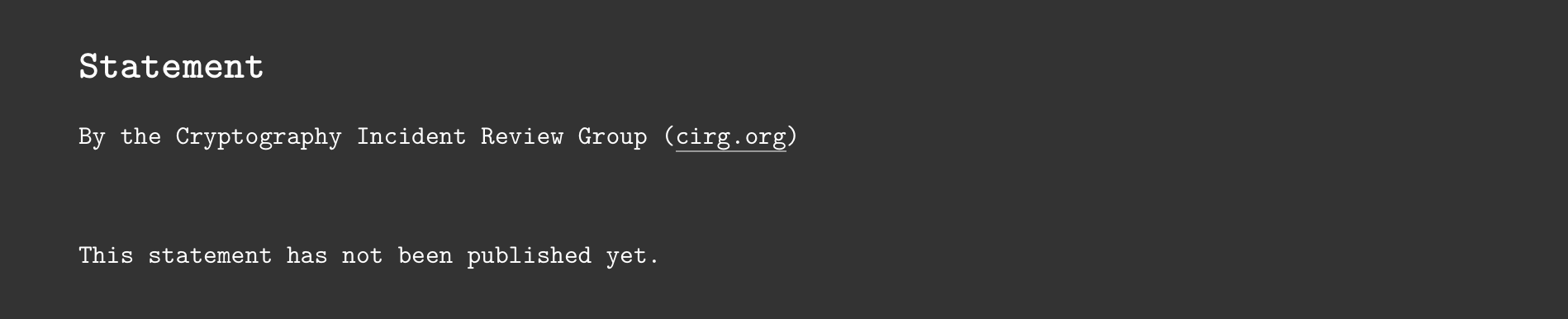
The timing, nevertheless, has attracted appreciable scrutiny. Joi Ito, former director of the MIT Media Lab, urged his 138,000 followers on X to pay shut consideration to the group’s forthcoming assertion. “Regulate the brand new Cryptography Incident Evaluation Group, a bunch of well-known cryptographers, for a press release on latest crypto advances,” Ito wrote.
What Has Scott Aaronson Revealed About AI Cryptanalysis?
A lot of the hypothesis stems from feedback revealed by Scott Aaronson, a theoretical pc scientist on the College of Texas at Austin, who has mentioned doubtlessly important unpublished analysis from frontier AI laboratories on his Shtetl-Optimized weblog. Bitcoin.com Information reported on Aaronson’s statements amid hypothesis that RSA (Rivest–Shamir–Adleman), an uneven public-key cryptosystem extensively employed to safe knowledge transmission, had been cracked.
To this point, no such cryptographic breakthrough in opposition to RSA has been independently verified. Nonetheless, Aaronson mentioned in his editorial that he was “nearly sure, from a number of dependable sources, that the AI labs at the moment are sitting on a number of bombshells” involving cryptography-related algorithms. Nonetheless, the pc scientist expressed significantly much less confidence concerning the exact nature of these discoveries.
Among the many extra consequential rumors is that researchers at OpenAI or Anthropic would possibly possess an algorithm able to factoring massive integers in polynomial time, a discovery that would undermine the mathematical basis of RSA encryption. Aaronson’s weblog put up subsequently clarified that the knowledge he thought-about dependable fell nicely in need of establishing such a breakthrough.
Nonetheless, hypothesis has proliferated throughout social media, with more and more dramatic interpretations extending to Bitcoin’s digital signatures and the potential of AI fixing considered one of pc science’s best mysteries. The hypothesis comes in opposition to a backdrop of extraordinary mathematical developments. Each Anthropic and OpenAI have introduced claimed proofs establishing VP ≠ VNP, an algebraic analogue of the well-known P versus NP drawback.
Different advances concern matrix multiplication and Fourier-transform complexity. None of those developments, nevertheless, establishes that trendy cryptography has been compromised. Inexperienced, a CIRG member, beforehand estimated a roughly 15% chance of successfully shedding confidence in current public-key algorithms. He assigned a significantly smaller 1% chance to a theoretical surroundings generally known as “Minicrypt,” by which public-key encryption is not possible.
Coinbase Addresses Considerations Over Bitcoin’s Cryptographic Safety
On Saturday, Nov. 28, cryptocurrency change Coinbase revealed a press release addressing the hypothesis and reassuring clients concerning the safety of their digital property. The centralized crypto change acknowledged latest AI-assisted enhancements to integer factoring however distinguished these developments from assaults in opposition to elliptic-curve cryptography, which gives the mathematical basis for transaction signatures throughout main blockchain networks.
The Coinbase weblog put up revealed this weekend states:
“Regardless of all of the rumors during the last week, we’ve deep connectivity throughout AI and cryptography and we don’t at present consider that there’s an AI breakthrough that poses an instantaneous and sensible risk to the cryptography that trendy techniques depend on at this time”
RSA depends on the issue of factoring massive composite integers into their constituent prime numbers. Bitcoin and Ethereum, in contrast, depend on the issue of fixing the elliptic-curve discrete logarithm drawback for his or her standard transaction signatures. Consequently, a breakthrough in opposition to RSA wouldn’t robotically invalidate Bitcoin’s signature schemes.
Though each techniques depend on mathematical issues believed to be computationally tough, the underlying issues are distinct. Coinbase’s cryptography staff, led by Yehuda Lindell, continues to evaluate rising analysis whereas making ready for post-quantum cryptography (PQC). Such preparations are designed to facilitate the substitute of susceptible cryptographic algorithms with out requiring a complete technological infrastructure to be rebuilt from scratch.
A sufficiently highly effective quantum pc presents a separate risk as a result of Shor’s algorithm can theoretically resolve each integer factoring and discrete logarithm issues effectively.
What Would Occur to Bitcoin if P Equals NP?
On the coronary heart of a lot of the dialogue lies P versus NP, a mathematical drawback formally launched in 1971 that carries a $1 million prize from the Clay Arithmetic Institute. The query is deceptively easy: If a pc can rapidly confirm that a solution is appropriate, can it additionally rapidly uncover that reply?
Think about a tough Sudoku puzzle. Discovering the answer would possibly take hours, but verifying {that a} accomplished puzzle satisfies each rule takes significantly much less time. Laptop scientists wish to know whether or not that disparity essentially exists for sure computational issues.
The touring salesman drawback gives one other illustration. Assuming symmetric journey distances, a salesman visiting 10 cities has 181,440 distinct potential routes to think about. Improve that quantity to twenty cities, and the probabilities balloon to roughly 60.82 quadrillion. If at this time’s mathematicians uncover a polynomial-time algorithm for an NP-complete drawback, they’d set up that P equals NP, demonstrating that a complete class of computational issues possesses environment friendly options within the formal mathematical sense.
The ramifications might lengthen far past cryptocurrency. Pharmaceutical analysis, industrial manufacturing, logistics, mathematical proof discovery, and synthetic intelligence (AI) may benefit enormously from sufficiently sensible algorithms. For cryptography, nevertheless, the implications could possibly be significantly much less welcoming.
Bitcoin depends on the mathematical asymmetry between producing legitimate digital signatures and deriving the non-public keys needed to provide them. The community additionally employs SHA-256 hashing, which makes verifying proof-of-work easy whereas making its manufacturing computationally costly. A sufficiently sensible P = NP breakthrough might threaten these foundations, in addition to standard banking infrastructure, encrypted communications, and even cryptographic techniques developed to face up to quantum computing.
But polynomial time doesn’t essentially translate into sensible velocity. An algorithm requiring numerous computational steps proportional to the enter dimension raised to the a centesimal energy technically qualifies as polynomial time, regardless of doubtlessly being ineffective on up to date {hardware}. Conversely, proving P ≠ NP would set up that sure effectively verifiable issues can’t be solved in polynomial time. It could not, nevertheless, independently set up the safety of Bitcoin’s explicit cryptographic algorithms.
Bitcoin Proponents Push Again
Cryptography skilled and Blockstream CEO Adam Again weighed in with P!=NP or galactic parameters, punctuating his evaluation with a shrug emoji. He added that “virtually actually P!=NP, however neither end result is more likely to influence SHA-256, nor Elliptic Curve. and EC has a prepared substitute, Lamport-Signatures (aka SHRINCS in Bitcoin context). And there are greater, newer hashes. So give it up, fellas. The cryptography sky is just not falling,” Again remarked on X.
Jan3 founder and CEO Samson Mow defined that even when P = NP have been confirmed, Bitcoin might stay safe, as researchers would nonetheless want to plan a computationally environment friendly algorithm able to fixing the tough issues underpinning its cryptographic primitives, equivalent to ECDSA and SHA-256, at sensible scales.
“Simply figuring out that such an algorithm exists is just not sufficient. Even when algorithms that work in polynomial time on the cryptography Bitcoin makes use of have been someway discovered, there are nonetheless methods Bitcoin can proceed on, although it will look radically completely different.”
Cryptography Neighborhood Awaits CIRG’s Forthcoming Assertion
As of Sunday, Nov. 29, no sensible break of a significant blockchain’s signature scheme has been publicly demonstrated. Neither has a definitive answer to P versus NP been introduced. The formation of CIRG however displays a rising recognition that AI-assisted mathematical analysis might advance quicker than establishments can consider discoveries, coordinate disclosures and implement technological replacements.
For now, essentially the most tangible improvement is the emergence of a corporation devoted to navigating exactly these circumstances. Its forthcoming assertion might present higher readability about what researchers are confronting and whether or not the cryptographic neighborhood faces an instantaneous problem or a longer-term preparation train. The excellence between mathematical risk and computational practicality stays the dividing line between at this time’s hypothesis and tomorrow’s safety actuality.