

The query behind each e mail verification API is whether or not it does sufficient. Not whether or not it validates addresses (all of them declare to), however whether or not the authentication mannequin is open, the speed limits are workable, the SDKs cowl your stack, and the pricing scales with out surprises.
NeverBounce’s REST API has been the usual verification API for builders constructing e mail checks into pipelines, varieties, and CRM workflows since 2014. Seven official SDKs, a JavaScript Widget for client-side type validation, and credit-based pricing beginning at $0.008 per e mail make it simple to get operating. Backed by ZoomInfo Applied sciences since 2019, the platform processes billions of verifications month-to-month throughout 150,000+ companies.
However validation and intelligence are completely different layers.
NeverBounce’s API does one factor: confirm whether or not an e mail tackle is deliverable. Single-check verification for point-of-entry validation, and bulk jobs for current lists. It tells you whether or not an tackle is legitimate, invalid, disposable, catch-all, or unknown. It doesn’t let you know who owns that tackle, what firm they work for, what know-how that firm runs, whether or not the account is researching your class, or the place the contact sits in an org chart. That may be a completely different class, and NeverBounce’s API was by no means designed to cowl it.
That is the place ZoomInfo enters the image. A B2B intelligence platform constructed on 500M contacts and 100M corporations, ZoomInfo’s Enterprise API covers search, enrichment, AI intelligence, and viewers administration, with OAuth 2.0 authentication and an MCP server for AI-agent workflows. NeverBounce verifies emails you have already got; ZoomInfo gives the B2B intelligence behind these emails.
This evaluation covers the NeverBounce API in full technical depth first, then examines ZoomInfo’s API because the layer that picks up the place e mail verification stops.
NeverBounce API at a Look
|
Attribute |
Element |
|---|---|
|
API kind |
REST over HTTPS, JSON responses |
|
Authentication |
API key handed as a request parameter |
|
Base URL |
https://api.neverbounce.com/v4.2/ |
|
Price limits |
10 concurrent bulk jobs; 50 job runs/day; single-check restricted to real-time, user-triggered use |
|
Pricing / entry |
Credit score-based: $0.008/e mail (pay-as-you-go at 10K); 10 free credit on signup |
|
SDKs |
Node.js, PHP, Ruby, Python, Go, .NET, Java |
|
Webhooks |
Job Callbacks for bulk verification occasions (v4.2) |
|
Documentation |
builders.neverbounce.com (interactive API reference on ReadMe) |
NeverBounce API: What Works Effectively & What to Plan Round
|
What works effectively |
What to plan round |
|---|---|
|
Official SDKs in 7 languages (Node.js, PHP, Ruby, Python, Go, .NET, Java) |
Single-purpose scope: e mail verification solely, no contact enrichment or firm knowledge |
|
Interactive API reference with reside “Strive It!” explorer |
10 concurrent bulk jobs max; 50 job runs per day |
|
Easy API key authentication, no OAuth required |
Single-check endpoint restricted to real-time user-triggered occasions; sequential listing iteration is prohibited |
|
JavaScript Widget for client-side type validation with out exposing server credentials |
Accounts with out a cost methodology face fee limiting and restricted bulk API entry |
|
Per-app API keys for granular reporting throughout integrations |
Catch-all/accept-all domains return an unverifiable standing (a category-wide limitation) |
|
Free pre-clean bounce evaluation earlier than credit are consumed |
Pay-as-you-go credit expire one year after buy |
|
Job Callbacks for event-driven bulk workflows |
No documented retry coverage or supply ensures for webhook callbacks |
NeverBounce API: Authentication & Getting Began
Getting API entry is easy. Create a free NeverBounce account, navigate to the Apps tab, and create a Customized Integration App to generate an API key. Each new account receives 10 free credit usable by way of the API, sufficient to check each single and bulk verification.
Authentication makes use of an API key handed as a parameter in every request. No OAuth move, no token trade, no token refresh cycle. You embody key={api_key} within the request physique or question string, and the API authenticates the decision.
Beginning with API v4, accounts can maintain a number of API keys by creating a number of Customized Integration Apps, permitting per-integration reporting and settings administration.
A fundamental single-check request:
curl “https://api.neverbounce.com/v4.2/single/verify?key=YOUR_API_KEY&e mail=check@instance.com&timeout=10”
Two issues to learn about credential dealing with:
-
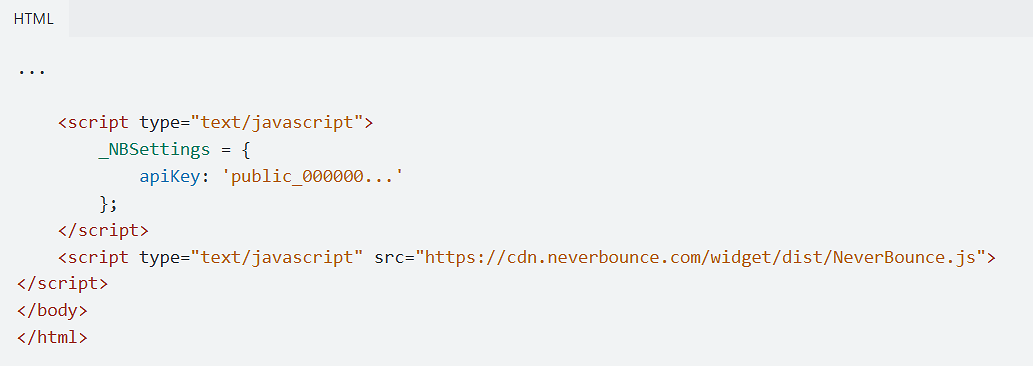
By no means use the usual API key in client-side code (browsers), as a result of doing so exposes the credential. The JavaScript Widget exists for that use case, utilizing a public key scoped to licensed domains with throttling to forestall abuse.
Supply: NeverBounce
-
NeverBounce separates server-side API entry (Customized Integration with non-public key) from client-side type validation (JavaScript Widget with domain-scoped public key), so credentials by no means seem in browser contexts.
Past the ten free credit, verification consumes bought credit from the identical pool the dashboard makes use of. There isn’t a developer-only free tier. Accounts with out a saved cost methodology face fee limiting and restricted bulk entry; including a cost methodology removes these restrictions.
NeverBounce API: Core Endpoints & Capabilities
The API covers two use circumstances: real-time single-email verification and asynchronous bulk listing verification. Each run from the identical base URL at https://api.neverbounce.com/v4.2/.
Single Verification: /single/verify
The /single/verify endpoint verifies one e mail tackle in actual time. It’s designed for point-of-entry validation: type submissions, button clicks, checkout flows. Key parameters:
The response returns a outcome subject with one in every of 5 outcome codes:
|
Code |
Which means |
|---|---|
|
legitimate |
Verified actual tackle |
|
invalid |
Verified as not deliverable |
|
disposable |
Short-term/throwaway tackle |
|
catchall |
Area accepts all mail (unverifiable) |
|
unknown |
Distant server unreachable after as much as 75 makes an attempt |
The response additionally features a flags array with metadata: free_email_host, role_account, spamtrap_network, spelling_mistake, disposable_email, bad_syntax, and others. A suggested_correction subject catches frequent typos (e.g., gmial.com to gmail.com), and diagnostic flags like has_dns and has_dns_mx expose infrastructure-level element past the top-level outcome code.
The documentation recommends a 10-second client-side timeout and treating timeout responses as unknown.
What you’ll construct with this: a registration move that checks e mail addresses at signup, blocking disposable and invalid addresses earlier than they enter your database, and suggesting corrections for typos.
Bulk Verification: Jobs API
The Jobs API handles current contact lists asynchronously via a four-step pipeline:
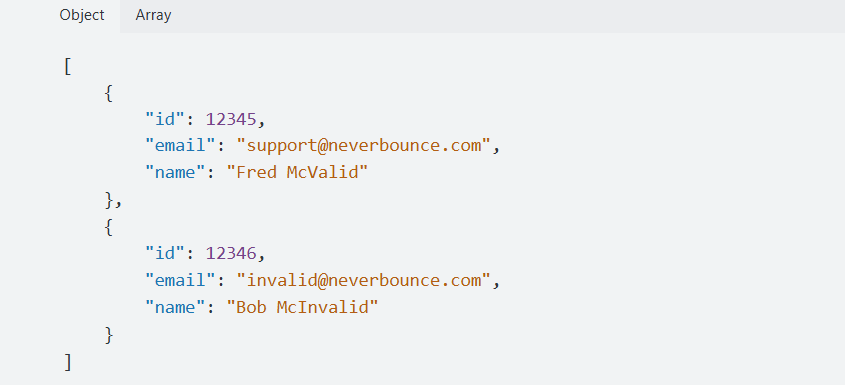
1. Create (POST /jobs/create): Submit an inventory as a distant CSV URL (HTTP, HTTPS, or FTP with non-obligatory Fundamental Auth) or as inline knowledge (array of arrays or array of objects). Most inline payload is 25 MB. Key parameters embody auto_parse, auto_start, run_sample (for a free bounce-rate evaluation earlier than consuming credit), and callback_url for webhook supply.
Supply: NeverBounce
2. Standing (GET /jobs/standing): Ballot for completion. The response contains job_status, percent_complete, and outcome counts: total_valid, total_invalid, total_catchall, total_disposable, total_unknown, and bounce_estimate.
3. Obtain (GET /jobs/obtain): Retrieve outcomes as a CSV with outcome codes appended because the final column.
4. Outcomes (GET /jobs/outcomes): Various endpoint returning structured JSON outcomes.
Supporting endpoints embody /jobs/parse (manually set off indexing) and /jobs/begin (manually set off verification after parsing).
What you’ll construct with this: a nightly pipeline that pulls new CRM contacts, submits them as a bulk job, polls for completion (or listens by way of callback), then routes legitimate contacts to your sequencing software and flags invalid data for cleanup.
NeverBounce API: Webhooks & Occasions
NeverBounce calls its webhook system Job Callbacks, launched in API v4.2. You configure callbacks per job at creation time by passing a callback_url parameter (a URL your server exposes to obtain POST requests). Customized HTTP headers might be equipped by way of callback_headers.
Callbacks arrive as POST requests with a JSON physique:
{“job_id”: 4920062, “occasion”: “job_run_finished”}
Supported occasions:
|
Occasion |
Set off |
|---|---|
|
job_parsing_started |
Indexing part begins |
|
job_parsing_finished |
Indexing full; job prepared to begin |
|
job_run_started |
Verification begins |
|
job_stats_updated |
Stats up to date throughout verification (fires often) |
|
job_run_finished |
Verification full; outcomes obtainable |
|
job_sample_started |
Free evaluation begins |
|
job_sample_finished |
Free evaluation full |
|
job_review_completed |
Job launched from handbook evaluation |
|
job_failed |
Job failed (verify failure_reason by way of /standing) |
|
job_deleted |
Job eliminated |
Two constraints price noting:
-
The documentation doesn’t describe a retry coverage or supply assure. In case your callback URL is unreachable when NeverBounce sends the occasion, the documentation doesn’t specify whether or not the supply is retried or dropped.
For workflows that depend upon assured occasion supply, you have to both a polling fallback (utilizing /jobs/standing) or your individual reliability layer on prime of the callback mechanism.
NeverBounce API: SDKs, Docs & Price Limits
SDKs & Libraries
NeverBounce publishes seven official API wrappers on GitHub below the NeverBounce group:
-
Node.js: NeverBounceApi-NodeJS, installable by way of npm set up neverbounce –save. The docs describe a rewritten TypeScript model (v5.0.0) requiring Node.js 18+, constructed with ES Modules and the Fetch API. Server-side use solely.
Seven languages covers most stacks for a single-purpose verification API. The Node.js SDK is the one one with detailed launch notes within the present documentation; upkeep standing for the remaining six is just not said. No third-party neighborhood libraries are listed.
The JavaScript Widget is a separate, browser-safe software for client-side type validation. It auto-detects kind=”e mail” enter fields, verifies addresses because the consumer sorts (600ms debounce), and blocks disposable and invalid submissions by default. Configuration choices embody blocking freemail addresses, role-based accounts, and throttled makes an attempt, plus customized settle for/reject standing codes and suggestions messaging.
Documentation & Developer Expertise
The developer documentation at builders.neverbounce.com is hosted on the ReadMe platform and arranged into three sections:
-
Guides: quickstart walkthroughs for API setup, single verification, listing verification, free evaluation, and the JavaScript Widget
-
Interactive API Reference: endpoint-level documentation with a “Strive It!” reside explorer per endpoint, supporting Shell, PHP, JavaScript, Python, and Go code examples
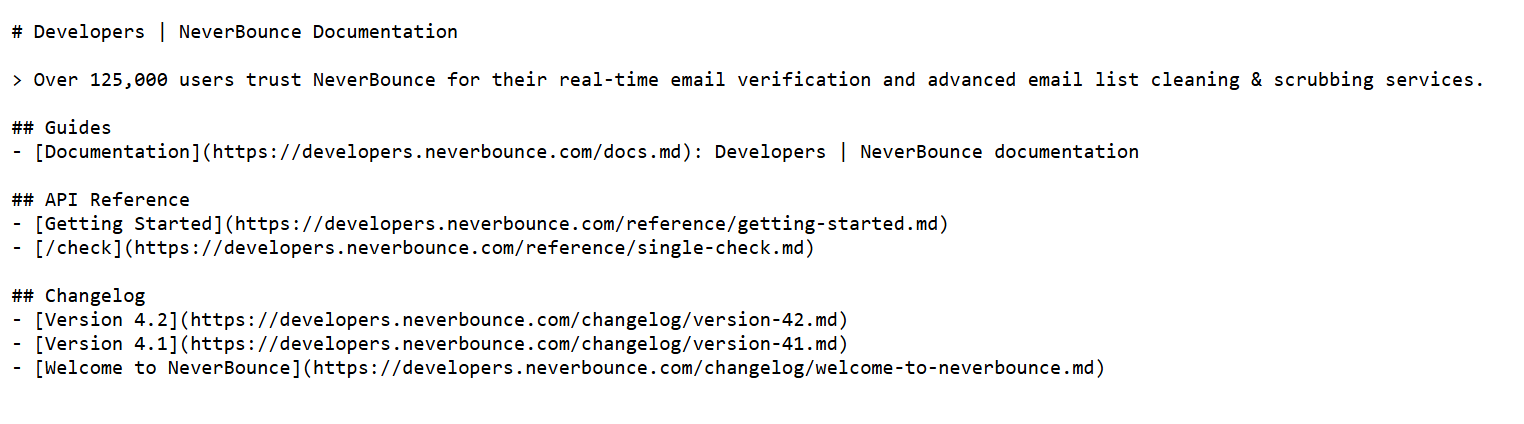
An OpenAPI/llms.txt index is obtainable, offering all pages in Markdown and endpoints in OpenAPI format. The docs embody sensible edge-case steerage (e.g., recommending a 10-second client-side timeout and treating timeouts as unknown).
Supply: NeverBounce
Developer assist is by way of e mail. No public developer Slack, neighborhood discussion board, or devoted assist channel exists. The changelog exhibits no latest updates to the v4.2 documentation, suggesting a steady however sometimes evolving API.
The documentation is ample for the API’s scope. The interactive reference is the quickest path to confirming request and response shapes, and the guides cowl frequent integration patterns clearly. What’s lacking: no Postman assortment, and the SDK documentation past Node.js is skinny.
Price Limits & Constraints
From the official Utilization Tips:
Bulk verification:
Single verification:
-
Should solely be used for real-time, user-triggered checks (type submissions, button clicks). Utilizing it to iterate via an inventory is prohibited and should lead to account lock and API entry suspension.
Cost-gated entry: Accounts with out a default cost methodology face fee limiting and restricted bulk API entry.
You’ll be able to request exceptions to the majority utilization limits by contacting NeverBounce straight.
The ten-concurrent-job restrict is the constraint most builders hit first. Should you run a number of bulk jobs in parallel (e.g., processing lists from completely different CRM segments directly), you have to to queue jobs in your facet. The 50-jobs-per-day restrict caps what number of distinct listing verification runs you possibly can set off in a 24-hour window.
NeverBounce API Pricing & Entry Prices
NeverBounce makes use of a credit-based mannequin: 1 credit score = 1 e mail verification. Credit are shared throughout dashboard and API utilization. There isn’t a separate API pricing tier; the API attracts from the identical credit score pool because the dashboard.
Pay-as-you-go
-
Shopping for in bigger batches prices much less (the docs be aware that buying 50,000 credit in a single batch versus ten batches of 5,000 saves roughly 37%)
Progress Plan ($49/month)
Enterprise (Customized Pricing)
What to Watch For
-
Each new account receives 10 free credit on registration, usable by way of the API. As soon as exhausted, accounts with a saved card are charged at customary charges. No ongoing free tier exists.
-
With auto-upgrade enabled on the Progress plan, exceeding the month-to-month credit score allotment triggers an computerized tier improve and an instantaneous cost.
For a developer constructing a pipeline that verifies 100,000 emails monthly, the efficient value on pay-as-you-go is roughly $400-500/month, relying on how credit are bought.
The place the NeverBounce API Falls Quick
These are scope selections and sensible constraints a developer ought to plan round.
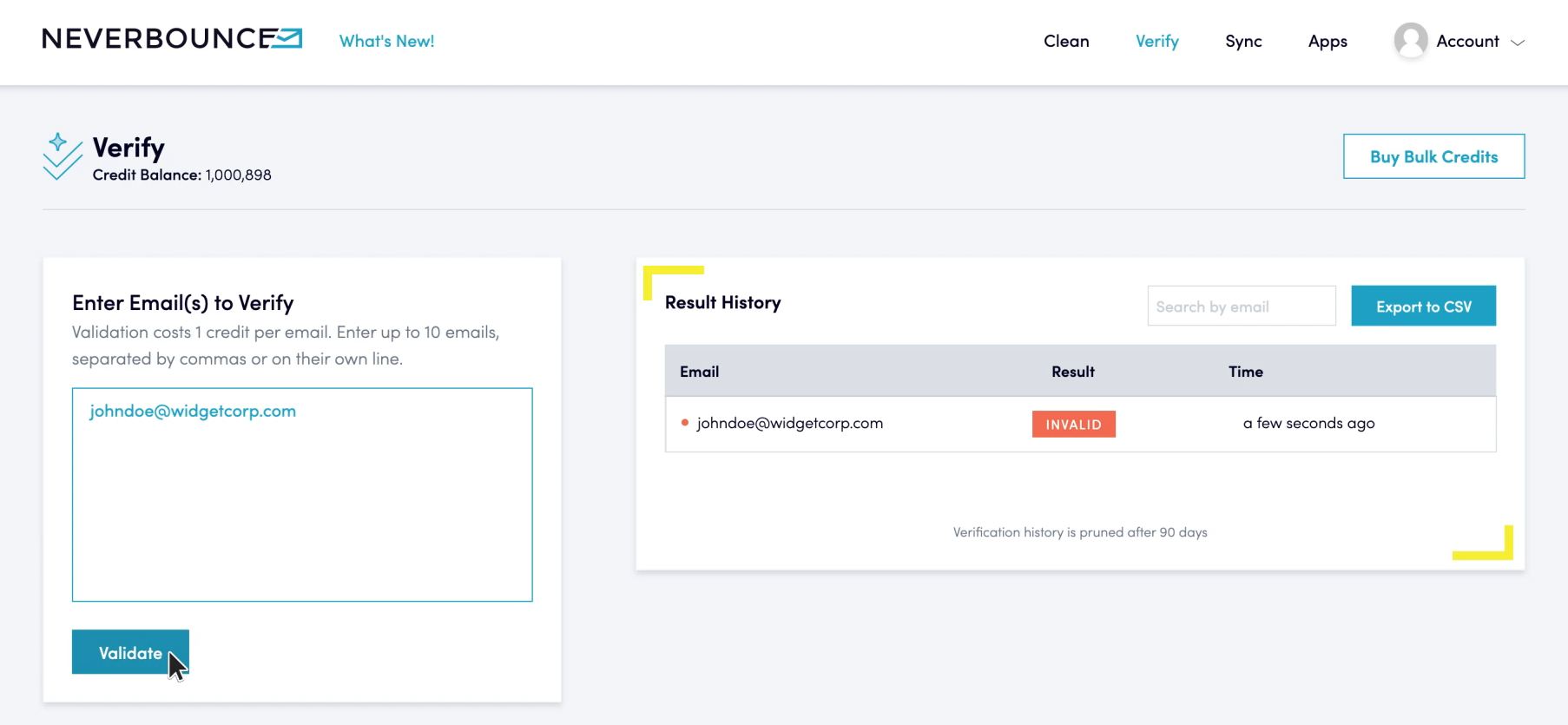
E mail verification is all the scope. The NeverBounce API verifies whether or not an e mail tackle is deliverable. It doesn’t return who owns that tackle, what firm they work for, their job title, their cellphone quantity, the corporate’s tech stack, or any shopping for intent indicators. In case your pipeline must reply “is that this e mail legitimate AND who is that this particular person,” the API covers half that query.
Supply: NeverBounce
Single-check can’t be used for batch processing. The Utilization Tips prohibit utilizing /single/verify to iterate via an inventory. Doing so might lead to account lock and API entry suspension. You could use the asynchronous Jobs API for any batch workflow, even if you happen to would favor the simplicity of sequential single-check calls.
Bulk job limits constrain throughput. Ten concurrent jobs and 50 job runs per day set onerous ceilings on parallel processing. A pipeline that verifies a number of listing segments directly (e.g., completely different CRM segments, completely different lead sources) will want its personal job queue.
No OAuth or scoped tokens. Authentication is a single API key handed as a parameter. No OAuth move, no scoped tokens, no documented key rotation mechanism. Groups that want granular entry management (e.g., completely different permissions for various providers) should create a number of Customized Integration Apps, every with its personal key.
Webhook supply is just not assured. Job Callbacks don’t doc retry habits or supply ensures. In case your callback endpoint is down when NeverBounce sends the occasion, the documentation doesn’t specify what occurs subsequent. Occasion-driven architectures will want a polling fallback.
Catch-all domains stay unresolvable. Domains configured to just accept all incoming mail return a catchall standing that can’t be resolved to legitimate or invalid. This can be a category-wide limitation (not particular to NeverBounce), but it surely means a significant share of B2B e mail addresses (notably at small companies, authorities, and academic organizations) will return an ambiguous outcome.
SDK upkeep is unclear. Seven official SDKs exist, however solely the Node.js SDK has detailed model documentation. The upkeep state of the PHP, Ruby, Python, Go, .NET, and Java wrappers is just not said within the official docs.
No B2B intelligence knowledge. NeverBounce tells you if an tackle bounces. It doesn’t let you know whether or not the particular person behind that tackle is a decision-maker, whether or not their firm is in-market, what know-how they use, or the place they sit within the org chart. In case your construct wants that layer, it wants a distinct API.
ZoomInfo API: The B2B Intelligence Layer NeverBounce Does Not Cowl
NeverBounce solutions one query: is that this e mail deliverable?
ZoomInfo’s API solutions the questions that come subsequent: who is that this particular person, what firm do they work for, what does that firm seem like, and are they researching options in your class?
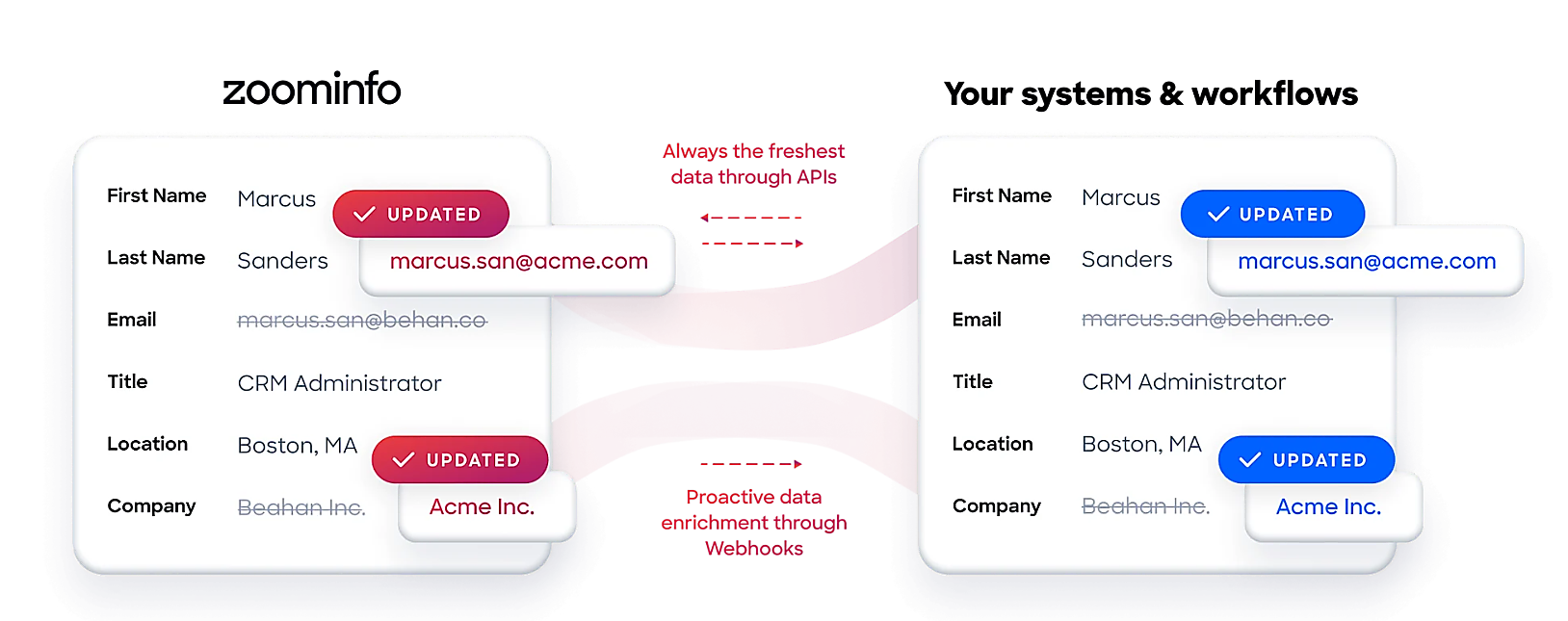
Supply: ZoomInfo
The 2 APIs function at completely different layers. NeverBounce validates addresses you have already got. ZoomInfo gives verified contact knowledge (together with 300M+ verified enterprise e mail addresses) alongside the intelligence you could act on these contacts: firm context, technographics, org charts, intent indicators, and AI-driven account analysis. Behind that intelligence is the GTM Context Graph, which processes 1.5B+ knowledge factors every day by combining ZoomInfo’s B2B knowledge along with your first-party knowledge.
What the API Covers: Search, Enrichment, and AI Intelligence
ZoomInfo’s Enterprise API is a REST suite served from https://api.zoominfo.com/gtm, organized into 4 teams documented within the interactive API reference:
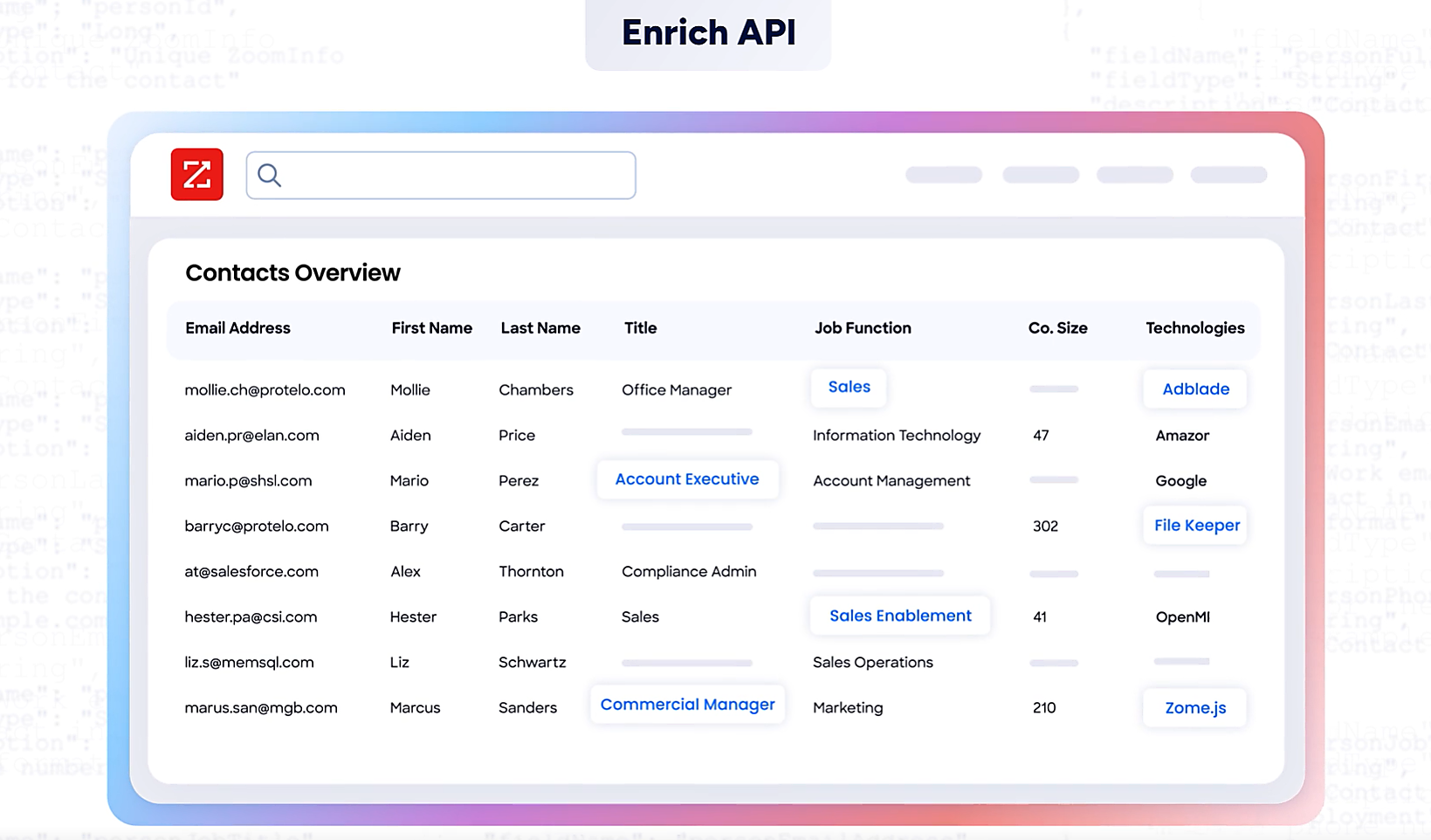
Knowledge API (Search and Enrich): The first group. Search endpoints cowl Contacts, Corporations, Intent, Information, and Scoops, returning matched data with out consuming credit. Enrich endpoints return full data: enterprise emails, direct dials, employment historical past, company hierarchy, org charts, technographics, and hashtag indicators, accepting as much as 25 data per name. The search-then-enrich sample means you filter freely, then pay just for the data you decide to. The underlying dataset spans 500M contacts, 100M corporations, 135M+ verified cellphone numbers, and 300M+ verified enterprise e mail addresses.
Supply: ZoomInfo
AI Intelligence API (GTM Workspace): A separate API group that exposes GTM Workspace AI options programmatically. Account Abstract returns structured account intelligence with a free-form Q&A endpoint. Discover Comparable Corporations performs lookalike growth from a seed account. Contact Suggestions returns AI-ranked buying-committee ideas by movement (prospecting, deal acceleration, renewals).
Advertising API: CRUD endpoints for viewers administration.
The pairing with a verification API is direct: a developer may use NeverBounce to confirm emails collected from varieties and third-party lists, then name ZoomInfo‘s Enrich endpoint to append firm knowledge, org charts, technographics, and intent indicators to these verified contacts, both via a downstream enrichment step or as a parallel pipeline.
Authentication, Price Limits & Credit
Authentication makes use of OAuth 2.0 with PKCE by way of Okta, issuing entry tokens with rotating refresh tokens. Three flows are supported: Authorization Code with PKCE (for internet purposes), Shopper Credentials (for server-to-server), and Refresh Token. Groups register purposes via the ZoomInfo Developer Portal, the place they generate credentials, outline scopes, and check endpoints.
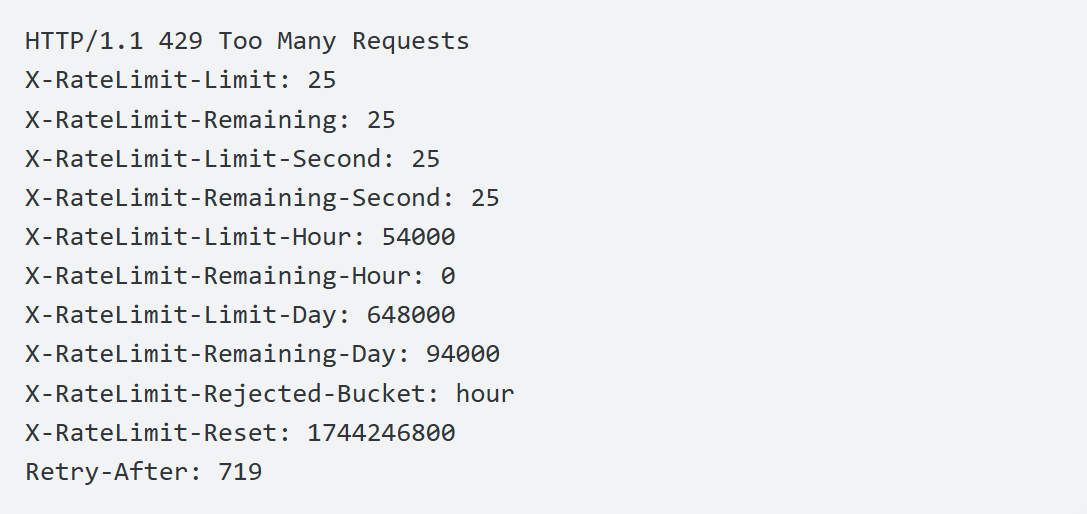
Price limits are printed by tier: Builder (5 req/sec), Commonplace (25 req/sec), and Scaling (35 req/sec), with per-hour and per-day sliding-window limits enforced concurrently. Each response contains quota headers with remaining capability, and 429 responses embody a Retry-After header with precise backoff timing. Credit comply with a rolling 12-month window: enriching a report for the primary time consumes one credit score; re-enriching the identical report throughout the 12 months is free.
Supply: ZoomInfo
Webhooks, MCP & Developer Expertise
Webhooks are obtainable by way of the Brokers API, tied to ZoomInfo’s Agent Groups system. Occasion sorts cowl bulk enrichment jobs finishing, data altering, credit score utilization crossing thresholds, and new GTM indicators (scoops, funding occasions, intent spikes) changing into obtainable, with retry habits and throttling configurable per occasion kind.
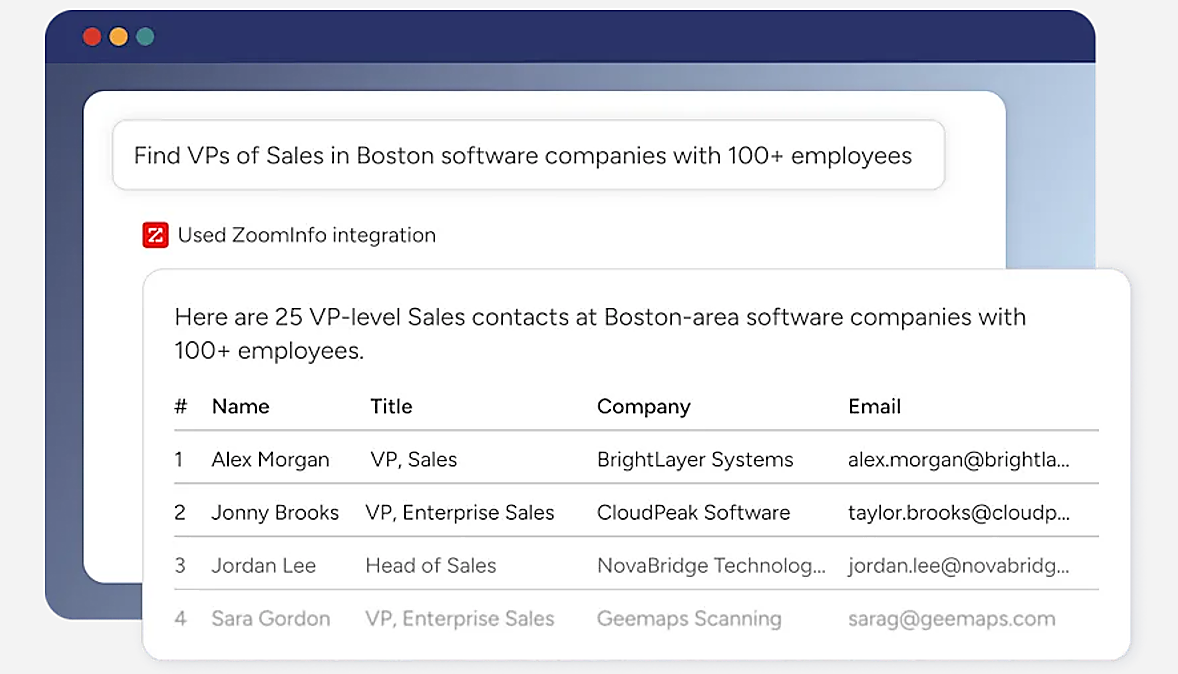
For builders constructing AI brokers, ZoomInfo’s MCP server at https://mcp.zoominfo.com/mcp exposes search, enrich, and account analysis as native instruments for MCP-compatible assistants, at present supporting Claude and ChatGPT. A developer constructing an AI agent may join the MCP server for contact and firm intelligence, then name NeverBounce for verification of addresses from exterior ZoomInfo’s database.
Supply: ZoomInfo
ZoomInfo doesn’t publish official SDKs, so that you combine over HTTP and personal the auth-and-retry layer. The interactive API reference helps reside testing, and a Docs MCP server lets AI growth instruments generate integration code towards the API spec. Documentation is at docs.zoominfo.com. ZoomInfo added API entry to all related plans in 2025 with consumption-based pricing.
BDO Canada reported an 87% discount in time spent on updates to inner knowledge dashboards utilizing the ZoomInfo API, with one analyst describing the mixing as plug-and-play throughout any course of. (ZoomInfo)
Last Verdict
NeverBounce’s API does e mail verification effectively. The REST API is straightforward, the authentication is easy (API key, no OAuth ceremony), the SDKs cowl seven languages, and credit-based pricing begins at below a penny per e mail. The JavaScript Widget offers non-backend groups a means so as to add type validation with out server-side code. For the job of checking whether or not an e mail tackle will bounce, the API is well-scoped.
Select the NeverBounce API if you could have e mail addresses from varieties, CRM imports, or third-party lists and must confirm their deliverability earlier than sending. The one-check endpoint handles point-of-entry validation, the Jobs API handles bulk lists, and the pricing is clear sufficient to mannequin prices earlier than you construct.
Select the ZoomInfo API when your pipeline wants greater than a sound/invalid reply: who owns that e mail, what firm they characterize, what know-how that firm runs, and whether or not the account is in-market. ZoomInfo’s search-then-enrich sample covers the B2B intelligence that NeverBounce was by no means designed to handle, and the AI Intelligence API provides account analysis and make contact with suggestions that no verification API gives. Collectively, the 2 APIs cowl each verification and intelligence. Begin with the ZoomInfo Enterprise API or discover the developer docs to see the endpoints straight.
A developer who solely must verify bounce danger and has no want for contact enrichment, firm intelligence, or intent knowledge ought to construct on NeverBounce’s API. It’s trustworthy about its scope, and that scope is strictly proper for the verification layer.
FAQ
Is the NeverBounce API free?
Not past an preliminary trial. Each new account receives 10 free credit on registration, usable by way of the API for each single and bulk verification. After these 10 credit are consumed, all verification requires bought credit at pay-as-you-go charges beginning at $0.008 per e mail ($8 per 1,000 credit). There isn’t a ongoing free tier. Accounts with out a saved cost methodology face fee limiting and restricted bulk API entry. Each listing add does embody a free immediate bounce evaluation earlier than any credit are consumed.
Does NeverBounce have a GraphQL API?
No. NeverBounce exposes a REST API that returns JSON. The present model is v4.2, served from api.neverbounce.com/v4.2/. There isn’t a GraphQL endpoint.
What’s the NeverBounce API fee restrict?
The documented limits apply to bulk verification: a most of 10 concurrent jobs, 50 job runs per day, and not more than 10 jobs per 100,000 objects per hour. The one-check endpoint doesn’t publish a requests-per-second restrict however is restricted to real-time, user-triggered use; sequential listing iteration is prohibited and should lead to account lock. You’ll be able to request exceptions to the majority limits by contacting NeverBounce straight.
Are there official NeverBounce SDKs?
Sure. NeverBounce publishes seven official API wrappers on GitHub: Node.js, PHP, Ruby, Python, Go, .NET, and Java. The Node.js SDK (v5.0.0) is probably the most lately documented, rewritten in TypeScript with ES Module assist and requiring Node.js 18+. A JavaScript Widget can be obtainable for client-side type validation with out exposing server-side credentials. All wrappers are hosted below the NeverBounce GitHub group.
Does the NeverBounce API assist webhooks?
Sure, via Job Callbacks launched in API v4.2. You configure callbacks per bulk job at creation time by passing a callback URL. NeverBounce sends POST requests for occasions together with job parsing, verification begin/end, stats updates, pattern evaluation, handbook evaluation completion, and job failure. Callbacks apply to bulk jobs solely; there isn’t a webhook for single-check verification occasions. Retry coverage and supply ensures will not be documented.
What does ZoomInfo’s API add to a NeverBounce construct?
ZoomInfo’s API provides the B2B intelligence layer that NeverBounce doesn’t cowl. NeverBounce verifies whether or not an e mail tackle is deliverable; ZoomInfo gives the identification and firm intelligence behind these addresses. A developer can use ZoomInfo’s search endpoints to seek out contacts matching an ICP, enrich them with direct dials, enterprise emails, org charts, technographics, and intent indicators, then use NeverBounce to confirm emails collected from different sources exterior ZoomInfo’s database. The 2 APIs use completely different authentication fashions (API key vs. OAuth 2.0) and completely different pricing buildings (per-credit vs. annual bulk credit), so plan the mixing layer accordingly. ZoomInfo’s MCP server extends the identical knowledge to AI-agent workflows, including a programmatic intelligence layer {that a} verification API doesn’t supply.
Associated breakdowns that can assist you select:

