

The query behind any demo automation API just isn’t whether or not the platform has one, however whether or not it exposes sufficient to construct on.
Consensus ranks #1 in demo automation on G2, Capterra, and Gartner. It serves 15 of the high 30 software program corporations with interactive video demos, product excursions, and its Demolytics engagement analytics engine. The platform exposes an Open API for {custom} integrations, three webhook occasion sorts for demo lifecycle automation, and an MCP server for AI-agent entry.
However main the demo automation class and providing a deep API are various things.
Consensus’s API covers the demo automation area: DemoBoard administration, demo library operations, lead seize knowledge, and Demolytics engagement analytics. In case your integration must push demo viewer indicators right into a CRM, set off workflows when a prospect watches or shares a demo, or join AI brokers to the demo library by way of MCP, the API handles it. Its scope stops on the platform boundary: no contact enrichment, no firm intelligence, no intent indicators, no org charts, and no B2B knowledge past what demo interactions generate.
That is the place ZoomInfo enters. A B2B intelligence platform constructed on 500M contacts and 100M corporations, ZoomInfo’s REST API suite covers search, enrichment, AI intelligence, and viewers administration, with OAuth 2.0 authentication and an MCP server for AI-agent workflows. The 2 APIs serve totally different layers of the identical pipeline: Consensus tells you which of them prospects have interaction with demos, and ZoomInfo tells you who these prospects are and whether or not their corporations are value pursuing.
This evaluate covers the Consensus API in technical depth first (authentication, endpoints, webhooks, documentation, and entry prices), then critiques ZoomInfo’s API because the intelligence layer that picks up the place demo engagement knowledge stops.
Consensus API at a Look
|
Attribute |
Element |
|---|---|
|
API sort |
REST over HTTP, JSON responses (based mostly on documented integration patterns; not explicitly labeled in Consensus’s public docs) |
|
Authentication |
Account-level API key/secret pair; OAuth 2.0 with PKCE for the MCP server |
|
Base URL |
Not publicly documented; interactive explorer at app.goconsensus.com/api-documentation/ (login required) |
|
Fee limits |
Not publicly documented |
|
Pricing / entry |
Enterprise plan solely; custom-quoted pricing |
|
SDKs |
None |
|
Webhooks |
Sure, 3 occasion sorts: demo_watched, new_lead, demo_utm |
|
MCP server |
mcp.goconsensus.com/mcp; helps Claude Desktop, ChatGPT, Microsoft Copilot Studio |
|
Documentation |
Interactive API explorer (login required); public information base covers integration setup however not endpoint references |
Consensus API: What Works Nicely & What to Plan Round
|
What works effectively |
What to plan round |
|---|---|
|
Interactive API explorer with dwell request testing contained in the platform |
Explorer and endpoint reference require a paid Enterprise account to entry |
|
MCP server gives AI-agent entry to demos and DemoBoards by way of OAuth 2.0 with PKCE |
API entry is gated to the Enterprise plan; no self-serve developer tier |
|
Webhooks cowl the three core demo lifecycle occasions a pipeline wants |
Solely 3 webhook occasion sorts; no retry coverage, payload signing, or supply ensures documented |
|
A number of API keys doable by way of separate Customized Integration Apps |
Account-level auth solely: no user-level tokens, no OAuth for third-party multi-tenant apps |
|
Zapier integration extends automation to 500+ apps with out direct API code |
No official SDKs in any language; all {custom} integrations are uncooked HTTP |
|
Webhook payloads out there in each JSON and XML |
Fee limits, quotas, and throughput constraints usually are not printed |
Consensus API: Authentication & Getting Began
API entry requires an energetic Consensus account on the Enterprise plan. There isn’t any developer tier, no public developer portal, and no self-serve key provisioning without cost or lower-tier customers.
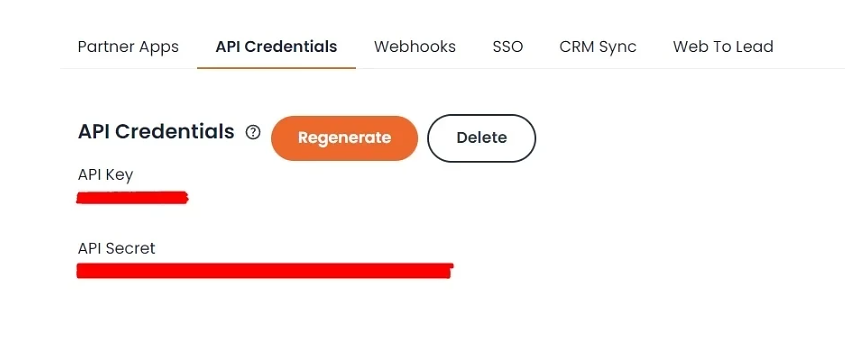
As soon as on Enterprise, you generate API credentials below Integrations > API Credentials. The credentials are an account-level key/secret pair that authenticates the complete account, not particular person customers. This simplifies setup however limits entry management: you can not scope a key to read-only entry or limit it to a single integration with out creating separate accounts.
Supply: Consensus
Consensus warns that regenerating API credentials breaks any present integration utilizing the outdated pair. There isn’t any rotation mechanism past full regeneration, so plan key administration accordingly.
The interactive API explorer at app.goconsensus.com/api-documentation/ requires each API credentials and consumer credentials. You choose a name, present parameters, and examine the response, however the explorer just isn’t accessible with out a paid account.
Two extra authentication paths exist for particular surfaces:
-
OAuth 2.0 for native integrations: Some platform integrations use OAuth 2.0 slightly than the important thing/secret pair. The Gong integration, for instance, connects by way of OAuth requesting api:integration-settings:write and api:digital-interactions:write scopes.
-
OAuth 2.0 with PKCE for the MCP server: The Consensus AI Join MCP server at mcp.goconsensus.com/mcp makes use of OAuth 2.0 with PKCE (RFC 6749 compliant, with Useful resource Indicators per RFC 8707). The MCP server runs stateless with no knowledge caching and enforces present Consensus RBAC permissions on the token stage. Setup documentation covers Claude Desktop, ChatGPT (Enterprise/Enterprise/Edu, requires Developer Mode beta), and Microsoft Copilot Studio.
The MCP path issues for builders constructing AI-agent workflows: it gives an OAuth-secured channel to Consensus demo knowledge with out requiring the REST API key/secret pair.
Consensus API: Core Endpoints & Capabilities
Consensus doesn’t publicly checklist its API endpoints exterior the authenticated explorer. The general public information base describes what the API allows however doesn’t checklist endpoint paths, request schemas, or response codecs. What follows is drawn from integration documentation, webhook specs, and the MCP instrument floor.
DemoBoards
DemoBoards are the core shareable demo object in Consensus: branded touchdown pages that maintain customized demo experiences for particular prospects or accounts.
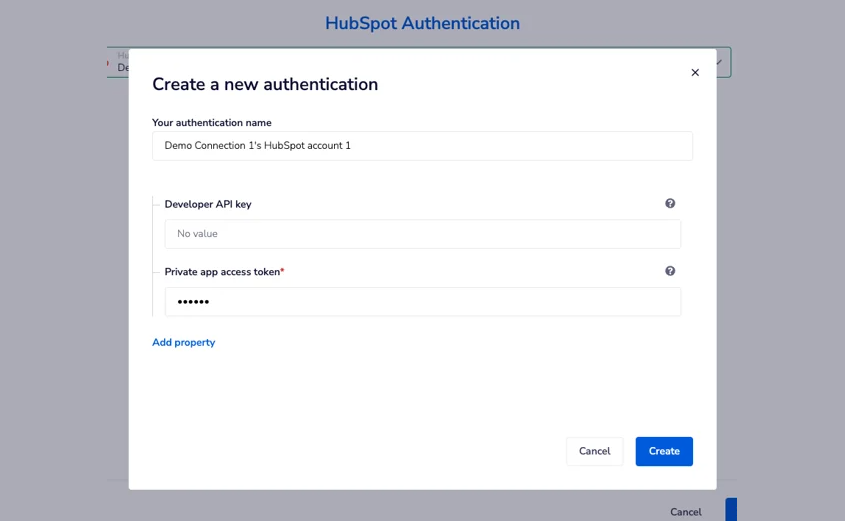
The API helps creating and updating DemoBoards programmatically, confirmed by two impartial integration surfaces: the HubSpot Knowledge Sync integration references creating DemoBoards tied to HubSpot offers, and the MCP server exposes DemoBoard creation and replace as native instruments for AI assistants.
Supply: Consensus
The Marketo integration goes additional, together with a workflow for sending demos from Marketo by way of the API. This confirms the API helps triggering demo sends programmatically.
What you’d construct with this: a CRM workflow that creates and sends a customized DemoBoard to a prospect when a deal reaches a particular stage, with out a rep touching the Consensus dashboard.
Demos & Demo Library
The demo library is the content material layer beneath DemoBoards. The MCP server exposes a search_demos instrument for locating demos by standards, and the Zapier integration surfaces demo metadata together with UUID, title, and viewer engagement knowledge (watch length, characteristic scores, UTM parameters).
Combining search with metadata retrieval, you may construct an integration that selects the fitting demo based mostly on prospect attributes, then packages it right into a DemoBoard for supply.
Leads & Contacts
Lead knowledge enters the API primarily by way of the new_lead webhook (coated within the Webhooks part under). When a viewer submits the lead seize type inside a public demo, the webhook payload consists of full contact fields (e-mail, first identify, final identify, group, title, nation, state, cellphone), characteristic choice rankings (essential, considerably necessary, not necessary), UTM parameters, and a session object.
The Zapier integration additionally exposes the New Lead set off with the identical knowledge schema, together with DemoBoard creator information, recipient information, characteristic rankings, and heatmap URLs.
Demolytics (Analytics & Engagement)
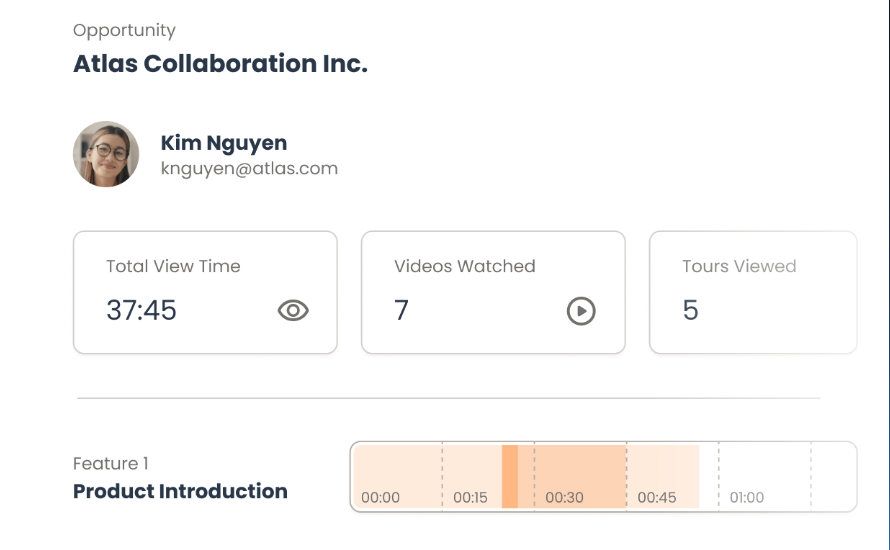
Demolytics knowledge flows out of Consensus by way of native CRM integrations and webhooks. Engagement indicators embody view length, heatmap URLs, particular person characteristic scores per viewer, stakeholder discovery knowledge (who forwarded to whom), and the engagement rating.
Supply: Consensus
This knowledge passes into linked techniques by way of native integrations (Salesforce, HubSpot, Marketo, Salesloft, Outreach, Gong, Pardot, Eloqua) or by way of the API.
Demolytics knowledge is exportable as CSV and filterable by group, consumer, demo, and timeframe.
What you’d construct with this: a layer that pulls Demolytics engagement indicators into a knowledge warehouse, correlating demo viewer habits with CRM deal phases to measure which demo content material patterns predict closed-won outcomes.
Consensus API: Webhooks & Occasions
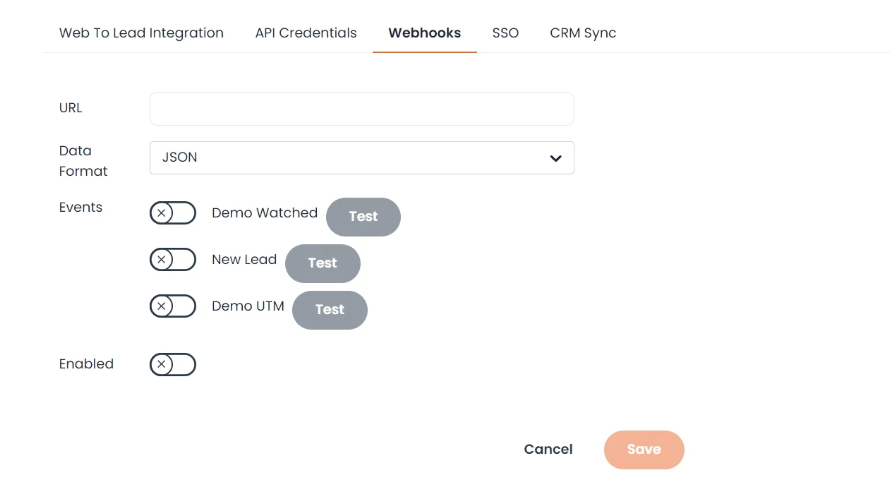
Consensus provides three webhook occasion sorts, configured contained in the platform below Integrations > Webhooks > Add Webhook.
Supply: Consensus
demo_watched
Fires when a recipient watches a DemoBoard despatched to them, or when an invited contact views a forwarded demo. The payload consists of:
-
Recipient information (e-mail, identify, title, group)
This occasion captures the core engagement sign: somebody seen the demo. As a result of it additionally fires on forwarded views, it tracks stakeholder enlargement past the unique recipient.
new_lead
Fires when a viewer submits the lead seize type inside a public demo. The payload consists of:
-
Full lead contact fields (e-mail, first identify, final identify, group, title, nation, state, cellphone)
That is the richer occasion: it carries each contact id and the customer’s acknowledged characteristic priorities, making it helpful for lead routing and qualification workflows.
demo_utm
Fires on each demo view no matter whether or not the viewer is a identified recipient. Returns solely the demo UUID and UTM parameters. Consensus’s personal documentation notes this webhook just isn’t really helpful until UTM monitoring is all the time used for attribution, because it triggers on all views indiscriminately.
Supply and Configuration
You configure webhook locations as a URL endpoint and select whether or not the payload arrives as JSON or XML. All payloads arrive by way of HTTP POST. The identical three occasion sorts can be found as triggers within the Zapier integration.
Three issues to plan round:
-
Three occasions solely: There are not any webhook occasions for DemoBoard creation, demo library modifications, account-level exercise, or Demolytics milestone triggers (comparable to a brand new stakeholder being found). In case your workflow must react to one thing apart from “somebody watched” or “somebody stuffed out a type,” you will want to ballot or use the Zapier integration as a proxy.
Consensus API: SDKs, Docs, Fee Limits & Pricing
SDKs & Libraries
Consensus doesn’t publish official SDKs in any language. The information base and integration documentation reference no shopper libraries, code samples, or packages on npm, PyPI, or some other registry. Builders constructing {custom} integrations work instantly towards the REST API utilizing HTTP requests with the important thing/secret credentials.
The closest alternate options to an SDK:
Documentation & Developer Expertise
The first developer useful resource is the interactive API documentation explorer contained in the Consensus utility. Builders choose an API name, enter credentials, and ship a dwell request to see the response. It really works as a built-in Swagger equal, however requires a paid Enterprise account to entry.
The general public-facing information base covers integration setup, webhook configuration, and the best way to find API credentials. It doesn’t embody endpoint references, request/response schemas, or code samples. Particularly, there’s:
A developer evaluating the API can’t examine endpoints, evaluate response schemas, or check calls with out first buying an Enterprise subscription and producing credentials. For a platform serving 15 of the high 30 software program corporations, the documentation is opaque in comparison with class norms.
Developer help routes by way of the Consensus Buyer Success group and the help portal. There isn’t any public developer discussion board, group Slack, or developer-specific help channel.
Fee Limits & Constraints
Consensus doesn’t publish price limits, request quotas, or throughput constraints in any public documentation. The information base makes no reference to per-minute or per-day limits, burst caps, or plan-tiered rate-limiting.
This can be a actual hole for anybody sizing an integration. With out printed price limits, you can not decide upfront whether or not your request quantity will work throughout the platform’s constraints, and you can not construct backoff logic towards documented thresholds. Verify operational constraints instantly with Consensus earlier than committing to a manufacturing integration.
Pricing & Entry Prices
API entry is an Enterprise plan characteristic on the Consensus pricing web page. It doesn’t seem on the Starter ($600/month) or Professional ($1,250/month) tiers. Enterprise pricing is quote-based.
No per-call, per-credit, or consumption-based API pricing is documented. The minimal path to API entry is a negotiated Enterprise contract, and the price just isn’t printed.
For a developer doing early-stage analysis, the gated pricing creates friction: you can not decide API value, check endpoints, or evaluate documentation with out first participating the Consensus gross sales course of.
The place the Consensus API Falls Quick
These are the sensible limits a developer ought to plan round when constructing on this API. A number of are scope choices that mirror what Consensus is (a demo automation platform) and what it was not designed to be.
The endpoint floor just isn’t publicly documented. You can not evaluate out there endpoints, request schemas, or response codecs with out a paid Enterprise account. For a developer evaluating whether or not to construct on this API, the dearth of public documentation means the analysis itself requires buying a subscription. Most API-first platforms publish their reference docs publicly because of this.
Enterprise gate on API entry. API entry requires Consensus’s highest tier, with custom-quoted pricing. There isn’t any self-serve developer plan, no API sandbox, and no free trial that features API entry.
The Starter ($600/month) and Professional ($1,250/month) plans don’t embody it. For groups that want a light-weight integration alongside a non-Enterprise Consensus subscription, the one programmatic paths are the Zapier integration and the MCP server (each of which nonetheless require Enterprise entry for API credentials).
No printed price limits. With out documented throughput constraints, you can not measurement your integration upfront. Whether or not your pipeline hits a ceiling at 100 requests per minute or 10,000, you’ll not know till you check towards a manufacturing account or ask Consensus instantly.
No official SDKs. Each {custom} integration is uncooked HTTP. For a easy webhook receiver, that’s high quality. For a manufacturing system managing DemoBoard creation, demo choice, and analytics ingestion, you construct and keep the shopper library your self.
Three webhook occasions and no supply ensures. The webhook floor covers watching and lead seize, however there are not any occasions for DemoBoard creation, stakeholder discovery milestones, demo library modifications, or analytics thresholds. Retry coverage and payload signing are undocumented.
Account-level authentication solely. The important thing/secret pair authenticates the complete account, not particular person customers or integrations. There isn’t any scoped-access mannequin, no token rotation, and no OAuth stream for third-party multi-tenant purposes. Groups with strict credential administration insurance policies will discover this limiting. The MCP server’s OAuth 2.0 with PKCE is the exception, but it surely applies solely to AI-agent entry, not common API consumption.
No B2B knowledge past demo engagement. Consensus’s API surfaces demo engagement knowledge: who watched, what they rated, how lengthy they seen. It doesn’t inform you who these individuals are past what they entered in a lead type. There isn’t any contact enrichment, no firm context or technographic knowledge, no intent indicators, and no org chart knowledge behind the engagement indicators. In case your pipeline must act on each “this particular person watched the demo” and “this particular person’s firm has 500 staff, makes use of Salesforce, and is actively researching your class,” you want a second API for the information layer.
ZoomInfo API: The B2B Intelligence Layer Past Demo Analytics
Supply: ZoomInfo
Consensus’s API tells you {that a} prospect watched a demo, which options they rated as necessary, and who else of their group obtained the hyperlink. ZoomInfo’s API tells you who that prospect is, what firm they work for, what expertise stack that firm runs, whether or not the account is actively researching your class, and the place the prospect sits within the org chart.
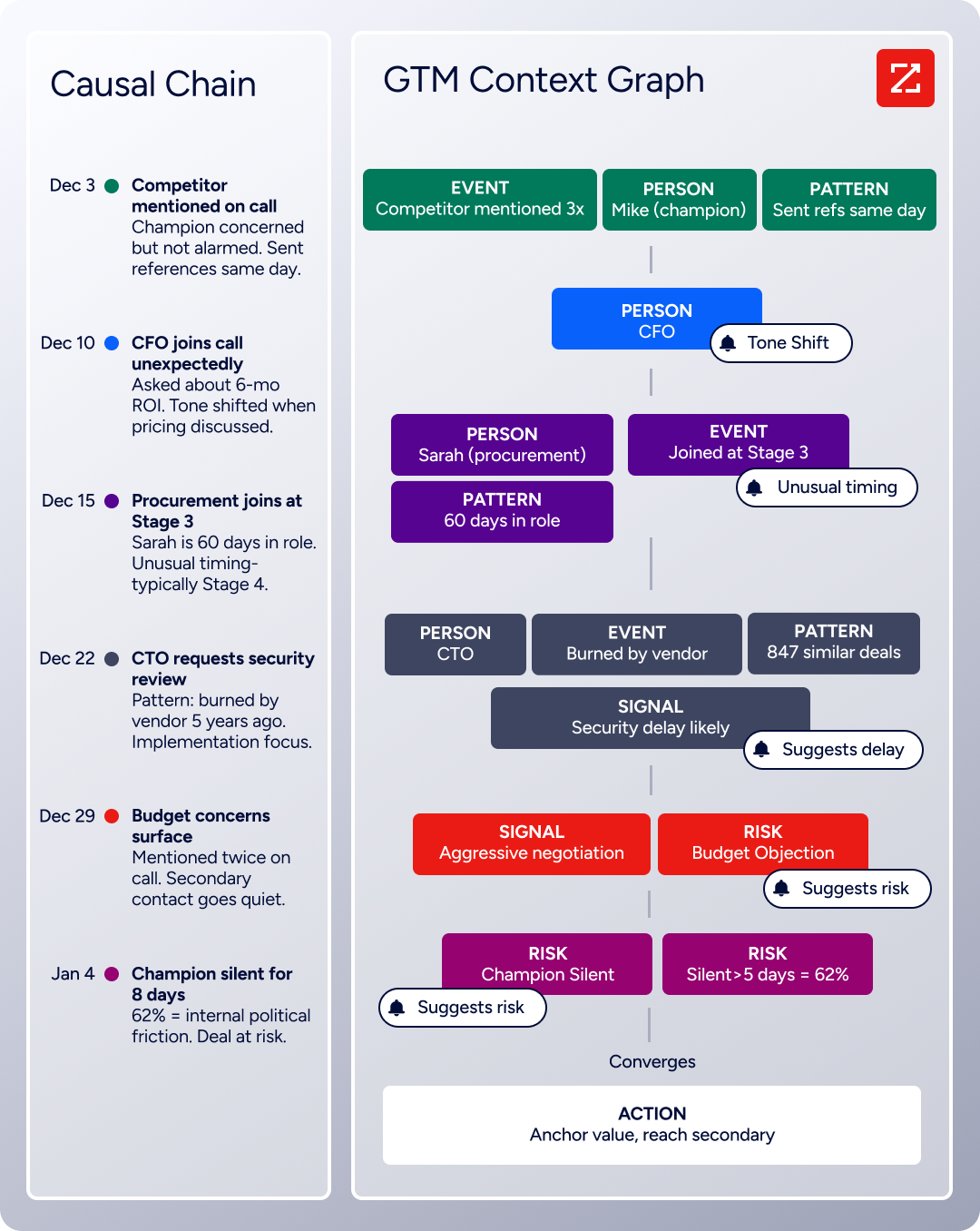
The 2 APIs function at totally different layers of a GTM pipeline. ZoomInfo’s GTM Context Graph (a knowledge layer that processes 1.5B+ knowledge factors every day by combining ZoomInfo’s B2B knowledge along with your first-party indicators) bridges the hole between “this particular person engaged with a demo” and “this particular person is a VP of Engineering at a 2,000-person firm that simply raised Sequence C and is evaluating your competitor.”
Supply: ZoomInfo
What the API Covers
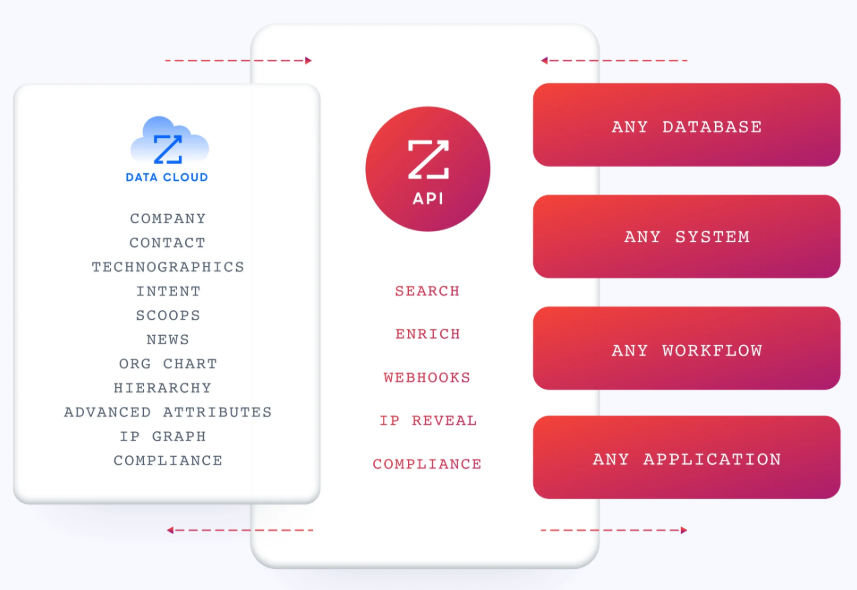
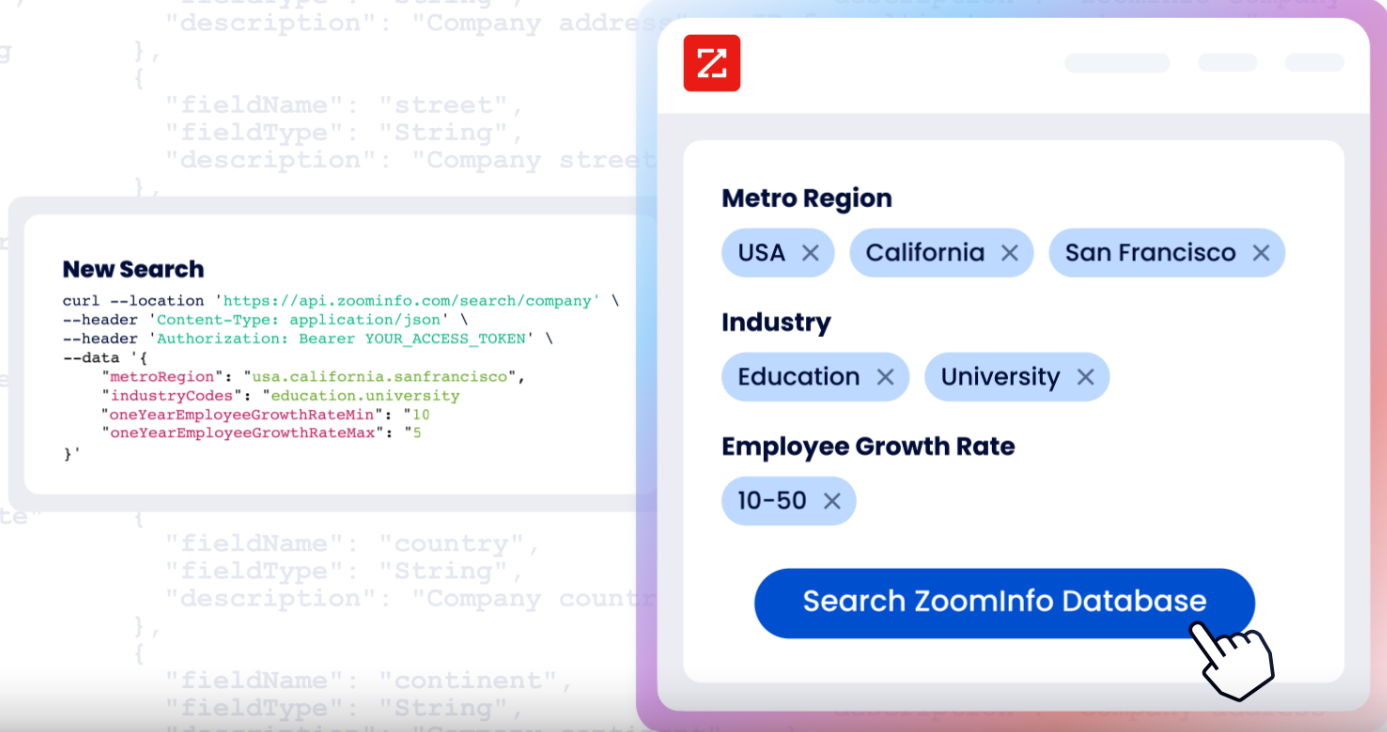
ZoomInfo’s Enterprise API is a REST suite served from https://api.zoominfo.com/gtm, organized into 4 classes documented within the interactive API reference:
Supply: ZoomInfo
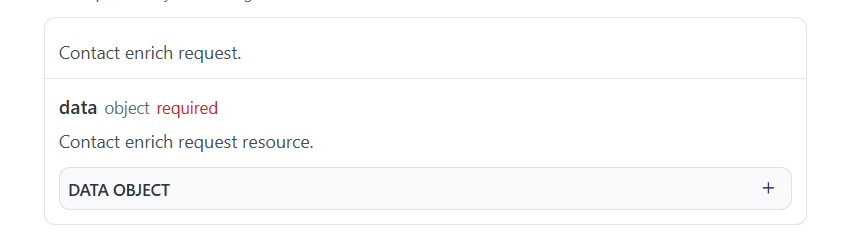
Knowledge API (Search & Enrich): Search endpoints cowl Contacts, Corporations, Intent, Information, and Scoops, returning matched information with out consuming credit. Enrich endpoints return the complete payload: enterprise emails, direct dials, employment historical past, company hierarchy, org charts, technographics, and hashtag indicators, as much as 25 information per name.
Supply: ZoomInfo
The underlying dataset spans 500M contacts and 100M corporations, 135M+ verified cellphone numbers, and 200M+ verified enterprise e-mail addresses. The search-then-enrich sample means you filter freely, then pay just for the information you decide to.

Supply: ZoomInfo
Copilot API (AI Intelligence): Account Abstract returns structured account intelligence with a free-form Q&A endpoint. Discover Related Corporations performs lookalike enlargement. Contact Suggestions returns AI-ranked buying-committee recommendations by movement (prospecting, deal acceleration, renewals).
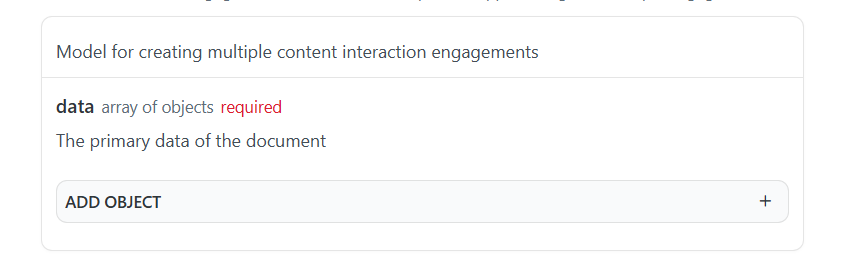
Advertising and marketing and Platform APIs full the suite with viewers administration (CRUD for promoting audiences) and bidirectional engagement knowledge by way of the Engagements API, at present in Beta.
Supply: ZoomInfo
The pairing with a demo automation API is direct: when Consensus surfaces a brand new stakeholder by way of Demolytics, ZoomInfo enriches that contact with verified e-mail, direct dial, title, firm context, and intent indicators, turning an nameless demo viewer into a certified lead with full context.
Authentication, Fee Limits & Credit
Authentication makes use of OAuth 2.0 with PKCE by way of Okta, issuing 24-hour entry tokens with rotating refresh tokens.
Supply: ZoomInfo
Three flows are supported: Authorization Code with PKCE (for internet purposes), Consumer Credentials (for server-to-server), and Refresh Token. You register purposes by way of the ZoomInfo Developer Portal, the place you generate credentials, outline scopes, and check endpoints.
Fee limits are printed by tier: Builder (5 req/sec), Normal (25 req/sec), and Scaling (35 req/sec), with per-hour and per-day sliding-window limits enforced concurrently. Each response consists of quota headers with remaining capability, and 429 responses embody a Retry-After header with precise backoff timing. Credit comply with a rolling 12-month window: enriching a document for the primary time consumes one credit score; re-enriching the identical document throughout the yr is free.
MCP, Webhooks & Developer Expertise
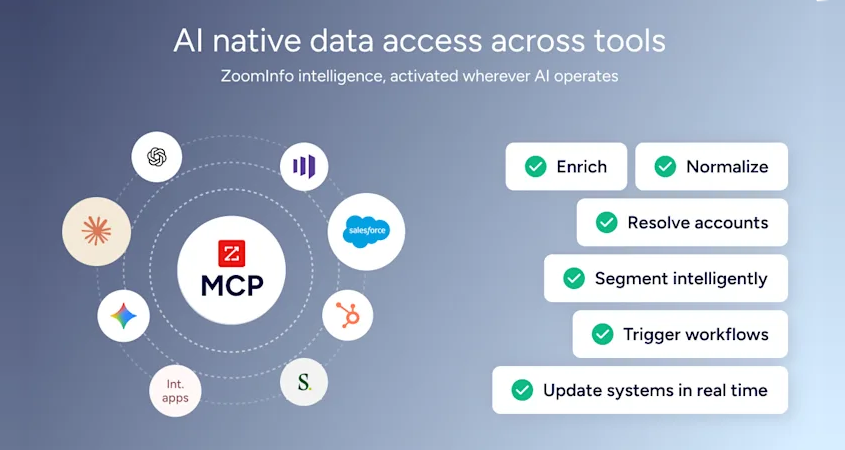
For builders constructing AI brokers, ZoomInfo’s MCP server at https://mcp.zoominfo.com/mcp exposes search, enrich, and account analysis as native instruments for MCP-compatible assistants, at present supporting Claude and ChatGPT. The credit score mannequin carries over from the REST API.
Supply: ZoomInfo
Webhooks can be found by way of the Brokers API, tied to ZoomInfo’s Agent Groups system: occasion sorts cowl bulk enrichment jobs finishing, information altering, credit score utilization crossing thresholds, and new GTM indicators (scoops, funding occasions, intent spikes) turning into out there. Retry habits and throttling are configurable per occasion sort.
Documentation lives at docs.zoominfo.com with an interactive API reference, OAuth recipes in 5 languages, and an llms.txt index for AI growth instruments. ZoomInfo doesn’t publish official SDKs, so that you combine over HTTP and handle the auth-and-retry layer your self. ZoomInfo added API entry to all related plans in 2025; API utilization follows consumption-based pricing.
BDO Canada reported an 87% discount in time spent on updates to inner knowledge dashboards utilizing the ZoomInfo API, with one analyst describing the combination as plug-and-play throughout any course of. (ZoomInfo)
Closing Verdict
Consensus’s API delivers programmatic demo automation for groups on the Enterprise plan: DemoBoard administration, demo library search, Demolytics analytics, three webhook occasions, and an OAuth-secured MCP server for AI brokers. The MCP path is a helpful entry level for agent-based workflows, and the webhook payloads carry engagement knowledge that the majority demo platforms solely floor in a dashboard.
The place the API falls brief is on the developer analysis layer. Unpublished endpoint documentation, no public price limits, Enterprise-only entry, and no official SDKs imply a developer can’t examine, measurement, or prototype towards the API with out first committing to a subscription. The API itself could also be succesful. The problem is figuring out what it might do earlier than you pay.
Select the Consensus API if your construct facilities on demo automation: embedding DemoBoard workflows into your CRM, automating demo supply based mostly on deal stage, feeding Demolytics engagement indicators right into a pipeline system, or connecting AI brokers to your demo library by way of MCP. For groups already on Consensus Enterprise, the API turns dashboard work into automated work.
Select the ZoomInfo API if your pipeline wants the intelligence layer upstream of demo engagement: figuring out who demo viewers are, what their corporations appear like, whether or not these accounts are in-market, and which stakeholders to succeed in earlier than the following dwell demo.
The search-then-enrich sample (search is free, enrich consumes credit) and the Copilot API’s AI endpoints cowl the information and reasoning that demo analytics alone can’t present. Begin with the ZoomInfo Enterprise API or discover the developer docs to see the endpoint floor instantly.
A developer whose construct wants neither demo automation nor B2B intelligence ought to look elsewhere. However a developer whose pipeline operates at each layers will discover that combining Consensus’s engagement indicators with ZoomInfo’s enrichment knowledge creates a workflow stronger than both API alone: confirm the curiosity by way of demo engagement, then make investments enrichment credit solely on the contacts who’ve already proven shopping for intent.
FAQ
Is the Consensus API free?
No. API entry is an Enterprise plan characteristic and doesn’t seem on the Starter ($600/month) or Professional ($1,250/month) tiers. Enterprise pricing is custom-quoted. There isn’t any free trial that features API entry, no self-serve developer tier, and no printed per-call pricing. The MCP server and Zapier integration use the identical API credentials and require Enterprise-level entry.
Does Consensus have a REST API?
Consensus describes its programmable floor as an “Open API” for {custom} integrations. The underlying sort just isn’t explicitly labeled within the public documentation, however all documented integration patterns (webhook payloads, Zapier triggers, MCP operations) use JSON over HTTP, per REST. No GraphQL, SOAP, or gRPC endpoint is documented. ZoomInfo’s API, by comparability, is explicitly documented as REST with JSON:API format responses and a versioned endpoint construction.
What occasions do Consensus webhooks help?
Three occasion sorts: demo_watched (fires when a DemoBoard is seen, together with forwarded shares), new_lead (fires when a viewer submits a lead seize type inside a public demo, together with characteristic choice rankings), and demo_utm (fires on each demo view, returning solely UTM parameters). Webhooks are configured per URL endpoint and ship payloads by way of HTTP POST in JSON or XML. There are not any webhook occasions for DemoBoard creation, demo library modifications, or Demolytics milestone triggers.
Are there official Consensus SDKs?
No. Consensus doesn’t publish official SDKs in any language. The information base and integration documentation reference no shopper libraries, code samples, or packages on any registry. Builders construct integrations instantly over HTTP. The MCP server at mcp.goconsensus.com/mcp gives entry for AI brokers, and the Zapier integration (in beta) provides a no-code path to automation, however neither replaces a developer SDK.
Does Consensus publish API price limits?
No. Consensus doesn’t doc price limits, request quotas, or throughput constraints in any public supply. Builders ought to affirm operational constraints instantly with Consensus earlier than committing to a manufacturing integration. ZoomInfo publishes price limits by tier (5 to 35 requests per second, with per-hour and per-day sliding home windows), consists of quota headers in each API response, and gives precise backoff timing in 429 responses.
Can I take advantage of the Consensus and ZoomInfo APIs collectively?
Sure, and there’s a sensible cause to. Consensus’s API and webhooks floor demo engagement indicators: who watched, what they rated, how lengthy they seen, and which stakeholders emerged by way of forwarding.
ZoomInfo’s API enriches these indicators with verified B2B knowledge: enterprise e-mail, direct dial, job title, firm attributes, technographics, org chart place, and purchaser intent. The pipeline sample is easy: Consensus’s demo_watched or new_lead webhook fires, your middleware captures the viewer’s e-mail or firm identify, and a ZoomInfo Enrich name returns the complete contact and account profile.
The result’s a demo engagement occasion paired with the information wanted to determine what to do about it. Each platforms additionally provide MCP servers, so AI brokers can entry demo knowledge and B2B intelligence as native instruments in a single workflow. ZoomInfo Agent Groups can carry that additional, working the complete play from the demo sign by way of enrichment and outreach, with specialist brokers sharing account context and appearing throughout the approvals you set.

