Key Takeaways
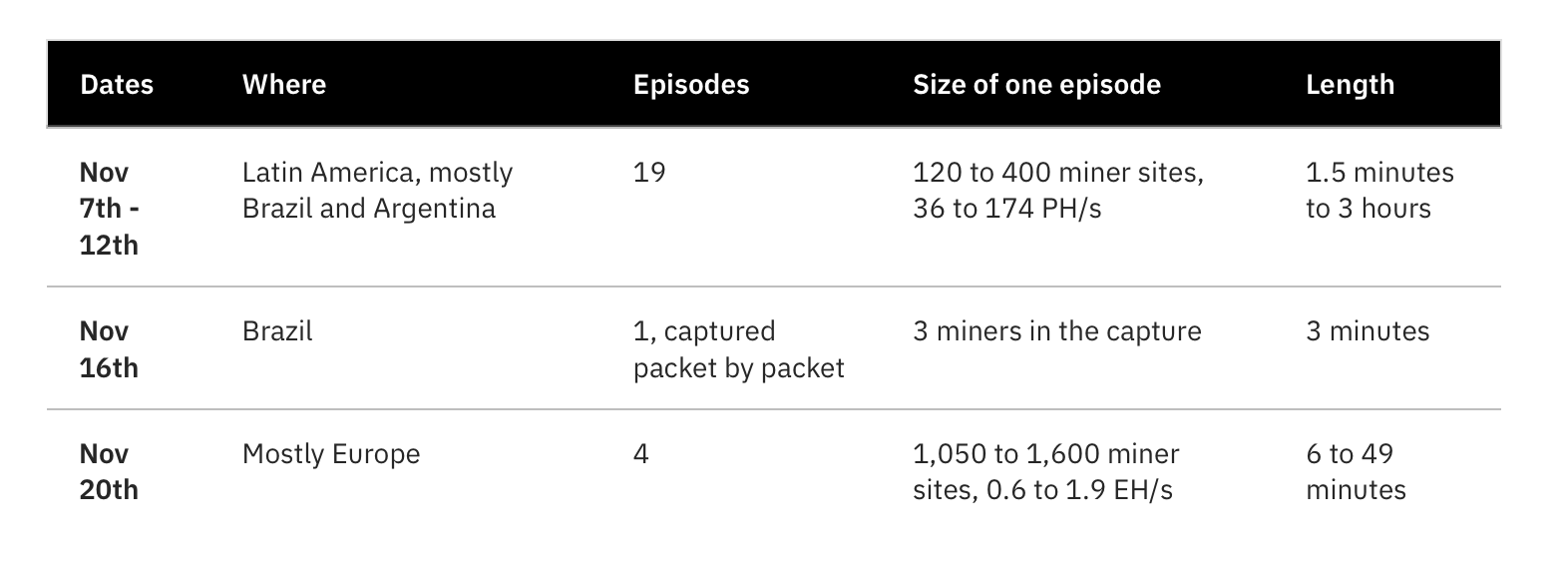
- Braiins recognized 4 assaults on Nov. 20 affecting between 1,050 and 1,600 mining websites per episode.
- Attackers exploited web routing vulnerabilities and unencrypted mining connections with out compromising mining pool infrastructure.
- Braiins recommends migrating to Stratum V2 or authenticated encrypted connections because the risk stays energetic.
Braiins Reveals Bitcoin Mining Assaults Throughout A number of Continents
In an X put up and safety advisory revealed Wednesday, Braiins disclosed that an attacker redirected bitcoin miners towards an impersonated mining pool by manipulating web site visitors. The corporate confused that neither its mining pool nor the affected mining tools was straight compromised.
The earliest incidents documented by Braiins occurred between Nov. 7 and Nov. 12, primarily affecting mining operations in Brazil and Argentina. Investigators recognized 19 episodes involving between 120 and 400 mining websites per incident, with diverted computational energy starting from 36 to 174 petahash per second (PH/s).
By Nov. 20, the assaults had grown significantly bigger and shifted predominantly towards Europe. Braiins recognized 4 episodes lasting between six and 49 minutes, every affecting greater than 1,000 mining websites and redirecting between 0.6 and 1.9 EH/s.
“The weak point they used isn’t newly found,” Braiins defined.
Stratum V1, launched in 2012, facilitates communication between mining tools and mining swimming pools. Its unencrypted implementation lacks a mechanism for miners to authenticate the server assigning their computational work, leaving mining income uncovered to malicious community interference.
Braiins traced the European incidents to manipulation of the Border Gateway Protocol (BGP), the system chargeable for directing web site visitors between impartial networks. Fraudulent routing bulletins diverted authentic mining communications towards unauthorized infrastructure.
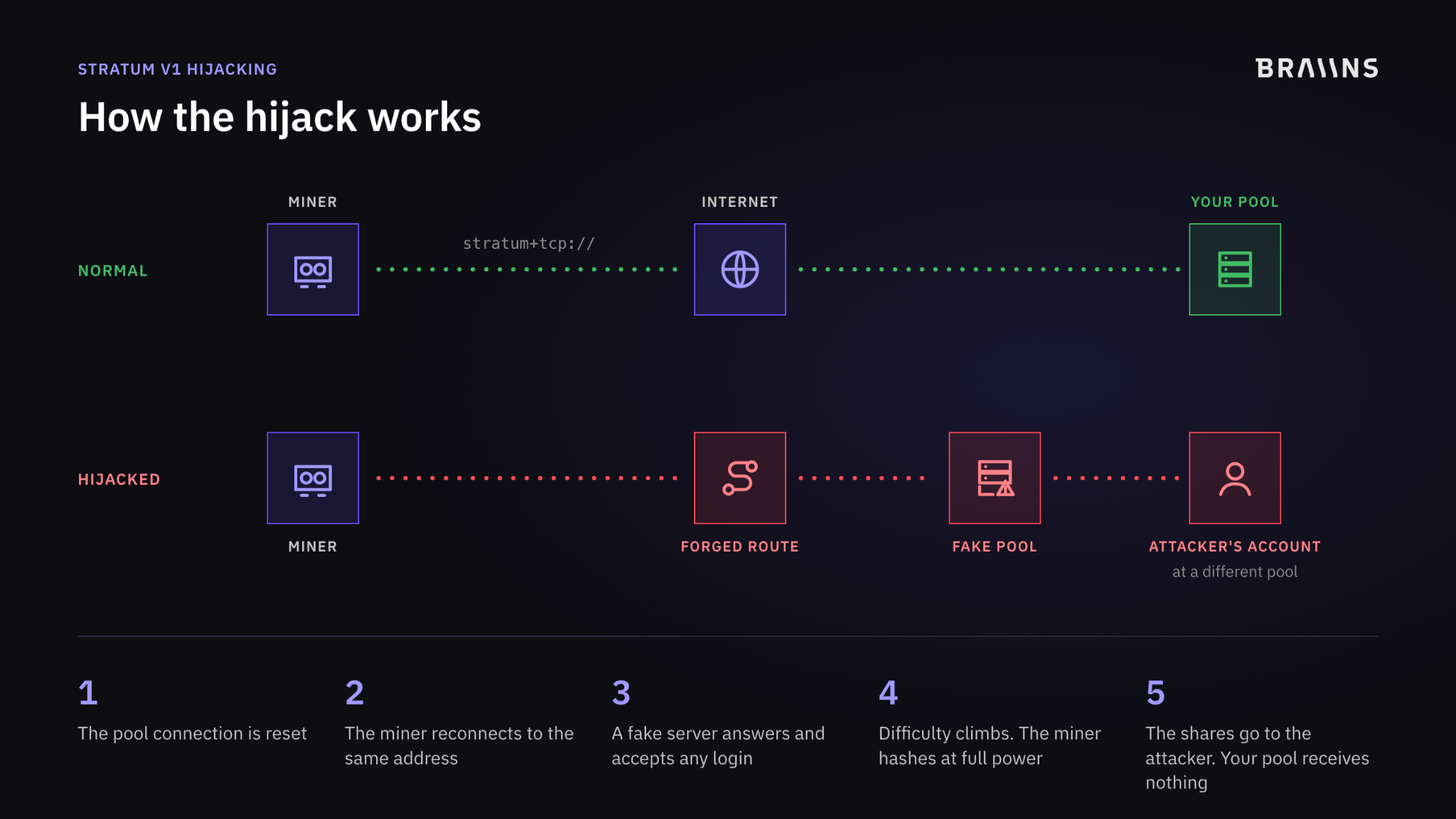
The investigation discovered that affected tools continued working at full computational capability whereas authentic pool dashboards recorded disappearing hashrate. Consequently, miners may proceed consuming electrical energy with out receiving credit score for his or her work.
Stratum V1 Exploit Differs From Current Luxor Mining Hack
The newest safety disclosure follows a separate hashrate hijacking incident involving Luxor Expertise earlier this month. On Nov. 15, Luxor confirmed that unauthorized modifications to mining pool configurations by way of its Commander administration platform affected simply over a dozen buyer accounts.
Estimates advised roughly 13 EH/s had been redirected to the Ocean mining pool, though the determine stays independently unverified. Luxor CEO Nick Hansen attributed the compromise to a “refined AI-enabled vector,” with out publicly disclosing its technical mechanics.
Not like the Luxor incident, which concerned unauthorized configuration modifications, the assaults documented by Braiins intercepted communications between mining machines and their meant swimming pools. No modifications to mining configurations have been needed, and pool account balances and payout settings remained unaffected.
The underlying vulnerability has endured for greater than a decade. In 2014, Dell Secureworks documented an identical web routing assault that diverted roughly $83,000 in cryptocurrency mining rewards. Braiins subsequently addressed the risk in 2020 whereas advocating the adoption of Stratum V2.
The corporate believes November’s escalating incidents could characterize preliminary experimentation by the attacker.
Braiins Requires Industrywide Migration to Safe Mining Connections
Braiins recommends that mining operators undertake Stratum V2, which encrypts communications and authenticates the id of mining swimming pools. Operators unable emigrate instantly can use Stratum V1 protected by Transport Layer Safety (TLS), supplied their firmware correctly validates safety certificates.
The corporate launched Braiins OS 26.11 on Wednesday, introducing TLS certificates and hostname verification alongside protections towards automated transitions to unencrypted connections. Braiins additionally launched a free Stratum V2 proxy for tools that lacks appropriate firmware.
Testing performed throughout seven firmware implementations on Nov. 20 and Nov. 23 revealed further safety deficiencies. Two extensively used implementations accepted invalid certificates regardless of providing TLS performance, doubtlessly exposing operators to impersonation even when communications appeared encrypted.
Braiins additionally urged mining swimming pools, firmware builders and web suppliers to strengthen infrastructure safety, whereas recommending that operators monitor discrepancies between regionally reported hashrate and computational energy credited by their swimming pools.
Authenticated encryption can’t forestall malicious actors from disrupting web connectivity, however it will possibly forestall mining tools from performing work for impersonated swimming pools.
November’s incidents expose an uncomfortable actuality for an business working more and more refined industrial infrastructure. Costly mining fleets stay depending on communication protocols developed throughout Bitcoin’s youth. Whereas computational effectivity has superior significantly, securing the connection by way of which that computational energy generates income stays unfinished enterprise.