


Choose up two wi-fi earbud instances with the identical chip, the identical battery, and practically the identical value. One snaps shut with a satisfying, strong click on. The opposite rattles barely and leaves a visual hole on the hinge. You’ll most likely determine which one feels “premium” inside three seconds, lengthy earlier than you learn a spec sheet.
That feeling shouldn’t be an accident, and it not often comes from the electronics. It comes from mechanical design: dozens of small selections about supplies, wall thickness, seams, buttons, and tolerances, most of them made months earlier than a product reaches a shelf. Listed below are these selections, and the right way to spot them within the devices you personal.
Supplies, weight and the partitions you’ll be able to’t see
The very first thing your hand judges is weight and stiffness. Most gadget shells are injection-molded plastic, similar to ABS or polycarbonate, typically paired with aluminum or glass. The fabric units the baseline, however the wall design determines the way it really feels.
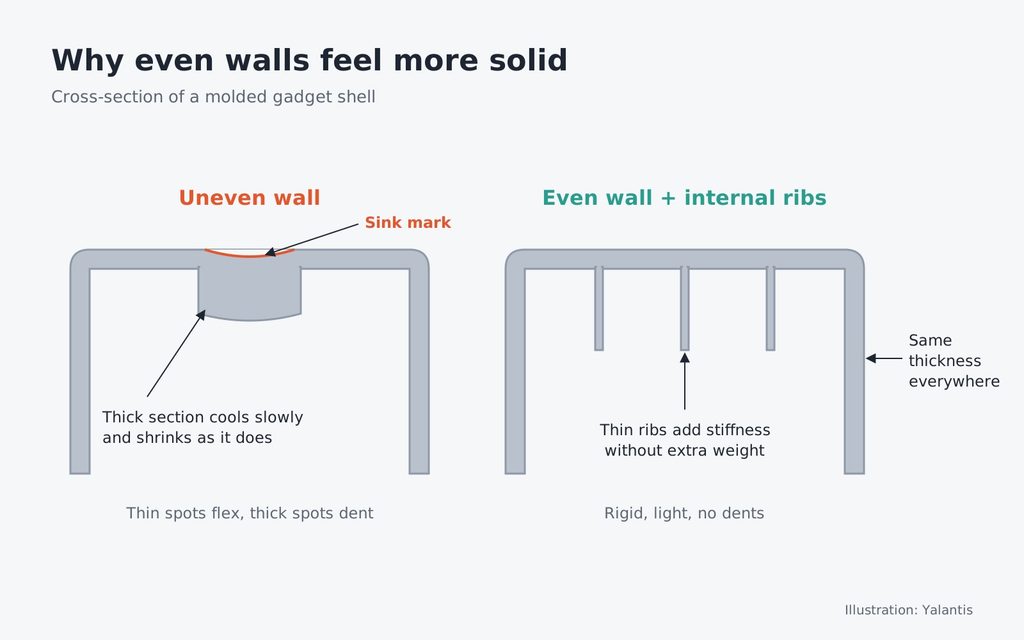
Plastic elements work greatest when their partitions are a constant thickness. Thick spots cool extra slowly within the mould and shrink as they do, leaving shallow dents known as sink marks. Skinny spots flex once you squeeze them, which is precisely the “creaky” feeling low cost merchandise have. Good designers maintain partitions even and add skinny inside ribs the place the shell must be stiffer, so a case can really feel inflexible with out being heavy.
Weight placement issues too. A tool whose battery sits low and centered feels balanced and deliberate. One which suggestions ahead in your hand feels off, even when you can’t say why.
Seams, gaps and the way the shell holds collectively
Look intently at the place two elements of a gadget meet. On a well-designed product, the hole is slender and the identical width all the way in which round. On a less expensive one, it widens on the corners or lets one half sit barely happy with the opposite.
Constant gaps come from tight tolerances: the allowed variation in every half’s measurement. Tighter tolerances want higher tooling and extra cautious design, so that they value extra. Designers additionally determine the place the mould’s parting line falls, the faint ridge the place the 2 halves of the mould meet. Hiding it alongside an edge or a design function is a small contact that separates polished merchandise from rushed ones.
Then there may be the query of what holds the shell collectively:
- Snap-fits are clips molded into the plastic. They’re low cost and invisible, however they should be designed rigorously or they loosen and rattle.
- Screws add value and want hiding, however they make a tool stronger and simpler to restore.
- Adhesives and ultrasonic welding create seamless, usually waterproof enclosures, on the value of constructing repairs troublesome or not possible.
None of those is fallacious. The selection displays what the product is supposed to prioritize: value, sturdiness, waterproofing or repairability.
Buttons, hinges, and every thing that strikes
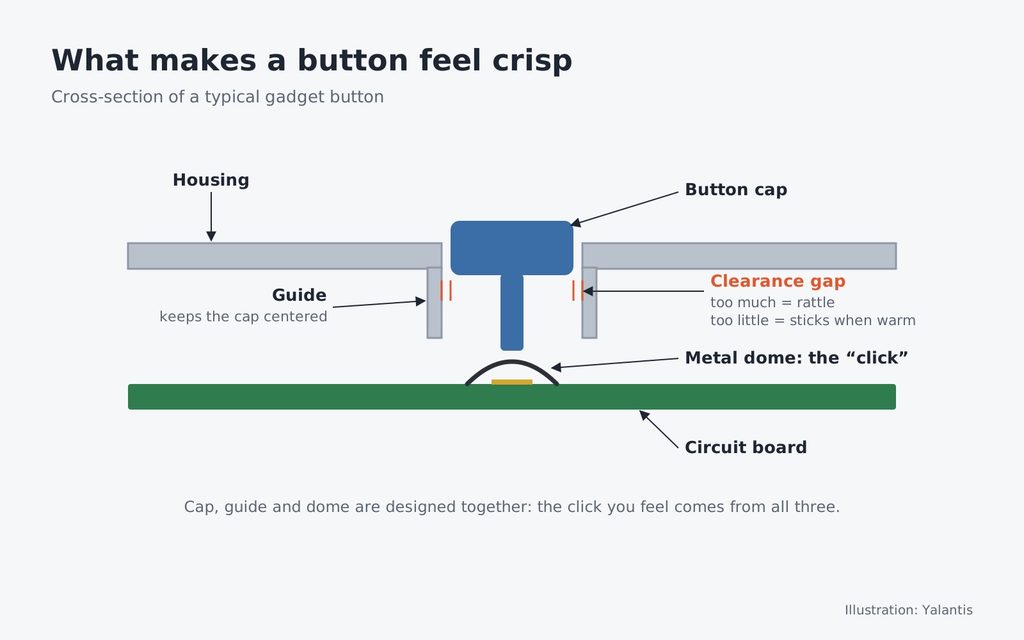
Shifting elements are the place low cost design provides itself away quickest. A very good button has a crisp, constant “click on” and no side-to-side wobble. That click on often comes from a small metallic dome beneath the button cap, and the texture is dependent upon how the cap, the dome, and the information round it are designed collectively. Go away an excessive amount of clearance, and the button rattles. Go away too little, and it sticks when the plastic expands on a sizzling day.
Hinges, sliders and charging-case lids observe the identical rule. A lid that closes with a agency, damped movement, then stays shut because of a well-placed magnet, indicators care. One which flops open or wants two tries to shut indicators the alternative. These particulars take further prototypes and testing, which is why they’re usually the very first thing minimize when a schedule slips.
Warmth, water and drops: the stress checks you by no means see
A number of the most essential mechanical work is invisible till one thing goes fallacious.
Warmth. Processors and batteries get heat, and a sealed plastic shell traps that warmth. Designers unfold it with skinny metallic or graphite sheets, route it to the outer floor, or add discreet vents. When that is performed badly, a gadget will get uncomfortably sizzling in your hand or slows itself down to chill off.
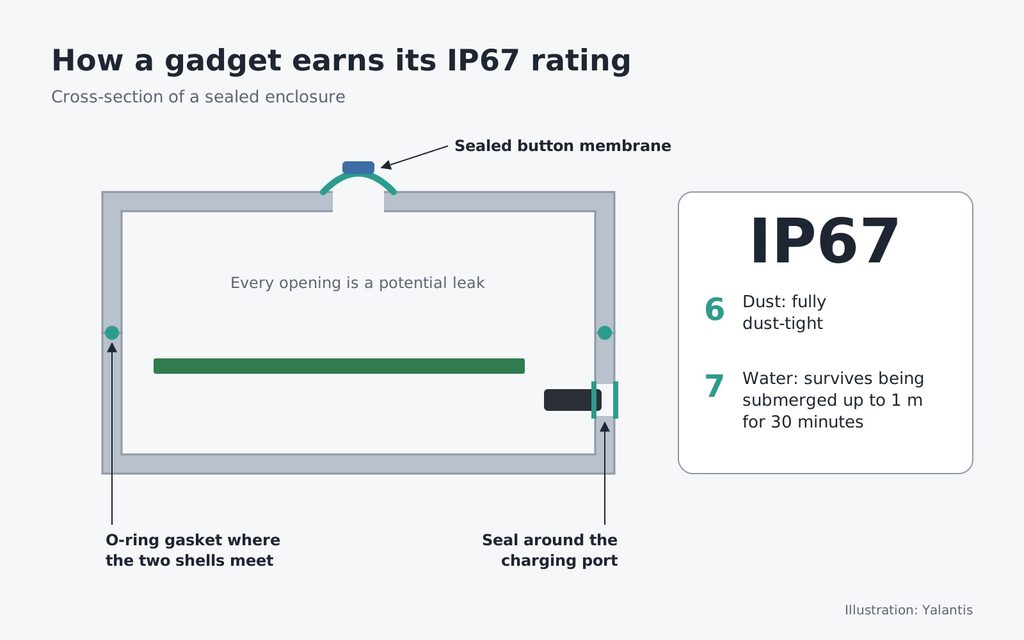
Water and mud. An IP ranking tells you the way properly a tool is sealed. In IP67, for instance, the 6 means totally dust-tight, and the 7 means it survives submersion as much as one meter for half-hour. Reaching that takes gaskets, sealed buttons, and thoroughly designed seams, and each opening, from a charging port to a speaker grille, is a possible leak.
Drops. Rugged merchandise are sometimes examined towards drop procedures from MIL-STD-810, a US navy check normal. Even on a regular basis devices undergo drop testing throughout improvement, and the fixes are mechanical: inside bumpers, ribs that unfold the affect and mounts that maintain the battery and circuit board from shifting.
From first prototype to the field in your doorstep
Most of those particulars are settled in an extended loop of prototypes. Early variations are 3D-printed in days so designers can test match and really feel. Later ones are CNC-machined or forged to get nearer to the ultimate materials. Solely after many rounds does the staff decide to metal injection molds, which might take weeks to make and are costly to vary.
That final step explains lots concerning the devices we purchase. As soon as the molds exist, each repair will get slower and costlier, so issues discovered late are sometimes patched slightly than solved. Merchandise that really feel easy often had their mechanical design locked down early, in line with the circuit board and firmware, as a part of how a gadget strikes from schematic to manufacturing.
Who designs the elements you by no means see
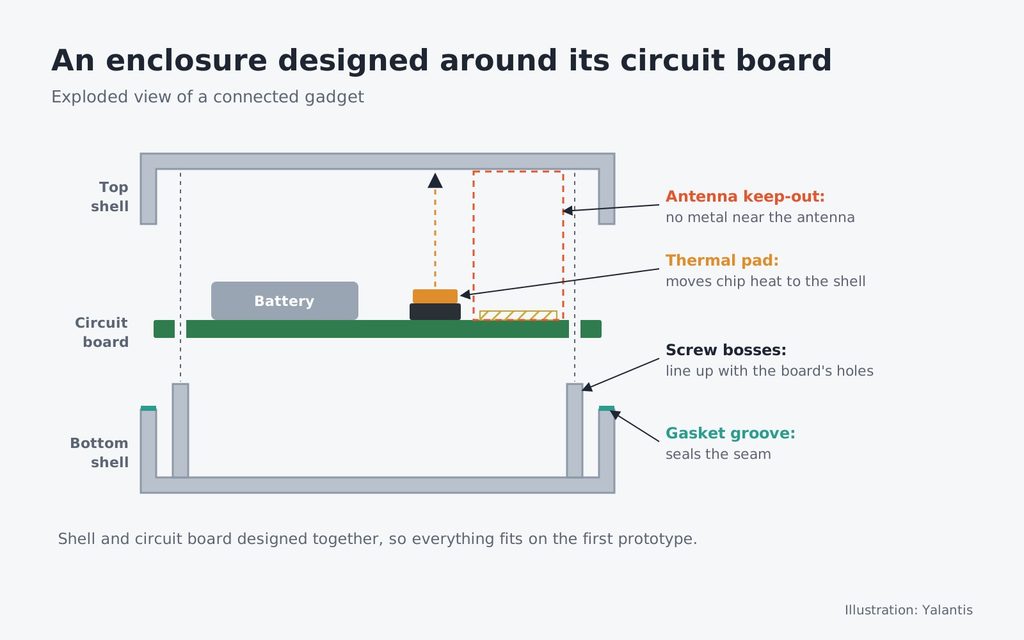
The model on the field shouldn’t be at all times the staff that designed the enclosure. Many gadget makers, particularly startups and corporations shifting from software program into {hardware}, usher in outdoors engineering corporations for mechanical design. Corporations similar to Yalantis, whose mechanical design staff works on enclosures for related gadgets, design the shell along with the circuit board inside it, in order that screw bosses, antenna placement, warmth paths, and seals match from the primary prototype slightly than being compelled in later.
That joint method is commonly the distinction between a product that feels resolved and one which seems like a circuit board in a field. When the enclosure and electronics are designed aside, the compromises have a tendency to point out up precisely the place your fingers discover them.
What to test before you purchase
You don’t want an engineering diploma to evaluate mechanical design. Subsequent time you deal with a gadget in a retailer or unbox one at house, do that:
- Squeeze it gently. A well-designed shell stays silent. Creaks and flex level to skinny or uneven partitions.
- Run a fingernail alongside the seams. The hole ought to be even all the way in which round, with no step between the halves.
- Press each button from the perimeters, not simply the middle. It ought to click on the identical method every time, with no wobble.
- Open and shut something that strikes. Lids and hinges ought to really feel damped and land in the identical place each time.
- Learn the IP ranking, not simply the phrase “waterproof”. The 2 digits inform you precisely what the system was examined to outlive.
- Search for screws. If repairability issues to you, a number of seen or hidden screws are signal.
The devices that really feel greatest not often shout about it. Their high quality lives in partitions, seams, and clicks that most individuals by no means consciously discover, and that’s precisely the purpose.

