

Selecting between When2meet and Doodle for assembly coordination comes down to 5 questions:
-
Are you scheduling with classmates and mates, or with purchasers, candidates, and cross-functional groups?
This is what we advocate:
When2meet is the quickest approach to discover a time when a gaggle is free. There isn’t any account to create, no electronic mail to enter, no value. You title an occasion, choose candidate dates, and share a hyperlink. Individuals drag throughout a grid to mark their availability, and a color-coded heatmap reveals the overlap in actual time. For college students, golf equipment, volunteer teams, and anybody who wants a fast availability test, When2meet has been the default since its founding at Brown College round 2000. However the device stops at discovering the overlap. There are not any calendar invitations, no reserving confirmations, no reminders, no cell optimization, and no integrations.
Doodle is knowledgeable scheduling platform that covers 4 coordination patterns in a single product: Group Ballot for multi-party consensus, 1:1 for curated time-slot presents, Reserving Web page for persistent calendar hyperlinks, and Signal-up Sheet for occasion enrollment. Doodle integrates with Google Calendar, Outlook, Zoom, and Microsoft Groups, sends automated reminders, delivers calendar invitations on reserving, and holds SOC 2 Sort II, HIPAA, and GDPR compliance. For skilled groups, healthcare organizations, and universities that want scheduling throughout organizational boundaries, Doodle is a transparent step up. The trade-off is value: paid plans begin at $15/month, and the free tier reveals adverts to each participant.
Each instruments clear up the logistics of scheduling. However for B2B groups, the more durable problem typically is not discovering an open time slot. It is figuring out which prospects, accounts, and decision-makers belong on the calendar within the first place. That is a special drawback, and it is the place ZoomInfo suits in.
ZoomInfo is a go-to-market platform that helps gross sales, advertising and marketing, and income groups discover the proper folks to fulfill with earlier than a scheduling device enters the image. Constructed on a B2B knowledge basis spanning 500M contacts, 100M corporations, 135M+ verified telephone numbers, and 200M+ verified enterprise electronic mail addresses, ZoomInfo surfaces in-market consumers, maps shopping for committees, and supplies the verified contact knowledge that makes outreach land. Its GTM Context Graph fuses this knowledge together with your CRM data, dialog transcripts, and behavioral indicators to disclose not simply who to contact, however why they’re value contacting now. For B2B groups, pairing ZoomInfo’s intelligence with a scheduling device like Doodle means each assembly on the calendar is with somebody certified and well timed.
If figuring out the proper prospects is your bottleneck, see how ZoomInfo works.
When2meet vs. Doodle at a look
|
When2meet |
Doodle |
ZoomInfo |
|
|---|---|---|---|
|
Core perform |
Group availability heatmap |
Multi-format scheduling platform |
B2B intelligence and prospecting |
|
Account required |
No (organizer or participant) |
No for contributors; sure for organizers on paid plans |
Sure |
|
Calendar integration |
None |
Google Calendar, Outlook, Apple Calendar |
Salesforce, HubSpot, Dynamics 365 (CRM-level) |
|
Video conferencing |
None |
Zoom, Google Meet, Microsoft Groups, Webex |
N/A (not a scheduling device) |
|
Reserving automation |
None (stops at availability overlap) |
Reserving Web page with real-time availability, reminders, and calendar invitations |
N/A |
|
Cellular expertise |
Poor (desktop-only design) |
Net-based, purposeful on cell |
Net and cell app |
|
Safety certifications |
None revealed |
SOC 2 Sort II, HIPAA, GDPR |
ISO 27001, ISO 27701, SOC 2 Sort II, GDPR, CCPA |
|
Pricing mannequin |
Free (ad-supported) |
Freemium (Free, Professional at $15/mo, Crew at $8.95/consumer/mo yearly) |
Customized-quoted, consumption-based |
|
Free plan |
Full entry, no limits |
Restricted (adverts, 1 reserving web page, 10 ballot time slots) |
ZoomInfo Lite (everlasting free tier, 10 month-to-month credit) |
|
Greatest for |
College students, golf equipment, and informal teams needing zero-friction polling |
Skilled groups needing scheduling automation and compliance |
B2B gross sales and advertising and marketing groups needing prospect intelligence |
Free simplicity vs. skilled scheduling
When2meet and Doodle characterize reverse philosophies about what a scheduling device needs to be.
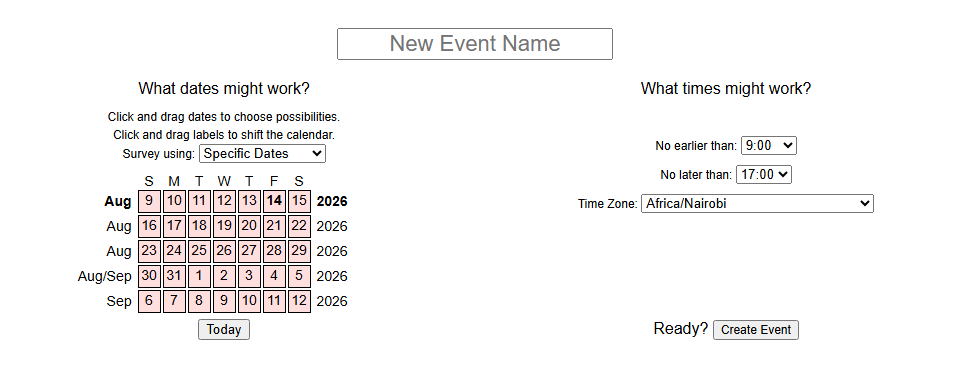
When2meet is a single-purpose utility.
Your complete product suits on one web page: title an occasion, choose dates, set a time window, share the URL. The location is designed to be compact so occasions may be created and accessed rapidly. There isn’t any dashboard, no settings menu, no account profile. The interface hasn’t modified for the reason that mid-2000s, and that stability is a part of the attraction. It really works the identical means it labored when Don Engel constructed it as a pupil at Brown, and it solves the identical drawback: discovering the one time when everybody in a gaggle is free.
Supply: When2meet
Doodle began in the identical place.
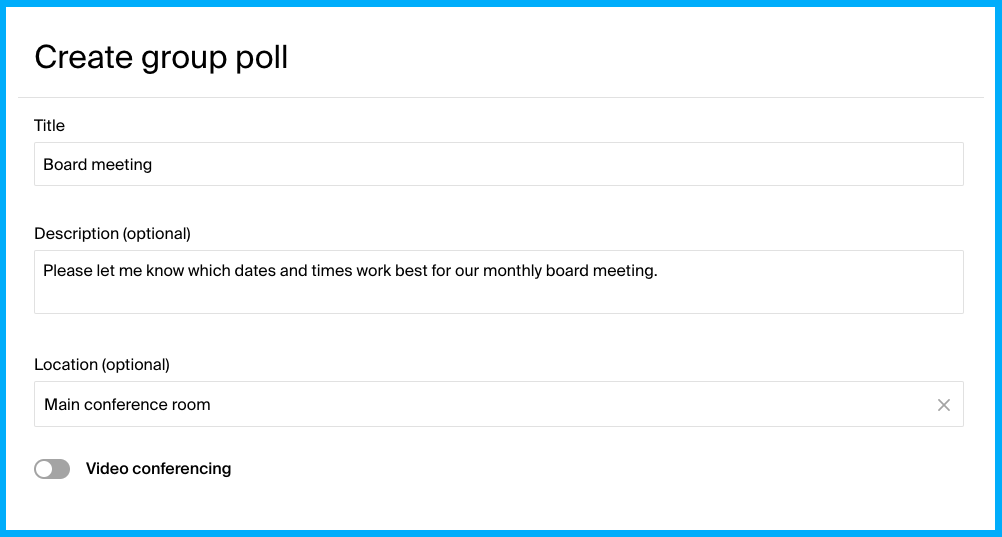
Based in 2007 by two ETH Zurich college students who needed to remove electronic mail back-and-forth for group gatherings, Doodle’s unique Group Ballot labored very like When2meet does right now: suggest instances, let folks vote, choose the winner.
However Doodle developed right into a full scheduling platform. The 2018 launch of 1:1 conferences, 2019 Reserving Web page, and subsequent Signal-up Sheet turned Doodle from a ballot device right into a system that handles all the scheduling workflow, from proposing instances by way of reserving affirmation and calendar supply.
Supply: Doodle
That evolution introduced trade-offs.
Doodle’s free tier now contains adverts on all ballot pages, which contributors see even when the organizer is on the free plan. Options like automated reminders, {custom} branding, and Microsoft Groups integration sit behind paid plans. When2meet has none of those options, nevertheless it additionally has none of those restrictions. Every little thing the device does is on the market to everybody, all the time.
Group scheduling: heatmap vs. structured ballot
Each instruments clear up the identical core drawback (discover a time for a gaggle), however the interplay mannequin differs.
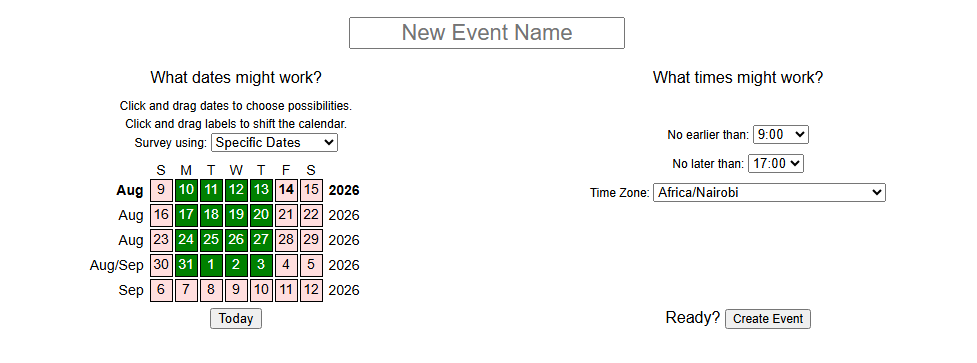
When2meet makes use of a drag-to-select grid.
Individuals click on and drag throughout time blocks to color their accessible hours. The group’s mixed availability seems as a heatmap that updates in actual time as responses are available in, with darker cells displaying extra folks accessible. Hovering over any cell reveals precisely who’s free at that second.
The heatmap provides organizers a steady visible sign: they will see not simply one of the best time however each near-miss, and make knowledgeable trade-offs (a slot the place one peripheral particular person cannot attend versus one the place three key folks cannot).
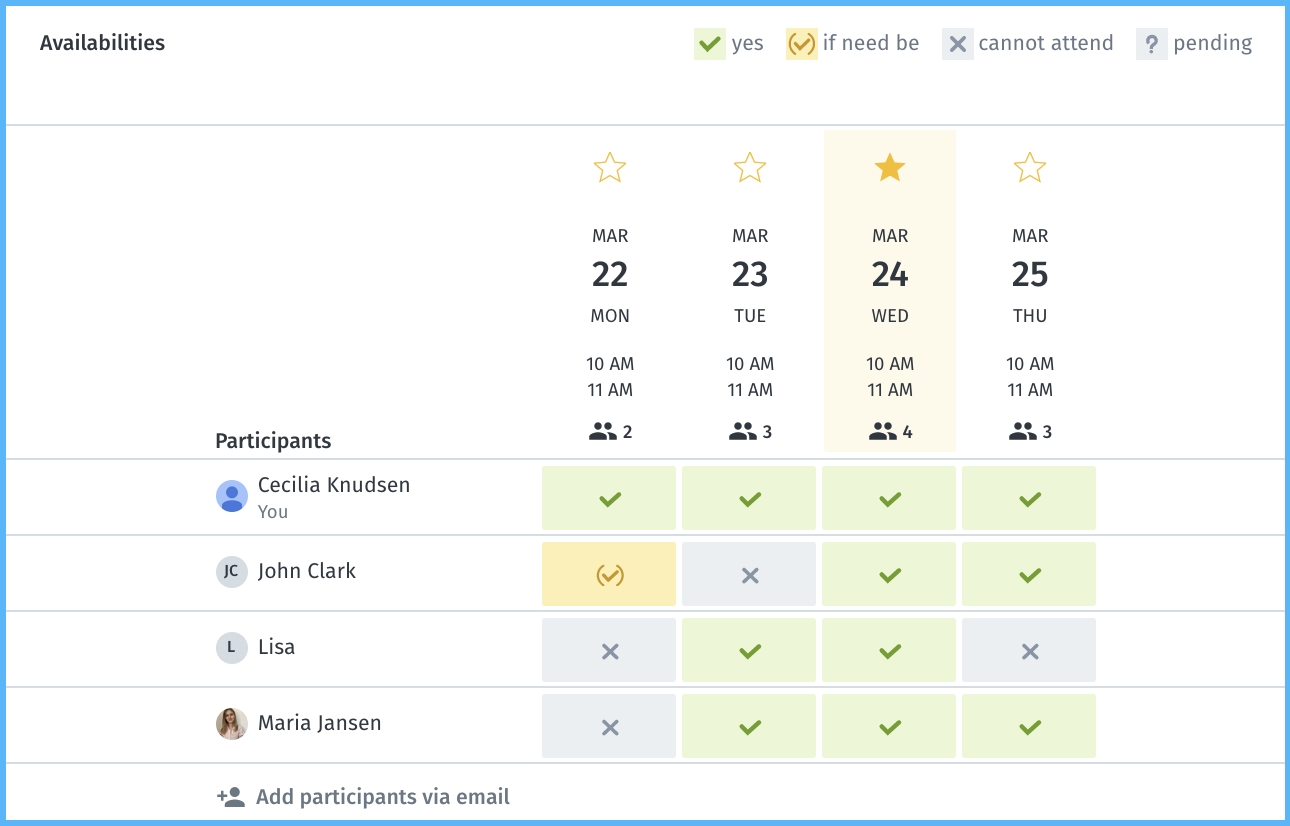
Doodle makes use of a structured voting mannequin.
The organizer proposes particular time slots, and contributors mark every as accessible (inexperienced), “if-need-be” (yellow), or depart it unselected. This three-state voting captures a nuance that binary sure/no polls miss. As much as 1,000 folks can reply to a single Doodle ballot, and Skilled accounts can embody as much as 1,000 time slots. Doodle additionally helps voting deadlines, participant caps per slot, and hidden participant lists for situations like interview scheduling the place privateness issues.
Supply: Doodle
When2meet works greatest while you need contributors to indicate all their availability throughout a time vary. Doodle works greatest when the organizer already is aware of which slots to suggest and needs a clear vote.
For a examine group looking for overlapping free time this week, When2meet’s steady grid is extra pure. For a hiring supervisor proposing three interview home windows to a panel, Doodle’s structured ballot is cleaner.
What occurs after you discover a time
That is the place the 2 instruments diverge most sharply.
When2meet stops on the overlap.
As soon as contributors fill of their grids and the organizer identifies one of the best time, every little thing else occurs exterior the device. The organizer messages the group with the choice, creates a calendar occasion in a separate app, and handles follow-up. There are not any affirmation emails, no calendar invitations, no reminders, and no approach to notify contributors {that a} time has been chosen. When2meet is a ballot, not a reserving system.
Doodle completes the workflow.
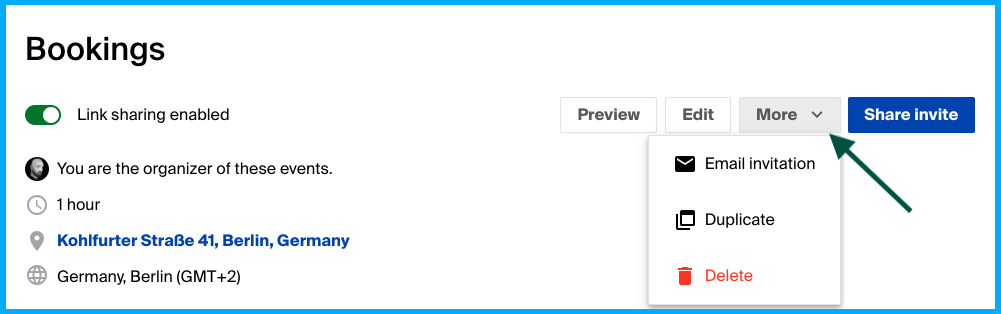
When the organizer clicks “Ebook it” on a Group Ballot, contributors obtain an electronic mail with occasion particulars and a calendar invite. Reserving Pages go additional: they work as persistent scheduling hyperlinks that test linked calendars in actual time, stop double-booking, and ship 24-hour reminders earlier than appointments. For paid consultations or teaching periods, Stripe integration allows fee assortment at reserving.
Supply: Doodle
For a one-off examine group, the guide follow-up after When2meet is a minor inconvenience. For a college working a whole lot of lab inspections or a nonprofit coordinating volunteer shifts, the dearth of automated affirmation and reminders turns into an actual operational hole.
Calendar integration and the cell divide
When2meet has no integrations.
It doesn’t hook up with Google Calendar, Outlook, Apple Calendar, or some other software. Individuals fill within the availability grid from reminiscence, which means they want their very own calendar open in one other window to cross-reference. An unofficial browser extension exists to drag Google Calendar knowledge into the grid, however the official product presents no native sync.
The cell expertise compounds this hole.
When2meet’s drag-to-select grid was designed for desktop browsers with a mouse. On contact screens, the small time-slot targets trigger unintentional alternatives, and scroll gestures intrude with drag interplay. The interface predates responsive net design and has not been tailored for cell.
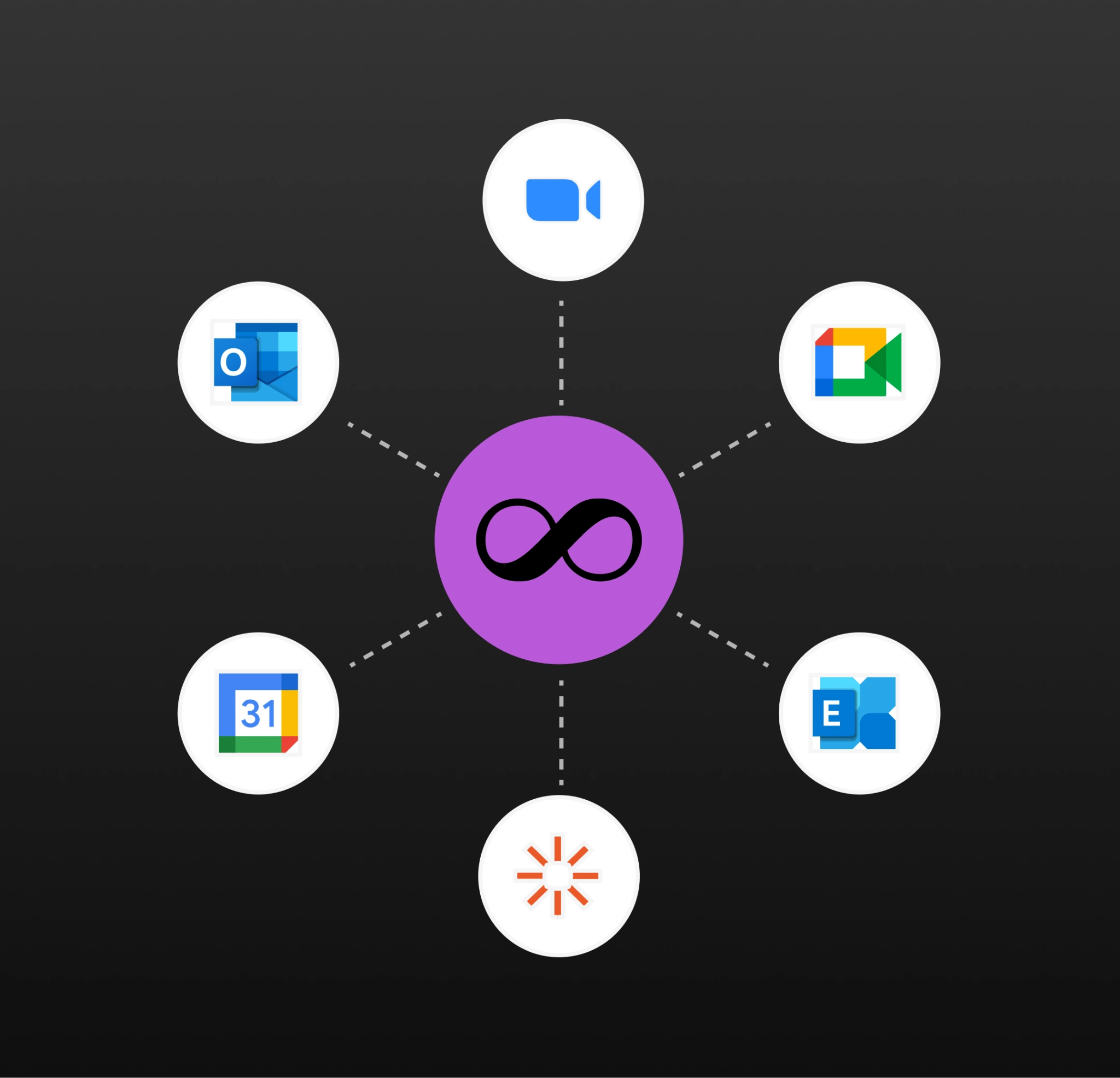
Doodle integrates with Google Calendar, Microsoft Outlook, and Apple iCloud Calendar (the final listed as beta).
When an organizer connects their calendar, Doodle reads availability and surfaces conflicts throughout ballot creation and reserving. For video conferencing, Doodle generates hyperlinks for Google Meet and Zoom on all plans, with Microsoft Groups and Webex on paid plans. The online-based platform works throughout units, and whereas some reviewers observe the cell expertise is much less polished than desktop, it’s purposeful.
Supply: Doodle
For groups that dwell of their calendars, Doodle’s integrations take away an actual supply of scheduling errors. For teams the place nobody shares a calendar system (cross-organizational conferences, volunteer networks, worldwide analysis collaborations), Doodle’s means to work throughout boundaries with out shared calendar entry is a core benefit.
When2meet handles cross-organization scheduling too, however solely on the availability-polling stage, not the reserving stage.
Safety and compliance form who can use every device
For casual teams, safety certifications do not matter. For organizations in regulated industries, they are a gate.
When2meet collects minimal knowledge by design.
Individuals enter solely a show title. No electronic mail, no account, no billing data. This minimalism presents a type of privateness by way of knowledge absence. However the device publishes no privateness coverage, no knowledge retention assertion, and holds no safety certifications. Show adverts introduce third-party monitoring scripts. For enterprise consumers with compliance obligations, or organizations certain by GDPR knowledge processor necessities, it is a disqualifying hole.
Doodle holds SOC 2 Sort II, HIPAA, and GDPR certifications.
Infrastructure is hosted on AWS within the EU, with transit encryption by way of TLS 1.2+ and common third-party penetration testing. A Information Safety Officer is in place, and inactive polls and participant knowledge are deleted after 90 days. Enterprise accounts get SSO/SAML authentication and 99.5% uptime ensures.
For healthcare networks scheduling multi-provider appointments, universities coordinating compliance inspections, or authorities companies working grant consultations, Doodle’s certifications open doorways that When2meet’s lack of compliance documentation closes.
The upstream drawback: realizing who belongs on the calendar
Scheduling instruments clear up the “when” drawback. However for B2B groups, the “who” drawback is more durable and extra consequential. You’ll find a gathering time in seconds. Figuring out which accounts are in-market, which contacts are decision-makers, and which indicators recommend somebody is able to purchase takes actual intelligence.
ZoomInfo addresses this upstream problem.
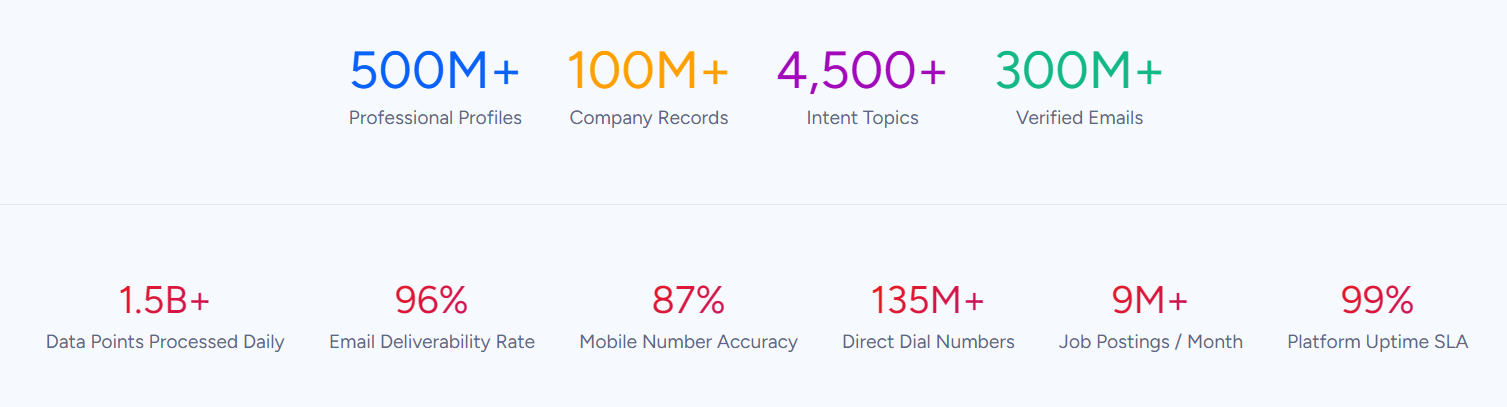
The platform’s B2B knowledge covers 500M contacts and 100M corporations, verified by way of a pipeline backed by 300+ human researchers and as much as 95% accuracy on first-party knowledge. In a Fortune 500 aggressive RFP analyzing 25 million contacts throughout distributors, an unbiased advisor concluded that “no different competitor got here even shut.”
Supply: ZoomInfo
The info alone would make ZoomInfo helpful for locating contacts value assembly. However the GTM Context Graph, which processes 1.5B+ knowledge factors day by day, goes additional. It combines ZoomInfo’s third-party intelligence together with your CRM data, dialog transcripts, and behavioral indicators to indicate why a prospect is value assembly now.
Purchaser Intent knowledge tracks indicators from 210 million IP-to-Group pairings, figuring out corporations researching matters associated to your product earlier than they fill out a kind. Guided Intent, unique to ZoomInfo, identifies the matters traditionally correlated together with your closed-won offers relatively than requiring guide subject choice.
For gross sales groups, this intelligence flows into three channels: GTM Workspace provides sellers a prioritized account feed with AI-drafted outreach. GTM Studio lets entrepreneurs and RevOps groups construct and launch performs in pure language. And APIs plus MCP expose the identical intelligence to any third-party device or AI agent.
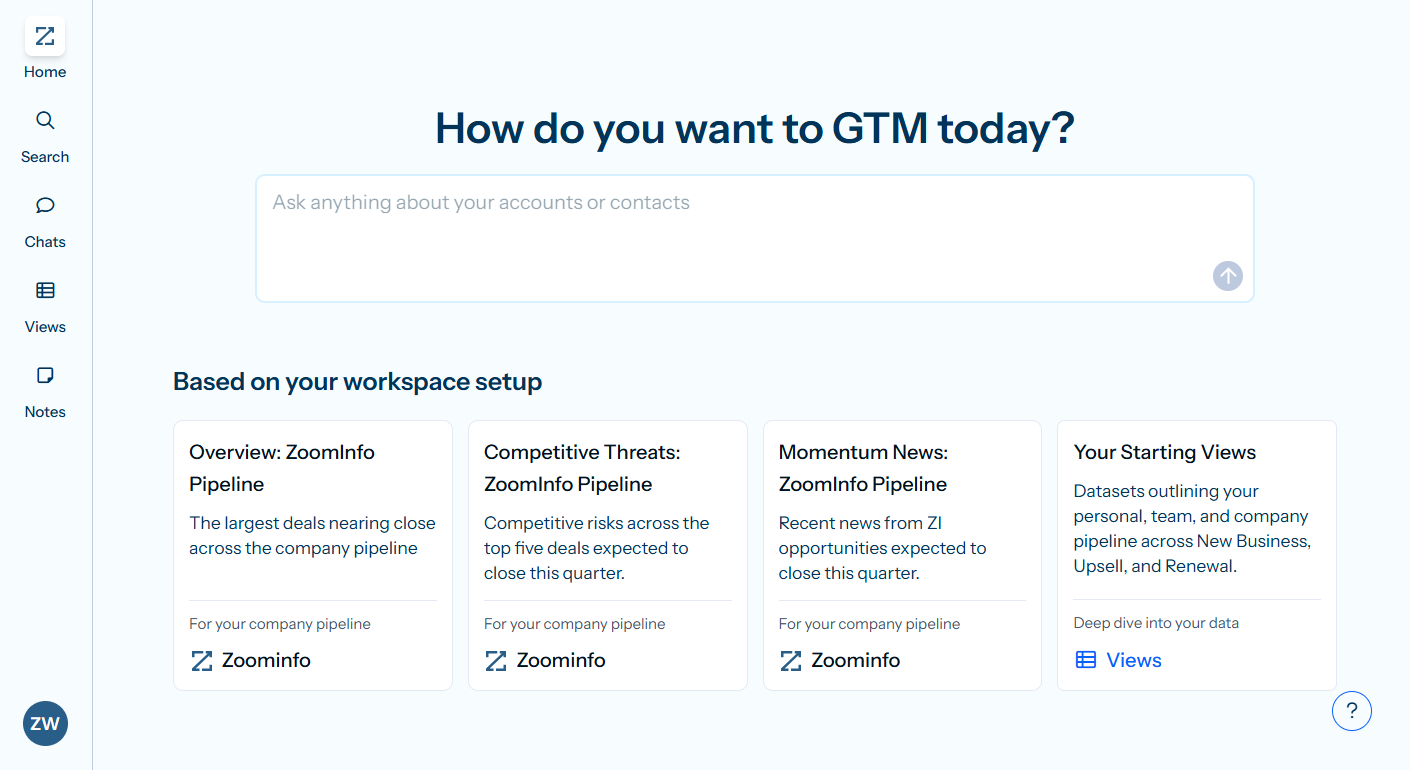
The sensible workflow: ZoomInfo identifies an in-market account, surfaces the proper contacts with verified direct dials and emails, and the gross sales rep makes use of a scheduling device like Doodle to guide the assembly. The scheduling device handles logistics. ZoomInfo makes positive the logistics are spent on the proper folks.
Seismic’s gross sales staff boosted productiveness by 54% and attributed 39% of energetic pipeline to alternatives recognized or influenced by ZoomInfo indicators. (Seismic)
Pricing: free vs. freemium vs. enterprise
When2meet prices nothing.
Your complete device is free and ad-supported, with non-compulsory PayPal donations ($5, $10, or $20). There isn’t any paid tier, no characteristic gatekeeping, and no improve path. This is not a freemium mannequin; it is a free product run by a solo operator.
Doodle makes use of a per-seat subscription mannequin:
|
Plan |
Worth |
Key options |
|---|---|---|
|
Free |
$0 |
Group polls (10 time slots max), 1 reserving web page, 1 energetic 1:1, adverts proven |
|
Professional |
Limitless polls and reserving pages, ad-free, reminders, {custom} branding, Zapier, Groups/Webex |
|
|
Crew |
$8.95/consumer/month (annual) or $19.95/consumer/month (month-to-month) |
All Professional options, 2-100 customers, admin controls, shared reserving pages |
|
Enterprise |
Customized pricing |
SSO/SAML, devoted account administration, {custom} coaching, uptime ensures |
The free tier works for infrequent private use however reveals adverts to each participant, caps polls at 10 time slots, and limits you to at least one reserving web page. For skilled use, the Professional plan at $15/month removes these restrictions.
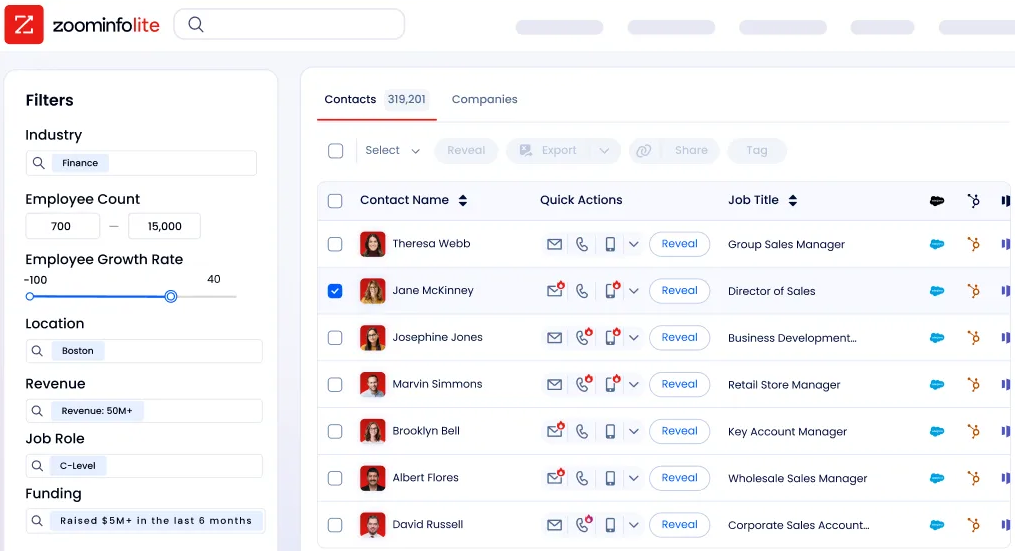
ZoomInfo makes use of custom-quoted, consumption-based pricing. ZoomInfo Lite presents a everlasting free tier with entry to the B2B database and 10 month-to-month export credit, no bank card required. A 7-day free trial of the total platform can also be accessible. Paid plans scale primarily based on seats, credit score quantity, and have entry.
Supply: ZoomInfo
These three pricing fashions mirror three totally different merchandise for 3 totally different issues. When2meet’s free mannequin sustains a single-purpose utility. Doodle’s freemium tiers fund knowledgeable scheduling platform. ZoomInfo’s enterprise pricing helps the information infrastructure, intelligence, and compliance certifications that B2B groups require.
“ZoomInfo provides us the knowledge we have to execute. We do not have to undergo and spend our time digging. It is already there, so we may be three steps forward.” (Vensure)
When2meet vs. Doodle vs. ZoomInfo: Which do you have to select?
These three instruments serve totally different roles. The fitting alternative is dependent upon what drawback you are fixing.
Select When2meet if:
Select Doodle if:
-
Compliance issues (healthcare, schooling, authorities, regulated industries)
-
You want a number of scheduling codecs (group polls, 1:1, reserving pages, sign-up sheets)
Select ZoomInfo if:
See how ZoomInfo identifies your subsequent greatest assembly with a free trial.
Thomson Reuters elevated closed-won offers by 40% and achieved 115% common quota attainment every month utilizing ZoomInfo’s intelligence to prioritize accounts and personalize outreach. (ZoomInfo GTM Workspace)
When2meet and Doodle each clear up scheduling properly, at totally different ranges of sophistication and value. When2meet is the proper device when simplicity and 0 friction matter greater than options. Doodle is the proper device when scheduling wants skilled polish, compliance, and automation. For B2B groups, ZoomInfo ensures that the conferences you schedule are with the folks almost definitely to develop into clients.
When2meet vs. Doodle vs. ZoomInfo FAQ
Is When2meet actually free, or are there hidden prices?
When2meet is free with no paid tier, no characteristic restrictions, and no improve prompts. The device is ad-supported, and show adverts seem on occasion pages. The one non-compulsory value is a voluntary PayPal donation. There are not any hidden charges as a result of there isn’t any billing relationship with customers.
Can contributors use When2meet or Doodle with out creating an account?
Each instruments let contributors reply with out creating an account. When2meet requires solely a show title. Doodle lets contributors vote on Group Polls, guide 1:1 conferences, and register on Signal-up Sheets with no Doodle account. For organizers, When2meet requires no account both. Doodle requires an account for organizers on paid plans and for options like limitless polls and reserving pages.
Which device is best for scheduling throughout totally different time zones?
Doodle handles time zones extra fully. Calendar integrations test availability in opposition to actual schedules, and all instances show in every participant’s native time zone. When2meet helps automated time zone adjustment in its Particular Dates mode (every participant’s grid renders of their native time primarily based on browser settings), however its Days of the Week mode assumes a single shared time zone.
Neither device requires contributors to transform instances manually of their major scheduling modes.
Does When2meet combine with Google Calendar or Outlook?
No. When2meet has no native integrations with any calendar, video conferencing, or productiveness device. Individuals should manually test their calendars whereas filling within the availability grid. An unofficial browser extension exists to import Google Calendar knowledge, however it’s not maintained or endorsed by When2meet. Doodle integrates natively with Google Calendar, Microsoft Outlook, and Apple iCloud Calendar.
Which device is best for skilled or client-facing scheduling?
Doodle is best fitted to skilled contexts. It presents {custom} branding, ad-free experiences on paid plans, automated reminders, calendar invite supply, Stripe fee assortment, and compliance certifications (SOC 2 Sort II, HIPAA, GDPR). When2meet reveals adverts on occasion pages, has no branding choices, and supplies no post-poll workflow.
For enterprise groups that additionally have to establish the proper contacts earlier than scheduling, ZoomInfo supplies the prospecting intelligence layer.
What’s ZoomInfo, and the way does it relate to scheduling instruments?
ZoomInfo shouldn’t be a scheduling device. It’s a B2B intelligence platform that helps gross sales and advertising and marketing groups establish which prospects, accounts, and decision-makers are value assembly with. It supplies verified contact knowledge, purchaser intent indicators, and AI-powered account insights.
The connection to scheduling is workflow-based: ZoomInfo identifies the proper folks, and a scheduling device like Doodle handles the logistics of getting the assembly on the calendar.
Can Doodle deal with massive group scheduling?
Sure. A single Doodle Group Ballot can accommodate as much as 1,000 participant responses, and Skilled accounts can embody as much as 1,000 time slots per ballot. Signal-up Sheets help as much as 99 periods with unbiased seat caps of as much as 999 per session. When2meet doesn’t publish formal participant limits, however its interface turns into more durable to learn with very massive teams since each participant’s title seems within the hover overlay.
Does Doodle supply a free plan, or only a free trial?
Doodle presents a everlasting free plan, not a time-limited trial. The free plan contains Group Polls (capped at 10 time slots), one reserving web page, one energetic 1:1, Google Meet and Zoom integration, and Stripe fee assortment. It excludes advert removing, automated reminders, Microsoft Groups and Webex integrations, {custom} branding, and Zapier connectivity. Doodle doesn’t publicly verify a time-limited trial of paid options.

