

The concept that crypto will turn out to be the default fee alternative for autonomous AI brokers is widespread within the business. The thesis is that as a result of AI brokers can’t open financial institution accounts and must make plenty of transactions, they are going to inexorably gravitate to on the spot, decentralized and low price crypto funds.
However the bank card business has no intention of letting that occur.
The Wall Avenue Journal reported on Nov. 19 that AI brokers are already utilizing bank cards to make purchases on customers’ behalf, and banks and fee firms are racing to accommodate them. Crypto dealer and co-host of the 1000x podcast Jonah Van Bourg posted a screenshot, and commented:
“Brokers is not going to use crypto rails. The ebook is closed on blockchain as an answer, outdoors of area of interest again workplace purposes. Its solely use instances are sov, privateness, and ledger stuff. Unhappy.”
However specialists argue the jury continues to be out. Professor emeritus of finance at Marquette College, David Krause, tells Journal that bank cards provide some benefits, however excessive prices could possibly be their downfall in sure eventualities.
“Bank cards have been constructed for a world the place a human decides to pay, so when an agent pays $0.005 for an API name, the fastened charges on card rails are 50x the transaction itself.”
Stablecoins, he says, make far more sense for “these conditions involving micropayments.”
The fee rail relies on what the agent is shopping for
Bank card funds are the default for many human-initiated transactions on the net. So an agent tasked with reserving a flight or a lodge room might also default to any such fee as properly.
Associated: DeepSeek creating AI agent requiring much less human enter: Report
“When an agent books your flight or reorders your groceries, it’s appearing for an individual, at a service provider that already accepts playing cards, with shopper protections folks count on, like chargebacks,” Lewis Nurcombe, chief income officer at WalletConnect, tells Journal.
Visa’s current paper on the rise of agentic commerce says tokenization can provide brokers permission to transact without having to show the cardholder’s underlying fee particulars, and spending controls can limit the purchases they’ll make.
So when the service provider already accepts playing cards and has acquainted mechanisms for dealing with disputed transactions, it’s laborious to argue the virtues of introducing a wholly new fee system.
However the economics begin to change when brokers start paying different machines.
Stablecoins make sense when machines pay machines
AI brokers might create a brand new financial system of machine-to-machine transactions, the place brokers purchase entry to a dataset, request computing energy, or pay to entry a single piece of knowledge. Many of those transactions might solely be price a fraction of a cent and doubtlessly must happen 1000’s of instances with out a human approving every one.
“If an agent needs to pay just a few cents for one API name or one piece of information, card charges don’t make sense,” Aitor Argomaniz, chief govt of AI funds firm Nevermined, tells Journal.
That’s as a result of card networks have been designed round transactions large enough to soak up fastened processing charges, relatively than micro-payments.
Stablecoins provide a distinct mannequin. Brokers can maintain funds in a pockets, make funds programmatically and settle transactions onchain with out going by means of a traditional checkout course of.
Nurcombe says that stablecoins are most helpful “wherever the transaction is simply too small, too frequent or too world for playing cards to make sense.”
Protocols like x402 let providers request fee as a part of an web interplay. That permits an agent to pay for entry to a useful resource relatively than subscribe to a service or manually full a checkout.
x402 is an open, impartial normal for internet-native funds. Supply: x402
Nevermined in contrast 100 API calls priced at 10 cents every. Utilizing a traditional card by way of Stripe wouldn’t be an possibility because the funds infrastructure community rejects expenses below $0.50. However utilizing stablecoins, the corporate estimates the identical 100 funds would price round 10 cents in whole utilizing Coinbase’s x402 facilitator on Base.
That doesn’t imply crypto funds will routinely win nonetheless, as a lot of microtransactions could possibly be aggregated right into a single card fee. Stablecoin transactions additionally carry prices associated to infrastructure, conversion, custody and liquidity.
The Financial institution for Worldwide Settlements (BIS) discovered that stablecoin transfers can nonetheless incur buying and selling, conversion and withdrawal charges, whereas restricted liquidity between stablecoins and native currencies can add additional friction.
Who takes accountability when an AI agent makes a mistake?
Within the transition to agentic finance, there’s a extra basic query to beat: who’s accountable when an agent will get one thing incorrect?
Associated: Banks are banning AI brokers over safety… and competitors considerations
“I inform my college students the true query isn’t ‘crypto or playing cards,’ it’s who solves the agent identification and legal responsibility attribution points,” Krause says.
“That’s as a result of the primary time an agent books the incorrect flight, somebody has to personal that dispute, and that’s a 50-year competency the crypto world hasn’t constructed but.”
One partial resolution is a separate pockets funded with a restricted sum of money that would stop an agent from by accident draining a person’s fundamental account.
WalletConnect is creating methods for customers to offer brokers entry to devoted wallets whereas retaining management over the remainder of their funds.
“Probably the most an agent can ever spend is what the individual selected to offer it,” Nurcombe says.
However spending limits solely mitigate the injury. They’ll’t decide who’s liable when an agent makes an unauthorized buy, buys the incorrect service or falls sufferer to manipulation. Nor do they supply the form of decision customers count on from established fee suppliers.
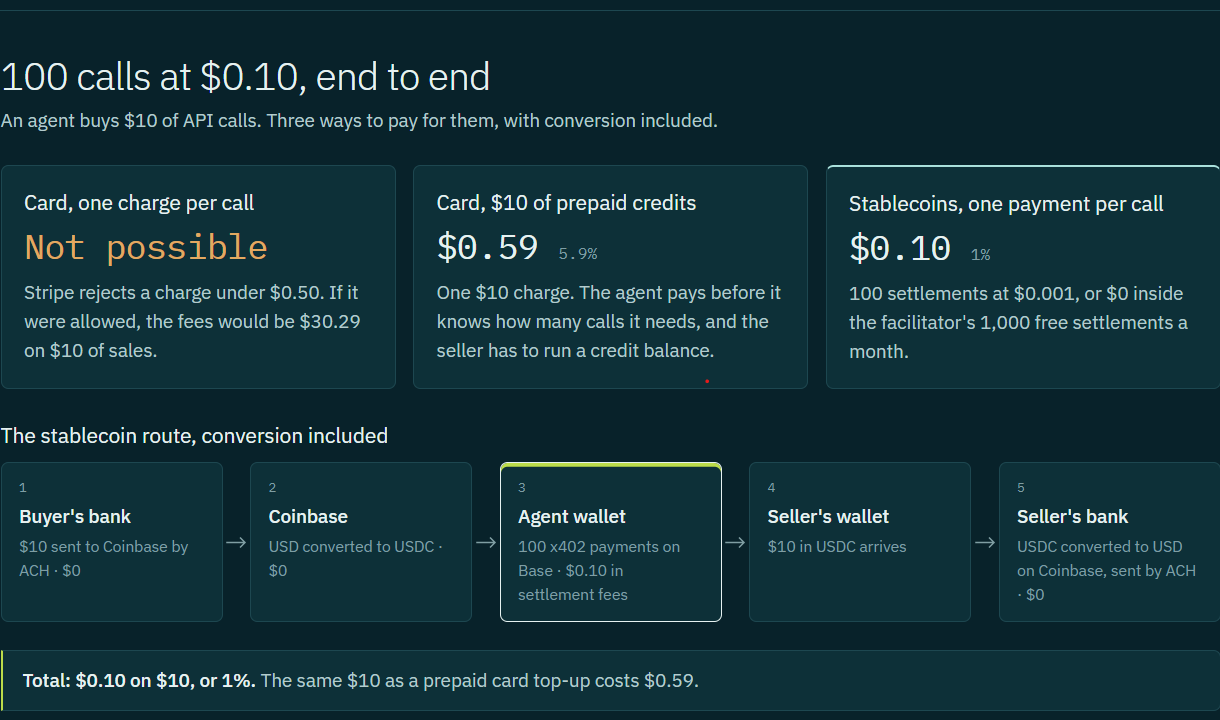
Nevermined in contrast 100 API calls priced at 10 cents every. Supply: Nevermined.
That will imply banks and card networks have a bonus past simply having extra retailers on their programs; they have already got relationships with clients, companies and regulators, in addition to established processes for dealing with disputes.
Krause says that stacks the chances in conventional finance’s favor. “My guess is the massive TradFi gamers will finally win,” he says. “They’re those with funding entry and are positioned to straddle the divide and provide a hybrid model.”
Nevermined helps funds utilizing each playing cards and stablecoins, and Argomaniz expects the 2 programs to coexist, “a minimum of for the following few years.”
Crypto may energy the plumbing with out proudly owning the market
That is the place Van Bourg’s argument turns into more durable for the crypto business to dismiss — even when stablecoins are helpful for machine-to-machine funds, established fee networks may simply incorporate them with out handing over management of the client relationship.
So an agent would possibly work together with Visa or Mastercard whereas the networks use blockchain infrastructure behind the scenes.
That may successfully flip blockchain into fee plumbing with out companies or customers needing to carry crypto or work together with a decentralized protocol.
Mastercard accomplished its acquisition of stablecoin infrastructure supplier BVNK in August, in a deal introduced at as much as $1.8 billion, giving Mastercard the infrastructure to attach fiat and onchain funds.
So, whereas AI brokers may use blockchain-based funds the place present rails battle, crypto may discover itself powering the agent financial system with out capturing a lot of its worth.
Journal: Find out how to protect wealth and entry funds throughout a nationwide emergency

