Key Takeaways
- Solo bitcoin miners have recorded dozens of profitable block discoveries all through 2026, together with a number of victories involving comparatively cheap gear.
- Bitcoin’s hashrate has reclaimed the 1 ZH/s threshold regardless of declining mining income and mounting operational pressures.
- Small-scale miners proceed chasing full block rewards, even when electrical energy bills exceed their anticipated every day earnings.
A $190,000 Bitcoin Jackpot With Astronomical Odds
Think about buying a lottery ticket with odds so unbelievable that arithmetic suggests ready greater than 2,000 years for a successful consequence. Now think about beating these odds on an in any other case extraordinary Sunday morning.
That’s primarily what occurred on Nov. 22, when an unidentified solo bitcoin miner found block peak 977057 by CKPool Solo at roughly 7:54 a.m. Jap time.
The lucky participant collected 3.1287 BTC, comprising the usual 3.125 BTC block subsidy and roughly 0.0037 BTC in transaction charges. With bitcoin’s worth buying and selling close to $60,700 at 10 a.m. Jap time, the reward carries an estimated worth of $190,000 earlier than the mining service’s price.
The block contained 584 transactions and arrived simply 3.3 minutes after its predecessor. But probably the most extraordinary element considerations the comparatively modest computing gear answerable for the invention.
In response to the mining information logged by soloblocks.io, the winner commanded roughly 8 terahash per second (TH/s), equal to the mixed output of roughly seven Bitaxe Gamma units.
Towards Bitcoin’s present community hashrate of 1,042 exahash per second (EH/s), that represents an virtually imperceptible fraction of the computational energy competing to find the subsequent block. The miner’s estimated chance of discovering any specific block was roughly one in 130 million. At that hashrate, the statistically anticipated ready interval stretched roughly 2,500 years.
As a substitute, the miner struck gold. The winner’s id stays unknown, however like all of the solo blocks found earlier than it, the reward is recorded on Bitcoin’s public blockchain. It’s principally one other instance of how a comparatively small participant can often overcome the big computational benefit loved by industrial mining operations.
Solo Bitcoin Miners Are Having fun with an Extraordinary 2026
Sunday’s discovery was hardly an remoted incident. All through 2026, solo miners have repeatedly captured total block rewards, often utilizing gear that would seem virtually insignificant beside business mining services.
Bitcoin.com Information beforehand documented 36 solo-style block discoveries between Feb. 11 and Nov. 7, collectively producing roughly 113 BTC in rewards, valued close to $8.5 million at prevailing costs. November has been particularly lively.
CKPool Solo members found two blocks on Nov. 7, adopted by extra victories on Nov. 11 and Nov. 19. Sunday’s discovery marked the fifth reported CKPool Solo block throughout November alone.
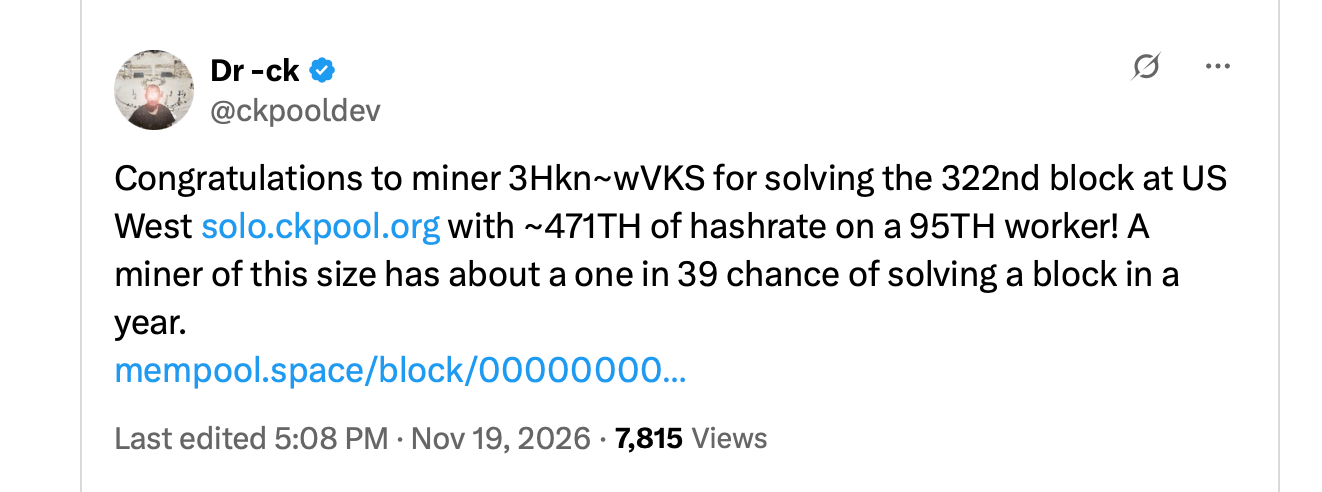
One Nov. 11 winner operated with roughly 161 TH/s, whereas one other participant in July reportedly found block 957382 utilizing a single Bitaxe producing round 1 TH/s by Public Pool. In response to Soloblocks.io’s historic monitoring, the newest discovery introduced the documented whole to 146 solo-style blocks since 2016, representing greater than 1,000 BTC in cumulative rewards.
Nevertheless, these successes shouldn’t be mistaken for enhancing particular person possibilities. The extra miners collaborating, the better the chance for infrequent unbelievable victories throughout your complete group. For any specific machine, the mathematical odds stay unforgiving.
Bitcoin Mining Economics Make the Jackpot Even Sweeter
These victories arrive throughout one of many trade’s extra financially demanding durations. On Saturday, Nov. 21, bitcoin slipped to $55,081 on Bitstamp, whereas hashprice deteriorated to $26.16 per petahash per second (PH/s) per day. Bitcoin’s community hashrate, however, has recovered above 1 zettahash per second (ZH/s), regardless of the appreciable monetary stress confronting business operators.
For smaller members, the economics are notably discouraging. A miner working 8 TH/s may anticipate roughly 21 cents in gross every day income underneath the provided community situations. Electrical energy bills for a comparable setup drawing 100 to 200 watts may vary from 24 to 48 cents every day at $0.10 per kilowatt-hour (kWh).
{Hardware} bills additional complicate the equation. A number of solo mining swimming pools cost profitable miners a price whereas permitting members to retain the rest of their block rewards. In contrast to conventional swimming pools like Foundry, Antpool or F2pool, unsuccessful miners obtain nothing. For a lot of members, that association transforms mining from a traditional revenue-generating operation right into a calculated wager involving electrical energy, gear and extraordinary endurance.
Others take part for instructional functions, technical experimentation, or the easy satisfaction of contributing computing energy exterior conventional reward-sharing swimming pools. Regardless of the motivation, Sunday’s victory illustrates an enduring peculiarity of Bitcoin’s design. An industrial operation commanding monumental computational assets enjoys vastly superior odds, but it surely can’t fully exclude smaller rivals from the competition.
The overwhelming majority of solo miners won’t ever expertise a comparable payday, and the latest assortment of winners does nothing to change that mathematical actuality. Nonetheless, amid depressed costs, shrinking margins, and relentless competitors, one modest mining setup has delivered one other extraordinary reminder: Bitcoin’s subsequent jackpot stays out there to anybody lucky sufficient to find the successful block.