Key Takeaways
- Investigators found an uncommon cryptographic signature that will clarify how the unauthorized withdrawals occurred.
- The attacker transformed stolen stablecoins into ethereum earlier than routing 1000’s of cash by means of Twister Money.
- Chainflip has provided a ten% restoration bounty, with a deadline set for Monday, Nov. 23.
Chainflip Vaults Emptied in Coordinated Bitcoin and Ethereum Transactions
The decentralized trade (DEX) generally known as Chainflip facilitates native cryptocurrency swaps throughout totally different blockchains with out requiring customers to depend on standard wrapped property. Its infrastructure operates by means of a distributed community of as much as 150 validators answerable for managing shared vaults and authorizing transfers.
Underneath regular circumstances, roughly 100 validators should take part in a threshold-signing course of earlier than property can go away these reserves. The system employs combination cryptographic signatures, with signing keys ordinarily rotated each three days to restrict publicity. The intruder managed to avoid these protections.
In keeping with onchain findings, preparations started round Nov. 11, when funds related to the suspected attacker handed by means of Twister Money, an Ethereum-based privateness mixer. On Nov. 20, the person bought FLIP tokens and registered a validator account, establishing a presence inside Chainflip’s infrastructure.
The theft commenced round 1:41 a.m. Jap on Nov. 21, when a single bitcoin transaction transferred 122.86137042 BTC into a newly created tackle. Roughly 20 minutes afterward, the funds moved once more, introducing one other step into their transaction historical past.
The ether-side withdrawal adopted at 07:10:59 UTC, executing by means of the vault’s transferBatch perform. That operation transferred 520.2243399 ETH, 3,249,631.41 USDC and 758,141.33 USDT to deal with 0x7d14a719072DA80076b4edcec3e3401209d21Eaf.
The submitting pockets, 0x78fa4ac270db14886033e95b9b9e93f887aa2db0, had obtained its preliminary transaction charges from Twister Money roughly one minute earlier. Its in any other case empty transaction historical past suggests the tackle was created particularly for the operation.
Inside minutes, the stablecoin proceeds have been exchanged for ether by means of Uniswap. Roughly 2,909 ETH subsequently entered Twister Money throughout 38 transactions executed in simply 48 seconds, leaving investigators to comply with a quickly fragmented path.
Cryptographic Anomaly Exposes Potential Weak point in Validator Safety
Blockchain analytics agency Bitquery examined 299,677 signatures accepted by Chainflip’s Ethereum KeyManager since 2023, figuring out an irregularity that distinguishes the unauthorized switch from extraordinary vault exercise. The transaction contained a 39-digit nonce that departed from the established sequential sample. Not one of the different signatures within the historic dataset exhibited the identical attribute.
This discovering suggests the authorization could have been generated exterior the customary multiparty signing process, doubtlessly by means of unauthorized entry to the combination signing key or adequate cryptographic shares.
In contrast to reentrancy assaults or standard contract-logic vulnerabilities, the vault accepted what gave the impression to be a legitimate signature. The underlying query, due to this fact, considerations how the attacker obtained the authority crucial to supply it, somewhat than whether or not the contract appropriately executed its directions.
Chainflip Labs subsequently linked the incident to the newly registered validator and mentioned investigators had recognized and corrected the precise mechanism accountable. Nonetheless, the group has not printed a complete technical autopsy explaining exactly how the publicity occurred.
The earlier scheduled key rotation occurred on Nov. 18. Following the unauthorized transfers, validators accomplished one other rotation roughly one hour and 42 minutes later, changing the doubtless compromised credentials forward of the extraordinary schedule. Different vaults, together with Arbitrum, displayed no comparable rapid withdrawals.
Chainflip Points Restoration Ultimatum With 10% Bounty
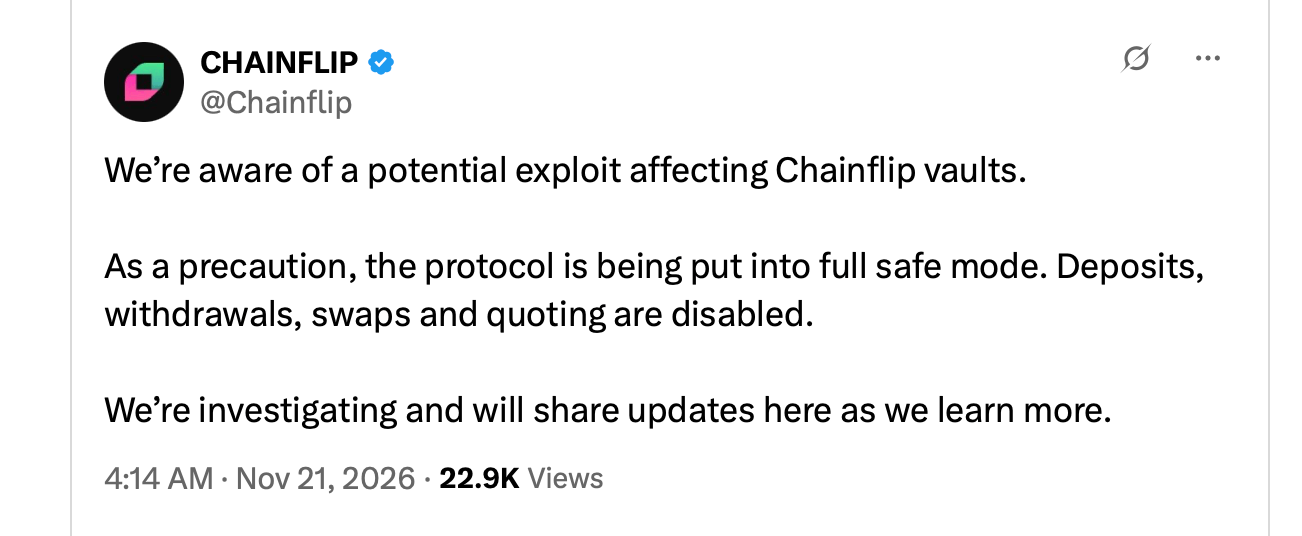
Builders activated Full Protected Mode, suspending deposits, withdrawals, swaps and value quotations whereas the investigation continued. Chainflip Labs subsequently contacted the perpetrator by means of an onchain message, proposing that 90% of the proceeds be returned earlier than 18:38 UTC on Monday, Nov. 23, in trade for permission to retain the remaining 10%.
The requested compensation consisted of 110.57523337 BTC and a couple of,618.1 ETH, with the latter representing the transformed Ethereum-side holdings. Underneath the proposed association, Chainflip would classify a well timed compensation as a white-hat restoration and withdraw its current law-enforcement complaints.
The communication additionally warned that blockchain surveillance companies had flagged the implicated addresses and have been monitoring withdrawals from the privateness mixer. Investigators reportedly recognized the server used for validator registration, alongside further metadata doubtlessly helpful in establishing the perpetrator’s id.
Chainflip confirmed that authorities had already obtained studies regarding the theft. As of Nov. 22, no restitution had been introduced, and the group had not outlined a proper compensation plan for affected customers.
FLIP Value Collapse Erases November Rally
The safety failure interrupted what had beforehand been an encouraging month for the protocol’s native cryptocurrency. FLIP traded round $0.30 earlier in November earlier than climbing into the $0.45 to $0.48 vary between Nov. 18 and Nov. 20. The following liquidation erased these positive factors, pushing the asset towards costs final noticed in late Might.
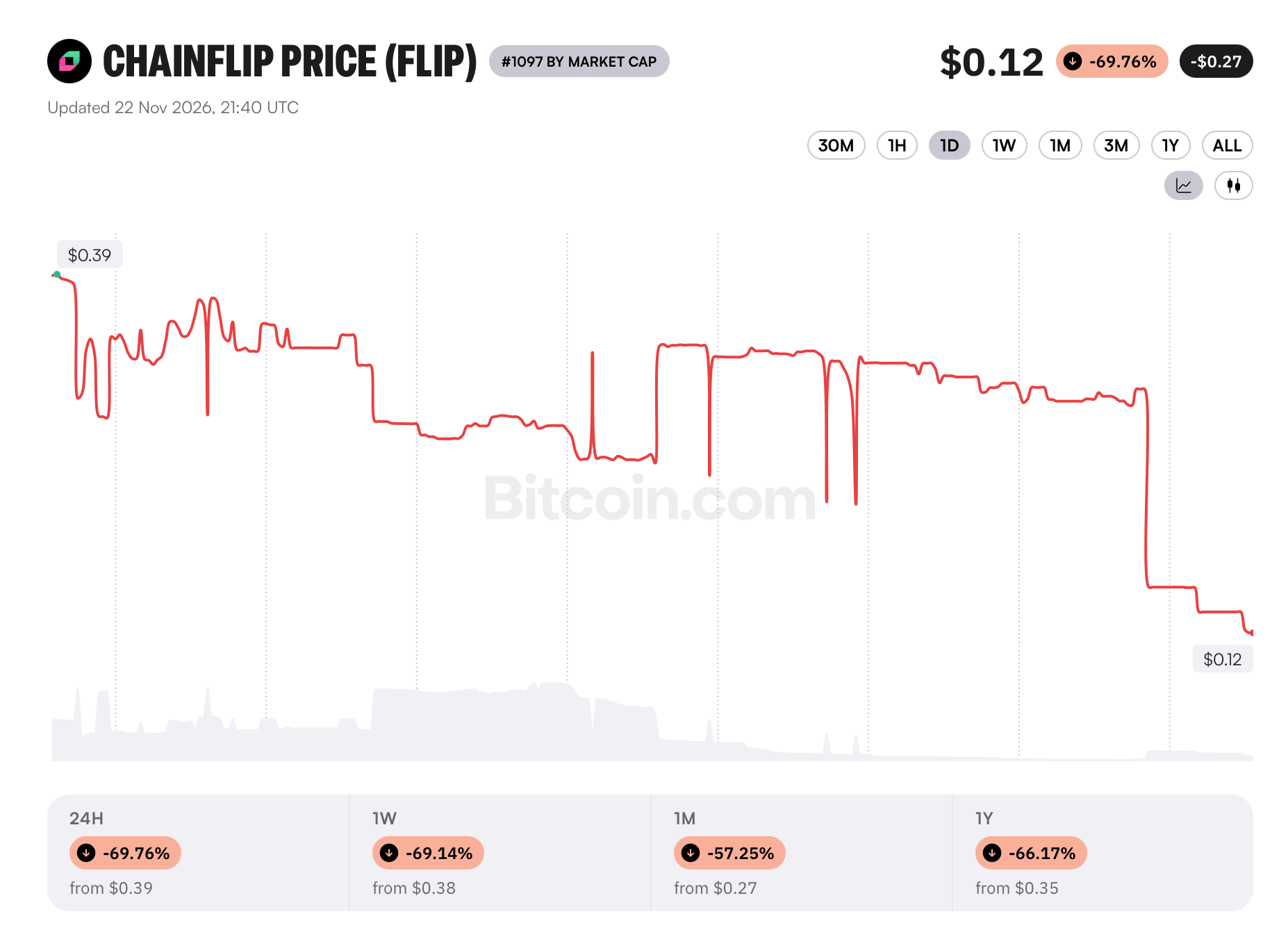
By Sunday, Bitcoin.com’s market value feed confirmed quotations between $0.12 and $0.15 per FLIP, with reported 24-hour losses reaching roughly 60% to 66%. Variations throughout buying and selling venues mirrored skinny liquidity and unstable situations. The episode additionally revived considerations stemming from Chainflip’s Sept. 12 exploit, when a TRON transaction-memo flaw enabled an attacker to acquire duplicate refunds totaling roughly 736,442 USDT.
That earlier vulnerability concerned beforehand processed deposits being incorrectly interpreted as failed swaps. Validators finally permitted reimbursement of affected liquidity suppliers utilizing surplus funds. The newest incident presents a considerably totally different problem as a result of the suspected weak point considerations the authorization infrastructure itself somewhat than an remoted transaction-processing error.
For Chainflip, the rapid monetary injury is barely a part of the issue. The approaching restoration deadline, unanswered technical questions, and uncertainty surrounding buyer compensation go away the protocol going through a troublesome check of its safety structure. Even when the lacking property are recovered, establishing why its distributed safeguards failed will stay important to rebuilding confidence.