

Key Takeaways
- A newly disclosed Bitcoin Core vulnerability raises recent questions concerning the resilience of vital community infrastructure.
- Synthetic intelligence is uncovering safety weaknesses that escaped years of typical software program scrutiny.
- The rising sophistication of automated vulnerability analysis is forcing cryptocurrency builders to rethink how shortly safety threats are addressed.
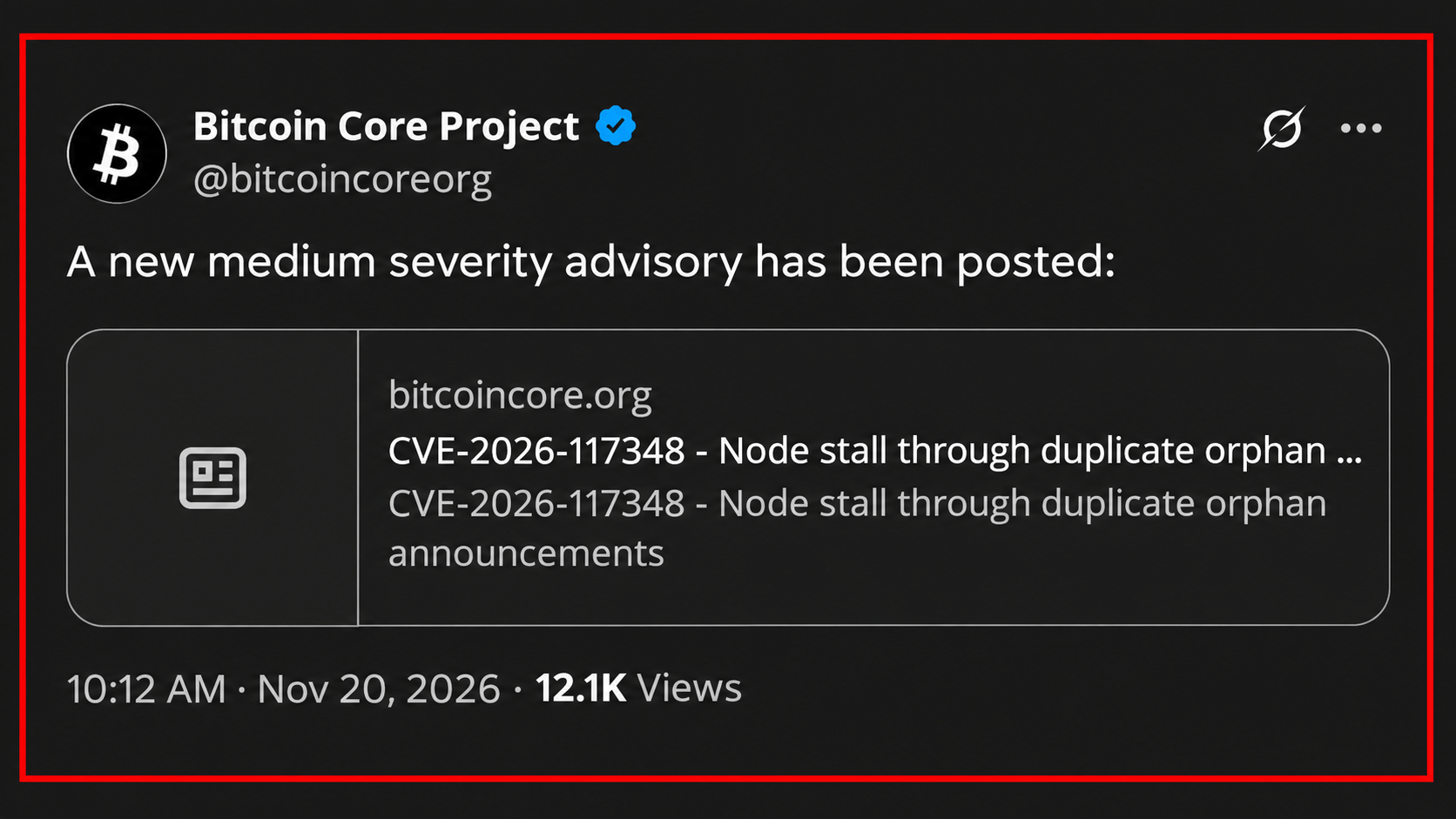
The vulnerability, cataloged as CVE-2026-117348 and titled “Node stall by duplicate orphan bulletins,” may stop affected Bitcoin nodes from processing incoming blocks and transactions for greater than a dozen seconds per malicious message.
In accordance with the official Bitcoin Core disclosure, the issue affected variations 29.0 by 29.5, 30.0 by 30.4, and 31.0 by 31.2. Corrective updates can be found in variations 30.5, 31.3, and 32.1, whereas the discontinued 29.x department will obtain no additional patches.
How an AI Scanner Uncovered Bitcoin Core’s Node-Stalling Vulnerability
The software program improvement staff often called Bitcoin Core maintains a brief holding space often called the “orphanage,” the place transactions await lacking father or mother transactions. When one other community participant broadcasts one in every of these transactions, the software program examines its dependencies to find out which lacking data must be requested.
The vulnerability exploited an ignored inefficiency in that course of. Bitcoin stock messages can include 50,000 entries, but the software program didn’t disregard duplicate transaction bulletins. An attacker may repeatedly reference an orphan transaction with hundreds of lacking mother and father, forcing the receiving node to carry out the identical computationally costly checks hundreds of occasions.
Every manipulated message may stall processing for greater than 12 seconds, leaving the focused node briefly unable to deal with incoming blocks or different community communications.
The invention originated with Venture Loupe, an automatic massive language mannequin (LLM) safety initiative developed by Elias Rohrer at Spiral, Block’s open-source Bitcoin improvement division. Bitcoin Core developer Gregory Sanders subsequently validated the discovering and introduced it to the challenge’s safety staff.
Venture Loupe reported the vulnerability on July 8. An impartial researcher recognized as Stutxo submitted a separate report on Aug. 4, the identical day Sanders opened a corrective pull request. Builders merged the repair on Aug. 6, and Bitcoin Core 32.1 included it on Oct. 27.
The Nov. 20 disclosure accompanied up to date releases for maintained older branches. The correction ensures every distinctive transaction announcement is processed solely as soon as per stock message.
Though the flaw permitted non permanent denial-of-service assaults, the advisory didn’t set up any mechanism for stealing bitcoin or completely damaging nodes.
AI Safety Analysis Exposes Lengthy-Standing Blockchain Weaknesses
The disclosure arrives amid an extraordinary 12 months for AI-assisted vulnerability analysis throughout cryptocurrency infrastructure.
In February, an AI-assisted evaluate recognized a vital signature-verification weak point within the XRP Ledger’s proposed Batch modification earlier than activation. One other investigation uncovered a high-severity vulnerability in Nethermind, an Ethereum execution shopper, probably affecting validator operations.
By late Might, researcher Taylor Hornby had used an AI-assisted auditing system to determine a four-year-old flaw in Zcash’s Orchard privateness protocol. The vulnerability may have permitted undetectable counterfeit ZEC, though builders corrected it earlier than public disclosure.
August introduced one other putting demonstration. Sixteen volunteer builders taking part in a Bitcoin safety initiative generated 4,962 findings throughout 390 initiatives in roughly in the future, together with 85 initially labeled as vital.
Nonetheless, automated discovery launched appreciable issues. Maintainers confronted hundreds of studies requiring human verification, whereas authentic safety considerations competed with false positives and poorly substantiated findings.
Core Lightning builders additionally confronted an inflow of AI-generated vulnerability studies, in the end figuring out real safety issues requiring corrective releases.
The implications prolong past defensive analysis. Safety specialists have raised considerations that malicious actors can make use of related know-how to uncover weaknesses in older software program, probably shortening the helpful lifespan of conventional safety audits.
Bitcoin Core Accelerates Disclosure as AI Adjustments Safety Analysis
Recognizing this improvement, Bitcoin Core revised its vulnerability disclosure coverage in October. Points labeled as simply discoverable, together with weaknesses identifiable by comparatively easy LLM-assisted evaluation, now obtain accelerated public disclosure alongside corrective releases.
CVE-2026-117348 illustrates that strategy in observe.
The episode additionally exposes a tough safety paradox. AI can determine ignored vulnerabilities quicker than typical analysis, however its rising accessibility probably provides attackers comparable capabilities. For open-source cryptocurrency infrastructure, the central problem is more and more not merely discovering weaknesses, however validating and correcting them earlier than adversaries exploit the identical data.


