

Chances are high, you’ve already used VoIP right this moment with out realizing it. Everytime you place a voice name on WhatsApp, meet up with household on FaceTime Audio, or be part of a Zoom assembly, you’re counting on VoIP know-how.
Whereas tapping a client calling app takes seconds, selecting, deploying, and managing a enterprise VoIP cellphone system takes extra planning. This information explains what VoIP is, how voice knowledge travels over the web, how VoIP compares to conventional landlines on price and reliability, and what your workforce must make the change.
What Is VoIP?
VoIP — quick for Voice over IP or Voice over Web Protocol — is a know-how that allows you to make and obtain voice calls over a broadband web connection as a substitute of conventional analog copper cellphone strains.
As a substitute of sending electrical alerts throughout native phone firm wires, cloud telephony turns your voice into digital knowledge and routes it via your web router. You may place VoIP calls from a bodily IP desk cellphone, a laptop computer softphone, an internet browser, or a smartphone app, and nonetheless attain any conventional landline or cellular quantity worldwide.

Voice over IP vs. Voice over Web Protocol: Similar factor?
Sure. Individuals use a number of interchangeable phrases to explain the identical VoIP know-how:
- VoIP: The on a regular basis shorthand acronym.
- Voice over IP: The operational description, sending voice site visitors throughout Web Protocol (IP) networks.
- Voice over Web Protocol: The total technical title of the underlying communication commonplace.
- Alternate trade names: You’ll additionally see VoIP known as IP telephony, web telephony, broadband telephony, or broadband cellphone service, all referring to cellphone calls delivered over broadband web as a substitute of legacy copper circuits.
How Does VoIP Work?
VoIP converts analog voice alerts (sound waves) into compressed digital knowledge, breaks that knowledge into tiny knowledge packets, and transmits these packets over the web. A VoIP service supplier manages signaling and name routing between you and the particular person you’re calling in milliseconds.

Right here’s what occurs behind the scenes throughout an energetic name:
- Connection: Your IP desk cellphone, laptop computer softphone, or cellular app registers over your Native Space Community (LAN) router together with your VoIP service.
- Signaling: Once you dial a quantity, your system asks your supplier to arrange a name session. Most enterprise programs use open requirements like Session Initiation Protocol (SIP) so totally different desk telephones and software program apps work collectively cleanly.
- Packetization: As soon as linked, software program packages known as codecs (comparable to G.711 or G.722 for wideband HD audio) compress your audio alerts into tiny, numbered knowledge packets.
- Transmission: Your supplier sends these knowledge packets throughout IP networks utilizing Actual-Time Transport Protocol (RTP) over UDP, shifting far sooner and extra effectively than legacy copper wires.
- Conversion to the cellphone community: If the particular person you’re calling makes use of a daily conventional landline or cell phone moderately than VoIP, your supplier routes the decision via a gateway that converts the digital packets again into a regular phone sign on the Public Switched Phone Community (PSTN). The particular person on the opposite finish wants no particular gear or app to reply.
- Reassembly: On a VoIP-to-VoIP name, the recipient’s system receives the incoming knowledge packets, places them again so as, and decodes them into clear, pure audio alerts in actual time.
Circuit switching vs. packet switching: Why VoIP prices much less
The largest technical shift behind VoIP is how networks carry a dialog:
| Switching Methodology | Used By | How a Name Travels |
|---|---|---|
| Circuit switching | Conventional copper landlines (PSTN) | Reserves one devoted, steady bodily circuit between caller and recipient for the complete size of the decision, even throughout silence. |
| Packet switching | VoIP (web telephony) | Compresses voice into small knowledge packets that share present broadband web pathways alongside different knowledge and reassemble on the vacation spot. |
Packet switching eliminates the necessity for devoted copper strains to be held open throughout cities or oceans, permitting carriers to deal with much more calls on present web infrastructure, which is why VoIP dramatically lowers long-distance and worldwide calling prices.
VoIP vs. Landline Telephones: Key Variations
Legacy enterprise cellphone programs use conventional cellphone strains wired into an on-site Non-public Department Change (PBX) closet. Fashionable VoIP cellphone programs transfer the switching intelligence into the cloud.
| Characteristic | VoIP Telephone System | Conventional Landline (PSTN / On-Web site PBX) |
|---|---|---|
| Calls to landlines & cellular | Sure (through PSTN gateways) | Sure |
| Lengthy-distance & worldwide | Included or low per-minute charges | Excessive per-minute toll charges |
| Inside firm calls | Free throughout places of work & distant employees | Free inside one constructing; additional trunking between places of work |
| Caller ID & name ready | Included | Usually billed as paid add-ons |
| Setup & enlargement | Plug-and-play through internet dashboard | Technician go to & bodily wiring required |
| Web requirement | Broadband (~100 Kbps per energetic name) | None (makes use of devoted copper wiring) |
| Wi-fi & mobility | Wi-Fi, DECT cordless, Bluetooth, cellular apps | Restricted to on-premise cordless handsets |
| Outage resilience | Auto-routes calls to cellular apps over 4G/5G | Stops working if bodily strains are minimize; no cellular failover |
| Underlying requirements | SIP, RTP, TLS, SRTP over IP | Analog copper circuits / PRI / T1 strains |
| Name high quality | HD wideband voice (with wholesome bandwidth) | Customary narrowband analog audio |
| {Hardware} setup price | $0 (with softphones) or ~$80–$600 per IP cellphone | ~$110+ per wired wall jack + on-site PBX {hardware} |
| Typical month-to-month price | $15–$60 per person | $35+ per analog line + upkeep contracts |
| Auto attendant & IVR | In-built | Costly PBX add-on |
| Distant & hybrid work | Seamless throughout laptop computer, cellular, and residential desk | Tied to bodily workplace strains |
| Software program integrations | Native CRM, helpdesk, and calendar sync | Uncommon or requires expensive third-party middleware |
Clear indicators it’s time to maneuver off landlines:
- Your workforce works hybrid or remotely and desires enterprise numbers outdoors the workplace.
- You’re paying month-to-month charges for unused copper strains or growing old on-site PBX upkeep.
- Callers hit busy alerts or voicemails since you lack multi-level name menus and name routing.
- Including a brand new worker takes days of service tickets as a substitute of two minutes in a browser.
- You need voice, SMS, workforce chat, and video conferencing unified in a single workspace.
What Tools Do You Want To Set Up VoIP?
Getting began with a VoIP cellphone service requires far much less {hardware} than an on-site Non-public Department Change. At minimal, you solely want a dependable broadband web connection, a business-grade router, and a subscription with a VoIP supplier.
From there, your workforce can reply calls on three endpoint choices:
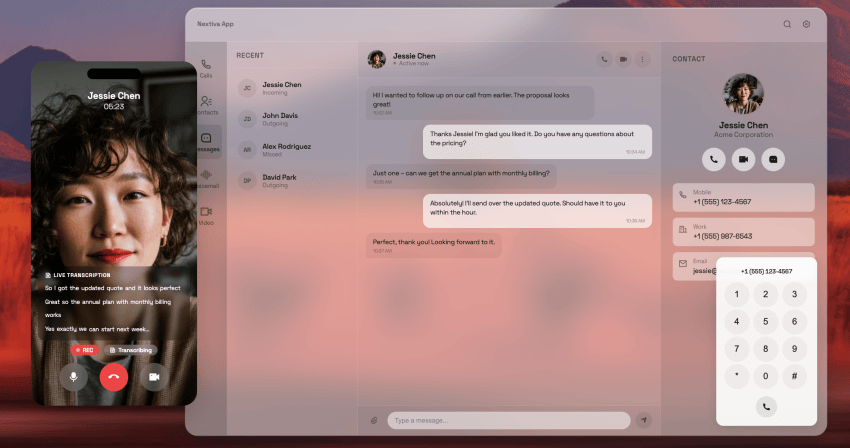
- Desktop softphones & internet dialers: Software program apps on Home windows, Mac, or Chrome paired with a USB or Bluetooth headset.
- Cell VoIP apps: Native iOS and Android VoIP apps that maintain work calls separate from private cell numbers.
- Bodily IP desk telephones & cordless handsets: Devoted {hardware} handsets that plug into Ethernet or join over Wi-Fi.
Evaluating {hardware} fashions? For a whole breakdown of hardphones, cordless DECT handsets, convention telephones, softphones, and present 2026 pricing, learn our devoted information to enterprise VoIP telephones.
Superior infrastructure you would possibly want
Bigger places of work or buildings with legacy {hardware} might also add two easy parts:
- Energy over Ethernet (PoE) switches: Provide each community knowledge and electrical energy to IP telephones over a single Ethernet cable — holding desks freed from wall energy bricks.
- Analog phone adapters (ATAs): Compact {hardware} converters that plug into your web router and switch analog alerts into IP knowledge. Companies use an analog phone adapter to maintain legacy fax machines, overhead warehouse paging horns, or door/alarm strains operating. An ATA may also join present analog cellphone desk handsets, letting groups part {hardware} upgrades progressively as a substitute of shopping for new IP telephones .
How To Change To VoIP
Migrating from copper strains to a cloud VoIP service can take just a few days to a few weeks (largely ready on service quantity switch approval). Comply with these six steps for a zero-downtime transition:
1. Validate your web community capability
As a result of VoIP cellphone programs share your web reference to e-mail, cloud apps, and video calls, confirm your connection can deal with peak quantity earlier than switching.
Every energetic VoIP name makes use of roughly 100 Kbps (0.1 Mbps) of add and obtain bandwidth. Multiply 100 Kbps by the utmost variety of simultaneous calls your workforce expects throughout busy hours:
- 10 simultaneous calls: ~1 Mbps add and ~1 Mbps obtain
- 25 simultaneous calls: ~2.5 Mbps add and ~2.5 Mbps obtain
Do not forget that voice shares your reference to regular internet site visitors. Run a devoted VoIP high quality check to substantiate low latency, jitter, and packet loss, and allow High quality of Service (QoS) in your router so voice site visitors at all times takes precedence.
2. Select your supplier and plan
Listing the options your workforce truly makes use of, comparable to name recording, name forwarding, video conferencing, CRM integration, or multi-level auto attendants, so that you don’t overpay for enterprise contact-center bundles should you solely want core enterprise calling.
3. Hold your online business quantity (quantity porting)
You don’t have to surrender your established native or toll-free numbers. By means of federal quantity porting, your new VoIP supplier coordinates instantly together with your outdated service to switch present numbers cleanly. Hold your legacy cellphone service energetic till porting completes so callers expertise zero interruption.
4. Stock legacy gadgets
Earlier than reducing over your copper strains, stroll your workplace and listing each analog system nonetheless plugged right into a wall cellphone jack, together with analog cellphone handsets, fax machines, overhead paging horns, postage meters, and constructing alarm panels.
Determine whether or not every system will join via an ATA or transfer to a cloud substitute (like eFax or mobile alarm monitoring) earlier than canceling copper service.
5. Arrange your telephones
Determine which roles want bodily desk handsets and which choose desktop/cellular apps (our information to selecting the best VoIP cellphone breaks down prices and fashions by function). Supplier-certified IP telephones ship preconfigured, so that you merely plug them in, whereas distant employees obtain the softphone app and register.
6. Configure routing paths and prepare your workforce
Inside your on-line admin portal, report your primary greeting, set enterprise hours and after-hours name routing, assign extensions, and run a 15-minute walkthrough so staff know tips on how to switch calls, examine voicemail-to-email, and reply on cellular.
Benefits of VoIP
Companies transfer to VoIP cellphone programs for the next primary causes:
- Substantial price discount: Eliminating bodily cellphone wiring, on-site PBX upkeep, and long-distance tolls helps corporations minimize month-to-month telecom spend by as much as 50%.
- HD audio readability: Fashionable wideband codecs ship noticeably crisper name high quality than legacy narrowband copper strains on a wholesome connection.
- Constructed-in calling & collaboration instruments: Options that was once costly add-ons — auto attendants, name forwarding, name recording, voicemail transcription, SMS, and video conferencing — come bundled in a single plan.
- Decrease worldwide calling charges: Routing calls over IP slashes worldwide per-minute prices in comparison with legacy telecom carriers.
- Fast deployment and mobility: Add new customers in minutes from an internet portal, and reply calls from any workplace, dwelling desk, or smartphone.
- Native presence with any space code: As a result of a VoIP quantity is tied to a person account moderately than a bodily copper wire, companies can decide native numbers in any space code to ascertain a neighborhood presence in new markets, and people numbers observe staff throughout each system.
Disadvantages of VoIP & How To Overcome Them
Like several cloud know-how, VoIP has sensible limitations you must plan round earlier than migrating:
Dependency on energetic web connections
A neighborhood ISP outage can take workplace desk telephones offline, since calls journey over your web connection.
The repair: Configure cloud failover guidelines so incoming calls mechanically path to staff’ cellular VoIP apps over mobile knowledge (4G/5G) or backup cell numbers — and take into account a secondary mobile/fiber failover line for high-volume places of work.
Vulnerability to native energy outages
Conventional copper strains carried low-voltage energy from the phone trade; VoIP routers, PoE switches, and desk telephones depend on constructing electrical energy.
The repair: Plug your modem, router, and PoE change into an uninterruptible energy provide (UPS) battery backup to maintain workplace telephones alive via transient outages, whereas cellular apps maintain distant and hybrid employees reachable on battery energy.
Emergency service monitoring (E911)
Conventional landlines are bodily tied to at least one road handle. With VoIP, emergency operators depend on the handle registered in your VoIP service portal, so shifting an IP cellphone to a house workplace with out updating your handle can route first responders to the fallacious location.
The repair: Hold each desk cellphone and distant person’s bodily road handle present in your supplier’s E911 dashboard. Additionally affirm together with your supplier whether or not listing help and white-page listings are supported if public listing placement issues to your online business, as VoIP suppliers differ in providing them.
Name high quality relies on community situations
Even and not using a full outage, a congested or unstable community causes uneven audio, robotic voices, latency (noticeable speaking delays), and jitter (packets arriving out of order).
The repair: Run a VoIP high quality check earlier than rollout, dimension your bandwidth for peak concurrent calls (100 Kbps per name), and activate QoS in your router so voice packets at all times bounce forward of huge downloads or streaming video.
Finest VoIP Telephone System Options
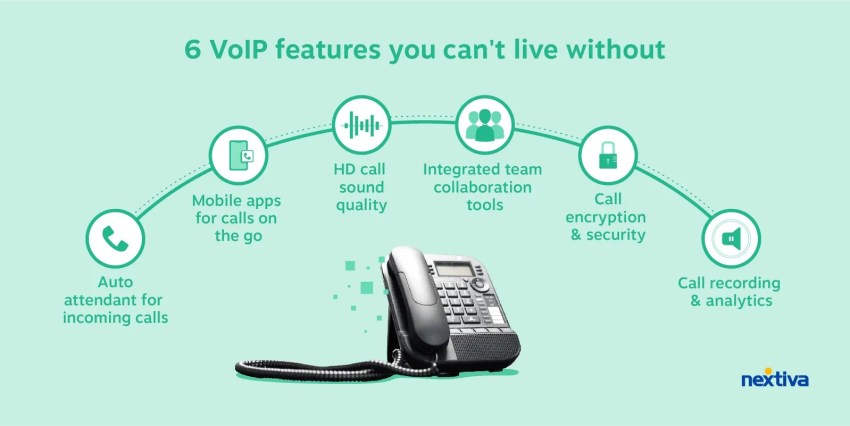
Fashionable VoIP cellphone programs bundle enterprise calling options that legacy cellphone corporations charged additional for, or couldn’t provide in any respect:
1. Auto attendant & IVR
A digital receptionist greets callers professionally and makes use of Interactive Voice Response (IVR) menus (“Press 1 for Gross sales, Press 2 for Help”) and rules-based name routing or name forwarding to ship each caller to the fitting particular person, even after hours.
2. Cell and desktop apps
Native desktop and cellular softphone apps let groups place calls with their firm caller ID, examine voicemail transcripts, and switch calls from any laptop computer or smartphone.
3. HD name high quality
Wideband audio codecs seize a broader vocal frequency vary than conventional analog strains, making conversations clearer and simpler to observe on lengthy calls.
4. Unified communications (UCaaS)
Many VoIP suppliers mix voice calling with workforce chat, enterprise SMS, and video conferencing inside one Unified Communications as a Service (UCaaS) platform, lowering app switching throughout your workforce.
5. Name encryption and VoIP safety
Respected enterprise suppliers shield conversations with TLS (signaling encryption) and SRTP (media encryption), multi-factor authentication, and SOC 2 / ISO-certified knowledge facilities.
6. Name recording & analytics
Constructed-in name recording and call-volume dashboards assist gross sales and assist managers coach reps, confirm compliance, and spot peak name hours with out shopping for third-party recording {hardware}.
How A lot Does VoIP Value?
Most companies pay round $25 per person per thirty days for normal VoIP plans, with general VoIP prices usually starting from $15 to $60 per person per thirty days, relying on plan tier and options.
Typical VoIP prices:
- Preliminary setup: $15–$60 per line (often simply your first month of service)
- Month-to-month service: $15–$25+ per person on commonplace enterprise tiers
- Optionally available IP cellphone {hardware}: $80–$600 per desk cellphone (or $0 utilizing included softphones)
- Worldwide calls: Beginning round $0.01+ per minute
- Taxes & regulatory charges: Differ by metropolis, county, and state
Typical conventional landline prices:
- Month-to-month service: $35+ per analog voice line
- Set up charges: $50–$100 per wired wall drop
- Provider deposit: $100–$500
- Annual PBX upkeep contract: $1,000+ per yr
- Worldwide calls: Usually $1.00+ per minute
Labored Instance: First-Yr Value for a 10-Individual Workplace
Utilizing the baseline figures above, right here is how Yr 1 compares for a 10-employee enterprise whose employees use present laptops and smartphones for VoIP:
| Value Part (10 Customers, Yr 1) | Cloud VoIP ($25/person/mo) | Conventional Landline ($35+/line/mo) |
|---|---|---|
| Annual line/service charges | $3,000 (10 × $25 × 12) | $4,200+ (10 × $35 × 12) |
| {Hardware} or set up drops | $0 (utilizing present laptops/telephones) | $500–$1,000 (10 drops × $50–$100) |
| Provider deposit | $0 | $100–$500 |
| Annual upkeep contract | $0 (included in cloud plan) | $1,000+ |
| Estimated Yr-1 Complete | ~$3,000 (plus taxes/charges) | $5,800–$6,700+ (plus taxes/charges) |
Even earlier than counting long-distance or worldwide calls ($0.01+ vs. $1.00+ per minute), a 10-person workforce usually saves $2,800 to $3,700+ in its first yr and avoids recurring upkeep payments yearly afterward.
How To Select the Proper VoIP Supplier
When evaluating VoIP suppliers for your online business, consider 5 sensible standards:
- Verified uptime and community redundancy: Search for geographically redundant knowledge facilities, a printed uptime SLA (ideally 99.99%–99.999%), and a public standing web page.
- Clear complete price: Verify whether or not necessities like auto attendants, name recording, SMS, and toll-free minutes are included or billed as paid add-ons, and examine annual vs. month-to-month billing reductions.
- Safety and compliance: Confirm TLS/SRTP name encryption, two-factor authentication, and trade compliance (comparable to HIPAA or PCI) if your online business handles delicate knowledge.
- Integrations and ease of administration: Be sure your admin workforce can add customers and alter name routing with out submitting assist tickets, and make sure native integrations together with your CRM or helpdesk.
- Dwell buyer assist: Test whether or not 24/7 cellphone and chat assist is included on entry-level tiers, particularly should you don’t have a devoted IT division.
Analog to Digital: The (Quick) Historical past of VoIP
Researchers started experimenting with sending voice over packet networks within the Seventies, when long-distance phone calls had been costly and locked to copper circuits. In 1995, the primary business PC-to-PC web telephony software program appeared, letting early web customers speak throughout continents for the price of a neighborhood dial-up connection, although audio high quality was tough.
As soon as high-speed broadband, standardized SIP signaling, and wideband codecs matured within the 2000s and 2010s, VoIP moved from client hobbyists into mainstream enterprise communications. In the present day, regulatory transitions just like the FCC’s March 2026 Community and Companies Modernization Order, alongside FCC transition knowledge exhibiting solely about 5% of U.S. households nonetheless depend on copper voice strains, and the UK’s PSTN copper switch-off have cemented VoIP as the trendy commonplace for enterprise calling.
Technical VoIP Terminology
Should you’re working with an IT workforce or evaluating vendor spec sheets, these core phrases come up most frequently:
- SIP (Session Initiation Protocol): The signaling protocol that begins, modifies, transfers, and ends VoIP calls and video conferencing periods.
- RTP (Actual-Time Transport Protocol): The protocol that carries reside audio alerts and video streams throughout the community as soon as a SIP session connects.
- SRTP (Safe Actual-Time Transport Protocol): The encrypted model of RTP that retains VoIP conversations non-public in transit.
- UDP (Consumer Datagram Protocol): The light-weight transport protocol VoIP makes use of to ship real-time RTP voice packets. Not like TCP, UDP prioritizes low latency over retransmitting dropped packets, stopping awkward audio delays throughout reside speech.
- TCP (Transmission Management Protocol): A dependable, error-checked transport protocol generally used for SIP name signaling and internet knowledge the place accuracy issues greater than millisecond velocity.
- VoIP Codecs: Compression algorithms (comparable to G.711, G.722, G.729, and Opus) that convert analog voice alerts into digital streams and stability bandwidth use in opposition to name high quality.
- PBX (Non-public Department Change): A system for switching enterprise phone calls that routes inside extensions and exterior calls. VoIP replaces bodily on-site PBX {hardware} with cloud-hosted switching.
- QoS (High quality of Service): A router setting that provides precedence to voice knowledge packets over non-urgent community site visitors to stop uneven calls.
- WebRTC (Net Actual-Time Communication): An open browser commonplace that allows real-time voice and video calling instantly inside internet browsers; no desktop software program set up required.
Getting Began With Nextiva VoIP
If you wish to transfer your online business off copper strains or consolidate separate cellphone, SMS, and video instruments into one platform, Nextiva pairs a 99.999% uptime cloud community and ISO/IEC 27001–licensed knowledge facilities with 24/7 reside assist and plans beginning at $15/person/month (billed yearly).
Corporations like Franklin Road (a 325-employee business actual property agency) used Nextiva to unify multi-office communications whereas scaling 30% annual income progress.
On this full platform overview, know-how educator Frank Bergdoll walks via how Nextiva unifies enterprise VoIP calling, apps, name flows, and analytics in a single dashboard.

A VoIP cellphone system for each enterprise want.
Get a whole enterprise cellphone system with superior options and superior name high quality for much less. U.S. Information named Nextiva the Finest VoIP Telephone System.
FAQs About VoIP
On a regular basis apps like WhatsApp voice calls, FaceTime Audio, and Zoom are client examples of VoIP; they ship voice over the web as a substitute of mobile voice channels or copper wires. Enterprise VoIP cellphone programs use the identical core know-how however add firm cellphone numbers, auto attendants, name routing, name recording, and CRM integrations.
Client apps like WhatsApp or FaceTime allow you to name at no cost, however free app calling often works solely between customers of the identical app. In contrast, a paid interconnected VoIP service connects to the common phone community (PSTN) so you possibly can dial or obtain calls from any landline or cellular quantity worldwide. Underneath FCC guidelines, interconnected VoIP suppliers should additionally meet E911 emergency calling obligations. For companies, paid VoIP plans usually begin round $15–$25 per person per thirty days and embody reliability SLAs, enterprise numbers, and reside assist that free apps don’t present.
Companies use VoIP and devoted VoIP numbers for primary workplace cellphone strains, regional gross sales and buyer assist queues, distant and field-service groups, and multi-location places of work. Many professionals additionally run a enterprise VoIP quantity via a cellular app on their private smartphone to allow them to take consumer calls anyplace whereas holding their private cell quantity non-public.
Wi-Fi calling is a service function constructed into smartphones that routes common mobile calls over Wi-Fi when cell reception is weak, making it helpful for people, not groups. VoIP is a full enterprise communication platform that helps shared firm numbers, extensions, auto attendants, name routing, name recording, and desktop/cellular apps throughout a complete group.
Sure. Most trendy enterprise VoIP suppliers assist enterprise SMS/MMS texting instantly from your online business cellphone quantity, in addition to digital on-line faxing (eFax) or bodily fax integration via an ATA or fax bridge.
Sure. You may obtain your supplier’s cellular softphone app onto any iPhone, Android cellphone, or pill and place or reply enterprise calls over Wi-Fi or 4G/5G mobile knowledge.
Throughout a reside name, you often can’t inform. A well-configured VoIP name sounds and behaves identical to a landline or cellular name. If you have to confirm whether or not a particular cellphone quantity is VoIP-hosted, service lookup companies can examine the quantity’s assigned telecom service and line kind (mounted VoIP, non-fixed VoIP, landline, or wi-fi).

