

The intelligence layer for fintech professionals who suppose for themselves.
Main supply intelligence. Authentic evaluation. Contributed items from the individuals defining the business.
Trusted by professionals at JP Morgan, Coinbase, BlackRock, Klarna and extra.
Be part of the FinTech Weekly Readability Circle →
Insights from 6M Credit score Functions: How Digital Credit score Rating Correlates with Defaults
As digital interactions form how individuals handle their funds, lenders are paying nearer consideration to different knowledge.
Threat groups now use credit score scoring software program to floor danger indicators that conventional credit score bureaus usually miss, particularly for underserved and thin-file debtors.
However a crucial query stays: do these digital indicators really translate into real-world credit score outcomes?
This text presents key findings from a large-scale analysis mission performed by RiskSeal, analyzing greater than 6 million lending selections.
Testing digital credit score scoring in an actual market
Every utility within the research was scored utilizing solely the information accessible on the time of submission, mirroring how underwriting selections are made in follow.
Throughout each rising and developed markets, lenders face an identical problem: components of the borrower inhabitants stay invisible (or solely partially seen) to credit score bureaus.
In rising markets, that is usually as a result of restricted bureau penetration. In additional mature markets, it stems from thin-file segments resembling youthful debtors, migrants, or digitally native customers.
To seize a broad vary of lending environments, RiskSeal partnered with seven establishments, together with microfinance suppliers, buy-now-pay-later platforms, and a neobank.
How the evaluation was performed
The evaluation examined over 6.1 million mortgage purposes. Every utility was scored in actual time, utilizing solely knowledge accessible for the time being of submission, mirroring stay underwriting situations.
Defaults have been outlined persistently as funds 90 days or extra overdue. Candidates have been grouped into rating bands, and default charges have been measured throughout these bands.
The place debtors fall on the digital rating spectrum
The researchers analyzed how candidates have been distributed throughout the digital rating vary.
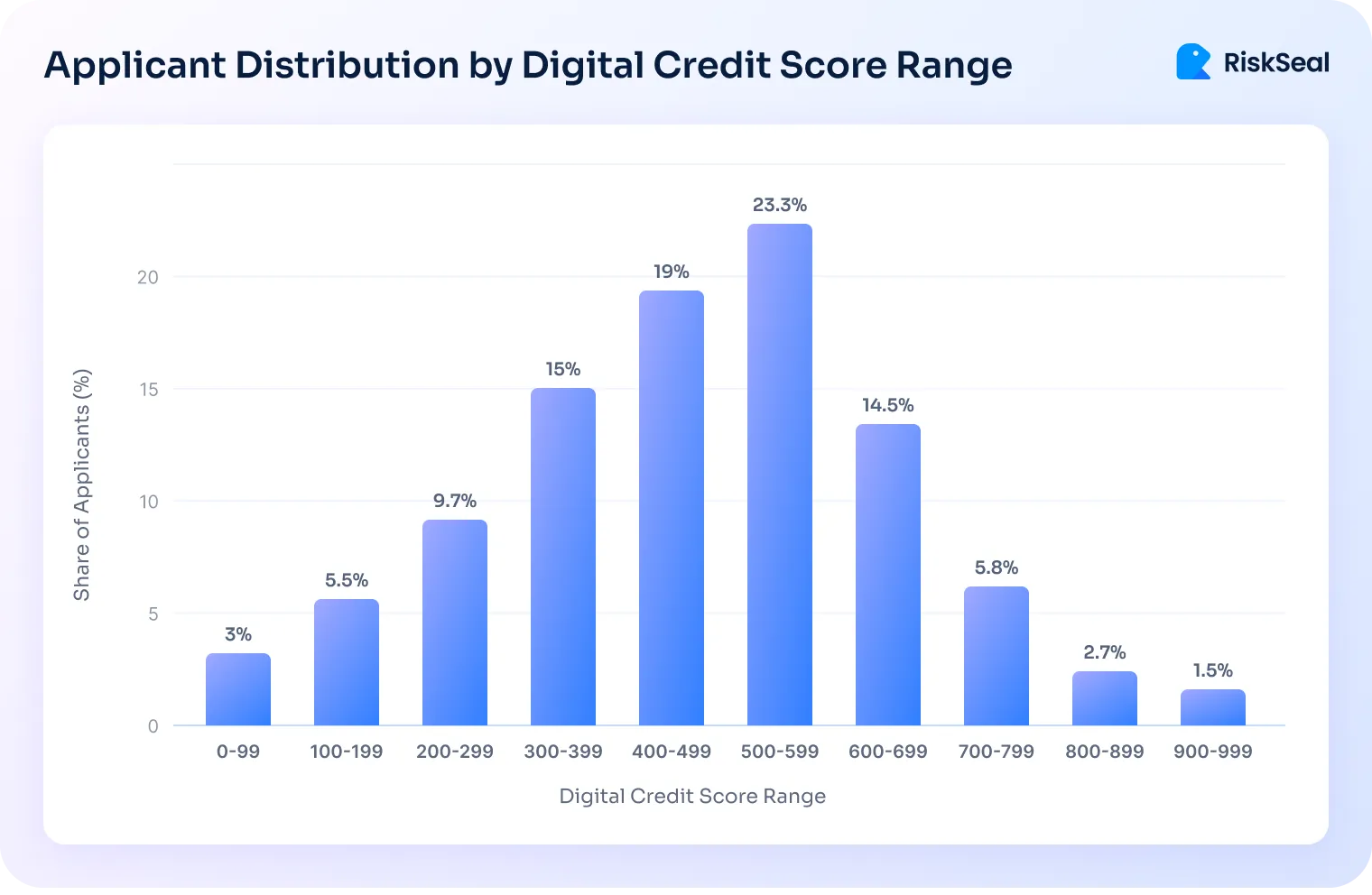
This step is crucial as a result of closely populated rating bands have a disproportionate affect on portfolio danger and underwriting outcomes.
Debtors weren’t evenly distributed throughout rating ranges:
- Low scores (0–299): 18.2% of candidates
- Mid-range scores (300–599): 57.3% of candidates
- Excessive scores (600–999): 24.5% of candidates
The mid-range debtors are sometimes probably the most troublesome to evaluate utilizing credit score bureau knowledge alone. They’re neither clearly high-risk nor clearly low-risk.
The core discovering: default charges fall as scores rise
The evaluation exhibits a transparent, monotonic relationship between digital credit score scores and default danger: as scores improve, default charges persistently decline.
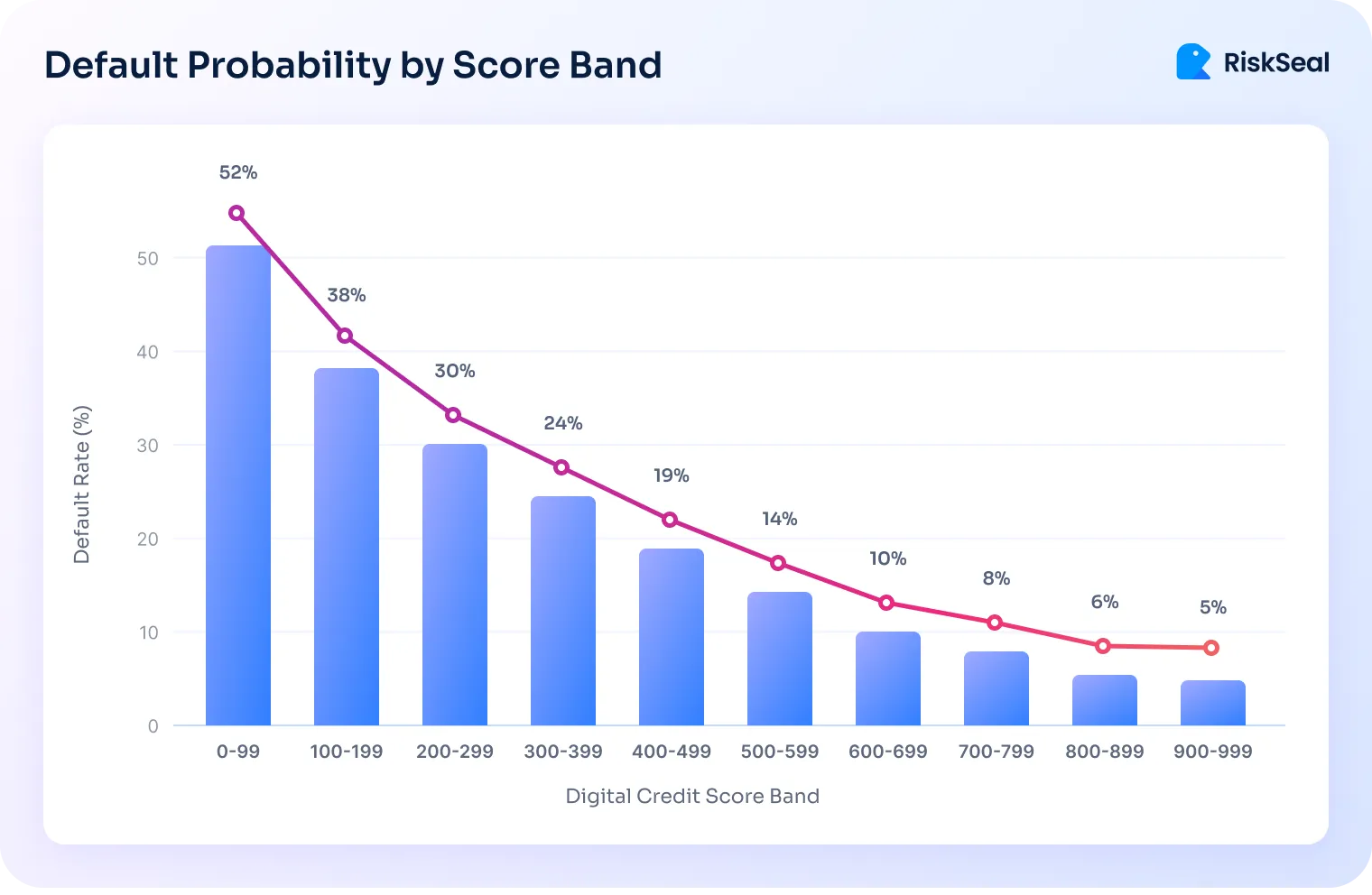
On the backside of the size, greater than half of debtors defaulted. Amongst prime scorers, defaults dropped to single digits.
The mid-range tells crucial story. As scores moved by means of the center bands, default charges fell steadily from the excessive twenties to the mid-teens.
This demonstrates significant danger differentiation precisely the place lenders want it most.
What the digital credit score rating is definitely capturing
A digital credit score rating appears to be like at patterns in a borrower’s digital footprint to estimate stability, authenticity, and danger.
It doesn’t decide individuals based mostly on one “purple flag.” As an alternative, it combines a number of small indicators and reads them in context.
A digital credit score rating usually captures indicators like:
- How established the identification appears to be like, resembling long-lived e mail addresses and telephone numbers with multi-year exercise.
- Whether or not the digital identification is constant, like matching names and particulars throughout e mail, apps, and on-line profiles.
- Gadget and community stability, together with constant gadget utilization and low-variance IP patterns over time.
- Recurring monetary habits, resembling lively paid subscriptions that renew frequently.
- Actual-world buy exercise, together with e-commerce transactions on established accounts.
- Lengthy-term messaging platform use, for instance secure exercise on WhatsApp or Telegram.
- Clear indicators of fraud or manipulation, like disposable contact particulars, digital numbers linked to fraud, and anonymized or quickly shifting IPs, and so on.
Some digital behaviors require much more cautious interpretation.
VPN utilization, pay as you go vs. postpaid plans, low social presence, quantity portability, or gadget resets are sometimes impartial on their very own.
They grow to be significant solely when paired with timing, frequency, and different supporting indicators.
Every sign by itself could also be weak. However when a number of of them level in the identical course, the rating turns into a robust indicator of reimbursement danger and fraud publicity.
What this implies for danger groups
Somewhat than changing bureau knowledge, digital scoring strengthens it.
Threat groups can now fill data gaps and sharpen danger differentiation the place underwriting selections are the toughest.
Notably, within the massive center phase of debtors who fall outdoors conventional approval or decline thresholds.
This strategy allows extra assured credit score growth with out loosening danger self-discipline.
Groups can approve extra candidates within the mid vary by counting on present habits somewhat than conservative assumptions. The result’s portfolio development with improved danger efficiency.

