
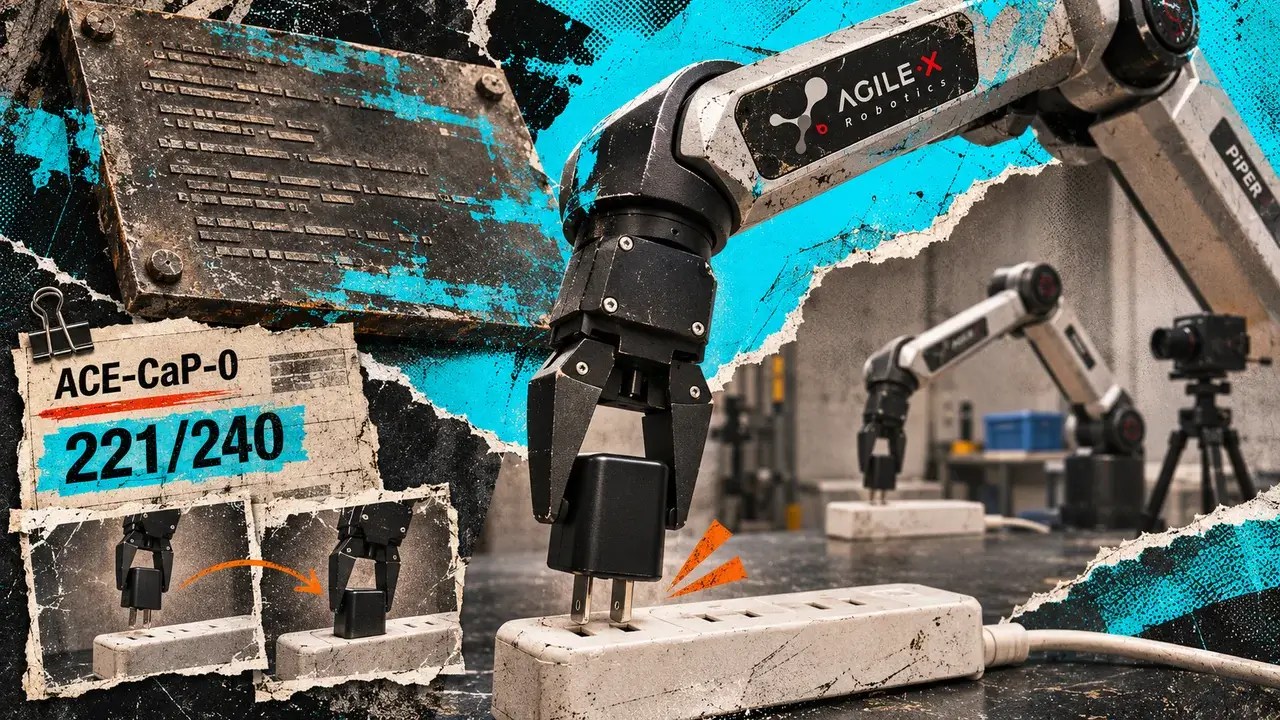
Robotic packages developed by Anthropic’s Claude Opus 5.5 coding agent accomplished 221 of 240 bodily analysis trials, ACE-CaP-0 researchers reported in a research posted November 12. The end result reveals that task-specific abilities can persist in code and run with out the coding agent selecting every motion.
The researchers behind ACE-CaP-0, a way for growing robotic management packages, reported a 92.1% success fee throughout eight duties. Every program was frozen earlier than 30 separate analysis trials, with no additional updates. Human steerage and demonstrations have been accessible throughout improvement.
The experiment separates program improvement from repeated execution. The agent’s work produced a program that could possibly be used repeatedly. Throughout analysis, that program nonetheless used notion and management techniques to answer observations, whereas its resolution guidelines stayed mounted. Neither a human nor the coding agent remained within the execution loop.
Human help is out there throughout improvement; the frozen job program runs and not using a human or coding agent within the execution loop.
Authors’ preprint account. Improvement permits human help; demonstration-collection resets are excluded from the ten-reset funds. Repeated execution on examined duties doesn’t set up reuse below new circumstances.
Success different throughout the eight duties
Creator-reported profitable trials out of 30 for every frozen program. These have been bodily analysis trials, separate from improvement; Desk 1, November 12 preprint.
 CryptoSlate
The bodily setup used two Agilex PIPERX arms and three cameras. Duties included inserting a charger, uncapping a bottle and packing sneakers. Charger insertion succeeded in all 30 trials; bread packing, the weakest end result, succeeded in 25. Imply bodily execution instances throughout duties ranged from 0.97 to 2.27 minutes.
Human assist throughout improvement
Throughout improvement, the coding agent wrote, ran, inspected and revised its code utilizing bodily suggestions. It may ask for textual recommendation or demonstrations during which an individual bodily guided the robotic arms. These demonstrations provided video, arm trajectories and key joint poses.
Improvement allowed at most ten human-assisted scene resets per job. Resets used to gather demonstrations have been excluded, and the funds counted scene resets fairly than all robotic executions or demonstrations.
The agent may additionally use simulated experiments once they helped resolve a improvement query. In a charger-insertion comparability, on-demand simulation produced a program with 100% analysis success, versus 86.7% for improvement with out simulation. The comparability used one improvement run per situation.
That comparability additionally illustrates a value trade-off. Improvement took 2.6 hours with on-demand simulation versus 3.7 hours with out it, whereas output-token utilization elevated from 730,000 to 1,090,000. The time and token figures depart whole improvement prices unresolved; the researchers name for accounting that features demonstration effort.
Repeating analysis trials measures how the ensuing program performs. Establishing how constantly the event course of produces an equally succesful program requires separate improvement runs throughout duties.
ACE-CaP-0 leaves behind task-specific packages that may execute repeatedly with recent observations and stuck resolution guidelines. The research offers proof for that type of talent reuse after human-assisted improvement. Testing these routines below new circumstances is the subsequent step towards establishing how broadly they are often reused.

