

Launch OUR Interactive Instrument
Preface to the New Version
The research earlier than you, which has been printed because the State Enterprise Tax Local weather Index since 2003, was rebranded because the State Tax Competitiveness Index for the 2025 version to raised mirror what it assesses: states’ total tax competitiveness, not simply the enterprise tax local weather. This wasn’t simply an train in slapping a brand new title on the duvet and calling it a day. Somewhat, we reworked the Index from the bottom as much as make it a greater product.
For greater than twenty years, the Index has helped policymakers consider their tax codes, serving as a highway map for reform. Every year, the research underwent methodological refinements—which we all the time outlined—to seize altering components of the tax code, just like the introduction of worldwide intangible low-taxed earnings, which has since been modified to internet CFC examined earnings, or the design of distant vendor taxes following the Supreme Court docket’s Wayfair determination. However the tempo of change has accelerated in recent times, with the adoption of the federal Tax Cuts and Jobs Act, the Supreme Court docket’s Wayfair determination, the rise of distant work and different outgrowths of the worldwide pandemic (together with a roiling of unemployment insurance coverage tax regimes), the adoption of the One Massive Lovely Invoice Act, the adoption of the nation’s first digital promoting taxes, and an rising curiosity in new or expanded taxes on wealth, unrealized beneficial properties, information, digital merchandise, and extra.
We noticed a necessity to handle these extra comprehensively, and to supply further granularity in our analysis of tax provisions already encompassed by the Index. The previous Index did its job nicely. Certainly, impartial evaluations demonstrated a robust correlation between Index ranks and state financial outcomes. However we needed to broaden and refresh the publication earlier than it bought stale, to remain forward of recent developments in tax. A refresh additionally gave us an opportunity to raised systematize and rebalance the therapy of some outlier state tax provisions that needed to be shoehorned into the methodology of prior editions.
With the 2025 refresh, we did greater than replace the methodology and undertake a brand new identify. We additionally rethought the presentation of the Index’s treasure trove of tax coverage info. The Index’s 150+ variables are not hidden away in appendix tables, and the web publication, previously simply an interactive map accompanied by a prolonged PDF, was reimagined for a digital surroundings.
Now, every state receives its personal abstract, highlighting a number of of essentially the most notable options of its tax code and explaining why it ranks because it does on the Index—together with some state-specific reforms that may enhance its tax competitiveness. And customers now have entry to interactive, sortable, filterable datasets, along with some new visuals and historic price instruments. We invite you to discover. See your state’s coverage selections on each variable within the Index. Add one other state or two and evaluate them. Or drill all the way down to a single variable or set of variables and see how all states carry out on them.
That is the third 12 months underneath the brand new methodology, however when you’re evaluating our rankings this 12 months to previous editions from 2024 or earlier than, you would possibly discover that some ranks have shifted a bit greater than we normally see from 12 months to 12 months. A few of that, in fact, is just because states have been extremely busy just lately, adopting important modifications to their tax codes. However a few of it is because of our methodological modifications.
To make sure an apples-to-apples comparability, and within the curiosity of transparency, now we have backcast states’ rankings underneath the brand new methodology going again seven years previous to this present version. These are the controlling rankings, and are those that needs to be cited to indicate precise motion by states in recent times. That is nothing new: we’ve all the time backcast to account for methodological revisions. What’s totally different within the new version is the scope of the change, as we’ve added extra variables and made extra changes than in prior years.
Readers within the particulars of what has modified are invited to learn on to find out about our revised methodology, and for explanations of our variables. Most readers, nonetheless, will possible want to soar forward to the general rankings, their state’s web page, or the newly interactive datasets.
For all readers, we hope that the 2027 State Tax Competitiveness Index will function a helpful information for navigating state tax coverage. It ranks, each total and throughout 5 subindices—company taxes, particular person earnings taxes, gross sales and excise taxes, property and wealth taxes, and unemployment insurance coverage taxes—how states compete, and the place every has room to enhance. And for would-be reformers, our datasets (now rather more accessible!) are a useful information to how states construction their tax codes, and the place they diverge—for good and for sick—from their friends.
Even a superb highway map, nonetheless, just isn’t all the time a enough substitute for a information. That’s why the Tax Basis has a group of state tax specialists whose main objective is to assist educate policymakers and the general public. As all the time, we invite you to succeed in out together with your questions. That’s why we’re right here.
Katherine Loughead
Vice President of State Coverage, Tax Basis
Govt Abstract
The Tax Basis’s State Tax Competitiveness Index permits policymakers, taxpayers, and enterprise leaders to gauge how their states’ tax methods evaluate. Whereas there are various methods to indicate how a lot state governments gather in taxes, the Index evaluates how nicely states construction their tax methods and gives a highway map for enchancment.[1]
The ten greatest states on this 12 months’s Index are:
- Wyoming
- South Dakota
- Alaska
- Florida
- Texas
- New Hampshire
- Montana
- Tennessee
- Missouri
- Utah
The absence of a significant tax is a typical issue amongst lots of the high 10 states. Property taxes and unemployment insurance coverage taxes are levied in each state, however there are a number of states that do with out a number of of the most important taxes: the company earnings taxA company earnings tax (CIT) is levied by federal and state governments on enterprise income. Many firms should not topic to the CIT as a result of they’re taxed as pass-through companies, with earnings reportable underneath the person earnings tax., the particular person earnings taxA person earnings tax (or private earnings tax) is levied on the wages, salaries, investments, or different types of earnings a person or family earns. The U.S. imposes a progressive earnings tax the place charges improve with earnings. The Federal Revenue Tax was established in 1913 with the ratification of the sixteenth Modification. Although barely 100 years previous, particular person earnings taxes are the most important supply, or the gross sales tax. South Dakota and Wyoming don’t have any company or particular person earnings tax; Alaska and New Hampshire don’t have any particular person earnings or state-level gross sales tax; Florida, Tennessee, and Texas don’t have any particular person earnings tax; and Montana has no gross sales tax.
This doesn’t imply, nonetheless, {that a} state can’t rank nicely whereas nonetheless levying all the most important taxes. Missouri and Utah, for instance, levy all the most important tax sorts, as do all the opposite states that rank 11th to 16th: North Carolina, North Dakota, Idaho, Indiana, Oklahoma, and Nebraska.
The ten lowest-ranked, or worst, states on this 12 months’s Index are:
- Minnesota
- Vermont
- Hawaii
- Maryland
- Massachusetts
- Connecticut
- Washington
- New Jersey
- California
- New York
The states within the backside 10 are inclined to have plenty of points in widespread: advanced, nonneutral taxes with comparatively excessive charges. New Jersey, for instance, is hampered by among the highest property tax burdens within the nation, has the highest-rate company earnings tax within the nation, and has one of many highest-rate particular person earnings taxes. Moreover, the state levies an inheritance taxAn inheritance tax is levied upon the worth of inherited belongings obtained by a beneficiary after a decedent’s dying. To not be confused with property taxes, that are paid by the decedent’s property based mostly on the dimensions of the overall property earlier than belongings are distributed, inheritance taxes are paid by the recipient or inheritor based mostly on the worth of the bequest obtained. and maintains among the nation’s worst-structured particular person earnings taxes.
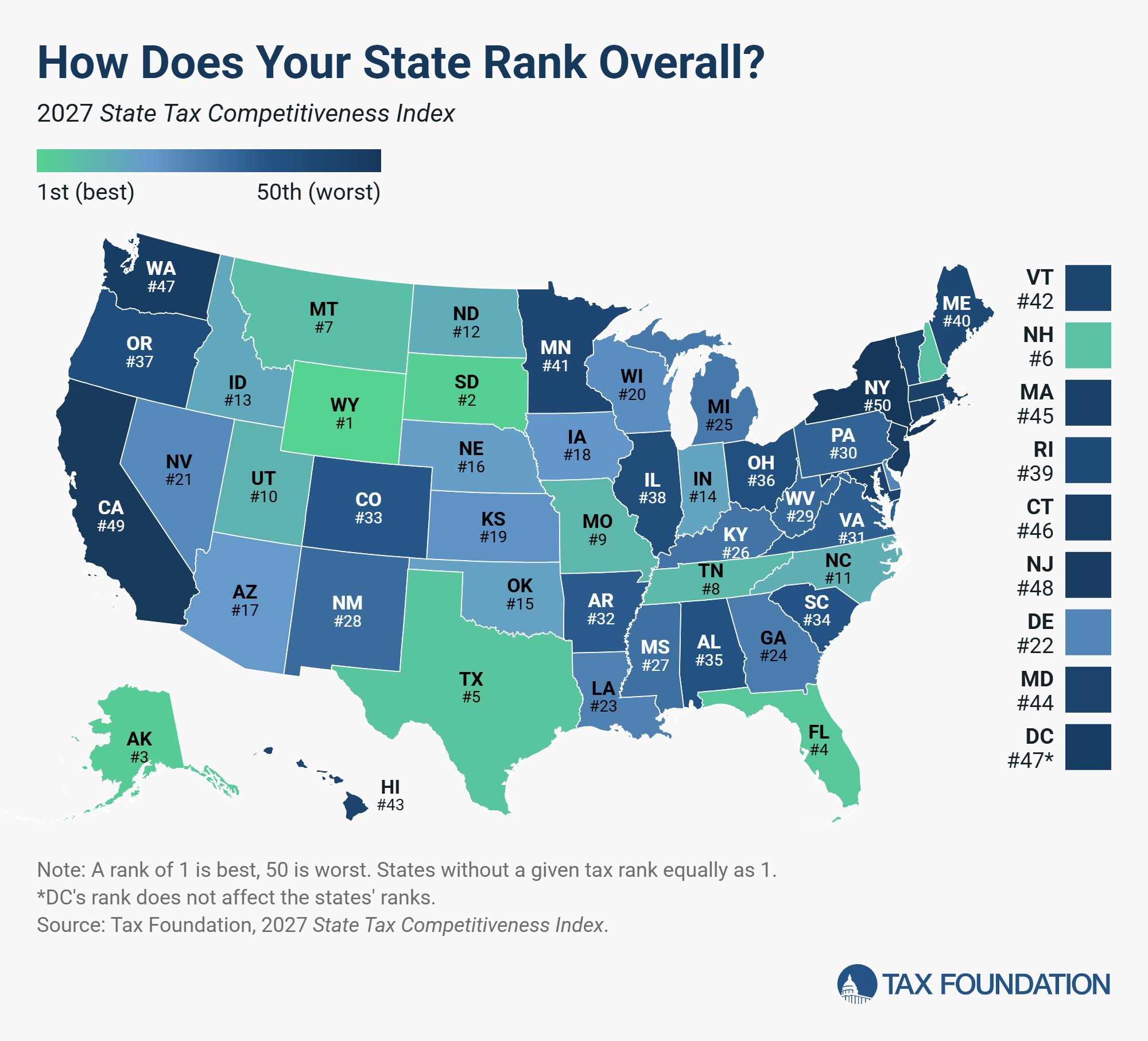
Launch OUR Interactive Instrument
Desk 1. 2027 State Tax Competitiveness Index Ranks and Element Tax Ranks
Be aware: A rank of 1 is greatest, 50 is worst. Rankings don’t common to the overall. States with no tax rank equally as 1. DC’s rating and rank don’t have an effect on different states. The report reveals tax methods as of July 1, 2026 (the start of fiscal 12 months 2027).
Supply: Tax Basis.
Understanding the Index and Tax Competitors
Tax competitors is slightly like WAR—not battle, however Wins Above Substitute. The time period comes from baseball, the place it’s meant as a sabermetric statistic to measure what number of extra wins a group can declare resulting from a particular participant above the quantity that may be generated by a replacement-level participant. It’s a lot the identical approach in public finance: a well-structured tax code received’t make the Wyoming Basin a metropolis, nor will poor tax construction make Manhattan a ghost city. However tax construction does play a task in a state’s financial successes or failures, and sometimes a considerable one. Each state can profit from a easy, impartial, clear, pro-growth tax construction.
The Index scores states throughout 5 subindices, every representing a significant part of state tax codes: company taxes, particular person earnings taxes, gross sales and excise taxes, property and wealth taxes, and unemployment insurance coverage taxes. Somewhat than weighting every subindex equally, their weight is decided based on the variance throughout states in every class, which has the impact of assigning extra weight to areas the place states have extra alternatives wherein to compete.
After all, it’s tough to introduce any structural flaws to the design of a tax one doesn’t impose, so some states, by forgoing a tax altogether (the person earnings tax, the company earnings tax, or the gross sales tax) rating completely on a subindex or some portion of 1. That is why states like Wyoming and South Dakota, which each forgo earnings taxes, achieve this nicely on the Index. States that may keep away from imposing a number of of the most important taxes both need to lean very closely on the opposite main tax sorts (which might imply decrease rankings on these parts), select to function on leaner budgets, reap the benefits of pure assets like oil and fuel, or have demographics (like Florida) the place different taxes can generate a stunning quantity of income.
In different phrases, the Wyoming mannequin might not be potential in some states—however the Missouri, Utah, and North Carolina fashions are. These states all rank within the high 11 on the Index whereas imposing all the main taxes, however at reasonable charges with comparatively well-designed tax buildings.
For taxpayers, the Index is an efficient start line for understanding how their state compares to its friends. However for policymakers and others eager about the right way to enhance the construction of their state’s tax code, it’s greater than that: it’s a precious diagnostic instrument, with tables that enable readers to check their state to its friends on a variety of things—tax charges, sure, but in addition throwback guidelines, the therapy of internet working losses, recapture provisions, indexation, spit roll taxation, comfort guidelines, expensing, and rather more.
When you saddled South Dakota with New York’s tax code, the state would battle. Individuals are clearly prepared to pay a premium to stay in New York—on actual property, on shopper purchases, and sure, on taxes. However there are limits, to say nothing of the truth that a system that’s bearable in Manhattan could also be significantly extra burdensome in Syracuse. And even in states like New York tax burdens, and tax buildings, matter.
Taxes should not all the pieces, however they do matter, and they’re inside the management of policymakers. Even inside a given income goal, there are higher and worse methods to lift income.
The Index measures tax construction, not all the opposite issues companies care about, like an informed workforce, high quality of life, proximity to related markets, and even the climate—and a few of these issues contain trade-offs. Taxes, nonetheless, are an vital a part of the combo, and modernizing a state’s tax construction helps place it for progress. States that rank higher on the Index have better-structured tax codes, and states with better-structured tax codes get Wins Above Substitute.
Notable Modifications in This Yr’s Index
Arizona
Arizona fell three locations total, from 14th to 17th. Arizona handed conformity laws with a number of retroactive provisions, however because the laws contained no emergency clause, the retroactivity was not legally in impact as of the Index’s snapshot date of July 1, 2026. This timing, along with not conforming to full expensingFull expensing permits companies to right away deduct the total value of sure investments in new or improved know-how, gear, or buildings. It alleviates a bias within the tax code and incentivizes firms to take a position extra, which, in the long term, raises employee productiveness, boosts wages, and creates extra jobs. underneath Part 168(okay), resulted in its company earnings tax rating falling from 16th to twentyth. Arizona’s fiscal 12 months 2027 price range, which took impact on July 1, 2026, included a three-year moratorium on tax incentives on new information heart tax initiatives, with a ensuing drop within the state’s gross sales and use tax rating from 35th to 40th as a result of suspension of gross sales tax exemptions for the qualifying gear purchases of recent information facilities. The state’s tangible private property (TPP) tax exemptionA tax exemption excludes sure earnings, income, and even taxpayers from tax altogether. For instance, nonprofits that fulfill sure necessities are granted tax-exempt standing by the Inside Income Service (IRS), stopping them from having to pay earnings tax. elevated from $269,905 to $500,000, barely enhancing its property and wealth tax rating.
Arkansas
Regardless of reductions to its high particular person earnings tax price (from 3.9 p.c to three.7 p.c), Arkansas fell 3 spots total to thirty second. This was pushed largely by different states’ enhancements together with Arkansas’s continued nonconformity with the federal full expensing allowance underneath Part 168(okay), inflicting its company earnings tax rating to fall 9 locations to nineteenth.
Georgia
Georgia dropped from 18th to 24th in its total rating, pushed largely by a discount in its company earnings tax rating. Georgia didn’t conform to the aggressive company expensing provisions within the OBBBA, together with Part 168(n), main the state to be handed by rivals like Kansas and Oklahoma, which conformed to expensing provisions or decreased their particular person earnings tax charges. Georgia additionally partially exempted ideas and extra time pay from its particular person earnings tax, narrowing the bottom.
Idaho
Idaho’s rating fell 4 locations total (from 9th to 13th), together with falling eight locations on the person earnings tax part, primarily as a result of state’s determination to adapt to the OBBBA’s non permanent particular person deductions for ideas and extra time. Conforming to those provisions prices the state a considerable quantity of income with out producing a lot financial progress.
Indiana
Indiana fell three spots, to 14th total. Regardless of a low, flat state particular person earnings tax price of two.95 p.c, Indiana authorizes counties to impose native earnings taxes at charges that almost double the mixed price in some jurisdictions. Moreover, Indiana narrows its tax base by providing earnings tax deductions for certified ideas and extra time pay. Because of this, Indiana’s particular person earnings tax rating fell from 21st to twenty-eightth. Indiana doesn’t conform to key expensing provisions, together with Part 168(okay) and Part 174A, whereas a number of competing states do. Because of this, its company earnings tax rating fell from 7th to 11th. Indiana maintains a property and wealth tax rating of 4th, due partially to the rise to its tangible private property (TPP) tax exemption from $80,000 to $2 million.
Iowa
Iowa fell simply barely on this 12 months’s Index, from 17th to 18th total. One main variable change was its particular person earnings tax rating, falling eight locations to 18th. As a result of Iowa makes use of federal taxable earningsTaxable earnings is the quantity of earnings topic to tax, after deductions and exemptions. Taxable earnings differs from—and is lower than—gross earnings. as the place to begin for state earnings tax legal responsibility, newer federal provisions reminiscent of no tax on ideas, extra time, and auto loans slender the state’s particular person earnings tax base. Moreover, 5 states that climbed forward of Iowa on this part additional decreased their flat and high marginal earnings tax charges (Georgia, Kentucky, Nebraska, Oklahoma, and Utah). Whereas Iowa’s particular person rating fell a number of spots on the Index, this was offset as its company earnings tax rating rose eight locations to 17th resulting from conforming to full bonus depreciationBonus depreciation permits corporations to deduct a bigger portion of sure “short-lived” investments in new or improved know-how, gear, or buildings within the first 12 months. Permitting companies to write down off extra investments partially alleviates a bias within the tax code and incentivizes firms to take a position extra, which, in the long term, raises employee productiveness, boosts wages, and creates extra jobs. and decoupling from the taxation of internet CFC examined earnings. Prior-year unemployment insurance coverage tax reforms have continued to enhance Iowa’s rating on this portion of the Index, transferring it from 35th to 30th.
Kansas
Kansas’ rating improved 4 locations total (from 23rd to 19th), together with seven locations on the company tax part and 5 locations on the person earnings tax part. These enhancements have been primarily attributable to Kansas’ rolling conformity to the OBBBA’s pro-growth enterprise expensing provisions. Kansas did fall seven locations, nonetheless, on the property tax part, due partially to a considerable improve within the state’s property tax collections per capita.
Louisiana
As a part of the ultimate phase-in of the 2024 tax reform package deal, Louisiana noticed a 17-place enchancment in its property tax rank as a result of elimination of the state’s capital inventory tax, a harmful tax that taxes companies no matter revenue. This, together with newly permitting S companies to file via the person earnings tax, helped increase Louisiana from 32nd to 23rd total.
Maine
Maine slid seven locations, from 33rd to 40th, with the adoption of a 2 p.c “high-income surcharge” that brings the state’s high particular person earnings tax price to 9.15 p.c on incomes over $1 million. The brand new price additionally contains a big marriage penaltyA wedding penalty is when a family’s total tax invoice will increase due to some marrying and submitting taxes collectively. A wedding penalty usually happens when two people with related incomes marry; that is true for each high- and low-income {couples}. and offers Maine the eighth-highest high price within the nation.
Michigan
Michigan’s rating was very near a number of different states in 2026 however fell behind them in 2027 when it didn’t conform to the improved expensing provisions within the OBBBA. Mixed with a brand new exemption for tipped and extra time earnings and a relatively low Part 179 restrict, the Nice Lake State dropped 9 locations total, from 16th to 25th, and from 18th all the way in which to 30th on the person earnings tax part.
Mississippi
Mississippi noticed its particular person earnings tax rating enhance from 34th to 29th, resulting from an earnings tax price discount from 4.4 to 4 p.c. Mississippi additionally decreased its capital inventory tax price from 0.075 p.c to 0.05 p.c. Nonetheless, resulting from different states additionally enhancing, Mississippi’s total rank fell one place, from 26th to 27th.
Missouri
Missouri noticed its total rank enhance from 12th to 9th this 12 months, breaking into the Index’s high 10. A part of this rating improve got here from conforming to the brand new and elevated expensing provisions included within the OBBBA. Not like Idaho, Indiana, and North Dakota, which fell behind, the Present-Me State resisted conforming to the exemptions for tipped and extra time pay, which might have narrowed its earnings tax base.
Montana
Montana’s total rating fell two spots, from 5th to 7th. Though a decrease high earnings tax price of 5.65 p.c and the elimination of the state’s marriage penalty took impact this 12 months, Montana’s particular person earnings tax rating fell from 13th to 21st. As a result of Montana makes use of federal taxable earnings as the place to begin for state earnings tax legal responsibility, newer federal provisions reminiscent of no tax on ideas, extra time, and auto loans slender the state’s particular person earnings tax base. Moreover, 5 states that climbed forward of Montana on this part additional decreased their flat and high marginal earnings tax charges (Georgia, Kentucky, Nebraska, North Carolina, and Oklahoma). Montana’s conformity to full bonus depreciation underneath Part 168(okay) and Part 174A contributed to its company earnings tax rating enhancing from 26th to 18th. The continued phase-in of Montana’s tiered-structure property tax reforms contributed to it falling from 16th to twentyth on the property and wealth tax variable.
Nebraska
Nebraska improved eight locations total, from 24th to 16th, as a result of continued phase-down of its earnings tax charges. The state’s high particular person earnings tax price decreased from 5.2 p.c to 4.55 p.c, with a ensuing elimination of its fourth bracket, transferring Nebraska from 22nd to 13th on the person earnings tax part. The state’s flat company price additionally decreased to 4.55 p.c, and its conformity to full bonus depreciation has allowed the Cornhusker State’s company tax rank to climb 4 spots to 9th.
New Mexico
New Mexico improved three locations, from 31st to twenty-eightth total, as a result of the state routinely conformed to the restoration of first-year expensing for analysis and experimentation bills, and to the upper cap for small enterprise expensing underneath Part 179, whereas a few of its peer states didn’t.
North Carolina
North Carolina rose two spots total from 13th to 11th. A person earnings tax price discount from 4.25 p.c to three.99 p.c improved its particular person earnings tax rating, with the state transferring up 4 spots to 19th. The state’s company rating remained comparatively steady. Though North Carolina doesn’t conform to federal bonus depreciation provisions, it continues to levy the nation’s lowest company earnings tax price amongst states that impose one. That price declined additional this 12 months from 2.25 to 2.0 p.c.
Ohio
Ohio moved from a graduated-rate particular person earnings tax to a flat particular person earnings tax at a decrease price of two.75 p.c, enhancing its particular person earnings tax rating 5 locations, from 38th to 33rd, whereas serving to enhance the state’s total rating from 38th to 36th.
Oklahoma
Because of tax payments handed in 2025, Oklahoma moved from six particular person earnings tax brackets to 3, and from a high price of 4.75 to 4.5 p.c, enhancing the state’s particular person earnings tax rank by 13 locations. The state additionally conformed to the improved expensing therapy enacted by the OBBBA, whereas resisting the choice to exempt ideas and extra time pay from the earnings tax. All these enhancements introduced Oklahoma’s rank from 19th to fifteenth total.
South Carolina
South Carolina handed price reductions this 12 months, bringing its high particular person earnings tax price from 6 p.c to five.21 p.c. Nonetheless, the scoring advantage of the speed discount was outweighed by its lagged basic conformity, low Part 179 limitation, and lack of Part 168(n) expensing. In the long run, South Carolina’s total rating dropped six spots, from 28th to 34th.
Utah
Utah improved 5 locations, to 10th total, because the state conformed to pro-growth provisions of the OBBBA from which a few of its friends decoupled. Utah trimmed its particular person and company earnings tax charges to 4.45 p.c, constructing on years of modest price reductions. Extra considerably, nonetheless, it conformed to the restoration of first-year expensing for each manufacturing equipment and gear and for analysis and experimentation bills. Utah additionally conformed to the brand new increased small enterprise expensing cap underneath Part 179, and its inflation-adjusted tangible private property (TPP) tax de minimis exemption improved relative to states with unindexed exemptions. Utah’s best enchancment was in its company tax part, the place its rank improved 7 locations, from 15th to eightth.
Virginia
Virginia fell 4 locations total to 31st, a decline principally attributable to different states adopting aggressive reforms whereas the Commonwealth stood nonetheless. Virginia’s company tax rating dropped essentially the most in contrast with its different Index rankings, sliding from 17th to 24th. Whereas many states conform to full bonus depreciation underneath Part 168(okay) and Part 174A, Virginia stays decoupled from these provisions. Moreover, the Commonwealth permits municipalities to determine native gross receipts taxes, additional lowering its competitiveness.
Washington
Though Washington’s total rank fell one place, from 46th to 47th, the state improved 5 locations on the property and wealth tax part after reverting the highest property tax price from 35 p.c to twenty p.c. The inclusion of digital promoting within the gross sales tax base, a part of a broader growth of business-to-business taxation of digital merchandise, dropped Washington’s gross sales and excise tax part rank from 49th to 50th. A just lately adopted 9.9 p.c tax on earnings above $1 million goes into impact in 2028 and doesn’t have an effect on present rankings.
West Virginia
West Virginia’s rating improved six locations total (from 35th to 29th), together with seven locations on the company part and 5 locations on the person part, as a result of state’s conformity to the OBBBA’s enterprise expensing provisions. Nonetheless, West Virginia fell 5 locations on the property tax part resulting from modifications that exacerbated the state’s property tax break up roll ratio, shifting extra of the property tax burden onto industrial properties, and resulting from a rise within the state’s property tax collections per capita.
Forthcoming Modifications and Modifications Not But Mirrored
Arkansas
Arkansas already noticed a person earnings tax price discount in 2026, however in 2027, the state’s company earnings tax price is scheduled to fall to 4.1 p.c. As such, that change falls outdoors of the snapshot date for this version however will have an effect on future years’ scores.
Georgia
As a part of a tax reform package deal handed this 12 months, Georgia’s high particular person earnings tax price will fall by 0.125 proportion factors yearly if income thresholds are met, with the customary deductionThe usual deduction reduces a taxpayer’s taxable earnings by a set quantity decided by the federal government. Taxpayers who take the usual deduction can’t additionally itemize their deductions; it serves instead. elevated on a triggered foundation as nicely. If these tax modifications are triggered, Georgia will see Index rating enhancements in coming years.
Hawaii
In Could 2026, Hawaii lawmakers adopted a brand new, further tax bracket with a price of 13 p.c on residents with incomes over $500,000 ($1 million for married filers). Whereas this modification doesn’t take impact till 2027, Hawaii can count on to see a drop in each its particular person earnings tax rank and total rank in coming years, very like Maine has seen within the present Index.
Illinois
In June 2026, Illinois adopted a price range that included a number of new and elevated taxes. A number of of those new taxes, together with a focused promoting companies tax, a digital asset tax, and a social media platform payment, are scheduled to take impact on January 1, 2027, affecting Illinois’ efficiency on the 2028 Index.
Iowa
In Could 2026, Iowa lawmakers enacted laws establishing a property tax levy restrict for counties and municipalities. As a result of the brand new levy restrict doesn’t take impact till 2027, the change falls outdoors of this 12 months’s snapshot of the Index.
New Mexico
In early 2026, New Mexico lawmakers enacted a regulation decoupling the state from the expensing provisions in Sections 168(okay) and 168(n) of the IRC. The identical act newly expands the company tax base to incorporate NCTI, an aggressive change that may create double taxationDouble taxation is when taxes are paid twice on the identical greenback of earnings, no matter whether or not that’s company or particular person earnings. of overseas earnings. As these modifications don’t take impact till January 1, 2027, they’ll negatively influence New Mexico’s rating in future Index editions.
North Carolina
Because the state adopted a tax reform package deal in 2021, North Carolina’s particular person and company earnings tax charges have seen repeated reductions. If revenues comply with projections, the person earnings tax price will drop to three.49 p.c in 2027 and a pair of.99 p.c in 2028. Additionally in 2028, the company price is scheduled to drop to 1 p.c, with complete elimination of the company earnings tax deliberate for 2030.
Rhode Island
H 7127 was adopted, creating a brand new three percentage-point surtax on particular person earnings over $1 million. This coverage change will part in over three years, elevating the state’s high marginal particular person earnings tax price from 5.99 in 2026 to six.99 p.c in 2027, 7.99 p.c in 2028, and eight.99 p.c in 2029. This alteration will harm Rhode Island’s efficiency on future editions of the Index.
Utah
Utah enacted a tax on “focused promoting” in 2026, which, whereas ostensibly broad, virtually contains digital promoting alone. This alteration takes impact in January 2027, so it doesn’t have an effect on Utah’s rating for this version however will probably be mirrored in subsequent 12 months’s Index.
Washington
Regardless of the state’s judicial historical past of ruling towards earnings taxes, Washington lawmakers adopted a brand new 9.9 p.c tax in 2026 on earnings above $1 million. This tax will go into impact in 2028, possible going through authorized questions earlier than then, and considerably affecting the state’s future Index scores.
Desk 2. State Tax Competitiveness Index (2020-2027)
Be aware: A rank of 1 is greatest, 50 is worst. All scores are for fiscal years. DC’s rating and rank don’t have an effect on different states.
Supply: Tax Basis.
Introduction
Taxation is inevitable, however the specifics of a state’s tax construction matter enormously. The measure of complete taxes paid is related, however different components of a state tax system can even improve or hurt the competitiveness of a state’s enterprise surroundings. The State Tax Competitiveness Index distills many advanced issues to an easy-to-understand rating.
The trendy market is characterised by cellular capital and labor, with all forms of companies, small and huge, tending to find the place they’ve the best aggressive benefit. The proof reveals that states with one of the best tax methods would be the best at attracting new companies and best at producing financial and employment progress. It’s true that taxes are however one consider enterprise decision-making. Different issues additionally matter–reminiscent of entry to uncooked supplies or infrastructure or a talented labor pool–however a easy, smart tax system can positively influence enterprise operations with regard to those assets. Moreover, in contrast to modifications to a state’s health-care, transportation, or training methods, which might take a long time to implement, modifications to the tax code can rapidly enhance a state’s competitiveness.
It is very important keep in mind that even in our world economic system, states’ stiffest competitors typically comes from different states. The Division of Labor studies that almost all mass job relocations are from one US state to a different quite than to a overseas location.[2] Definitely, job creation is speedy abroad, as beforehand underdeveloped nations enter the world economic system, although within the aftermath of federal tax reform, US companies not face the third-highest company tax price on the planet, however quite one according to averages for industrialized nations.[3] State lawmakers are proper to be involved about how their states rank within the world competitors for jobs and capital, however they must be extra involved with firms transferring from Detroit, Michigan, to Dayton, Ohio, than from Detroit to New Delhi, India. Which means state lawmakers should pay attention to how their states’ enterprise climates match up towards their rapid neighbors and to different regional competitor states.
Anecdotes in regards to the influence of state tax methods on enterprise funding are plentiful. In Illinois within the early 2000s, a whole bunch of tens of millions of {dollars} of capital investments have been delayed when then-Governor Rod Blagojevich (D) proposed a hefty gross receipts taxGross receipts taxes are utilized to an organization’s product sales, with out deductions for a agency’s enterprise bills, like compensation, prices of products offered, and overhead prices. Not like a gross sales tax, a gross receipts tax is assessed on companies and applies to transactions at each stage of the manufacturing course of, resulting in tax pyramiding..[4] Solely when the legislature resoundingly defeated the invoice did the funding resume. In 2005, California-based Intel determined to construct a multibillion-dollar chip-making facility in Arizona resulting from its favorable company earnings tax system.[5] In 2010, Northrup Grumman selected to maneuver its headquarters to Virginia over Maryland, citing the higher enterprise tax local weather.[6] In 2015, Normal Electrical and Aetna threatened to decamp from Connecticut if the governor signed a price range that may improve company tax burdens, and Normal Electrical really did so.[7] Anecdotes reminiscent of these reinforce what we all know from financial idea: taxes matter to companies, and people locations with essentially the most aggressive tax methods will reap the advantages of business-friendly tax climates.
Tax competitors is an disagreeable actuality for state income and price range officers, however it’s an efficient restraint on state and native taxes. When a state imposes increased taxes than a neighboring state, companies will cross the border to some extent. Subsequently, states with extra aggressive tax methods rating nicely within the Index as a result of they’re greatest suited to generate financial progress.
State lawmakers are conscious of their states’ tax competitiveness, however they’re typically tempted to lure companies with profitable tax incentives and subsidies as a substitute of broad-based tax reform. This could be a harmful proposition, as the instance of Dell Computer systems and North Carolina illustrates. North Carolina agreed to $240 million price of incentives to lure Dell to the state. Lots of the incentives got here within the type of tax credit from the state and native governments. Sadly, Dell introduced in 2009 that it might be closing the plant after solely 4 years of operations.[8] A 2007 USA TODAY article chronicled related issues different states have had with firms that obtain beneficiant tax incentives.[9]
Lawmakers make these offers underneath the banner of job creation and financial improvement, however the fact is that if a state wants to supply such packages, it’s probably overlaying for an undesirable enterprise tax local weather. A much more efficient method is the systematic enchancment of the state’s enterprise tax local weather for the long run to enhance the state’s competitiveness. When assessing which modifications to make, lawmakers want to recollect two guidelines:
- Taxes matter to enterprise. Enterprise taxes have an effect on enterprise selections, job creation and retention, plant location, competitiveness, the transparency of the tax system, and the long-term well being of a state’s economic system. Most significantly, taxes diminish income. If taxes take a bigger portion of income, that value is handed alongside to both shoppers (via increased costs), workers (via decrease wages or fewer jobs), shareholders (via decrease dividends or share worth), or some mixture of the above. Thus, a state with decrease tax prices will probably be extra engaging to enterprise funding and extra more likely to expertise financial progress.
- States don’t enact tax modifications (will increase or cuts) in a vacuum. Each tax regulation will indirectly change a state’s aggressive place relative to its rapid neighbors, its area, and even globally. In the end, it’ll have an effect on the state’s nationwide standing as a spot to stay and to do enterprise. Entrepreneurial states can reap the benefits of the tax will increase of their neighbors to lure companies out of high-tax states.
To some extent, tax-induced financial distortions are a reality of life, however policymakers ought to try to maximise the events when companies and people are guided by enterprise ideas and reduce these instances the place financial selections are influenced, micromanaged, and even dictated by a tax system. The extra riddled a tax system is with politically motivated preferences, the much less possible it’s that enterprise selections will probably be made in response to market forces. The Index rewards these states that reduce tax-induced financial distortions.
Rating the competitiveness of fifty very totally different tax methods presents many challenges, particularly when a state dispenses with a significant tax completely. Ought to Utah’s tax system, which incorporates three comparatively impartial taxes on gross sales, particular person earnings, and company earnings, be thought-about kind of aggressive than Alaska’s tax system, which features a significantly burdensome company earnings tax however no statewide tax on particular person earnings or gross sales?
The Index offers with such questions by evaluating the states on greater than 150 variables within the 5 main areas of taxation (company taxes, particular person earnings taxes, gross sales and excise taxes, unemployment insurance coverage taxes, and property and wealth taxes) after which including the outcomes to yield a ultimate, total rating. This method rewards states on significantly sturdy features of their tax methods (or penalizes them on significantly weak features), whereas measuring the overall competitiveness of their total tax methods. The result’s a rating that may be in comparison with different states’ scores. In the end, each Alaska and Utah rating nicely.
Literature Evaluation
Economists haven’t all the time agreed on how people and companies react to taxes. As early as 1956, Charles Tiebout postulated that if residents have been confronted with an array of communities that provided differing types or ranges of public items and companies at totally different prices or tax ranges, then all residents would select the group that greatest glad their explicit calls for, revealing their preferences by “voting with their toes.” Tiebout’s article is the seminal work on the subject of how taxes have an effect on the situation selections of taxpayers.
Tiebout urged that residents with excessive calls for for public items would focus in communities with excessive ranges of public companies and excessive taxes, whereas these with low calls for would select communities with low ranges of public companies and low taxes. Competitors amongst jurisdictions leads to quite a lot of communities, every with residents who all worth public companies equally.
Nonetheless, companies kind out the prices and advantages of taxes otherwise from people. For companies, which may be extra cellular and should earn income to justify their existence, taxes cut back profitability. Theoretically, companies might be anticipated to be extra responsive than people to the lure of low-tax jurisdictions. Analysis means that companies have interaction in “yardstick competitors,” evaluating the prices of presidency companies throughout jurisdictions. Shleifer (1985) first proposed evaluating regulated franchises in an effort to decide effectivity. Salmon (1987) prolonged Shleifer’s work to have a look at subnational governments. Besley and Case (1995) confirmed that “yardstick competitors” impacts voting habits, and Bosch and Sole-Olle (2006) additional confirmed the outcomes discovered by Besley and Case. Tax modifications which can be out of sync with neighboring jurisdictions will influence voting habits. In a current research, De Paula et al. (2025) discovered that the character of tax competitors amongst US states modifications over time and that “financial” neighbors might play an much more vital position in tax-setting habits than geographic neighbors.
The financial literature over the previous 60 years has slowly cohered round this speculation. Ladd (1998) summarizes the post-World Battle II empirical tax analysis literature in a wonderful survey article, breaking it down into three distinct durations of differing concepts about taxation: (1) taxes don’t change habits; (2) taxes might or might not change enterprise habits relying on the circumstances; and (3) taxes positively change habits.
Interval one, apart from Tiebout, included the Nineteen Fifties, Sixties, and Seventies and is summarized succinctly in three survey articles: Due (1961), Oakland (1978), and Wasylenko (1981). Due’s was a polemic towards tax giveaways to companies, and his analytical methods consisted of primary correlations, interview research, and the examination of taxes relative to different prices. He discovered no proof to help the notion that taxes affect enterprise location. Oakland was skeptical of the assertion that tax differentials on the native stage had no affect in any respect. Nonetheless, as a result of econometric evaluation was comparatively unsophisticated on the time, he discovered no important outcomes to help his instinct. Wasylenko’s survey of the literature discovered among the first proof indicating that taxes do affect enterprise location selections. Nonetheless, the statistical significance was decrease than that of different elements, reminiscent of labor provide and agglomeration economies. Subsequently, he dismissed taxes as a secondary issue at most.
Interval two was a quick transition throughout the early to mid-Eighties. This was a time of nice ferment in tax coverage as Congress handed main tax payments, together with the so-called Reagan tax minimize in 1981 and a dramatic reform of the federal tax code in 1986. Articles revealing the financial significance of tax coverage proliferated and have become extra refined. For instance, Wasylenko and McGuire (1985) prolonged the standard enterprise location literature to nonmanufacturing sectors and located, “Increased wages, utility costs, private earnings tax charges, and a rise within the total stage of taxation discourage employment progress in a number of industries.” Nonetheless, Newman and Sullivan (1988) nonetheless discovered a combined bag in “their statement that important tax results [only] emerged when fashions have been fastidiously specified.”
Ladd was writing in 1998, so her “interval three” began within the late Eighties and continued as much as 1998, when the amount and high quality of articles elevated considerably. Articles that match into interval three start to floor as early as 1985, as Helms (1985) and Bartik (1985) put forth forceful arguments based mostly on empirical analysis that taxes information enterprise selections. Helms concluded {that a} state’s means to draw, retain, and encourage enterprise exercise is considerably affected by its sample of taxation. Moreover, tax will increase considerably retard financial progress when the income is used to fund switch funds. Bartik concluded that the traditional view that state and native taxes have little impact on enterprise is fake.
Papke and Papke (1986) discovered that tax differentials amongst places could also be an vital enterprise location issue, concluding that constantly excessive enterprise taxes can characterize a hindrance to the situation of business. Curiously, they use the identical kind of after-tax mannequin utilized by Tannenwald (1996), who reaches a special conclusion.
Bartik (1989) gives sturdy proof that taxes have a detrimental influence on enterprise start-ups. He finds particularly that property taxes, as a result of they’re paid no matter revenue, have the strongest detrimental impact on enterprise. Bartik’s econometric mannequin additionally predicts tax elasticities of -0.1 to -0.5 that suggest a ten p.c minimize in tax charges will improve enterprise exercise by 1 to five p.c. Bartik’s findings, in addition to these of Mark, McGuire, and Papke (2000), and ample anecdotal proof of the significance of property taxes, buttress the argument for inclusion of a property index dedicated to property-type taxes within the Index.
By the early Nineteen Nineties, the literature had expanded sufficiently for Bartik (1991) to establish 57 research on which to base his literature survey. Ladd succinctly summarizes Bartik’s findings:
The massive variety of research permitted Bartik to take a special method from the opposite authors. As an alternative of dwelling on the outcomes and limitations of every particular person research, he checked out them within the combination and in teams. Though he acknowledged potential criticisms of particular person research, he convincingly argued that some systematic flaw must minimize throughout all research for the consensus outcomes to be invalid. In putting distinction to earlier reviewers, he concluded that taxes have fairly giant and important results on enterprise exercise.
Ladd’s “interval three” absolutely continues to this present day. Agostini and Tulayasathien (2001) examined the consequences of company earnings taxes on the situation of overseas direct funding in US states. They decided that for “overseas buyers, the company tax price is essentially the most related tax of their funding determination.” Subsequently, they discovered that overseas direct funding was fairly delicate to states’ company tax charges. Extra just lately, Agostini (2007) introduced additional proof that overseas direct funding in manufacturing is delicate to modifications in state company tax charges, and likewise confirmed that the apportionmentApportionment is the dedication of the share of a enterprise’s income topic to a given jurisdiction’s company earnings tax or different enterprise tax. US states apportion enterprise income based mostly on some mixture of the share of firm property, payroll, and gross sales positioned inside their borders. formulation performs a key position in figuring out the efficient tax price confronted by companies and considerably influences the situation of overseas direct funding.
Mark, McGuire, and Papke (2000) discovered that taxes are a statistically important consider private-sector job progress. Particularly, they discovered that non-public property taxes and gross sales taxes have economically giant detrimental results on the annual progress of personal employment.
Harden and Hoyt (2003) level to Phillips and Gross (1995) as one other research contending that taxes influence state financial progress, they usually assert that the consensus amongst current literature is that state and native taxes negatively have an effect on employment ranges. Harden and Hoyt conclude that the company earnings tax has essentially the most important detrimental influence on the speed of progress in employment.
Gupta and Hofmann (2003) regressed capital expenditures on quite a lot of elements, together with weights of apportionment formulation, the variety of tax incentives, and burden figures. Their mannequin lined 14 years of information and decided that corporations are inclined to find property in states the place they’re topic to decrease earnings tax burdens. Moreover, Gupta and Hofmann counsel that throwback necessities are essentially the most influential on the situation of capital funding, adopted by apportionment weights and tax charges, and that investment-related incentives have the least influence.
Latest analysis focuses on the connection between tax coverage and entrepreneurship. Curtis and Decker (2018) research the consequences of various tax buildings on new agency exercise and discover that new agency employment is considerably and negatively affected by state company earnings tax charges, however not by particular person earnings or gross sales tax charges. The authors conclude that younger corporations are extra conscious of modifications in state company taxes than extra mature corporations. This discovering is according to the outcomes from a big cross-national research (Djankov et al., 2010), which concludes {that a} 10 proportion level improve within the efficient company tax price reduces entry of recent corporations by 17.5 p.c.
One other strand of analysis focuses on the tax therapy of capital funding. Chirinko and Wilson (2008) doc a rising significance of funding tax credit in state company tax codes. They discover that capital formation in a state is elevated by tax-induced reductions within the value of capital and is decreased by related reductions in competitor states. Particularly, the authors display that the variety of manufacturing institutions round state borders is increased on the facet of the border with the cheaper price of capital.
In a later paper, Chirinko and Wilson (2023) discover that the consequences of job creation tax credit are smaller within the brief run (that means these credit are much less efficient as a countercyclical instrument) and extra significant in the long term (implying they are often efficient as an financial improvement instrument). Nonetheless, Jolley et al. (2015), of their survey of enterprise executives in North Carolina, discover that these executives typically choose tax reductions to selective tax incentives, no matter whether or not their agency really obtained any incentives from the state. The Index favors broad-based aid over focused jobs incentives.
Different economists have discovered that taxes on particular merchandise can produce behavioral outcomes related to people who have been present in these basic research. For instance, Fleenor (1998) appeared on the impact of excise tax differentials between states on cross-border purchasing and the smuggling of cigarettes. Moody and Warcholik (2004) examined the cross-border results of beer excises. Their outcomes, supported by the literature in each instances, confirmed important cross-border purchasing and smuggling between low-tax states and high-tax states.
Fleenor discovered that purchasing areas sprouted in counties of low-tax states that shared a border with a high-tax state, and that roughly 13.3 p.c of the cigarettes consumed in america throughout FY 1997 have been procured through some kind of cross-border exercise. Equally, Moody and Warcholik discovered that in 2000, 19.9 million instances of beer, on internet, moved from low- to high-tax states. This amounted to some $40 million in gross sales and excise tax income misplaced in high-tax states.
Though the literature has largely congealed round a basic consensus that taxes are a considerable issue within the decision-making course of for companies, disputes stay, and a few students are unconvinced.
Based mostly on a considerable evaluation of the literature on enterprise climates and taxes, Wasylenko (1997) concludes that taxes don’t seem to have a considerable impact on financial exercise amongst states. Nonetheless, his conclusion is premised on there being few important variations in state tax methods. He concedes that high-tax states will lose financial exercise to common or low-tax states “so long as the elasticity is detrimental and considerably totally different from zero.” Certainly, he approvingly cites a State Coverage Reviews article that finds that the highest-tax states have acknowledged that top taxes could also be answerable for the low charges of job creation in these states.[10]
Wasylenko’s rejoinder is that policymakers routinely overestimate the diploma to which tax coverage impacts enterprise location selections and that on account of this misperception, they reply readily to public stress for jobs and financial progress by proposing decrease taxes. Based on Wasylenko, different legislative actions are more likely to accomplish extra optimistic financial outcomes as a result of in actuality, taxes don’t drive financial progress.
Nonetheless, there’s ample proof that states compete for companies utilizing their tax methods. A notable instance comes from Illinois, the place in early 2011 lawmakers handed two main tax will increase. The person earnings tax price elevated from 3 p.c to five p.c, and the company earnings tax price rose from 7.3 p.c to 9.5 p.c.[11] The end result was that many companies threatened to depart the state, together with some very high-profile Illinois firms reminiscent of Sears and the Chicago Mercantile Trade. By the tip of the 12 months, lawmakers had minimize offers with each corporations, totaling $235 million over the subsequent decade, to maintain them from leaving the state.[12]
Funderburg et al. (2013) research the consequences of state and native enterprise taxes on worth added in 15 manufacturing sectors throughout a subset of states and discover {that a} 10 p.c discount in tax legal responsibility on new funding corresponds to a 3.5–5.3 p.c improve in worth added by the manufacturing sector. These estimates characterize the upper finish of the vary present in prior analysis (Bartik 1991; Wasylenko 1997).
Giroud and Rauh (2019) use microdata on multistate corporations to estimate the influence of state taxes on enterprise exercise and discover that C company employment and institutions have short-run company tax elasticities of -0.4 to -0.5, whereas pass-through entities present elasticities of -0.2 to -0.4. Which means, for every percentage-point improve within the price, employment decreases by 0.4 to 0.5 p.c for C companies topic to the company earnings tax, and by 0.2 to 0.4 p.c inside pass-through companies topic to the person earnings tax.
Chow et al. (2022) discover that state company earnings taxes considerably have an effect on companies’ selections on the place to find their headquarters, an vital consideration for each companies and states. Particularly, they discover {that a} 1 proportion level improve within the company earnings tax price raises the chance of companies relocating their headquarters out of the state by 16.8 p.c, whereas a corresponding lower lowers that chance by 9.1 p.c. This end result enhances the broader literature (typically carried out in a federal or worldwide context) which reveals that lowering the efficient company earnings tax price results in increased capital funding, decrease debt (Ohrn 2018), and elevated entrepreneurial exercise, together with that financed by overseas direct funding (Djankov et al. 2010).
A brand new literature evaluation, Kleven et al. (2020), summarizes current proof for tax-driven migration. Whereas the empirical outcomes reviewed on this article are context-specific and don’t all the time present a big relationship between taxes and migration, there’s a basic consensus that high-income people are significantly delicate to tax will increase, each internationally and inside international locations. Particularly, inventors, entrepreneurs, sport stars, and billionaires have been proven to be extremely cellular inside america and conscious of main earnings and property tax modifications (Moretti and Wilson 2017; Akcigit et al. 2022; Moretti and Wilson 2023; Agrawal and Tester 2024).
Rauh and Shyu (2024) analyze Proposition 30 in California, which elevated the highest marginal earnings tax price by three proportion factors in 2012, and display that top earners reported $321,000–$436,000 much less in taxable earnings within the first three years following the reform—about 10 p.c of their baseline earnings of $4.15 million—in response to this main tax improve. Additionally they present that there was a significant outmigration impact, which elevated with earnings and was concentrated amongst high earners. Collectively, these responses eroded roughly 61 p.c of the potential windfall tax income from Proposition 30 inside two years of the reform.
Measuring the Impression of Tax Differentials
Some current contributions to the literature on state taxation criticize enterprise and tax local weather research typically.[13] Authors of such research contend that comparative studies just like the State Tax Competitiveness Index don’t consider these elements that immediately influence a state’s enterprise local weather. Nonetheless, a cautious examination of those criticisms reveals that the authors consider taxes are unimportant to companies and due to this fact dismiss the research as merely being designed to advocate low taxes.
Peter Fisher’s Grading Locations: What Do the Enterprise Local weather Rankings Actually Inform Us? now printed by Good Jobs First, criticizes 4 indices: The U.S. Enterprise Coverage Index printed by the Small Enterprise and Entrepreneurship Council, Beacon Hill’s Competitiveness Report, the American Legislative Trade Council’s Wealthy States, Poor States, and the earlier model of the research. The primary version additionally critiqued the Cato Institute’s Fiscal Coverage Report Card and the Financial Freedom Index by the Pacific Analysis Institute. Within the report’s first version, printed earlier than Fisher summarized his objections: “The underlying downside with the … indexes, in fact, is twofold: none of them really do an excellent job of measuring what it’s they declare to measure, and they don’t, for essentially the most half, got down to measure the best issues to start with” (Fisher 2005). Within the second version, he recognized three overarching questions: (1) whether or not the indices included related variables, and solely related variables; (2) whether or not these variables measured what they purport to measure; and (3) how the index combines these measures right into a single index quantity (Fisher 2013). Fisher’s main argument is that if the indexes did what they presupposed to do, then all 5 would rank the states equally.
Fisher’s conclusion holds little weight as a result of the 5 indices serve such dissimilar functions, and every group has a special space of experience. There isn’t any purpose to consider that the Tax Basis’s Index, which relies upon completely on state tax legal guidelines, would rank the states in the identical or related order as an index that features crime charges, electrical energy prices, and well being care (the Small Enterprise and Entrepreneurship Council’s Small Enterprise Survival Index), or toddler mortality charges and the share of adults within the workforce (Beacon Hill’s State Competitiveness Report), or constitution faculties, tort reform, and minimal wage legal guidelines (the Pacific Analysis Institute’s Financial Freedom Index).
The Tax Basis’s State Tax Competitiveness Index is an indicator of which states’ tax methods are essentially the most hospitable to financial progress. The Index doesn’t purport to measure financial alternative or freedom, and even the broad enterprise local weather, however quite tax competitiveness, and its variables mirror this focus. We achieve this not solely as a result of the Tax Basis’s experience is in taxes, however as a result of each part of the Index is topic to rapid change by state lawmakers. It’s certainly not clear what one of the best plan of action is for state lawmakers who need to thwart crime, for instance, both within the brief or long run, however they’ll change their tax codes now. Opposite to Fisher’s Seventies view that the consequences of taxes are “small or non-existent,” our research displays sturdy proof that enterprise selections are considerably impacted by tax issues.
Though Fisher doesn’t really feel tax climates are vital to states’ financial progress, different authors contend the alternative. Bittlingmayer, Eathington, Corridor, and Orazem (2005) discover of their evaluation of a number of enterprise local weather research {that a} state’s tax local weather does have an effect on its financial progress price and that a number of indices are in a position to predict progress, and that this research’s predecessor “explains progress constantly.” This discovering was confirmed by Anderson (2006) in a research for the Michigan Home of Representatives, and extra just lately by Kolko, Neumark, and Mejia (2013), who, in an evaluation of the power of 10 enterprise local weather indices to foretell financial progress, concluded that this research’s predecessor, the State Enterprise Tax Local weather Index, yielded “optimistic, sizable, and statistically important estimates for each specification” they measured, and particularly cited the Index as one in all two enterprise local weather indices (out of 10) with significantly sturdy and sturdy proof of predictive energy. Neumark and Muz (2016) discover that sturdy efficiency on tax-and-cost-related indices (together with the predecessor of this Index) is certainly related to increased financial progress, however it might even be linked to elevated earnings inequality—highlighting potential trade-offs in tax coverage.
Surfield and Reddy (2016) use ranks from this research’s predecessor and one other index to look at the consequences of enterprise local weather on job losses within the manufacturing sector. They discover that states with extra aggressive company tax codes expertise fewer unemployment insurance coverage claims, whereas states that underutilize their gross sales taxes are inclined to have extra such claims. The authors attribute the latter impact to the chance that decrease gross sales tax income limits a state’s means to fund different public sector areas (reminiscent of training and infrastructure) that help a optimistic manufacturing local weather. It may be {that a} increased reliance on gross sales taxes incessantly entails a decrease reliance on much less economically environment friendly, extra capital-intensive taxes. Bittlingmayer et al. additionally discovered that relative tax competitiveness issues, particularly on the borders, and due to this fact, indices that place a excessive premium on tax insurance policies do a greater job of explaining progress. Additionally they noticed that research centered on a single matter do higher at explaining financial progress at borders. Lastly, the article concludes that crucial components of the enterprise local weather are tax and regulatory burdens on enterprise (Bittlingmayer et al. 2005). These findings help the argument that taxes influence enterprise selections and financial progress, they usually help the validity of the Index.
Fisher and Bittlingmayer et al. maintain opposing views in regards to the influence of taxes on financial progress. Fisher finds help from Robert Tannenwald, previously of the Boston Federal Reserve, who argues that taxes should not as vital to companies as public expenditures. Tannenwald compares 22 states by measuring the after-tax price of return to money circulate of a brand new facility constructed by a consultant agency in every state. This very totally different method makes an attempt to compute the marginal efficient tax price of a hypothetical agency and yields outcomes that make taxes seem trivial.
The taxes paid by companies needs to be a priority to everybody as a result of they’re finally borne by people via decrease wages, elevated costs, and decreased shareholder worth. States don’t institute tax coverage in a vacuum. Each change to a state’s tax system makes its enterprise tax local weather kind of aggressive in comparison with different states and makes the state kind of engaging to enterprise. In the end, anecdotal and empirical proof, together with the cohesion of current literature across the conclusion that taxes matter an awesome deal to enterprise, present that the Index is a crucial and useful gizmo for policymakers who need to make their states’ tax methods welcoming to enterprise.
Methodological Modifications
The 2027 State Tax Competitiveness Index (STCI) introduces further variables to the company earnings, particular person earnings, and gross sales tax subindices.
A lot of the new variables extra absolutely define states’ IRC conformity selections. The Index now has a variable for basic conformity technique with the IRC for each particular person and company earnings taxes, giving full credit score to states that use rolling conformity, partial credit score to states with static conformity to the present IRC, and no credit score to states with both selective or lagged static conformity. Whereas not each federal tax change is the best alternative for a state (and states ought to decouple from sure provisions), sustaining shut conformity with the federal code, typically, simplifies the administration of state taxes by sharing widespread definitions, directions, info, and rulings.
The 2027 version additionally contains a number of extra particular conformity points. The One Massive Lovely Invoice Act (OBBBA) altered or added a number of expensing provisions, so the Index now contains Part 168(n) and Part 174 as variables within the capital portion of the company tax class. The person earnings tax class additionally newly tracks which states comply with the federal deductions for ideas and extra time pay, that are base-narrowing modifications that cut back scores for states that conform.
Given the rising curiosity and debate round information facilities, the gross sales tax base portion of the Index now features a variable to focus on states’ gross sales tax exemptions (or lack thereof) for information heart equipment and gear purchases, a business-to-business transaction that ought to rightly be exempted together with different enterprise inputs.
To correctly account for these additions, plenty of the subindex weightings have modified. Beforehand, the company tax base rating was calculated utilizing a mix of the gross receipts tax rating and 4 equally weighted subcategories (credit, internet working losses, capital, and “different”). This 12 months, though the gross receipts tax weight stays the identical, the bottom subcategories are weighted as follows: 15 p.c credit, 20 p.c NOLs, 45 p.c capital—newly together with Part 168(n) and Part 174 conformity—and 20 p.c “different”—now together with states’ basic conformity technique.
Methodology
The Tax Basis’s State Tax Competitiveness Index has a hierarchical construction constructed from 5 parts:
- Particular person Revenue Taxes
- Gross sales and Excise Taxes
- Company Taxes
- Property and Wealth Taxes
- Unemployment Insurance coverage Taxes
Utilizing the financial literature as our information, we designed these 5 parts to attain every state’s tax competitiveness on a scale of 0 (worst) to 10 (greatest). Every part is dedicated to a significant space of state taxation and contains quite a few tax price and tax base variables. Total, there are 159 variables measured on this report.
The 5 parts should not weighted equally, as they’re in some indices. Somewhat, every part is weighted based mostly on the variability of the 50 states’ scores from the imply. The usual deviation of every part is calculated, and a weight for every part is created from that measure. The result’s a heavier weighting of these parts with higher variability. The weighting of every of the 5 main parts is:
30.2% — Particular person Revenue Taxes
21.7% — Gross sales and Excise Taxes
21.3% — Company Taxes
15.2% — Property and Wealth Taxes
11.6% — Unemployment Insurance coverage Taxes
This improves the explanatory energy of the State Tax Competitiveness Index as an entire as a result of parts with increased customary deviations are these areas of tax regulation the place some states have important aggressive benefits. Companies which can be evaluating states for brand spanking new or expanded places should give higher emphasis to tax climates when the variations are giant. However, parts wherein the 50 state scores are clustered collectively—carefully distributed across the imply—are these areas of tax regulation the place companies usually tend to de-emphasize tax elements of their location selections.
For instance, Delaware is thought to have a big benefit in gross sales tax competitors, as a result of its tax price of zero attracts companies and customers from everywhere in the Mid-Atlantic area. That benefit and its drawing energy improve each time one other state raises its gross sales tax. Texas, in the meantime, goes with out particular person or company earnings taxes, although it does impose an uncompetitive “margins” tax on gross receipts. When different states’ earnings taxes rise, the Texas benefit turns into extra alluring.
In distinction with this variability in state earnings and gross sales tax charges, unemployment insurance coverage tax methods are comparatively related across the nation, so a small change in a single state’s regulation may change its part rating dramatically—however, as a result of Index’s weights, with solely a modest influence on total ranks.
Inside every part are two equally weighted subindices dedicated to measuring the influence of the tax charges and the tax bases. Every subindex consists of a number of dummy or scalar variables. Dummy variables, which might take the values of 0 or 1, describe varied binary tax provisions (e.g., whether or not a state indexes its particular person earnings tax brackets for inflation or presents particular job or R&D credit to companies), whereas scalar variables describe tax charges, tax progressivity, efficient tax burdens (within the property and unemployment insurance coverage tax parts), and different categorical or discrete tax provisions.
Relative Versus Absolute Indexing
The State Tax Competitiveness Index is designed as a relative index quite than an absolute or ultimate index. In different phrases, every variable is ranked relative to the variable’s vary in different states. The relative scoring scale is from 0 to 10, with zero that means not “worst potential” however quite worst among the many 50 states.
Many states’ tax charges are so shut to one another that an absolute index wouldn’t present sufficient details about the variations among the many states’ tax methods, particularly for pragmatic enterprise homeowners and people who need to know which states have one of the best tax system in every area.
Evaluating States With out a Tax. One downside related to a relative scale is that it’s mathematically unimaginable to check states with a given tax to states that would not have the tax. As a zero price is the bottom potential price and essentially the most impartial base, because it creates essentially the most favorable tax local weather for financial progress, these states with a zero price on particular person earnings, company earnings, or gross sales taxes achieve an immense aggressive benefit. Subsequently, states with no given tax typically obtain a ten, and the Index measures all the opposite states towards one another.
A couple of notable exceptions to this rule exist. The primary is in Washington, which doesn’t have a tax on wage earnings however applies varied charges to capital beneficial properties. We use an implied tax price right here, as we did for prior curiosity and dividend tax regimes (since repealed) in New Hampshire and Tennessee, accounting for the nationwide composition of the totally different parts of particular person earnings. The second exception is present in Nevada, the place a payroll tax (for functions apart from unemployment insurance coverage) can be included within the particular person earnings tax part. (A couple of different states have related taxes along with their particular person earnings taxes, and these are accounted for as nicely.) The ultimate exception is in zero gross sales tax states—Alaska, Montana, New Hampshire, Oregon, and Delaware—which would not have basic gross sales taxes however nonetheless don’t rating an ideal 10 in that part part due to excise taxes on gasoline, beer, and different merchandise, that are included in that part. Alaska, furthermore, forgoes a state gross sales tax, however does allow native choice gross sales taxes.
Normalizing Remaining Scores. One other problem with utilizing a relative scale inside the parts is that the typical scores throughout the 5 parts range. This alters the worth of not having a given tax throughout main indices. For instance, the unadjusted common rating of the company earnings tax part is 7.39, whereas the typical rating of the gross sales tax part is 5.68. To deal with this concern, scores on the 5 main parts are “normalized,” which brings the typical rating for all of them to five.00, excluding states that would not have the given tax. That is completed by multiplying every state’s rating by a continuing worth.
As soon as the scores are normalized, it’s potential to check states throughout indices. For instance, due to normalization, it’s potential to say that Connecticut’s rating of 5.01 on company earnings taxes is healthier than its rating of three.82 on the person earnings tax.
Time Body Measured by the Index (Snapshot Date)
The Index measures every state’s tax competitiveness because it stands at the start of the usual state fiscal 12 months, July 1. Subsequently, this version is the 2027 Index and represents the tax local weather of every state as of July 1, 2026, the primary day of fiscal 12 months 2027 for many states.
District of Columbia
The District of Columbia (DC) is simply included as an exhibit; its scores and “phantom ranks” provided don’t have an effect on the scores or ranks of different states.
Previous Rankings and Scores
This report contains 2020-2026 Index rankings that can be utilized for comparability with the 2027 rankings and scores. These differ from beforehand printed Index rankings and scores (together with all prior variations of the State Enterprise Tax Local weather Index) as a result of enactment of retroactive statutes, backcasting of the methodological modifications, and corrections to variables delivered to our consideration because the final report was printed. The scores and rankings on this report are definitive.
Company Taxes
This part measures the influence of every state’s principal tax on enterprise actions and accounts for 21.3 p.c of every state’s complete rating. It’s nicely established that the extent of enterprise taxation can have an effect on a enterprise’s stage of financial exercise inside a state. For instance, Newman discovered that differentials in state company earnings taxes have been a significant component influencing the motion of business to Southern states.[14] 20 years later, with world funding enormously expanded, Agostini and Tulayasathien decided {that a} state’s company tax price is essentially the most related tax for overseas buyers’ funding selections.[15]
Most states levy customary company earnings taxes on income (gross receipts minus bills). Some states, nonetheless, problematically impose taxes on the gross receipts of companies with few or no deductions for bills. Between 2005 and 2010, for instance, Ohio phased within the Business Actions Tax (CAT), which has a price of 0.26 p.c. Washington has the Enterprise and Occupation (B&O) Tax, which is a multi-rate tax (relying on business) on the gross receipts of Washington companies. Delaware has the same Producers’ and Retailers’ License Tax, as does Tennessee with its Enterprise Tax, Virginia with its locally-levied Enterprise/Skilled/Occupational License (BPOL) Tax, and West Virginia with its native Enterprise & Occupation (B&O) Tax. Texas additionally added the Margin Tax, a sophisticated gross receipts tax, in 2007; Nevada adopted the gross receipts-based multi-rate Commerce Tax in 2015; and Oregon applied a brand new modified gross receipts tax in 2020. Nonetheless, in 2011, Michigan handed a big company tax reform that eradicated the state’s modified gross receipts tax and changed it with a 6 p.c company earnings tax, efficient January 1, 2012. The earlier tax had been in place since 2007, and Michigan’s repeal adopted others in Kentucky (2006) and New Jersey (2006). A number of states contemplated gross receipts taxes in 2017, however none have been adopted.
Since gross receipts taxes and company earnings taxes are levied on totally different bases, we individually evaluate gross receipts taxes to one another, and company earnings taxes to one another. Gross receipts taxes and company earnings taxes every account for 50 p.c of price and base subindices.
For states with company earnings taxes, the company tax price subindex is calculated by assessing two key areas: the highest tax price and the variety of brackets. States that levy neither a company earnings tax nor a gross receipts tax obtain a superbly impartial system in regard to enterprise earnings and thus obtain an ideal rating. For states with gross receipts taxes, the company tax subindex is calculated by assessing the relevant gross receipts price.
States that do impose a company tax typically will rating nicely if they’ve a low price (Missouri, North Carolina, Oklahoma, Mississippi, Nebraska, and North Dakota). States with a excessive price or a fancy and multiple-rate system rating poorly (Delaware, Oregon, Tennessee, New Jersey, Illinois, and Maine).
To calculate the parallel subindex for the company tax base, 4 broad areas are assessed: tax credit, therapy of internet working losses, therapy of capital funding and overseas earnings, and an “different” class that features variables reminiscent of conformity to the Inside Income Code, protections towards double taxation, and the taxation of throwback earnings, amongst others. For states that impose gross receipts taxes, two forms of deductions are assessed: for bills on worker compensation and for value of products offered.
States that rating nicely on the company tax base subindex typically could have few enterprise tax credit, beneficiant carryback and carryforward provisions, conformity to the Inside Income Code, and provisions that alleviate double taxation.
Desk 3. Company Tax Element of the State Tax Competitiveness Index(2020–2027)
Be aware: A rank of 1 is greatest, 50 is worst. All scores are for fiscal years. DC’s rating and rank don’t have an effect on different states.
Supply: Tax Basis.
Company Tax Charge
The company tax price subindex is designed to gauge how a state’s high marginal company earnings tax price, bracket construction, and gross receipts price have an effect on its competitiveness in comparison with different states, because the extent of taxation can have an effect on a enterprise’s stage of financial exercise inside a state.[16]
A state’s company tax is levied along with the federal company earnings tax price of 21 p.c, considerably decreased by the Tax Cuts and Jobs Act of 2017 (TCJA) from a graduated-rate tax with a high price of 35 p.c, the best price amongst industrialized nations. Two states levy neither a company earnings tax nor a gross receipts tax: South Dakota and Wyoming. These states routinely rating an ideal 10 on this subindex. Subsequently, this part ranks the remaining 48 states relative to one another.
Prime Company Revenue Tax Charge. New Jersey’s 11.5 p.c price (together with a short lived and retroactive surcharge) qualifies for the worst rating amongst states that levy one, adopted by Minnesota’s 9.8 p.c price. Different states with comparatively excessive company earnings tax charges are Illinois (9.5 p.c), Alaska (9.4 p.c), Maine (8.93 p.c), and California (8.84 p.c). Against this, North Carolina’s price of two.0 p.c is the bottom nationally, adopted by Missouri’s and Oklahoma’s (each at 4 p.c), Arkansas’s at 4.3 p.c, North Dakota’s at 4.31 p.c, and Colorado’s at 4.4 p.c. Different states with comparatively low high company tax charges are Utah (4.45 p.c), Nebraska (4.55 p.c), Arizona and Indiana (each at 4.9 p.c), Georgia (4.99 p.c), and Kentucky, Mississippi, and South Carolina (all at 5 p.c). Gross receipts taxes are assessed individually utilizing the overall price (ignoring some particular sectors that will face increased charges), which ranges from 0.111 p.c in Nevada to 0.75 p.c in Texas.
Graduated Charge Construction. A variable that’s used to evaluate the financial drag created by multiple-rate company earnings tax methods is the variety of tax bracketsA tax bracket is the vary of incomes taxed at given charges, which usually differ relying on submitting standing. In a progressive particular person or company earnings tax system, charges rise as earnings will increase. There are seven federal particular person earnings tax brackets; the federal company earnings tax system is flat.. Thirty-seven states and the District of Columbia have single-rate methods, they usually rating greatest. Single-rate methods are in step with the sound tax ideas of simplicity and neutrality. Alaska’s 10-bracket system earns the worst rating on this class. In distinction to the person earnings tax, there isn’t a significant “means to pay” idea in company taxation. Jeffery Kwall notes that
graduated company charges are inequitable—that’s, the dimensions of a company bears no obligatory relation to the earnings ranges of the homeowners. Certainly, low-income companies could also be owned by people with excessive incomes, and high-income companies could also be owned by people with low incomes.[17]
A single-rate system minimizes the inducement for corporations to interact in costly, counterproductive tax planning to mitigate the injury of upper marginal tax charges that some states levy as taxable earnings rises.
Company Tax Base
This subindex measures the financial influence of every state’s definition of what needs to be topic to company taxation.
4 standards measure the competitiveness of every state’s company tax base, and every is given a special weight: the supply of sure tax credit (15 p.c), the power of taxpayers to deduct internet working losses (20 p.c), the supply of deductions for capital funding and overseas earnings (45 p.c), and a bunch of smaller tax base points that mix to make up the remainder of the company tax base subindex (20 p.c).
Beneath a gross receipts tax, a few of these tax base standards (internet working losses and a few company earnings tax base variables) are changed by the supply of deductions from gross receipts for worker compensation prices and price of products offered. States are rewarded for granting these deductions as a result of they diminish the best drawback of utilizing gross receipts as the bottom for company taxation: the uneven efficient tax charges that varied industries pay, relying on what number of ranges of manufacturing are hit by the tax.
Web Working Losses. The company earnings tax is designed to tax solely the income of a company. Nonetheless, a yearly revenue snapshot might not absolutely seize a company’s true profitability. For instance, a company in a extremely cyclical business might look very worthwhile throughout growth years however lose substantial quantities throughout bust years. When examined over the complete enterprise cycle, the company may very well have a median revenue margin.
The deduction for internet working losses (NOLs) helps be sure that, over time, the company earnings tax is a tax on common profitability. With out the NOL deduction, companies in cyclical industries pay a lot increased taxes than these in steady industries, even assuming an identical common income over time. Merely put, the NOL deduction helps stage the taking part in area between cyclical and noncyclical industries. Because the enactment of the Tax Cuts and Jobs Act in 2017, the federal authorities permits losses to be carried ahead indefinitely, although they could solely cut back taxable earnings by 80 p.c in any given 12 months. The carryforward provisions are extra vital within the federal tax code and thus weighted extra closely (80 p.c) than the carryback provisions (20 p.c) on the Index.
Variety of Years Allowed for Carryback and Carryforward. This variable measures the variety of years allowed on a carryback or carryforward of an NOL deduction. The longer the general time span, the upper the chance that the company earnings tax is being levied on the company’s common profitability. Following the federal therapy of NOLs, states entered FY 2027 with extra favorable carryforward provisions (permitting carryforwards for as much as a vast variety of years) in comparison with carryback provisions (restricted to a most of three years). States rating nicely on the Index in the event that they conform to federal tips or provide their very own sturdy system for carryforwards and carrybacks.
Caps on the Quantity of Carryback and Carryforward. When firms have a bigger NOL than they’ll deduct in a single 12 months, most states allow them to hold deductions of any quantity again to earlier years’ returns or ahead to future returns. States that restrict these quantities are ranked decrease within the Index. Two states, Idaho and Montana, restrict the quantity of carrybacks (to $100,000 and $500,000, respectively), although they do higher than lots of their friends in providing any carryback provisions in any respect. Of states that enable a carryforward of losses, solely Connecticut, Illinois, Louisiana, Minnesota, New Hampshire, and Pennsylvania restrict carryforwards extra strictly than federal therapy. Illinois’ cap will probably be loosened and phased up starting in 2027. The decrease a state’s cap, the more severe it scores on this variable.
Gross Receipts Tax Deductions. Proponents of gross receipts taxation invariably reward the steadier circulate of tax receipts into authorities coffers compared with the fluctuating income generated by company earnings taxes, however this stability comes at an awesome value. The attractively low statutory charges related to gross receipts taxes are an phantasm. Since gross receipts taxes are levied many occasions within the manufacturing course of, the efficient tax price on a product is far increased than the statutory price would counsel. Efficient tax charges underneath a gross receipts tax range dramatically by business or particular person enterprise, a stark departure from the precept of tax neutrality. Corporations with few steps of their manufacturing chain are comparatively calmly taxed underneath a gross receipts tax, and vertically built-in, high-margin corporations prosper, whereas corporations with longer manufacturing chains are uncovered to a considerably increased tax burden. The stress of this financial imbalance typically leads lawmakers to enact separate charges for every business, an inevitably unfair and inefficient course of.
Two reforms that states could make to mitigate this injury are to allow deductions from gross receipts for worker compensation prices and price of products offered, successfully transferring towards an everyday company earnings tax.
Delaware, Nevada, Ohio, Oregon, Tennessee, and Washington rating the worst, as a result of their gross receipts taxes don’t provide full deductions for both the price of items offered or worker compensation. Texas presents a deduction for both the price of items offered or worker compensation however not each. The Virginia BPOL tax, the West Virginia B&O tax, and the Pennsylvania enterprise privilege tax should not included on this survey, as a result of they’re assessed on the native stage and never levied uniformly throughout the state.
Federal Revenue Used as State Tax Base. States that use federal definitions of earnings cut back the tax compliance burden on their taxpayers. Two states (Arkansas and Mississippi) don’t conform to federal definitions of company earnings, they usually rating poorly.
Allowance of Federal ACRS and MACRS Depreciation. The huge array of federal depreciation schedules is, by itself, a tax complexity nightmare for companies. The specter of getting 50 totally different schedules can be a catastrophe from a tax complexity standpoint. This variable measures the diploma to which states have adopted the federal Accelerated Price RestorationPrice restoration refers to how the tax system permits companies to get well the price of investments via depreciation or amortization. Depreciation and amortization deductions have an effect on taxable earnings, efficient tax charges, and funding selections. System (ACRS) and Modified Accelerated Price Restoration System (MACRS) depreciation schedules. One state (California) provides complexity by failing to totally conform to the federal system.
Deductibility of Depletion. The deduction for depletion works equally to depreciation, however it applies to pure assets. As with depreciation, tax complexity can be staggering if all 50 states imposed their very own depletion schedules. This variable measures the diploma to which states have adopted the federal depletion schedules. Eleven states are penalized as a result of they don’t absolutely conform to the federal system: Alaska, California, Delaware, Louisiana, Maryland, Minnesota, Mississippi, New Hampshire, North Carolina, Oregon, and Tennessee.
Various Minimal Tax. The federal different minimal tax (AMT) was created to make sure that all taxpayers paid some minimal stage of taxes yearly. Sadly, it does so by making a parallel tax system to the usual company earnings tax code. Proof reveals that the AMT doesn’t improve effectivity or enhance equity in any significant approach. It nets little cash for the federal government, imposes compliance prices that in some years are literally bigger than collections, and encourages corporations to chop again or shift their investments.[18] As such, states which have mimicked the federal AMT put themselves at a aggressive drawback via useless tax complexity. 5 states have an AMT on companies and thus rating poorly: Alaska, California, Kentucky, Minnesota, and New Hampshire.
Deductibility of International Taxes Paid. This variable measures the extent of double taxation on earnings used to pay overseas taxes, i.e. paying a tax on cash the taxpayer has already mailed to overseas taxing authorities. States can keep away from this double taxation by permitting the deduction of taxes paid to overseas jurisdictions. Twenty-three states enable deductions for overseas taxes paid and rating nicely. The remaining states with company earnings taxation don’t enable deductions for overseas taxes paid and thus rating poorly.
Indexation of the Tax Code. For states which have multiple-bracket company earnings taxes, you will need to index the brackets for inflation. That stops de facto tax will increase on the nominal improve in earnings resulting from inflation. Put merely, this “inflation tax” leads to increased tax burdens on taxpayers, normally with out their data or consent. All 13 states with graduated company earnings taxes fail to index their tax brackets: Alaska, Arkansas, Connecticut, Hawaii, Iowa, Kansas, Maine, Mississippi, New Jersey, New York, North Dakota, Oregon, and Vermont.
Throwback and Throwout. To cut back the double taxation of company earnings, states use apportionment formulation that search to find out how a lot of an organization’s earnings a state can correctly tax. Usually, states require an organization with nexus (that’s, enough connection to the state to justify the state’s energy to tax its earnings) to apportion its earnings to the state based mostly on some ratio of the corporate’s in-state property, payroll, and gross sales in comparison with its complete property, payroll, and gross sales.
Among the many 50 states, there’s little concord in apportionment formulation. Many states weight the three elements equally whereas others weight the gross sales issue extra closely or have transitioned to a single gross sales issue formulation (a current development in state tax coverage). Since many companies make gross sales into states the place they don’t have nexus, companies can find yourself with “nowhere earnings,” earnings that isn’t taxed by any state. To counter this phenomenon, many states have adopted what are referred to as throwback guidelines as a result of they establish nowhere earnings and throw it again right into a state the place will probably be taxed, regardless that it was not earned in that state.
Throwback and throwout guidelines for gross sales of tangible property add one more layer of tax complexity. Since two or extra states can theoretically lay declare to “nowhere” earnings, guidelines need to be created and enforced to resolve who will get to tax it. Thirty states keep away from imposing throwback or throwout guidelines, whereas 20 states and the District of Columbia do.
Normal Conformity. Whereas no state adopts all the IRC’s provisions outright, up-to-date conformity permits state directors and taxpayers alike to depend on federal statutes, rulings, and interpretations, that are typically extra detailed and in depth than what any particular person state may produce. This gives consistency of definitions for these submitting in a number of states and reduces duplication of effort in submitting federal and state taxes. This additionally permits substantial reliance on federal audits and enforcement, together with federal taxpayer information.
As such, the 28 states which have rolling conformity with the IRC for company earnings taxes obtain full credit score on this variable; the 13 states with static conformity to the present IRC obtain partial credit score; and the seven states with lagged static conformity obtain no credit score on this variable.
Part 168(okay) Expensing. As a result of company earnings taxes are meant to fall on internet earnings, they need to embody deductions for enterprise bills—together with funding in equipment and gear. Traditionally, nonetheless, companies have been required to depreciate the worth of those purchases over time. Lately, the federal authorities provided “bonus depreciation” to speed up the deduction for these investments, and underneath the Tax Cuts and Jobs Act, investments in equipment and gear are absolutely deductible within the first 12 months, a coverage often known as “full expensing.” Over the previous few years, this provision started phasing out, lowering the quantity that companies may deduct. The One Massive Lovely Invoice Act (OBBBA) restored full expensing underneath Part 168(okay) and made it everlasting, so conforming states noticed a rating improve on this 12 months’s Index. Fifteen states comply with the federal authorities in providing an instantaneous deduction for eligible property, whereas 5 provide “bonus depreciation” in need of the federal quantity. Oklahoma, Louisiana, and Mississippi are the one three states that transitioned to everlasting full expensing individually from the federal provisions.
Part 168(n) Expensing. For the primary time, the federal tax code now gives first-year expensing for sure buildings underneath Part 168(n), which was created by the OBBBA. Nonetheless, the brand new provision is each non permanent (expiring after 2028) and largely restricted to manufacturing vegetation. Impartial value restoration for buildings is sweet coverage, and this non permanent provision would possibly finally change into a everlasting one. As a short lived coverage, although, its financial advantages should not as giant as they might be, and the non permanent provision will transfer up the timeline for development initiatives along with inducing higher development total. Nonetheless, significantly given the chance that this provision will probably be prolonged or made everlasting, it represents an enchancment to the tax code, and one with comparatively low prices. Eighteen states conform to Part 168(n) expensing, and thus obtain full credit score on this variable.
Part 174 Expensing. Since 1954, companies have been allowed to deduct R&E expenditures on the federal stage within the 12 months wherein these bills have been incurred, and each state with a company earnings tax adopted go well with. Nonetheless, the federal authorities shifted to five-year amortization starting in 2022 as a part of a “value financial savings” measure within the TCJA, and all however 11 states conformed to the change. The OBBBA restored rapid value restoration for analysis and improvement prices. Thirty states now enable full expensing underneath Part 174, whereas 15 states and DC don’t.
Web Curiosity Limitation. Federal regulation now restricts the deduction of enterprise curiosity, limiting the deduction to 30 p.c of modified earnings, with the power to hold the rest ahead to future tax years. This alteration was meant to eradicate the bias in favor of debt financing (over fairness financing) within the federal code, however significantly when states undertake this limitation with out incorporating its counterbalancing provision, full expensing, the result’s increased funding prices. Thirty-one states and the District of Columbia conform to the web curiosity limitation.
Inclusion of NCTI. Traditionally, states have largely prevented taxing worldwide earnings. Following the TCJA, nonetheless, some states have latched onto the federal provision for the taxation of worldwide intangible low-taxed earnings (GILTI), meant as a guardrail for the brand new federal territorial system of taxation, as a method to broaden their tax bases to incorporate overseas enterprise exercise. Beneath the OBBBA, GILTI was changed with a tax on internet CFC examined earnings (NCTI), with states largely shifting from GILTI to NCTI according to the federal change.
States conforming to NCTI carry within the worldwide earnings of US father or mother companies, however with out the overseas tax credit that flip the supply right into a minimal tax on the world stage. Whereas the federal authorities solely taxes earnings that experiences low tax burdens overseas, states with NCTI of their base tax an apportioned share of all earnings of those overseas subsidiaries and associated companies. States that tax NCTI or GILTI are penalized within the Index, whereas states obtain partial credit score for reasonable taxation of NCTI and are rewarded for decoupling or virtually absolutely decoupling from GILTI (for example, by treating it as largely deductible overseas dividend earnings along with offering the Part 250 deduction).
Tax Credit
Many states present tax credit that decrease the efficient tax charges for sure industries and investments, typically for big corporations from out of state which can be contemplating a transfer. Policymakers create these offers underneath the banner of job creation and financial improvement, however the fact is that if a state wants to supply such packages, it’s probably overlaying for a nasty enterprise tax local weather. Financial improvement and job creation tax credit complicate the tax system, slender the tax base, drive up tax charges for firms that don’t qualify, distort the free market, and sometimes fail to realize financial progress.[19]
A more practical method is to systematically enhance the enterprise tax local weather for the long run. Thus, this part rewards these states that don’t provide the next tax credit, with states that supply them scoring poorly.
Funding Tax Credit. Funding tax credit usually provide an offset towards tax legal responsibility if the corporate invests in new property, vegetation, gear, or equipment within the state providing the credit score. Typically, the brand new funding should be “certified” and authorised by the state’s financial improvement workplace. Funding tax credit distort the market by rewarding funding in new property versus the renovation of previous property.
Job Tax Credit. Job tax credit usually provide an offset towards tax legal responsibility if the corporate creates a specified variety of jobs over a specified time period. Typically, the brand new jobs should be “certified” and authorised by the state’s financial improvement workplace, allegedly to stop corporations from claiming that jobs shifted have been jobs added. Even when administered effectively, job tax credit can misfire in plenty of methods. They induce companies whose financial place can be greatest served by spending extra on new gear or advertising to rent new workers as a substitute. Additionally they favor companies which can be increasing anyway, punishing corporations which can be already struggling. Thus, states that supply such credit rating poorly on the Index.
Analysis and Improvement (R&D) Tax Credit. Analysis and improvement tax credit cut back the quantity of tax due by an organization that invests in “certified” analysis and improvement actions. The theoretical argument for R&D tax credit is that they encourage the form of primary analysis that isn’t economically justifiable within the brief run however that’s higher for society in the long term. In follow, their detrimental unwanted effects—enormously complicating the tax system and establishing a authorities company because the arbiter of what forms of analysis meet a criterion so tough to evaluate—far outweigh the potential advantages. Thus, states that supply such credit rating poorly on the Index.
Particular person Revenue Taxes
The person earnings tax part, which accounts for 30.2 p.c of every state’s complete Index rating, is vital to each people and companies as a result of a big variety of companies, together with sole proprietorships, partnerships, and S companies, report their earnings via the person earnings tax code.
Taxes can have a big influence on a person’s determination to change into a self-employed entrepreneur. Gentry and Hubbard discovered, “Whereas the extent of the marginal tax priceThe marginal tax price is the quantity of further tax paid for each further greenback earned as earnings. The typical tax price is the overall tax paid divided by complete earnings earned. A ten p.c marginal tax price signifies that 10 cents of each subsequent greenback earned can be taken as tax. has a detrimental impact on entrepreneurial entry, the progressivity of the tax additionally discourages entrepreneurship, and considerably so for some teams of households.”[20] Utilizing training as a measure of potential for innovation, Gentry and Hubbard discovered {that a} progressive taxA progressive tax is one the place the typical tax burden will increase with earnings. Excessive-income households pay a disproportionate share of the tax burden, whereas low- and middle-income taxpayers shoulder a comparatively small tax burden. system “discourages entry into self-employment for folks of all instructional backgrounds.” Furthermore, citing Carroll, Holtz-Eakin, Rider, and Rosen,[21] Gentry and Hubbard contend, “Increased tax charges cut back funding, hiring, and small enterprise earnings progress.” Much less impartial particular person earnings tax methods, due to this fact, harm entrepreneurship and a state’s tax competitiveness.
One other vital purpose particular person earnings tax charges are essential for companies is the price of labor. Labor usually constitutes a significant enterprise expense, so something that hurts the labor pool will even have an effect on enterprise selections and the economic system. Complicated, poorly designed tax methods that extract an inordinate quantity of tax income cut back each the amount and high quality of the labor pool. That is in step with the findings of Wasylenko and McGuire,[22] who discovered that particular person earnings taxes have an effect on companies not directly by influencing the situation selections of people. A progressive, multi-rate earnings tax exacerbates this downside by rising the marginal tax price at increased ranges of earnings, regularly lowering the worth of labor vis-à-vis the worth of leisure.
For instance, suppose a employee has to decide on between one hour of further work price $40 and one hour of leisure which to him is price $38. A rational individual would select to work for one more hour. But when a ten p.c earnings tax price reduces the after-tax worth of labor to $36, then a rational individual would cease working and take the hour to pursue leisure. Moreover, employees incomes increased wages who face progressively increased marginal tax charges usually tend to be discouraged from working further hours. Within the combination, the earnings tax reduces the obtainable labor provide.[23]
The person earnings tax price subindex measures the influence of tax charges on the marginal greenback of particular person earnings utilizing a number of standards: the highest tax price, the variety of brackets and high bracket threshold, and the progressivity of the person earnings tax code. The charges and brackets used are for a single taxpayer, not a pair submitting a joint return.
The person earnings tax base subindex takes into consideration measures enacted to stop double taxation, whether or not the code is listed for inflation, and the way the tax code treats married {couples} in comparison with singles. States that rating nicely shield married {couples} from being taxed extra severely than if that they had filed as two single people. Additionally they shield taxpayers from double taxation by recognizing S companies underneath the person tax code and indexing their brackets, exemptions, and deductions for inflation. The bottom subindex additionally accounts for the submitting and withholding thresholds for nonresidents.
States that don’t impose a person earnings tax typically obtain an ideal rating, and states that do impose a person earnings tax will typically rating nicely if they’ve a flat, low tax price with few deductions and exemptions. States that rating poorly have advanced, multiple-rate methods.
The seven states with out a person earnings tax or non-UI payroll tax are, not surprisingly, the highest-scoring states on this part: Alaska, Florida, South Dakota, Tennessee, Texas, and Wyoming. New Hampshire additionally scores nicely, because it phased out its curiosity and dividends tax in 2025, however nonetheless retains a low Part 179 restrict. Nevada, which taxes wage earnings (however not unearned earnings) at a low price underneath a capped non-UI payroll tax, additionally does extraordinarily nicely on this part of the Index. Louisiana, Utah, Illinois, and Arizona rating extremely as a result of they’ve a single, comparatively low tax price. Washington doesn’t tax wage or wage earnings, however as a result of the state imposes a high-rate, progressive tax on the capital beneficial properties earnings of excessive earners, it scores under common on this part regardless of its lack of a broad-based particular person earnings tax.
Scoring close to the underside of this part are states which have excessive tax charges and really progressive bracket buildings. They often fail to index their brackets, exemptions, and deductions for inflation, don’t enable for deductions of overseas or different state taxes, penalize married {couples} submitting collectively, and don’t acknowledge S companies.
Desk 4. Particular person Revenue Tax Element of the State Tax Competitiveness Index (2020–2027)
Be aware: A rank of 1 is greatest, 50 is worst. All scores are for fiscal years. DC’s rating and rank don’t have an effect on different states. Supply: Tax Basis.
Particular person Revenue Tax Charge
The speed subindex compares the states that tax particular person earnings after setting apart the seven states that don’t and due to this fact obtain good scores: Alaska, Florida, New Hampshire, South Dakota, Tennessee, Texas, and Wyoming. Tennessee, Texas, and Washington would not have a person earnings tax, however they do tax S companyAn S company is a enterprise entity which elects to move enterprise earnings and losses via to its shareholders. The shareholders are then answerable for paying particular person earnings taxes on this earnings. Not like subchapter C companies, an S company (S corp) just isn’t topic to the company earnings tax (CIT). earnings—and Texas and Washington tax LLC earnings—via their gross receipts taxes, which is mirrored of their company tax scores. Washington additionally taxes capital beneficial properties earnings. Nevada has a low-rate payroll tax on wage earnings.
Prime Marginal Tax Charge. California has the best high earnings tax price of 13.3 p.c. Different states with excessive high charges embody Hawaii (11.0 p.c), New York (10.9 p.c), New Jersey (10.75 p.c), Oregon (9.9 p.c), Washington (9.9 p.c on capital beneficial properties), Minnesota (9.85 p.c), Massachusetts (9 p.c with an extra 0.88 p.c payroll tax), and Maine (9.15 p.c).
States with the bottom high statutory charges are Arizona and North Dakota (each at 2.5 p.c), Ohio (2.75 p.c), Indiana (2.95 p.c), Louisiana (3.0 p.c), Pennsylvania (3.07 p.c), Kentucky (3.5 p.c), Arkansas (3.7 p.c), Iowa (3.8 p.c), North Carolina (3.99 p.c), Mississippi (4.0 p.c), Michigan (4.25 p.c), Colorado (4.4 p.c), Utah (4.45 p.c), and Oklahoma (4.5 p.c).
Along with statewide earnings tax charges, some states enable local-level earnings taxes.[24] We characterize these as the typical between the efficient charges within the two largest jurisdictions. In some instances, states authorizing local-level earnings taxes nonetheless hold the extent of earnings taxation modest total. As an illustration, Colorado and Iowa enable native earnings add-ons, however are nonetheless among the many states with the bottom total charges. Nonetheless, the place native earnings tax charges have gone up significantly, they’ll offset among the advantages of current state earnings tax reforms.
Prime Tax Bracket Threshold. This variable assesses the diploma to which pass-through companies are topic to decreased after-tax return on funding as internet earnings rises. States are rewarded for a high price that kicks in at decrease ranges of earnings, as a result of doing so approximates a much less distortionary flat-rate system. For instance, Alabama has a progressive earnings tax construction with three earnings tax charges. Nonetheless, as a result of Alabama’s high price of 5 p.c applies to all taxable earnings over $3,000, the state’s earnings tax price construction is sort of flat.
States with flat-rate methods rating one of the best on this variable as a result of their high price kicks in on the first greenback of earnings (after accounting for the usual deduction and private exemption). They’re Arizona, Colorado, Georgia, Idaho, Illinois, Indiana, Iowa, Kentucky, Louisiana, Michigan, Mississippi, North Carolina, Ohio, Pennsylvania, and Utah. States with excessive kick-in ranges rating the worst. These embody New York ($25 million); California, Maine, Maryland, Massachusetts, New Jersey, and the District of Columbia (all close to $1 million, with Massachusetts’ kick-in adjusted for inflation); and Connecticut ($500,000).
Variety of Brackets. States with flat earnings tax methods basically have one bracket and rating extremely on this variable. On the opposite finish of the spectrum, Hawaii scores worst with 12 brackets, adopted by California and Maryland with 10 brackets, New York with 9 brackets, and Connecticut, Missouri, and New Jersey with 7 brackets.
Progressivity of the Particular person Revenue Tax Charge Construction. This variable assesses the ratio of the highest marginal tax price (confronted by excessive earners and most pass-through entities) to the marginal tax price {that a} family with median earnings faces in a given tax 12 months. States with flat earnings taxes or the place the highest price kicks in at comparatively low earnings ranges (e.g., Kansas, Missouri, or Virginia) rating a 1 on this variable, that means tax incentives for prime earners should not distorted. States with extremely progressive particular person earnings tax codes embody Vermont (2.61), California (2.22), and New York (2.02). Excessive earners in these states face considerably higher-than-average tax burdens and could also be incentivized to make expensive relocation selections.[25]
Revenue Recapture. Connecticut and New York apply the speed of the highest earnings tax bracket to earlier taxable earnings after the taxpayer crosses the highest bracket threshold, whereas Arkansas imposes totally different tax tables relying on the filer’s stage of earnings. New York’s recapture provision is essentially the most damaging and leads to an roughly $215,000 penalty for reaching the highest bracket. Revenue recapture provisions are poor coverage, as a result of they lead to dramatically excessive marginal tax charges on the level of their kick-in, and they’re nontransparent in that they increase tax burdens considerably with out being mirrored within the statutory price.
Particular person Revenue Tax Base
States outline taxable earnings otherwise, with some creating higher impediments to financial exercise than others. The bottom subindex examines 13 variables, together with double taxation, indexation of tax provisions, the wedding penalty, and submitting and withholding thresholds, amongst different elements.
The states with no particular person earnings tax obtain good neutrality. Among the many remaining states, Louisiana, Illinois, Missouri, Utah, Rhode Island, and Nebraska have one of the best scores, avoiding many issues with the definition of taxable earnings that plague different states. In the meantime, states the place the tax base is discovered to trigger an pointless drag on financial exercise embody New Jersey, New York, California, Hawaii, Ohio, Pennsylvania, Virginia, Mississippi, Connecticut, and Maryland.
Marriage Penalty. A wedding penalty exists when a state’s customary deduction and tax brackets for married taxpayers submitting collectively should not double these for single filers. Because of this, two singles (if mixed) can have a decrease tax invoice than a married couple submitting collectively with the identical earnings. That is discriminatory and has critical enterprise ramifications. In tax 12 months 2023, virtually 70 p.c of these reporting partnership or S company earnings have been joint married filers, and over 80 p.c of filers with incomes above $200,000 have been married {couples} submitting collectively.[26] Due to these concentrations, marriage penalties have the potential to have an effect on a big share of pass-through companies. Eighteen states and the District of Columbia have marriage penalties constructed into their earnings tax brackets.
Some states try and get across the marriage penalty downside by permitting married {couples} to file as in the event that they have been singles or by providing an offsetting tax credit score. Whereas useful in offsetting the greenback value of the wedding penalty, these options come on the expense of added tax complexity. Nonetheless, states that enable married {couples} to file as singles don’t obtain a wedding penalty rating discount.
Submitting and Withholding Thresholds. This variable assesses states’ particular person earnings tax submitting and withholding necessities for nonresidents who conduct a restricted quantity of labor within the state. States that rating nicely on this variable present significant submitting and withholding aid to most nonresidents who spend a restricted period of time working within the state.
States that require submitting and withholding solely after nonresidents have labored within the state greater than 30 days obtain an ideal rating. For states which have income-based thresholds, we transformed these thresholds into their day-based equivalents based mostly on a median every day family earnings. Nonetheless, as a result of earnings thresholds are usually considerably extra advanced than day-based thresholds, states with income-based thresholds obtain a 25 p.c penalty.
States which have a person earnings tax and obtain an ideal rating on this variable are Illinois, Indiana, Louisiana, and Montana, which require submitting and withholding solely after a nonresident has labored within the state greater than 30 days. The District of Columbia receives an ideal rating as a result of federal regulation prohibits DC from levying earnings taxes on nonresidents. Arizona and Hawaii obtain good scores for withholding, however their lack of a significant submitting threshold yields a complete rating of 5.00.
Alabama, North Dakota, Utah, and West Virginia have comparatively beneficiant day-based thresholds, however these thresholds can be found solely to people who stay in states that forgo a person earnings tax or have a “considerably related exclusion,” which is vaguely outlined. Since a lot of the US inhabitants lives in states with out significant submitting and/or withholding thresholds, states with a mutuality requirement obtain a 50 p.c penalty.
Double Taxation of Capital Revenue. Since most states with a person earnings tax system mimic the federal earnings tax code, additionally they possess its best flaw: the double taxation of capital earnings. Double taxation is caused by the interplay between the company earnings tax and the person earnings tax. The last word supply of most capital earnings—curiosity, dividends, and capital beneficial properties—is company income. The company earnings tax reduces the extent of income that may ultimately be used to generate curiosity or dividend funds or capital beneficial properties.[27] This capital earnings should then be declared by the receiving particular person and taxed. The result’s the double taxation of this capital earnings—first on the company stage and once more on the particular person stage.
All states that tax all forms of earnings rating poorly by this criterion. Missouri just lately exempted capital beneficial properties earnings from taxation, giving the state a bonus on this class. Nevada’s payroll tax doesn’t apply to capital earnings, so Nevada scores completely on this measure, together with states that forgo all earnings taxation.
Federal Revenue Used as State Tax Base. Regardless of the shortcomings of the federal authorities’s definition of earnings, states that use it cut back the tax compliance burden on taxpayers. 5 states rating poorly as a result of they don’t conform to federal definitions of particular person earnings: Alabama, Arkansas, Mississippi, New Jersey, and Pennsylvania.
Normal Conformity. As is the case with company taxes, up-to-date conformity with the person portion of the federal code gives steering, consistency, and ease for taxpayers and directors alike. Twenty states and the District of Columbia have rolling conformity with the IRC and obtain full credit score on this variable. Ten states obtain partial credit score for having static conformity to the present IRC, and the 11 states with both selective or lagged static conformity obtain no credit score on this variable. States with out particular person earnings taxes obtain full credit score.
Various Minimal Tax. On the federal stage, the choice minimal tax was created in 1969 to make sure that all taxpayers paid some minimal stage of taxes yearly. Sadly, it does so by making a parallel tax system to the usual particular person earnings tax code. AMTs are an inefficient strategy to forestall tax deductions and credit from completely eliminating tax legal responsibility. As such, states which have mimicked the federal AMT put themselves at a aggressive drawback via useless tax complexity. 4 states rating poorly for imposing an AMT on people: California, Colorado, Connecticut, and Minnesota.
Credit score for Taxes Paid. This variable measures the extent of double taxation on earnings used to pay overseas and state taxes, i.e., paying the identical taxes twice. States can keep away from double taxation by permitting a credit score for state taxes paid to different jurisdictions.
Recognition of S Company Standing. One vital improvement within the federal tax system was the creation of the LLC and the S company. LLCs and S companies present companies with among the advantages of incorporation, reminiscent of restricted legal responsibility, with out the overhead of changing into a standard C company. The income of those entities are taxed underneath the person earnings tax code, which avoids the double taxation issues that plague the company earnings tax system. Each state with a full particular person earnings tax acknowledges LLCs to at the very least some extent, and all however the District of Columbia acknowledge S companies.
Indexation of the Tax Code. Indexing the tax code for inflation is essential to stop de facto tax will increase on the nominal improve in earnings resulting from inflation. This “inflation tax” leads to increased tax burdens on taxpayers, normally with out their data or consent. Three areas of the person earnings tax are generally listed for inflation: the usual deduction, private exemptions, and tax brackets. Twenty-six states absolutely index all three or don’t impose a person earnings tax; 16 states and the District of Columbia index one or two of the three; and eight states don’t index in any respect.
Part 179 Expensing. Part 179 comes with a greenback restrict, in contrast to Part 168(okay), however it’s obtainable to pass-through companies in addition to C companies, and a few belongings (together with used equipment and gear and HVAC methods) are eligible underneath Part 179 however not Part 168(okay). This provision is simply obtainable to small companies, with advantages starting to part out above an funding threshold. The OBBBA raised the limitation from $1.25 million to $2.5 million ($2.56 million in 2026), and states that adjust to the upper cap rating nicely on this variable. Most states share the federal restrict, however a number of states retain the pre-OBBBA limitation, and 10 states and the District of Columbia undertake their very own decrease caps, starting from $25,000 to $512,000.
Gross sales, Use, and Excise Taxes
Gross sales tax makes up 21.7 p.c of every state’s Index rating. The kind of gross sales tax acquainted to taxpayers is a tax levied on the acquisition value of a superb on the level of sale. Because of the inclusion of some enterprise inputs in most states’ gross sales tax bases, the speed and construction of the gross sales tax is a crucial consideration for a lot of companies. The gross sales tax can even harm a state’s enterprise local weather and tax competitiveness as a result of because the gross sales tax price climbs, clients make fewer purchases or search low-tax alternate options. Because of this, enterprise is misplaced to lower-tax places, inflicting misplaced income, misplaced jobs, and misplaced tax income.[28] The impact of differential gross sales tax charges amongst states or localities is clear when a traveler crosses from a high-tax state to a neighboring low-tax state. Sometimes, an enormous expanse of purchasing malls springs up alongside the border within the low-tax jurisdiction.
On the optimistic facet, gross sales taxes levied on items and companies on the level of sale to the end-user have at the very least two virtues. First, they’re clear: the tax isn’t confused with the value of products by clients. Second, since they’re levied on the level of sale, they’re much less more likely to trigger financial distortions than taxes levied at some intermediate stage of manufacturing (reminiscent of a gross receipts tax or gross sales taxes on business-to-business transactions).
The detrimental influence of gross sales taxes is nicely documented within the financial literature and thru anecdotal proof. For instance, Bartik discovered that top gross sales taxes, particularly gross sales taxes levied on gear, had a detrimental impact on small enterprise start-ups.[29] Furthermore, firms have been identified to keep away from finding factories or services in sure states as a result of the manufacturing unit’s equipment can be topic to the state’s gross sales tax.[30]
States that create essentially the most tax pyramidingTax pyramiding happens when the identical ultimate good or service is taxed a number of occasions alongside the manufacturing course of. This yields vastly totally different efficient tax charges relying on the size of the availability chain and disproportionately harms low-margin corporations. Gross receipts taxes are a chief instance of tax pyramiding in motion. and financial distortion, and due to this fact rating the worst, are states that levy a gross sales tax that typically permits no exclusions for enterprise inputs.[31] Hawaii, New Mexico, South Dakota, and Washington are examples of states that tax many enterprise inputs. The perfect base for gross sales taxation is all items and companies on the level of sale to the end-user.
Excise taxes are selective gross sales taxes levied on particular items. Items topic to excise taxation are usually (however not all the time) perceived to be luxuries or vices, the latter of that are much less delicate to drops in demand when the tax will increase their value. Examples usually embody tobacco, liquor, and gasoline. The gross sales tax part of the Index takes into consideration the excise tax charges every state levies.
The 5 states with no state gross sales tax—New Hampshire, Delaware, Montana, Oregon, and Alaska[32]—obtain one of the best gross sales tax part scores. Amongst states with a gross sales tax, these with low basic charges and broad bases, and which keep away from tax pyramiding, do greatest. Wyoming, Wisconsin, Idaho, Michigan, Iowa, Maine, North Carolina, and Virginia all do nicely, with well-structured gross sales taxes and modest excise tax charges.
On the different finish of the spectrum, Washington, Louisiana, Alabama, California, New Mexico, and Tennessee fare the worst, imposing excessive charges and taxing a spread of enterprise inputs, reminiscent of utilities, companies, manufacturing, and leases—and sustaining comparatively excessive excise taxes. Louisiana has the best mixed state and common native price at 10.13 p.c, adopted by Tennessee at 9.61 p.c. Normally, these states levy excessive gross sales tax charges that apply to a variety of enterprise enter gadgets.
Gross sales and Excise Tax Charges
The tax price itself is vital, and a state with a excessive gross sales tax price reduces demand for in-state retail gross sales. Shoppers will flip extra incessantly to cross-border or sure on-line purchases, leaving much less enterprise exercise within the state. This subindex measures the typical gross sales tax price relevant to in-state retail purchasing and taxable business-to-business transactions (with the burden of 75 p.c) in addition to a spread of excise taxes (with the burden of 25 p.c). 4 states—Delaware, Montana, New Hampshire, and Oregon—would not have state or native gross sales taxes and thus are assigned a gross sales tax price of zero. Alaska is typically counted amongst states with no gross sales tax because it doesn’t levy a statewide gross sales tax. Nonetheless, Alaska localities are allowed to levy gross sales taxes and the weighted statewide common of those taxes is 1.82 p.c.
The Index measures the state and native gross sales tax price in every state. A mixed price is computed by including the overall state price to the population-weighted common of the county and municipal charges. This subindex contains state and native gross sales tax charges, together with excise tax charges for main excise taxes.
State Gross sales Tax Charge. Of the 45 states (and the District of Columbia) with a statewide gross sales tax, Colorado’s 2.9 p.c price is the bottom. 5 states have a 4 p.c state-level gross sales tax: Alabama, Georgia, Hawaii, New York, and Wyoming. On the different finish is California with a 7.25 p.c state gross sales tax, together with a compulsory statewide native add-on tax. Tied for second highest are Indiana, Mississippi, Rhode Island, and Tennessee (all at 7 p.c). Different states with excessive statewide charges embody Minnesota (6.875 p.c) and Nevada (6.85 p.c).
Native Choice Gross sales Tax Charges. Thirty-seven states authorize using native choice gross sales taxes on the county and/or municipal stage, and in some states, the native choice gross sales tax considerably will increase the tax price confronted by shoppers.[33] Native jurisdictions in Colorado, for instance, add a median of 4.99 p.c in native gross sales taxes to the state’s 2.9 p.c state-level price, bringing the overall common gross sales tax price to 7.89 p.c. This can be an understatement in some localities with a lot increased native add-ons, however by weighting every locality’s price, the Index computes a statewide common of native charges that’s corresponding to the typical in different states.
Alabama and Louisiana have the best common native choice gross sales taxes (5.46 and 5.13 p.c, respectively), and in each states the typical native choice gross sales tax is increased than the state gross sales tax price. Different states with excessive native choice gross sales taxes embody Colorado (4.99 p.c), Oklahoma (4.56 p.c), and New York (4.54 p.c).
States with the best mixed state and common native gross sales tax charges are Louisiana (10.13 p.c), Tennessee (9.61 p.c), Washington (9.57 p.c), Arkansas (9.48 p.c), and Alabama (9.46 p.c). On the low finish are Alaska (1.82 p.c), Hawaii (4.50 p.c), Wyoming (5.39 p.c), Maine (5.50 p.c), and Wisconsin (5.72 p.c).
Excise Tax Charges. Excise taxes are largely single-product gross sales taxes. A lot of them are meant to cut back consumption of the product bearing the tax. Others, just like the gasoline tax, are sometimes used to fund particular initiatives reminiscent of highway development.
Gasoline and diesel excise taxes (levied per gallon) are normally justified as a type of consumer tax paid by those that profit from highway development and upkeep. Although fuel taxes—together with tolls—are probably the greatest methods to lift income for transportation initiatives (roughly approximating a consumer payment for infrastructure use), gasoline represents a big enter for many companies, so states that levy increased charges have a much less aggressive tax local weather. State excise taxes on gasoline vary from 73.6 cents per gallon (cpg) in California to 9.0 cpg in Alaska. The Index captures states’ base excise taxes along with different gallonage-based charges and advert valorem taxes positioned upon gasoline, whereas not together with locality-specific taxes. Normal gross sales tax charges that apply to gasoline are included on this calculated price, however states that embody, or partially embody, gasoline within the gross sales tax base are rewarded within the gross sales tax breadth measure.
Tobacco, vaping, spirits, and beer excise taxes can discourage in-state consumption and encourage shoppers to hunt decrease costs in neighboring jurisdictions.[34] This impacts a large swath of stores, reminiscent of comfort shops, that transfer giant volumes of tobacco and beer merchandise. The issue is exacerbated for these retailers positioned close to the border of states with decrease excise taxes as shoppers transfer their purchasing out of state—known as cross-border purchasing.[35]
There’s additionally the rising downside of cross-border smuggling of merchandise from states and areas that levy low excise taxes on tobacco into states that levy excessive excise taxes on tobacco. This each will increase prison exercise and reduces taxable gross sales by official retailers.
States with the best tobacco taxes per pack of 20 cigarettes are New York ($5.35), Maryland ($5.00), Rhode Island ($4.50), Connecticut ($4.35), Minnesota ($3.83), and Massachusetts ($3.51), whereas states with the bottom tobacco taxes are Missouri ($0.17), Georgia ($0.37), North Dakota ($0.44), North Carolina ($0.45), and Idaho and South Carolina ($0.57).
States with the best vaping taxes on a per mL foundation, estimated utilizing a pattern product to permit for cross-state comparability, are Minnesota and Washington ($2.49), Vermont ($2.41), Maryland ($2.14), California ($2.01), and Massachusetts and Maine ($1.96). Fifteen states haven’t levied any taxes on vaping merchandise, maximizing the potential for hurt discount from vaping and state competitiveness, however the states that levy the bottom taxes on vapes are Delaware, Georgia, Kansas, Nebraska, North Carolina, South Carolina, and Wisconsin (every at $0.05).
States with the best beer taxes on a per gallon foundation are Tennessee ($1.29), Alaska ($1.07), Hawaii ($0.93), Kentucky ($0.89), and South Carolina ($0.77), whereas states with the bottom beer taxes are Wyoming ($0.02), Missouri and Wisconsin ($0.06), and Colorado, Oregon, and Pennsylvania (every at $0.08). States with the best spirits taxes per gallon are Washington ($36.68), Oregon ($23.74), and Virginia ($23.47), whereas states with the bottom spirits taxes are Wyoming and New Hampshire (these two states achieve income immediately from alcohol gross sales via government-run shops and have set costs low sufficient that they’re comparable to purchasing spirits with out taxes), Missouri ($2.00), and Colorado ($2.28).
Digital Promoting Tax. Whereas Maryland and Washington are the one states with particular taxes on digital promoting in 2026 (with Illinois to hitch the ranks in 2027), Hawaii and New Mexico have extraordinarily broad gross sales tax bases that embody digital promoting as nicely. A digital promoting tax is a dangerous and nonneutral tax utilized to gross income from digital promoting companies. Definitions and sourcing guidelines for these taxes are ambiguous and nontransparent, leading to double taxation of digital promoting income.[36] The brand new Index penalizes states for imposing such a tax.
Desk 5. Gross sales and Excise Tax Element of the State Tax Competitiveness Index (2020–2027)
Be aware: A rank of 1 is greatest, 50 is worst. All scores are for fiscal years. DC’s rating and rank don’t have an effect on different states.
Supply: Tax Basis.
Gross sales Tax Base
The gross sales tax base subindex is computed based on 5 options of every state’s gross sales tax:
- Whether or not the bottom contains quite a lot of business-to-business transactions reminiscent of equipment, uncooked supplies, workplace gear, farm gear, enterprise leases, information heart purchases, and several other digital items and companies (software-as-a-service, platform-as-a-service, payroll companies, B2B digital items)
- Whether or not the bottom contains items and companies usually bought by shoppers, reminiscent of groceries, clothes, gasoline, e-books, and digital video companies
- Whether or not the bottom contains companies, reminiscent of monetary, health, landscaping, restore, parking, dry cleansing, barber, and veterinary
- Whether or not the state leans on gross sales tax holidays, which quickly exempt choose items from the gross sales tax
- Whether or not the state embraces unity and uniformity in its gross sales tax base and collections, and whether or not it gives sturdy secure harbor provisions for distant sellers
The highest states on this subindex—Delaware, New Hampshire, Oregon, and Montana—are states with no basic state gross sales tax. States like Wisconsin, Idaho, North Carolina, Kansas, and Indiana obtain excessive scores on their tax base by making use of their gross sales taxes to a broad vary of shopper items and companies whereas avoiding taxes on many enterprise inputs.
States with the worst scores on the bottom subindex are Hawaii, Louisiana, Ohio, South Dakota, West Virginia, New Mexico, Washington, and Alabama. Their tax methods hamper financial progress by together with too many enterprise inputs, excluding too many shopper items and companies, and imposing extreme charges of excise taxation.
Gross sales Tax on Enterprise-to-Enterprise Transactions (Enterprise Inputs). When a enterprise should pay gross sales taxes on manufacturing gear, uncooked supplies, or digital companies it makes use of within the manufacturing course of, then that tax turns into a part of the value of regardless of the enterprise makes with that gear, supplies, or digital companies. The enterprise should then gather gross sales tax by itself merchandise, leading to a tax charged on a value that already accommodates taxes. This tax pyramiding invariably leads to some industries being taxed extra closely than others, which violates the precept of neutrality and causes financial distortions.
These variables are sometimes inputs to different enterprise operations. For instance, a producing agency will rely the price of transporting its ultimate items to retailers as a big value of doing enterprise. Most corporations, small and huge alike, rent accountants, legal professionals, and different skilled service suppliers. If these companies are taxed, then it’s dearer for each enterprise to function.
To know how business-to-business gross sales taxes can distort the market, suppose a gross sales tax was levied on the sale of flour to a bakery. The bakery just isn’t the tip consumer as a result of the flour will probably be baked into bread and offered to shoppers. Financial idea just isn’t clear as to which get together will finally bear the burden of the tax. The tax might be “handed ahead” onto the client or “handed backward” onto the bakery.[37] The place the tax burden falls relies on how delicate the demand for bread is to cost modifications. If clients have a tendency to not change their bread-buying habits when the value rises, then the tax may be absolutely handed ahead onto shoppers. Nonetheless, if the buyer reacts to increased costs by shopping for much less, then the tax should be absorbed by the bakery as an added value of doing enterprise.
The hypothetical gross sales tax on all flour gross sales would distort the market, as a result of totally different companies that use flour have clients with various value sensitivities. Suppose the bakery is ready to move the complete tax on flour ahead to the buyer however the pizzeria down the road can’t. The homeowners of the pizzeria would face the next value construction and income would drop. Since income are the market sign for alternative, the tax would tilt the market away from pizza-making. Fewer entrepreneurs would enter the pizza enterprise, and present companies would rent fewer folks. In each instances, the gross sales tax charged to purchasers of bread and pizza can be partly a tax on a tax as a result of the tax on flour can be constructed into the value. Economists name this tax pyramiding, and public finance students overwhelmingly oppose making use of the gross sales tax to enterprise inputs as a result of ensuing pyramiding and lack of transparency.
Besley and Rosen discovered that for a lot of merchandise, the after-tax value of the great elevated by the identical quantity because the tax itself.[38] Meaning a gross sales tax improve was handed alongside to shoppers on a one-for-one foundation. For different items, nonetheless, they discovered that the value of the great rose by twice the quantity of the tax, that means that the tax improve interprets into a fair bigger burden for shoppers than is usually thought. Be aware that these inputs ought to solely be exempt from gross sales tax if they’re really inputs into the manufacturing course of. If they’re consumed by an finish consumer, they’re correctly includable within the state’s gross sales tax base.
Along with conventional enterprise inputs like uncooked supplies and manufacturing gear, the Index additionally accounts for information heart purchases and digital enterprise inputs, reminiscent of software-as-a-service, platform-as-a-service, payroll companies, and different B2B digital items. As digital companies change into a bigger a part of private consumption and enterprise transactions, digital taxation will more and more form state tax competitiveness within the years forward.
States that create essentially the most tax pyramiding and financial distortion, and due to this fact rating the worst, are states that levy a gross sales tax that typically permits no exclusions for enterprise inputs. Hawaii, South Dakota, New Mexico, and Washington are examples of states that tax many enterprise inputs.
Gross sales Tax Breadth. An economically impartial gross sales tax base contains all ultimate retail gross sales of products and companies bought by the tip customers. In follow, nonetheless, states have a tendency to incorporate most items, however comparatively few companies, of their gross sales tax bases, a rising concern in an more and more service-oriented economic system. Utilizing John Mikesell’s methodology, we estimate that, nationwide, gross sales taxes prolonged to about 35 p.c of all ultimate consumption.[39] Exempting any items or companies narrows the tax base, drives up the gross sales tax price on these gadgets nonetheless topic to tax, and introduces pointless distortions into the market. A well-structured gross sales tax, nonetheless, doesn’t fall upon enterprise inputs. Subsequently, states that tax companies which can be enterprise inputs rating poorly on the Index, whereas states are rewarded for increasing their base to incorporate extra ultimate retail gross sales of products and companies, together with digital companies (e-books and digital video).
Gross sales Tax on Gasoline. There isn’t any financial purpose to exempt gasoline from the gross sales tax, as it’s a ultimate retail buy by shoppers. Nonetheless, all however 4 states (not together with the no-sales-tax states) achieve this. Whereas all states levy an excise tax on gasoline, these funds are sometimes devoted for transportation functions, making them a type of consumer tax distinct from the overall gross sales tax. The three states that absolutely embody gasoline of their gross sales tax base (Hawaii, Illinois, and New York) get a greater rating. California receives partial credit score for making use of an advert valorem tax to gasoline gross sales, however at a special price than the overall gross sales tax.
Gross sales Tax on Groceries. A well-structured gross sales tax contains all end-user items within the tax base, to maintain the bottom broad and charges low, and forestall distortions within the market. Many states exempt groceries to cut back the incidence of the gross sales tax on low-income residents. Such an exemption, nonetheless, additionally advantages grocers and higher-income residents, and creates further compliance prices as a result of necessity of sustaining advanced, ever-changing lists of exempt and nonexempt merchandise. Public help packages such because the Girls, Infants, and Kids (WIC) program or the Supplemental Vitamin Help Program (SNAP) present extra focused help than excluding groceries from the gross sales tax base. 13 states embody or partially embody groceries of their state and/or native gross sales tax base.
Distant Vendor Protections. With the Supreme Court docket’s elimination of the bodily presence requirement for imposing gross sales tax assortment obligations, all states with gross sales taxes are actually requiring distant sellers to gather and remit gross sales tax. Whereas most states have adopted secure harbors for small sellers and have a single level of administration for all state and native gross sales taxes, a couple of diverge from these practices, imposing substantial compliance prices on out-of-state retailers. Alabama, Alaska (which solely has native gross sales taxes), Colorado, and Louisiana lack uniform administration.
Property Taxes
The property tax part, which incorporates taxes on actual and private property, internet price, and the switch of belongings, accounts for 15.2 p.c of every state’s Index rating.
When correctly structured, actual property taxes exceed most different taxes in comporting with the profit precept and may be pretty economically environment friendly. Within the realm of public finance, they’re typically additionally prized for his or her comparative transparency amongst taxes, although that transparency might contribute to the general public’s typically low view of property taxes. The Tax Basis’s Survey of Tax Attitudes discovered that native property taxes are perceived because the second most unfair state or native tax.[40]
Property taxes matter to companies, and the tax price on industrial property is commonly increased than the tax on comparable residential property. Moreover, many localities and states levy taxes on the private property or gear owned by a enterprise. They are often on belongings starting from automobiles to equipment and gear to workplace furnishings and fixtures, however are separate from actual property taxes, that are taxes on land and buildings.
Companies remitted over $1.1 trillion in state and native taxes in fiscal 12 months 2024, of which $390 billion (34.0 p.c) have been property taxes. The property taxes included taxes on actual, private, and utility property owned by companies.[41] Since property taxes could be a giant burden on companies, they’ll have a big impact on location selections.
Mark, McGuire, and Papke discover that taxes that fluctuate from one location to a different inside a area might be uniquely vital determinants of intraregional location selections.[42] They discover that increased charges of two enterprise taxes—the gross sales tax and the private property tax—are related to decrease employment progress. They estimate {that a} tax hike on private property of 1 proportion level reduces annual employment progress by 2.44 proportion factors.
Bartik,[43] discovering that property taxes are a big consider enterprise location selections, estimates {that a} 10 p.c improve in enterprise property taxes decreases the variety of new vegetation opening in a state by between 1 and a pair of p.c. Bartik backs up his earlier findings by concluding that increased property taxes negatively have an effect on the institution of small companies.[44] He elaborates that the significantly sturdy detrimental impact of property taxes happens as a result of they’re paid no matter income, and lots of small companies should not worthwhile of their first few years, so excessive property taxes can be extra influential than profit-based taxes on the start-up determination.
States that hold statewide property taxes low higher place themselves to draw enterprise funding. Localities competing for enterprise can put themselves at a higher aggressive benefit by maintaining private property taxes low.
Taxes on capital inventory, tangible and intangible property, stock, actual property transfers, estates, inheritances, and presents are additionally included within the property tax part of the Index. The states that rating one of the best on property tax are Idaho, New Mexico, Delaware, Indiana, Ohio, Wisconsin, and North Dakota. These states typically have low property tax charges, measured as a proportion of earnings. Additionally they keep away from distortionary taxes like property, inheritance, reward, and different wealth taxes. States that rating poorly on the property tax part are Vermont, Connecticut, Massachusetts, New York, Maine, Illinois, New Hampshire, and Rhode Island. These states typically have excessive property tax charges and levy one or a number of wealth-based taxes.
The property tax portion of the Index consists of two equally weighted subindices dedicated to measuring the financial influence of each charges and bases. The speed subindex consists of property tax collections (measured as a proportion of private earnings) and capital inventory taxes. Variables within the base portion element further property tax options like break up roll and limitation regimes, together with state taxes on wealth, reminiscent of inheritance, property, reward, stock, tangible, or intangible property.[45]
Desk 6. Property Tax Element of the State Tax Competitiveness Index (2020–2027)
Be aware: A rank of 1 is greatest, 50 is worst. All scores are for fiscal years. DC’s rating and rank don’t have an effect on different states.
Supply: Tax Basis.
Property Tax Charge
The property tax price subindex consists of property tax collections as a p.c of private earnings (80 p.c of the subindex rating) and capital inventory taxes (20 p.c of the subindex rating). The heavy weighting of tax collections is because of their significance to companies and people and their rising dimension and visibility to all taxpayers. Tax collections as a proportion of private earnings kinds an efficient price that offers taxpayers a way of how a lot of their earnings is dedicated to property taxes.
Whereas these measures should not ultimate—having efficient tax charges of private and actual property for each companies and people can be preferable—they’re one of the best measures obtainable as a result of important information constraints concerning property tax collections. Since a excessive proportion of property taxes are levied on the native stage, there are numerous jurisdictions. The sheer variety of totally different localities makes information assortment nearly unimaginable. The few research that deal with the topic use consultant cities or cities as a substitute of the complete state. Thus, one of the best supply for information on property taxes is the Census Bureau, as a result of it may well compile the info and reconcile definitional issues.
States that preserve low efficient charges usually tend to promote progress than states with excessive charges and collections.
Efficient Property Tax Charge. Property tax collections as a p.c of private earnings are derived by dividing the Census Bureau’s determine for complete property tax collections by private earnings in every state. This gives an efficient property tax price. States with the best efficient charges and due to this fact the worst scores are New Hampshire (4.89 p.c), Vermont (4.85 p.c), Maine (4.46 p.c), New Jersey (4.32 p.c), and New York (4.16 p.c). States that rating nicely with low efficient tax charges are Tennessee (1.39 p.c), Alabama (1.48 p.c), Oklahoma (1.56 p.c), Delaware (1.59 p.c), and Arkansas (1.62 p.c).
Capital Inventory Tax Charge. Capital inventory taxes (typically referred to as franchise taxes) are levied on the wealth of a company, normally outlined as internet price. They’re typically levied along with company earnings taxes, including a reproduction layer of taxation and compliance for a lot of companies. Firms that discover themselves in monetary hassle should use their restricted money circulate to pay their capital inventory tax. In assessing capital inventory taxes, the subindex accounts for 3 variables: the capital inventory tax price; the utmost cost; and whether or not any capital inventory tax is imposed along with a company earnings tax, or whether or not the enterprise is responsible for the upper of the 2.
This variable measures the speed of taxation as levied by the 14 states with a capital inventory tax. Legislators have come to understand the damaging results of capital inventory taxes, and a handful of states are lowering or repealing them. Kansas accomplished the phaseout of its tax in 2011. West Virginia and Rhode Island absolutely phased out their capital inventory taxes as of January 1, 2015, and Pennsylvania phased out its capital inventory tax in 2016. Mississippi started phasing out its capital inventory tax in 2019 and is scheduled to totally eradicate the tax in 2028. Oklahoma eradicated its capital inventory tax in 2023. New York completed a phaseout of the state’s capital inventory tax as of January 1, 2021, however the legislature determined to quickly reinstate the tax resulting from coronavirus-related price range issues. Equally, Illinois had plans to start a phaseout in 2020, finishing the method in 2024. After two years, Illinois reversed its phaseout plan and opted as a substitute to freeze the franchise tax exemption at $1,000. Connecticut plans to part out its tax by January 1, 2028. Most just lately, Louisiana phased out its capital inventory tax as of January 1, 2026. States with the best capital inventory tax charges embody Arkansas (0.30 p.c), Massachusetts (0.26 p.c), Tennessee (0.25 p.c), and New York (0.1875 p.c).
Most Capital Inventory Tax Fee. Seven states mitigate the detrimental financial influence of the capital inventory tax by inserting a cap on the utmost capital inventory tax cost. These states are Alabama, Connecticut, Delaware, Georgia, Illinois, Nebraska, and New York, and amongst states with a capital inventory tax, they obtain the best scores on this variable.
Capital Inventory Tax Versus Company Revenue Tax. Some states mitigate the detrimental financial influence of the capital inventory tax by permitting companies to pay the upper of their capital inventory tax or their company tax. These states (Connecticut and New York) are given credit score for this provision. States that would not have a capital inventory tax get one of the best scores on this subindex whereas the states that drive firms to pay each rating the worst.
Property Tax Base
This subindex consists of variables addressing the various kinds of property taxes every state levies and what limitation regimes a state has in place. Seven components are included. Wisconsin, Ohio, New Mexico, Indiana, Delaware, Idaho, and New Hampshire rating one of the best as a result of they’ve fewer taxes on property, wealth, or property transfers past the actual property tax (i.e., property and inheritance taxes, actual property switch taxes, tangible private property taxes, intangible property taxes, and stock taxes). Connecticut, Kentucky, Maryland, and Alabama obtain the worst scores as a result of they impose many of those taxes with out successfully limiting their influence.
Enterprise Tangible Property Tax. This variable rewards states that take away, or considerably take away, enterprise tangible private property from their tax bases. Taxes on tangible private property (TPP), that means property that may be touched or moved (versus actual property), are a supply of tax complexity and nonneutrality, incentivizing corporations to alter their funding selections and relocate to keep away from the tax. 9 states (Delaware, Hawaii, Illinois, Iowa, New Mexico, New York, Ohio, Pennsylvania, and Wisconsin) exempt all tangible private property from taxation, whereas one other 5 states (Minnesota, New Hampshire, New Jersey, North Dakota, and South Dakota) exempt most such property from taxation aside from choose industries which can be centrally assessed.
Tangible Private Property De Minimis Exemption. One other 15 states (plus DC) that tax enterprise tangible private property provide de minimis exemptions to keep away from unduly burdening companies with solely a small quantity of doubtless taxable property.[46] Alabama, Arizona, Colorado, Idaho, Indiana, Michigan, Montana, Rhode Island, Texas, Wyoming, and the District of Columbia have TPP de minimis exemptions of $50,000 or extra, whereas Florida, Georgia, Kentucky, Maryland, and Utah have decrease exemptions. States that supply TPP de minimis exemptions obtain further credit score on this subindex in comparison with the states that absolutely tax enterprise tangible private property.
Stock Tax. Levied on the worth of an organization’s stock, the stock tax is particularly dangerous to giant retail shops and different companies that retailer giant quantities of merchandise. Stock taxes are extremely distortionary, as a result of they drive firms to make selections about manufacturing that aren’t completely based mostly on financial ideas however quite on the right way to pay the least quantity of tax on items produced. Stock taxes additionally create sturdy incentives for firms to find stock in states the place they’ll keep away from these dangerous taxes. Fourteen states levy some type of stock tax.
Intangible Property Tax. This dummy variable offers low scores to these states that impose taxes on intangible private property. Intangible private property contains shares, bonds, and different intangibles reminiscent of logos. This tax may be extremely detrimental to companies that maintain giant quantities of their very own or different firms’ inventory and which have precious logos. Seven states levy this tax in varied levels: Alabama, Iowa, Kentucky, Louisiana, Mississippi, South Dakota, and Tennessee.[47]
Break up Roll Taxation. In some states, totally different courses of property—like residential, industrial, industrial, and agricultural property—face distinct tax burdens, both as a result of they’re taxed at totally different charges or are uncovered to totally different evaluation ratios. When such distinctions exist, the state is alleged to have a break up (quite than unified) property tax roll. The Index assesses whether or not states make the most of break up roll taxation, which tends to discriminate towards enterprise property, and what ratio exists between industrial and residential property taxation.
Property Tax Limitation Regimes. Most states restrict the diploma to which localities can increase property taxes, however these property tax limitation regimes range dramatically. Broadly talking, there are three forms of property tax limitations. Evaluation limits prohibit the speed at which a given property’s assessed worth can improve annually. (It typically, however not all the time, resets upon sale or change of use, and typically resets when substantial enhancements are made.) Charge limits, because the identify implies, both cap the allowable price or prohibit the quantity by which the speed may be raised in a given 12 months. Lastly, levy limits impose a restriction on the expansion of complete collections (excluding these from new development), implementing or necessitating price reductions if revenues exceed the allowable progress price. Most limitation regimes allow voter overrides. The Index penalizes states for imposing evaluation limitations, which distort property taxation, resulting in related properties going through extremely disparate efficient charges of taxation and influencing selections about property utilization. It additionally rewards states for adopting levy limits. The brand new version of the Index neither rewards nor penalizes price limitations, which frequently have little or no impact.
Asset Switch Taxes (Actual Property Switch, Property, Inheritance, and Present Taxes). 4 taxes levied on the switch of belongings are a part of the property tax base. These taxes, levied along with the federal property tax, all improve the fee and complexity of transferring wealth and harm a state’s tax competitiveness. These dangerous results may be significantly acute within the case of small, family-owned companies if they don’t have the liquid belongings essential to pay the property’s tax legal responsibility.[48] The 4 taxes are actual property switch taxes, property taxes, inheritance taxes, and reward taxes. Thirty-five states and the District of Columbia levy taxes on the switch of actual property, including to the price of buying actual property and rising the complexity of actual property transactions. This tax is dangerous to companies that switch actual property typically.
The federal Financial Progress and Tax Aid Reconciliation Act of 2001 (EGTRRA) lowered the federal property tax price via 2009 and eradicated it completely in 2010. Previous to 2001, most states levied an property tax that piggybacked on the federal system, as a result of the federal tax code allowed people to take a dollar-for-dollar tax credit score for state property taxes paid. In different phrases, states basically obtained free tax collections from the property tax, and people didn’t object as a result of their complete tax legal responsibility was unchanged. EGTRRA eradicated this dollar-for-dollar credit score system, changing it with a tax deductionA tax deduction permits taxpayers to subtract sure deductible bills and different gadgets to cut back how a lot of their earnings is taxed, which reduces how a lot tax they owe. For people, some deductions can be found to all taxpayers, whereas others are reserved just for taxpayers who itemize. For companies, most enterprise bills are absolutely and instantly deductible within the 12 months they happen, however ot.
Consequently, since 2010, some states have enacted their very own property taxes whereas others have repealed theirs. Some states have provisions reintroducing the property tax if the federal dollar-for-dollar credit score system is revived. This is able to have occurred in 2011, as EGTRRA expired and the federal property tax returned to pre-2001 ranges. Nonetheless, in late 2010, Congress reenacted the property tax for 2011 and 2012, however with increased exemptions and a decrease price than pre-2001 regulation, and maintained the deduction for state property taxes. The tax reform regulation of 2017 raised the federal exemption nonetheless additional, as did the OBBBA in 2025. Thirty-eight states obtain a excessive rating for both (1) remaining coupled to the federal credit score and permitting their state property tax to run out or (2) not enacting their very own property tax. Twelve states and the District of Columbia have maintained an property tax both by linking their tax to the pre-EGTRRA credit score or by creating their very own stand-alone system. These states are ranked based on the utmost property tax price they impose. The very best property tax charges are in Washington and Hawaii (20 p.c), whereas the bottom charges are in Connecticut and Maine (every at 12 p.c).
Every year, some companies, particularly people who haven’t spent a enough sum on property tax planning and on giant insurance coverage insurance policies, discover themselves unable to pay their property taxes, both federal or state. Normally, they’re small- to medium-sized family-owned companies the place the dying of the proprietor events a surprisingly giant tax legal responsibility.
Inheritance taxes are much like property taxes, however they’re levied on the inheritor of an property as a substitute of on the property itself. Subsequently, an individual may inherit a family-owned firm from his or her mother and father and be compelled to downsize it, or promote half or all of it, in an effort to pay the inheritor’s inheritance tax. 5 states have inheritance taxes and are punished within the Index as a result of the inheritance tax causes financial distortions. The very best most inheritance tax charges are in Kentucky and New Jersey (every at 16 p.c). The bottom price is in Maryland (10 p.c), which has each an property tax and an inheritance tax and is the one state to impose each after New Jersey accomplished the repeal of its property tax.
Connecticut is the one state with a present tax, and it scores poorly. Present taxes are designed to cease people’ makes an attempt to keep away from the property tax by giving their estates away earlier than they die. Present taxes have a detrimental influence on a state’s enterprise tax local weather as a result of additionally they closely influence people who’ve sole proprietorships, S companies, and LLCs.
Unemployment Insurance coverage Tax
Unemployment insurance coverage (UI) is a social insurance coverage program collectively operated by the federal and state governments. Taxes are paid by employers into the UI program to finance advantages for employees just lately unemployed. In comparison with the opposite main taxes assessed within the State Tax Competitiveness Index, UI taxes are a lot much less well-known. Each state has one, and all 50 of them are advanced, variable-rate methods that impose totally different charges on totally different industries and totally different bases relying upon such elements because the well being of the state’s UI belief fund.[49]
One of many worst features of the UI tax system is that financially troubled companies, for which layoffs could also be a matter of survival, really pay increased marginal charges as they’re compelled into increased tax price schedules. This may be thought-about the shutdown impact of UI taxes: failing companies face climbing UI taxes, with the end result that they fail sooner.
The unemployment insurance coverage tax part of the Index consists of two equally weighted subindices, one which measures every state’s price construction and one which focuses on the tax base. Unemployment insurance coverage taxes comprise 11.6 p.c of a state’s ultimate Index rating.
Total, the states with the least damaging UI taxes are Arizona, Delaware, Oklahoma, Nebraska, Kansas, North Carolina, and Missouri. Comparatively talking, these states have price buildings with decrease minimal and most charges and a wage base roughly on the federal stage. As well as, they’ve less complicated expertise formulation and charging strategies, they usually haven’t difficult their methods with profit add-ons and surtaxes. Additionally, their UI belief fund’s solvency is at or above the really useful stage.
Conversely, the states with the worst UI taxes are Alaska, Washington, Rhode Island, Nevada, Massachusetts, and New Jersey. These states are inclined to have price buildings with excessive minimal and most charges and wage bases above the federal stage. Additionally they are inclined to function extra difficult expertise formulation and charging strategies, have added surtaxes to their methods, and cost employers in additional conditions. Their UI belief funds’ solvency is usually under the really useful stage.
Desk 7. Unemployment Insurance coverage Tax Element of the State Tax Competitiveness Index(2020–2027)
Be aware: A rank of 1 is greatest, 50 is worst. All scores are for fiscal years. DC’s rating and rank don’t have an effect on different states.
Supply: Tax Basis.
Unemployment Insurance coverage Tax Charge
UI tax charges in every state are based mostly on a schedule of charges starting from a minimal price to a most price. The speed for any explicit enterprise depends upon the enterprise’s expertise ranking: companies with one of the best expertise scores can pay the bottom potential price on the schedule whereas these with the worst scores pay the best. The speed is utilized to a taxable wage base (a predetermined fraction of an worker’s wage) to find out UI tax legal responsibility.
A number of charges and price schedules can have an effect on neutrality as states try and stability the twin UI aims of spreading the price of unemployment to all employers and guaranteeing high-turnover employers pay extra.
Total, the states with one of the best scores on this price subindex are Nebraska, Alabama, Mississippi, Florida, South Carolina, and Maine. Usually, these states have low minimal and most tax charges on every schedule and a wage base at or close to the federal stage. The states with the worst scores are Rhode Island, New Jersey, Washington, Massachusetts, and Minnesota.
The subindex contains three elements: the precise price schedules in impact in the latest 12 months, the statutory price schedules that may probably be applied at any time relying on the state of the economic system and the UI fund, and the UI belief fund solvency stage.
Precise Charge. Each minimal and most precise UI tax charges, of their interplay with the taxable wage base, are included right here. The minimal charges in impact in the latest 12 months vary from zero p.c (Hawaii, Iowa, Kansas, Missouri, Nebraska, South Dakota, and Wisconsin) to 2.025 p.c in New York and a pair of.10 p.c within the District of Columbia. The utmost charges in impact in the latest 12 months vary from 5.4 p.c (Alabama, Alaska, Delaware, Florida, Idaho, Iowa, Nebraska, Nevada, Oregon, and Vermont) to 17.14 p.c (Massachusetts). The taxable wage base ranges from $7,000 (Arkansas, California, Florida, Louisiana, and Tennessee), according to the federal taxable wage base, to $78,200 (Washington). Along with these statutory variables, we use two variables printed by the US Division of Labor that calculate efficient UI tax charges: employer contribution charges as (1) a proportion of taxable wages and (2) as a proportion of complete wages. The primary variable ranges from 0.33 p.c (South Dakota) to three.40 p.c (Pennsylvania), whereas the second variable ranges from 0.08 p.c (Virginia) to 1.19 p.c (Oregon).
Potential Charge. Because of the impact of enterprise and seasonal cycles on UI funds, states will typically change UI tax price schedules. When UI belief funds are flush, states will development towards their decrease price schedules (“most favorable schedules”); nonetheless, when UI belief funds are low, states will development towards their increased price schedules (“least favorable schedules”). Each most and minimal charges of those schedules are collected within the Index, though solely most charges are scored, because the variation in minimal charges may be very low. On states’ most favorable schedules, the bottom most price of 5.4 p.c is imposed by 22 states and the District of Columbia. The state with the best most tax price and, thus, the worst most tax rating on essentially the most favorable schedule, is Wisconsin (10.7 p.c). On states’ least favorable schedules, 12 states obtain one of the best rating on this variable with a relatively low most tax price of 5.4 p.c. The state with the best most tax price on the least favorable schedule and, thus, the worst most tax rating, is Massachusetts (18.55 p.c).
UI Belief Fund Solvency. Yearly, the US Division of Labor publishes the “State UI Belief Fund Solvency Report,” rating all of the states based mostly on their UI belief fund solvency stage measured utilizing the Common Excessive Price A number of.[50] The really useful solvency stage is 1 or above. California has the bottom solvency stage at 0, which signifies that its UI belief fund is basically bancrupt. The states with the best solvency stage (all above 2) are Alaska, Oregon, and Wyoming.
Unemployment Insurance coverage Tax Base
The UI base subindex scores states on how they decide which companies ought to pay the UI tax and the way a lot, in addition to different UI-related taxes for which companies might also be liable.
The states that obtain one of the best scores on this subindex are Oklahoma, Delaware, North Dakota, Arizona, Vermont, and New Mexico. Normally, these states have comparatively easy expertise formulation, exclude extra elements from the charging technique, and implement fewer surtaxes.
States that obtain the worst scores are Virginia, Alaska, Nevada, Illinois, South Carolina, Alabama, and Wyoming. Normally, they’ve extra difficult expertise formulation, exclude fewer elements from the charging technique, and have difficult their methods with add-ons and surtaxes. The three equally-weighted elements thought-about on this subindex are expertise ranking formulation, charging strategies, and a bunch of smaller elements aggregated into one variable.
Expertise Ranking System. A enterprise’s expertise ranking formulation determines the speed the agency should pay—whether or not it’ll lean towards the minimal price or most price of the actual price schedule in impact within the state at the moment.
There are 4 primary expertise formulation: contribution, profit, payroll, and state expertise. The primary three expertise formulation—contribution, profit, and payroll—are based mostly solely on the enterprise’s expertise and are due to this fact nonneutral by design.[51] Nonetheless, the ultimate variable—state expertise—is a optimistic mitigating issue as a result of it’s based mostly on statewide expertise. In different phrases, the state expertise just isn’t tied to the expertise of anyone enterprise; due to this fact, it’s a extra impartial issue. This subindex penalizes states that depend upon the contribution (5 factors), profit (2.5 factors), and payroll expertise (0 factors) variables whereas rewarding states with the state expertise variable (10 factors).
Charging Strategies and Advantages Excluded from Charging. A enterprise’s expertise ranking will range relying on which charging technique the state authorities makes use of. When a former worker applies for unemployment advantages, the advantages paid to the worker have to be charged to a earlier employer. There are three primary charging strategies:
- Charging Most Latest or Principal Employer: Ten states cost all the advantages to at least one employer, normally the latest.
- Charging Base-Interval Employers in Inverse Chronological Order: Six states cost all base-period employers in inverse chronological order. Which means all employers inside a base time period (normally the final 12 months, typically longer) could have the advantages charged towards them, with the latest employer being charged essentially the most.
- Charging in Proportion to Base-Interval Wages: Thirty-four states and the District of Columbia cost in proportion to base-period wages. Which means all employers inside a base time period (normally the final 12 months, typically longer) could have the advantages charged towards them in proportion to the wages they paid.
None of those charging strategies might be referred to as impartial, however on the margin, charging the latest or principal employer is the least impartial as a result of the enterprise confronted with the need of shedding workers is aware of it’ll bear the total profit cost. Probably the most impartial of the three is the “charging in proportion to base-period wages” technique since there’s a increased chance of sharing the profit costs with earlier employers.
Because of this, the states that cost in proportion to base-period wages obtain one of the best rating. The states that cost the latest or principal employer obtain the worst rating. The states that cost base-period employers in inverse chronological order obtain an intermediate rating.
Many states additionally acknowledge that sure profit prices shouldn’t be charged to employers, particularly if the separation is past the employer’s management. Subsequently, this subindex additionally accounts for six forms of exclusions from profit costs:
- Profit award reversed
- Reimbursements on mixed wage claims
- Voluntary leaving
- Discharge for misconduct
- Refusal of appropriate work
- Continues to work for employer on part-time foundation
States are rewarded for every of those exclusions as a result of they nudge a UI system towards neutrality. As an illustration, if profit costs have been levied for workers who voluntarily give up, then industries with excessive turnover charges, reminiscent of retail, can be hit disproportionately more durable.
States that obtain one of the best scores on this mixed class are Connecticut, Delaware, Louisiana, Ohio, and Vermont. However, the states that obtain the worst scores are Virginia, Nevada, Georgia, Maine, and Massachusetts. Most states that rating poorly cost the latest or principal employer, and several other forbid many profit exclusions.
Solvency Tax. These taxes are levied on employers when a state’s unemployment fund falls under some outlined stage. Twenty-five states have a solvency tax on the books, although they fall underneath totally different names, reminiscent of solvency adjustment tax (Alaska), supplemental evaluation tax (Delaware), subsidiary tax (New York), and fund stability issue (Virginia).
Taxes for Socialized Prices or Unfavorable Steadiness Employer. These are levied on employers when the state needs to get well profit prices above and past the UI tax collections based mostly on the traditional expertise ranking course of. Ten states have these taxes on the books, although they fall underneath quite a lot of names.
Mortgage and Curiosity Reimbursement Surtaxes. Levied on employers when a mortgage is taken from the federal authorities or when bonds are offered to pay for profit prices, these taxes are of two basic sorts. The primary is a tax to repay the federal mortgage or bond concern. The second is a tax to pay the curiosity on the federal mortgage or bond concern. States should not allowed to pay curiosity prices immediately from the state’s unemployment belief fund. Twenty-eight states and the District of Columbia have these taxes on the books, although they fall underneath a number of names, reminiscent of advance curiosity tax and bond evaluation tax (Colorado) and non permanent emergency evaluation tax (Delaware).
Reserve Taxes. Reserve taxes are levied on employers, to be deposited in a reserve fund separate from the unemployment belief fund. Because the fund is separate, the curiosity earned on it’s typically used to create different funds for functions reminiscent of job coaching and paying the prices of the reserve tax’s assortment. 4 states have these taxes on the books: Idaho and Iowa (reserve tax), Nebraska (state UI tax), and North Carolina (reserve fund tax).
Surtaxes for UI Administration or Non-UI Functions. Thirty-one states and the District of Columbia levy surtaxes on employers, normally to fund administration however typically for job coaching or particular enhancements in know-how. They’re typically deposited in a fund outdoors of the state’s unemployment fund. Among the names they go by are the state coaching and employment program (Arkansas), reemployment service fund tax (New York), wage safety tax (Oregon), and funding in South Dakota future payment (South Dakota).
Non permanent Incapacity Insurance coverage (TDI). A handful of states—California, Hawaii, New Jersey, New York, and Rhode Island—have established a short lived incapacity insurance coverage (TDI) program that augments the UI program by extending advantages to these unable to work due to illness or harm. No separate tax funds these packages; the cash comes proper out of the states’ unemployment funds. As a result of the stability of the funds triggers varied taxes, the TDIs are included as a detrimental issue within the calculation of this subindex.
Voluntary Contributions. Twenty-seven states enable companies to make voluntary contributions to the unemployment belief fund. Usually, these contributions are rewarded with a decrease price schedule, typically saving the enterprise extra money in taxes than was paid via the contribution. The Index rewards states that enable voluntary contributions as a result of corporations are in a position to pay after they can greatest afford to as a substitute of when they’re struggling. This provision helps to mitigate the nonneutralities of the UI tax.
Time Interval to Qualify for Expertise Ranking. Newly fashioned companies, naturally, don’t qualify for an expertise ranking as a result of they don’t have any important employment historical past on which to base the ranking. Federal guidelines stipulate that states can levy a “new employer” price for one to 3 years, however a minimum of one 12 months. From a neutrality perspective, nonetheless, this new employer price is nonneutral in virtually all instances because the price is increased than the bottom price schedule. The longer this price is in impact, the more severe the nonneutrality. As such, the Index rewards states with the minimal one 12 months required to earn an expertise ranking and penalizes states that require the total three years.
Obtain Full Research Launch Interactive Instrument
Keep knowledgeable on the tax insurance policies impacting you.
Subscribe to our free publication to get the newest tax information, information and evaluation.
References
[1] The authors wish to thank Cole Kellison and Violet Lamptey for his or her precious analysis contributions to this 12 months’s version.
[2] See US Division of Labor, “Prolonged Mass Layoffs, First Quarter 2013,” Desk 10, Could 13, 2013.
[3] Cristina Enache, “Company Revenue Tax Charges Across the World, 2024,” Tax Basis, Dec. 17, 2024, https://taxfoundation.org/information/all/world/corporate-tax-rates-by-country-2024/.
[4] Editorial, “Scale it again, Governor,” Chicago Tribune, March 23, 2007.
[5] Ryan Randazzo, Edythe Jenson, and Mary Jo Pitzl, “Cathy Carter Weblog: Chandler getting new $5 billion Intel facility,” AZCentral.com, Mar. 6, 2013.
[6] Dana Hedgpeth and Rosalind Helderman, “Northrop Grumman decides to maneuver headquarters to Northern Virginia,” The Washington Submit, April 27, 2010.
[7] Susan Haigh, “Connecticut Home Speaker: Tax ‘errors’ made in price range,” Related Press, Nov. 5, 2015.
[8] Austin Mondine, “Dell cuts North-Carolina plant regardless of $280m sweetener,” TheRegister.co.uk, Oct. 8, 2009.
[9] Dennis Cauchon, “Enterprise Incentives Lose Luster for States,” USA TODAY, Aug. 22, 2007.
[10] State Coverage Reviews, Vol. 12, No. 11, Challenge 1, p. 9, June 1994.
[11] Each price will increase had a short lived part and have been allowed to partially expire earlier than legislators overrode a gubernatorial veto to extend charges above the place they’d have been ought to they’ve been allowed to sundown.
[12] Benjamin Yount, “Tax improve, influence, dominate Illinois Capitol in 2011,” Illinois Statehouse Information, Dec. 27, 2011.
[13] A development in tax literature all through the Nineteen Nineties was the rising use of indices to measure a state’s basic enterprise local weather. These embody the Middle for Coverage and Authorized Research’ Financial Freedom in America’s 50 States: A 1999 Evaluation and the Beacon Hill Institute’s State Competitiveness Report 2001. Such indexes even exist on the worldwide stage, together with the Heritage Basis and The Wall Avenue Journal’s 2004 Index of Financial Freedom. Plaut and Pluta (1983) examined using enterprise local weather indices as explanatory variables for enterprise location actions. They discovered that such basic indices do have a big explanatory energy, serving to to clarify, for instance, why companies have moved from the Northeast and Midwest towards the South and Southwest. In flip, additionally they discovered that top taxes have a detrimental impact on employment progress.
[14] Robert J. Newman, “Business Migration and Progress within the South,” The Evaluation of Economics and Statistics 65:1 (February 1983): 76-86.
[15] Claudio Agostini and Soraphol Tulayasathien, “Tax Results on Funding Location: Proof for International Direct Funding in america,” Workplace of Tax Coverage Analysis, College of Michigan Enterprise College, 2001.
[16] Robert J. Newman, “Business Migration and Progress within the South,” The Evaluation of Economics and Statistics 65:1 (February 1983): 76-86.
[17] Jeffrey L. Kwall, “The Repeal of Graduated Company Tax Charges,” Tax Notes, Jun. 27, 2011.
[18] Terrence R. Chorvat and Michael S. Knoll, “The Financial and Coverage Implications of Repealing the Company Various Tax,” Tax Basis, Feb. 1, 2002.
[19] For instance, see Alan Peters and Peter Fisher, “The Failures of Financial Improvement Incentives,” Journal of the American Planning Affiliation 70:1 (2004): 27; William F. Fox and Matthew N. Murray, “Do Financial Results Justify the Use of Fiscal Incentives?,” Southern Financial Journal 71:1 (July 2004): 78; and Bruce D. McDonald III, J.W. Decker, and Brad A.M. Johnson, “You Don’t At all times Get What You Need: The Impact of Monetary Incentives on State Fiscal Well being,” Public Administration Evaluation 81:3 (February 2020): 365-374.
[20] William M. Gentry and R. Glenn Hubbard, “’Success Taxes,’ Entrepreneurial Entry, and Innovation,” Innovation Coverage and the Economic system 5 (2005): 87-108.
[21] Robert Carroll, Douglas Holtz-Eakin, Mark Rider, and Harvey S. Rosen, “Revenue Taxes and Entrepreneurs’ Use of Labor,” Journal of Labor Economics 18 (April 2000): 324-351.
[22] Michael Wasylenko and Therese McGuire, “Jobs and Taxes: The Impact of Enterprise Local weather on States’ Employment Progress Charges,” Nationwide Tax Journal 38:4 (1985): 497-511.
[23] See Edward C. Prescott, “Why Do People Work So A lot Greater than Europeans?,” Federal Reserve Financial institution of Minneapolis Quarterly Evaluation, July 2004. See additionally J. Scott Moody and Scott A. Hodge, “Rich People and Enterprise Exercise,” Tax Basis, Aug. 1, 2004.
[24] See Andrey Yushkov, “Native Revenue vs. Gross sales Taxes: Which Is the Higher Supply of Native Income?,” Tax Basis, Jun. 13, 2024.
[25] See a evaluation of current tutorial literature on the subject in Andrey Yushkov, “Taxes and Migration: New Proof from Educational Analysis,” Tax Basis, Mar. 12, 2024.
[26] Inside Income Service, SOI Tax Stats- Particular person Statistical Tables by Submitting Standing, Tables 1.2 and a pair of.2. (2023).
[27] Fairness-related capital beneficial properties should not created immediately by a company. Somewhat, they’re the results of inventory appreciation resulting from company exercise reminiscent of rising retained earnings, rising capital investments, or issuing dividends. Inventory appreciation turns into taxable realized capital beneficial properties when the inventory is offered by the holder.
[28] States have sought to restrict this gross sales tax competitors by levying a “use tax” on items bought out of state and introduced into the state, usually on the identical price because the gross sales tax. Few shoppers adjust to use tax obligations.
[29] Timothy J. Bartik, “Small Enterprise Begin-Ups in america: Estimates of the Results of Traits of States,” Southern Financial Journal (April 1989): 1004-1018.
[30] For instance, in early 1993, Intel Company was contemplating California, New Mexico, and 4 different states as the positioning of a brand new billion-dollar manufacturing unit. California was the one one of many six states that levied its gross sales tax on equipment and gear, a tax that may have value Intel roughly $80 million. As Intel’s Bob Perlman defined in testimony earlier than a committee of the California state legislature, “There are two methods California’s not going to get the $80 million: with the manufacturing unit or with out it.” California wouldn’t repeal the tax on equipment and gear; New Mexico bought the plant.
[31] Gross sales taxes, that are ideally levied solely on gross sales to ultimate customers, are a type of consumption taxA consumption tax is usually levied on the acquisition of products or companies and is paid immediately or not directly by the buyer within the type of retail gross sales taxes, excise taxes, tariffs, value-added taxes (VAT), or earnings taxes the place all financial savings are tax-deductible.. Consumption taxes which can be levied as a substitute at every stage of manufacturing are often known as value-added taxes (VAT) and are widespread internationally. Theoretically, a VAT can keep away from the economically damaging tax pyramiding impact. The VAT has by no means gained vast acceptance within the US, and solely two states (Michigan and New Hampshire) have even tried a VAT-like tax.
[32] Alaska does authorize native governments to levy their very own gross sales taxes, nonetheless, which is mirrored within the state’s gross sales tax part rating.
[33] The typical native choice gross sales tax price is calculated as a median of native statutory charges, weighted by inhabitants. See Abir Mandal, “State and Native Gross sales Tax Charges, Midyear 2026,” Tax Basis, Jul. 6, 2026.
[34] J. Moody and Scott and Wendy P. Warcholik. “How Tax Competitors Impacts Cross-Border Gross sales of Beer in america,” Tax Basis, March 2004.
[35] See Adam Hoffer, “Cigarette Taxes and Cigarette Smuggling by State, 2022,” Tax Basis, Nov. 26, 2024.
[36] See Ulrik Boesen, “Tax Basis Feedback on Maryland’s Digital Promoting Tax Laws,” Tax Basis, Nov. 10, 2021.
[37] See Timothy J. Besley and Harvey S. Rosen, “Gross sales Taxes and Costs: An Empirical Evaluation,” NBER Working Paper No. 6667, July 1998.
[38] Ibid.
[39] Jared Walczak, “State Gross sales Tax Breadth and Reliance, Fiscal Yr 2022,” Tax Basis, Jul. 23, 2024, https://taxfoundation.org/information/all/state/sales-tax-revenue-reliance-breadth/.
[40] See Matt Moon, “How Do People Really feel about Taxes At this time?,” Tax Basis, Apr. 8, 2009.
[41] Andrew Phillips and Caroline Sallee, “Complete State and Native Enterprise Taxes: State-by-State Estimates for Fiscal Yr 2024,” Council on State Taxation (COST) with Ernst and Younger LLP and the State Tax Analysis Institute, December 2025.
[42] Stephen T. Mark, Therese J. McGuire, and Leslie E. Papke, “The affect of taxes on employment and inhabitants progress: Proof from the Washington, DC metropolitan space,” Nationwide Tax Journal 53:1 (2000): 105-123.
[43] Timothy J. Bartik, “Enterprise Location Choices in america: Estimates of the Results of Unionization, Taxes, and Different Traits of States,” Journal of Enterprise and Economics Statistics 3:1 (January 1985): 14-22.
[44] Timothy J. Bartik, “Small Enterprise Begin-Ups in america: Estimates of the Results of Traits of States,” Southern Financial Journal (April 1989): 1004-1018.
[45] Tangible private property taxes can even have an effect on enterprise selections and are actually a part of the brand new Index. For a complete evaluation of those taxes and reform suggestions, see Jared Walczak, “Tangible Private Property De Minimis Exemptions by State, 2024,” Tax Basis, Mar. 5, 2024, and Joyce Errecart, Ed Gerrish, and Scott Drenkard, “States Transferring Away from Taxes on Tangible Private Property,” Tax Basis, Oct. 4, 2012.
[46] See Joseph Johns, “Tangible Private Property De Minimis Exemptions by State, 2025,” Tax Basis, Apr. 29, 2025, https://taxfoundation.org/information/all/state/tangible-personal-property-taxes/.
[47] Some states, like Kentucky, are sometimes thought-about to not impose an intangible property tax however proceed to levy a low millage on monetary deposits.
[48] For a abstract of the consequences of the property tax on enterprise, see Congressional Funds Workplace, “Results of the Federal Property Tax on Farms and Small Companies,” July 2005. For a abstract of the property tax typically, see David Block and Scott Drenkard, “The Property Tax: Even Worse Than Republicans Say,” Tax Basis, Sep. 4, 2012.
[49] See Joseph Bishop-Henchman, “Unemployment Insurance coverage Taxes: Choices for Program Design and Bancrupt Belief Funds,” Tax Basis, Oct. 17, 2011.
[50] Based on the US Division of Labor, “Common Excessive Price A number of (AHCM) worth makes use of precise belief fund balances as of 12/31/2025 and estimated wages for CY2025. This measure compares the state belief fund stability to the typical of the three highest years of profit funds.” The complete report is on the market at https://oui.doleta.gov/unemploy/docs/trustFundSolvReport2026.pdf.
[51] Alaska is the one state to make use of the payroll expertise technique. This technique doesn’t use profit funds within the formulation however as a substitute the variation in an employer’s payroll from quarter to quarter. This can be a violation of tax neutrality since any determination by the employer or worker that may have an effect on payroll might set off increased UI tax charges.
Share this text

