

From 1 October 2026, companies can not add a surcharge whenever you pay with a Visa, Mastercard, eftpos or American Categorical card. That’s a win on the checkout, however the identical reforms additionally reduce the charges banks earn out of your card, and that’s why so many rewards playing cards are getting much less beneficiant proper now.
So, is it excellent news or dangerous information? A little bit of each, actually. Right here’s what’s altering, what isn’t, and easy methods to be sure you come out forward.
⛔
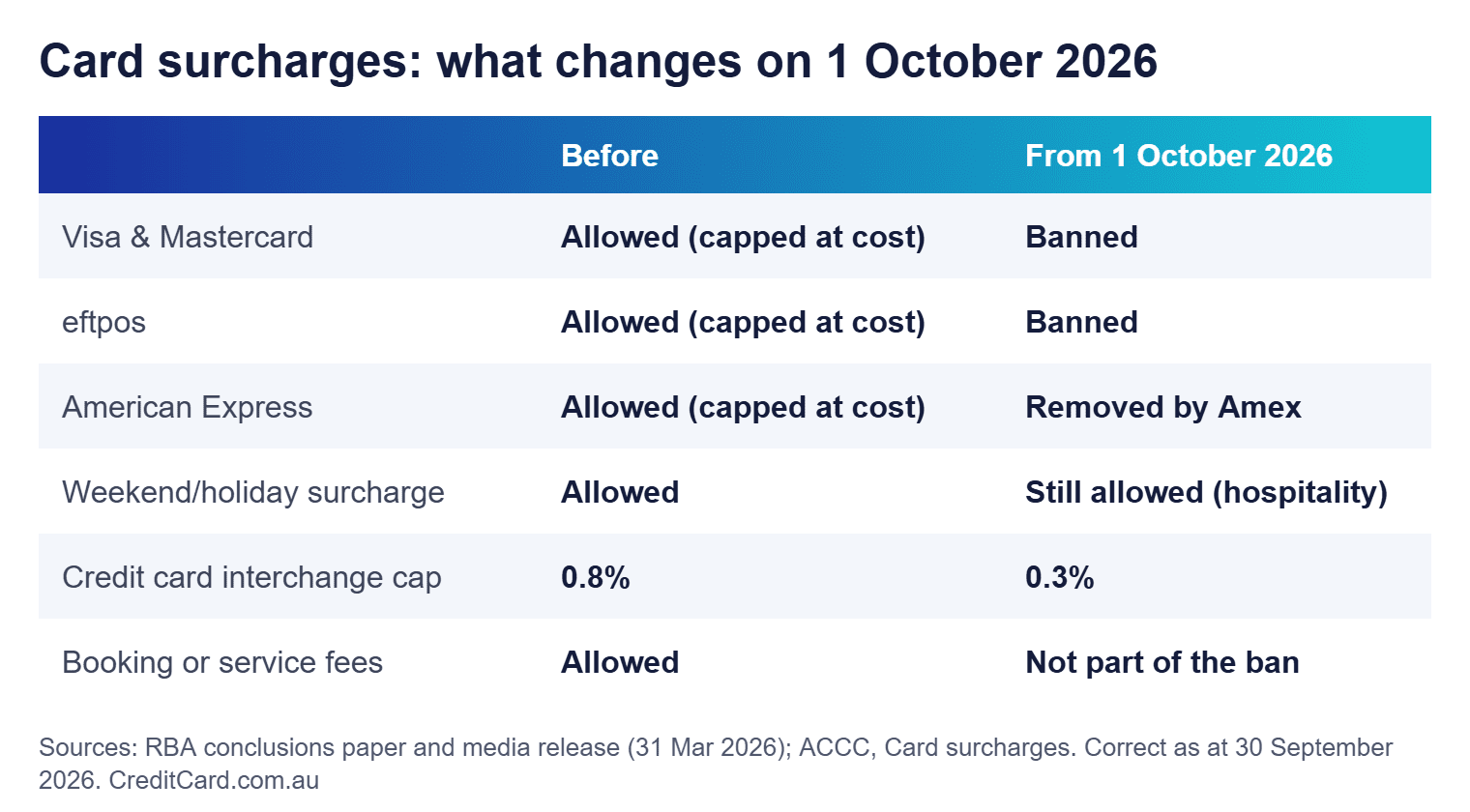
The ban is on card surcharges solely. Hospitality companies can nonetheless cost weekend and public vacation surcharges, and reserving or service charges aren’t a part of the ban. The value you see can also creep up, as a result of the price of taking playing cards can now be constructed into the sticker worth.
Key numbers
- 1 October 2026: card surcharges finish on eftpos, Mastercard, Visa and American Categorical
- ~$1.6 billion: what the RBA estimates customers pay in card surcharges annually
- 0.8% → 0.3%: the cap on interchange charges for client bank cards
- $240 → $90: probably the most a financial institution can earn in interchange on $30,000 of your card spend a yr (~, see under)
Methodology: surcharge and interchange figures from the RBA’s March 2026 conclusions paper and the ACCC, checked 30 September 2026. The $30,000 instance multiplies annual spend by the previous and new caps; it’s illustrative solely.
What precisely is being banned?
From 1 October 2026, a enterprise can’t cost you further simply since you pay by card on these networks:
- eftpos (debit and pay as you go)
- Visa and Mastercard (credit score, debit and pay as you go)
- American Categorical (credit score). Amex isn’t formally regulated by the RBA in the identical approach, but it surely has determined to take away surcharging too.
Till now, surcharges have been allowed so long as they didn’t exceed what the enterprise truly paid to just accept the cardboard. We’ve lined these older guidelines in our information to extreme bank card surcharges. The brand new guidelines go a step additional and take away card surcharges altogether.
What isn’t lined by the ban?
| Cost | From 1 October 2026 |
|---|---|
| Surcharge for paying by Visa, Mastercard, eftpos or Amex | Not allowed |
| Weekend and public vacation surcharges (hospitality) | Nonetheless allowed |
| Reserving charges and repair charges | Not a part of the cardboard surcharge ban |
| Different cost strategies not listed above | Test earlier than you pay, as the principles identify these 4 networks solely |
In different phrases, your Sunday brunch can nonetheless price a bit greater than your Tuesday one. What you shouldn’t see is a line on the receipt that claims “card payment”.
Will costs go up as a substitute?
Presumably, at some locations. The RBA says that when surcharging ends, the sticker worth would be the worth you pay. Consumers at companies that presently surcharge are anticipated to pay comparable quantities, simply constructed into the value moderately than added on the finish.
The upside is that it’s a lot simpler to match costs, and there are not any nasty surprises on the register. If you happen to already store largely at locations that don’t surcharge, you’re unlikely to note a lot in any respect.
Why are banks slicing rewards?
That is the half that stings for factors collectors. Each time you faucet a bank card, the store’s financial institution pays your financial institution an “interchange” payment. From 1 October 2026, the cap on that payment for client bank cards drops from 0.8 per cent to 0.3 per cent, and the previous 0.5 per cent common benchmark is scrapped.
Right here’s the straightforward maths on $30,000 of card spend a yr:
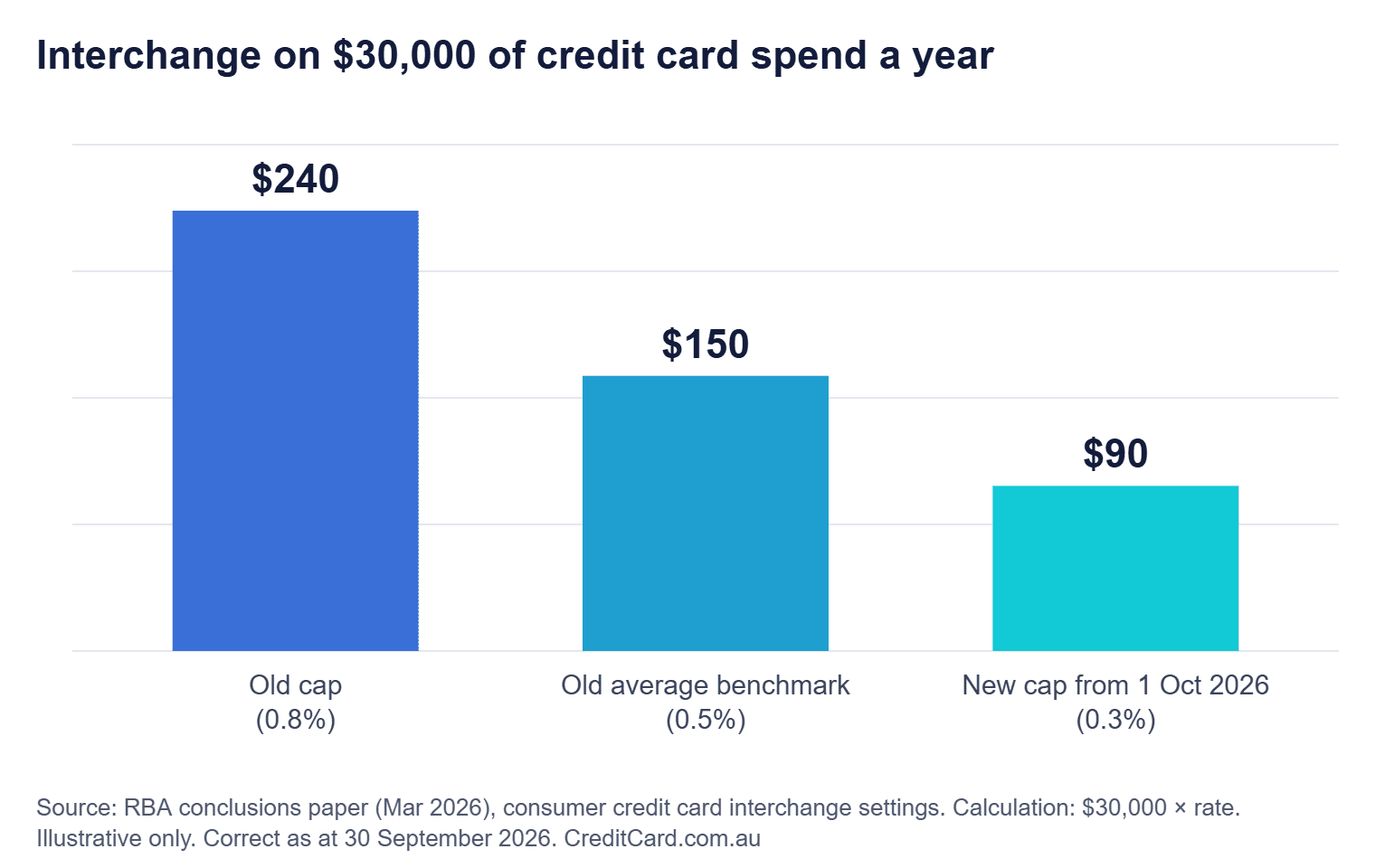
That’s a giant gap within the cash that has historically helped pay for factors. The RBA has been clear that it doesn’t assume interchange ought to fund rewards packages, and it anticipated banks to regulate their playing cards in response. Positive sufficient, a number of massive banks have introduced decrease earn charges, factors caps, increased charges or trimmed insurance coverage. Earlier than you assume your card is identical as final yr, test your financial institution’s newest notices.
Does this transformation which bank card is best for you?
It would. A fast rule of thumb: each 0.25 factors per $1 you lose on $30,000 of spend is 7,500 factors. At our frequent flyer factors valuation of two.47 cents per Qantas Level (flight redemptions solely), that’s ~$185 a yr (7,500 × 2.47c).
Now evaluate that to what you save from the surcharge ban. Say you’d been paying a 1.5 per cent surcharge on $4,000 of your yearly spend. That’s $60 a yr you gained’t pay any extra. It’s useful, however for a giant spender it could not cowl what a weaker rewards card prices you.
⭐
Tip: Work out your “factors revenue”: the worth of the factors you truly redeem annually, minus your annual payment. If it’s near zero (or detrimental), a no annual payment card might now be the smarter decide.
“Eliminating surcharges is a real win for on a regular basis customers. Nevertheless it’s the identical set of modifications that’s squeezing rewards playing cards, so don’t assume the cardboard that suited you final yr nonetheless does. Run the numbers, and in case your factors not beat your annual payment, it’s time to buy round.”
Pauline Hatch, bank card skilled at CreditCard.com.au
What do you have to do for those who’re nonetheless charged a surcharge?
The cardboard networks implement the ban by means of their very own guidelines for companies. In accordance with the ACCC, for those who’re surcharged for paying by card from 1 October 2026, you possibly can:
- Elevate it with the enterprise first. It might merely not have up to date its cost terminal but.
- Contact the cardboard community or the enterprise’s cost supplier.
- Report deceptive pricing to your state or territory client safety company.
- Report false or deceptive worth shows to the ACCC, which makes use of stories to information its work (it doesn’t resolve particular person complaints).
Continuously requested questions
Does the surcharge ban embody American Categorical?
Sure. Amex isn’t formally regulated by the RBA in the identical approach as Visa, Mastercard and eftpos, but it surely has determined to take away surcharging from 1 October 2026 too.
Can cafés and eating places nonetheless cost a weekend surcharge?
Sure. Hospitality companies can maintain charging weekend and public vacation surcharges. What they’ll’t do is add a separate payment since you paid by card.
Does the ban apply to debit playing cards as properly?
Sure. It covers debit, pay as you go and bank cards on the eftpos, Mastercard and Visa networks, so tapping your debit card shouldn’t price further both.
Are rewards bank cards nonetheless value it?
For some individuals, sure. If the factors you truly redeem are value greater than your annual payment, a rewards card can nonetheless pay its approach. If not, you could be higher off with a lower-fee card. Examine the most recent provides on our rewards card web page.
Closing suggestions
- Benefit from the less complicated checkout, however regulate sticker costs at locations that used to surcharge.
- Learn any letters or emails out of your financial institution. Earn charges, caps, charges and insurance coverage are all altering on some playing cards.
- Do the factors maths every year. If the worth doesn’t beat the payment, evaluate frequent flyer playing cards or a no annual payment card as a substitute.
- Pay in full every month. Curiosity wipes out the worth of factors sooner than any rule change. Moneysmart’s information to picking a bank card is an efficient place to begin.
Need the official element? The RBA has a plain-English abstract of the surcharging evaluate.
Common recommendation solely: this text is normal info and doesn’t take into consideration your goals, monetary scenario or wants. Think about the Goal Market Willpower (TMD), the phrases and situations and the product disclosure paperwork earlier than making use of for any bank card. Surcharge and interchange particulars are primarily based on RBA and ACCC info. Card particulars are right as at 30 September 2026 and might change.

