

Highlights
- AI ROI means measurable change from a baseline, protecting effectivity, danger, income safety, and strategic capability.
- Solely 16% of oblique tax professionals formally measure ROI, so hours saved alone hardly ever justifies AI spend.
- Set a baseline earlier than rollout, then observe a brief record of metrics to construct a defensible enterprise case.
Beneath are the questions oblique tax leaders ask most about AI ROI, drawn from the Thomson Reuters white paper Measuring AI ROI in oblique tax. Every reply stands by itself, so leap to the one you want.
Leap to ↓
Why isn’t “hours saved” instances labor price sufficient?
What must you observe for every type of AI worth?
How do you set a baseline earlier than rolling out AI?
What number of tax groups measure AI ROI at present?
How do you construct a defensible AI enterprise case?
What ought to oblique tax leaders measure first?
What’s AI ROI in oblique tax?
AI ROI in oblique tax is the measurable change in tax efficiency after an AI funding, in contrast with a baseline set earlier than rollout. It covers effectivity, danger discount, income safety, and strategic capability. A few of that converts immediately into {dollars} whereas the remaining acts as a number one indicator of long-term worth.
Utilization and satisfaction scores present adoption. They don’t present what modified, which is what ROI wants to ascertain.
Why isn’t “hours saved” instances labor price sufficient?
That system captures solely effectivity. It misses errors AI helps forestall, tax {dollars} it helps shield, and what your staff does with the time it will get again. A fuller view tracks all 4 sorts of worth.
The effectivity acquire is actual. The Contribution Hole, a Thomson Reuters Institute report, discovered that 87% of organizations run throughout a number of techniques and 85% name handbook reconciliation a significant problem. The identical report discovered that 88% of oblique tax professionals say their work contributes considerably or reasonably to enterprise efficiency, however solely 32% charge their very own perform’s contribution as important.
What must you observe for every type of AI worth?
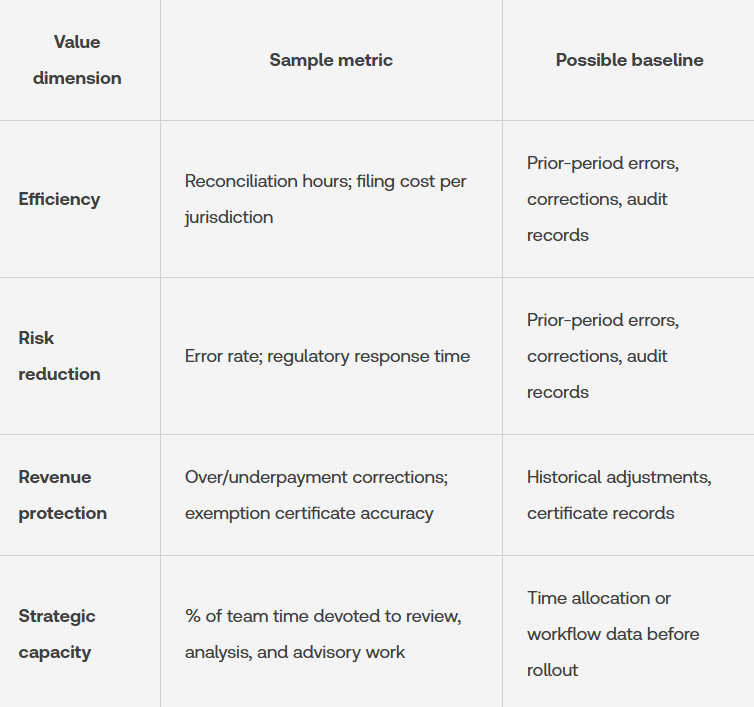
Observe processing time and reconciliation hours for effectivity, error charges and regulatory response time for danger discount, overpayment and underpayment corrections for income safety, and the share of staff time spent on assessment, evaluation, and advisory work for strategic capability.
A few of these outcomes are already inside tax’s attain: 63% of oblique tax capabilities say they immediately helped keep away from a regulatory penalty or enterprise disruption prior to now yr, and groups already affect provide chain selections (59%), pricing (54%), and contract phrases (50%). Dan LeCompte, a Thomson Reuters trade specialist, additionally describes one massive group whose pre-payment bill assessment discovered about $4 million in annual overpayments and different tax points.
How do you set a baseline earlier than rolling out AI?
Doc the present state of the workflow earlier than implementation, together with the info that feeds into it, the hassle it takes, and the outcomes you count on AI to affect. Prior-period workflow logs, error and audit information, historic changes, and time-allocation information all work as sources.
With out that place to begin, you possibly can’t present whether or not AI created worth. As LeCompte places it, “To know whether or not AI is really including worth, it’s worthwhile to begin with the aim and perceive the method you’re automating.”
What number of tax groups measure AI ROI at present?
Few do. Solely 16% of oblique tax professionals formally measure ROI on know-how investments. Throughout authorized, tax, accounting, danger, fraud, and authorities, solely 18% of execs say their organizations observe AI ROI, based on the Thomson Reuters Institute’s 2026 AI in Skilled Providers Report. In company tax, 41% of respondents within the 2026 Company Tax Division Know-how Report say they measure ROI and price financial savings.
Evaluate your self with groups of comparable measurement and maturity. In that very same report, 81% of company tax departments stated they had been nonetheless contemplating AI use.
How do you construct a defensible AI enterprise case?
Use 4 steps:
- Baseline: Set up present state
- Pilot metrics: Outline what change you’ll measure
- Projected worth: Translate anticipated grow to be enterprise worth
- Assessment cadence: Evaluate outcomes with the baseline over time
Then, write down the assumptions behind every projection so you possibly can check them in opposition to actual outcomes.
Flip anticipated adjustments into {dollars} solely the place the proof helps it. Prevented overpayments might justify a direct estimate, whereas extra time for planning and evaluation usually reads higher as a strategic indicator. For Thomson Reuters ONESOURCE Gross sales and Use Tax AI powered by CoCounsel, helpful measures embrace time spent monitoring financial nexus and whether or not you validate each line merchandise as an alternative of spot checking. For AI-powered product classification in ONESOURCE Willpower, take a look at classification pace and accuracy throughout jurisdictions. For a associated view on the monetary facet, see The right way to construct a enterprise case for oblique tax course of automation.
What ought to oblique tax leaders measure first?
Decide one or two metrics you possibly can baseline this quarter, then observe the operational change AI produces. Construct towards constant, platform-level visibility from there.
Many AI ROI “failures” are measurement failures slightly than know-how failures. Groups that begin now will be capable of present the place AI pays off and make the case for what comes subsequent.
Get the total framework
Obtain the white paper, Measuring AI ROI in oblique tax, for the metrics, benchmarks, and enterprise case course of intimately.

