

Bitcoin has spent 4 days buying and selling constantly beneath the present short-term holder value foundation (STH-CB) of $75,717, which marks the approximate breakeven degree for patrons throughout the final 155 days. Traditionally, this tends to elicit promoting if there’s any rally within the value that approaches value foundation, and due to this fact imposes an overhang into the market.
Following yesterday’s Client Value Index studying for October, BTC dropped additional, falling to a low of $72,706, placing it 16.8 p.c beneath the 21 September excessive of $87,392. This represents the deepest pullback of the uptrend that started on the 1 July low of $57,803.
The query now could be whether or not the lack of the STH-CB is a correction inside a recovering market or the beginning of a deeper reset.
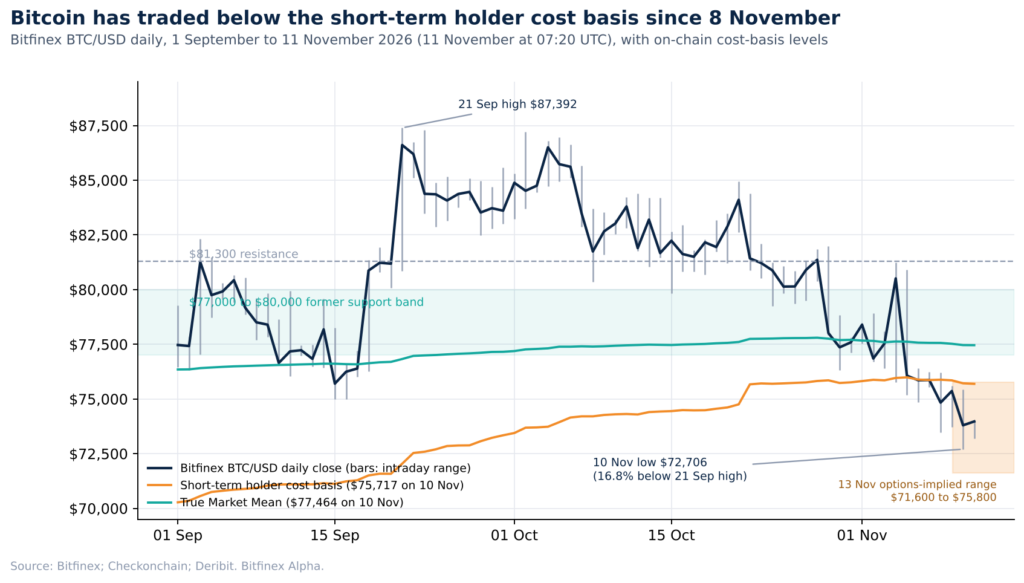
In our view, the reply is prone to come this month. Trying again on 14 earlier losses of value bases since 2016 offers a sign of how lengthy value can keep beneath the STH-CB earlier than what seems like a correction turns into one thing deeper. We focus on this additional beneath.
On this Intelligence Replace, we additionally study whether or not slowing Alternate Traded Fund (ETF) outflows may be sufficient to revive spot demand, what the choices market is pricing and why altcoins are falling nearly twice as quick as bitcoin. We additionally take a look at how fee expectations shifted after the CPI launch, the rising asymmetry between bitcoin and the Nasdaq, and what Nvidia’s earnings on 17 November and the Anthropic itemizing on 19 November may imply for crypto.
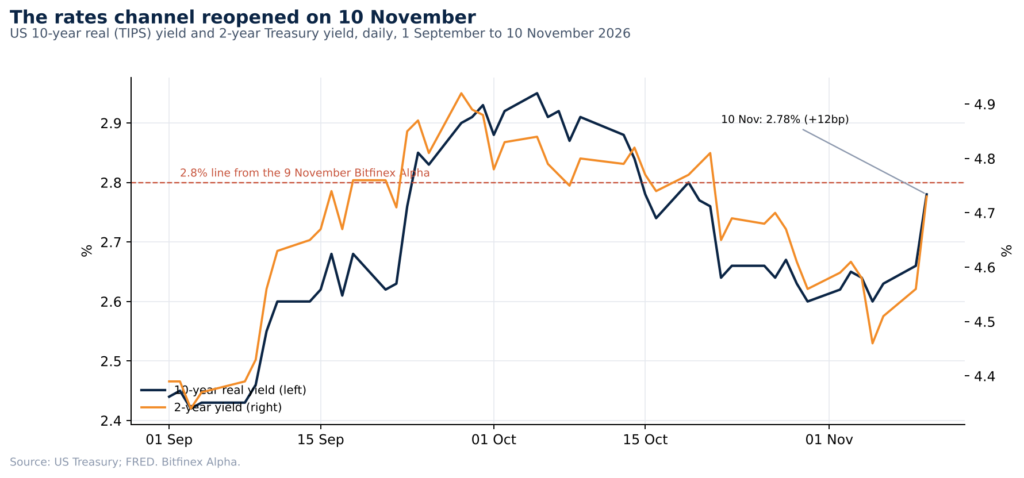
BTC is at the moment rooted throughout the $72,350 to $79,400 options-implied vary mentioned in Monday’s Bitfinex Alpha, however market situations have deteriorated. Mixture futures open curiosity (OI) has risen to 701,900 BTC, with funding again close to its impartial 10-11 p.c annualised fee, whereas the share of provide in revenue has slipped to 57.9 p.c, beneath the 58.3 p.c line that has traditionally separated corrections from deeper resets. The ten-year actual yield has in the meantime risen to 2.78 p.c, near the two.8 p.c degree at which we imagine charges overtake equities because the dominant affect on bitcoin.
A disorderly transfer in value has to date been averted, as ETF outflows have stayed effectively beneath $300 million this week and the Nasdaq 100 stays above its 5 November low.
Open Curiosity Stays Sticky Whereas Spot Holders Promote at a Loss
Mixture futures OI peaked at 701,900 BTC across the 11 November every day open. That’s 3.3 p.c above the 679,650 BTC recorded on 8 November, over a interval through which value fell 2.6 p.c, and marks the best degree of OI, since 22 September.
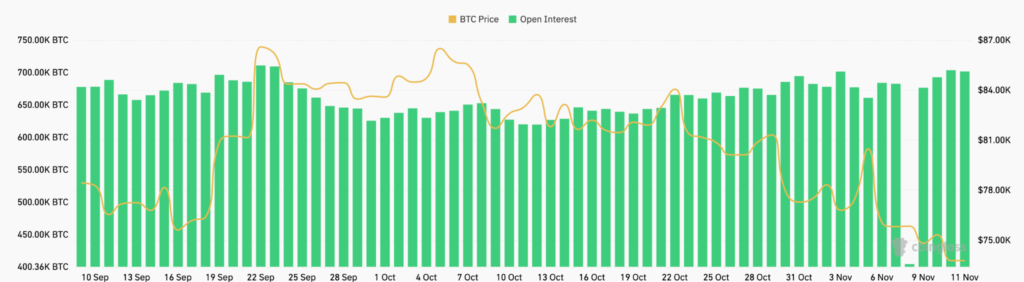
Certainly, the persistence of OI progress since early September is exceptional. When BTC fell following yesterday’s CPI, OI dropped simply 0.2 p.c, even after roughly $729 million in positions had been liquidated, of which $581 million had been longs, suggesting that positions are being changed nearly instantly. It was the sixth time since early October that merchants have added positioning right into a decline.
Perpetual funding has additionally sat at or close to its common of about 11 p.c annualised, which demonstrates that merchants are prepared to pay to remain lengthy, although the market has been dropping. Such behaviour additionally leaves the market uncovered to additional lengthy liquidations.
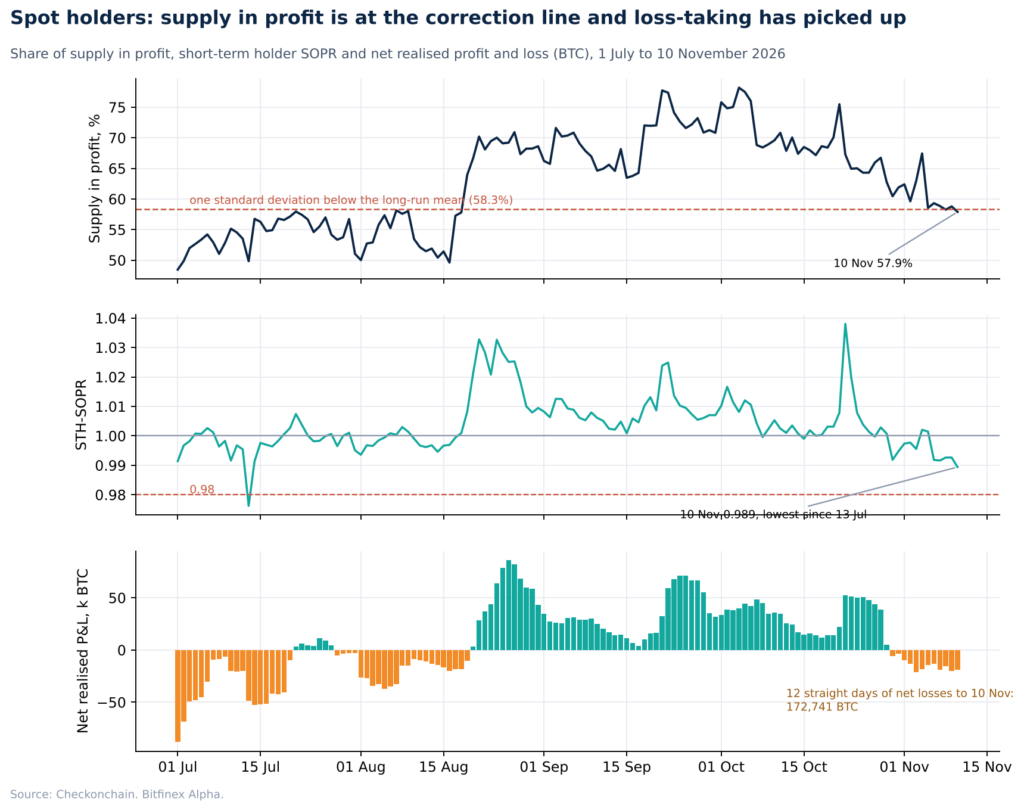
BTC spot holders have taken the other view. The short-term holder Spent Output Revenue Ratio (STH-SOPR), which compares the worth at which cash youthful than 155 days are bought with the worth at which they had been purchased fell to 0.989 on 10 November. This was its lowest degree since 13 July, displaying that latest patrons are promoting at a median lack of about one p.c.
Throughout all holders, internet realised losses have been recorded on 12 consecutive days to 10 November, totalling about 172,700 BTC. The tempo of losses retains the market in correction territory for now: about 14,400 BTC a day, in opposition to about 45,000 BTC a day in the course of the Could to July decline.
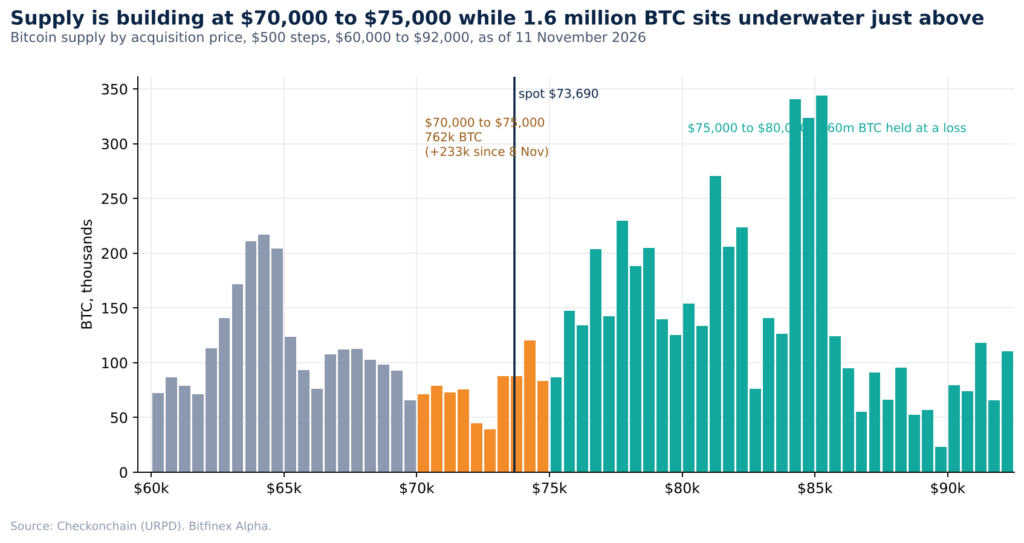
Price-basis focus between $70,000 and $75,000 rose by about 233,000 BTC between 8 and 11 November to 762,000 BTC. Regardless of that, 1.6 million BTC acquired between $75,000 and $80,000 is now held at a loss and any restoration should first work by way of that provide. A sustained restoration would require these holders to cease promoting as value returns in the direction of their value foundation.
Cycle Place: Time Spent Under the Price Foundation Is the Take a look at
Traditionally, the STH-CB has helped decide whether or not an uptrend marks the beginning of a brand new bull market or a restoration inside an extended bear market. Since 2016, bitcoin has fallen beneath the STH-CB 14 instances after spending at the very least 60 days above it. In 11 of these situations, value reclaimed the extent inside two weeks. Within the different three, the reclaim took between 57 and 114 days, and bitcoin’s low over the next 90 days was between 17 and 35 p.c decrease than the STH-CB.
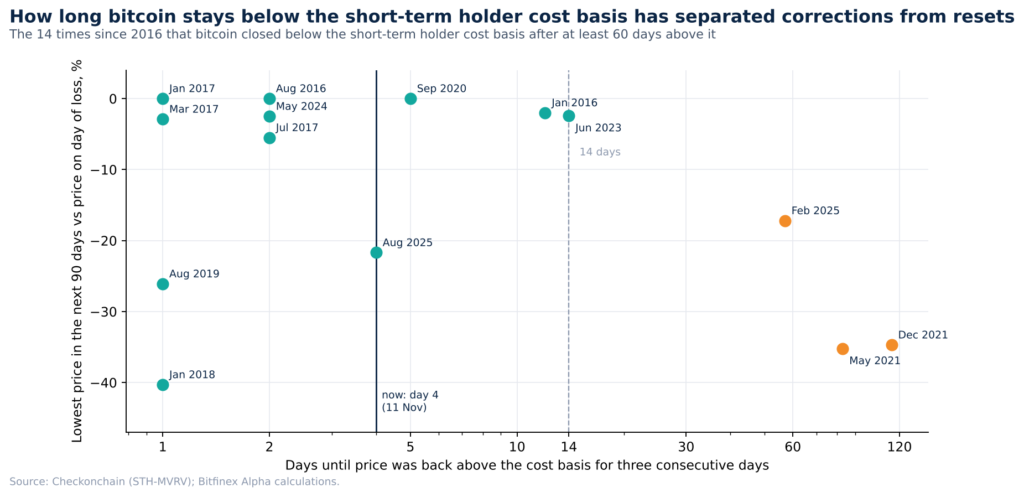
Bitcoin hovered inside 0.2 p.c of the STH-CB from 5 to 7 November and moved clearly beneath it on 8 November. The present episode is on its fourth day placing the two-week mark on 22 November, which shall be each after Nvidia’s earnings and the Anthropic itemizing. Provide in revenue provides to the warning: at 56.1 p.c, it’s beneath the 58.3 p.c threshold.
ETF Flows: Outflows Are Slowing, and Treasury Demand Has Weakened
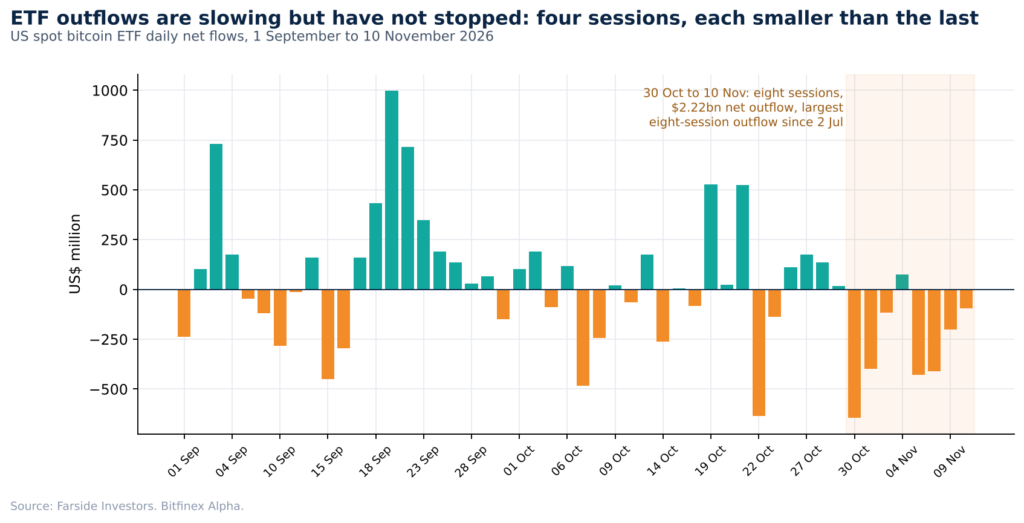
Bitcoin’s spot bid has two main demand engines: the US spot ETFs and bitcoin company treasury firms. ETFs have not too long ago been promoting their BTC holdings, though at a slower tempo this week than final week. The funds recorded internet outflows of $201 million on 9 November and $95 million on 10 November, extending the present outflow streak to 4 classes, every smaller than the one earlier than. Internet outflows since 30 October sit at $2.22 billion, the most important eight-session outflow since 2 July.
Slowing outflows are a primary step to discovering a ground, relatively than a sign on their very own. Our 4 November Intelligence Replace discovered that outflow runs earlier this 12 months had been adopted by a median 10-session acquire of 6.4 p.c solely after they ended with three or extra consecutive influx classes. The take a look at now could be whether or not that sample repeats.
Treasury firms have moved from patrons to a possible supply of provide. Technique purchased 1,036 BTC from 2 to eight November, however its common value of $75,456 leaves its 850,364 BTC holding underwater. MARA has additionally disclosed gross sales of 13,597 BTC over the previous six weeks and plans to promote extra. Moreover, Trump Media, which held 4,260 BTC as of the top of September, faces potential money repayments to convertible be aware holders on 30 November, which might be happy by BTC gross sales. Taken collectively, company treasuries are due to this fact not at the moment offsetting ETF promoting.
Choices: The CPI Premium Is Gone
The choices market has turn out to be calmer relatively than extra defensive for the reason that CPI report. At-the-money implied volatility (IV), the annualised transfer that choice costs suggest, fell to 37.8 p.c for the 13 November expiry from 41.7 p.c on 8 November. The premium of places over calls additionally narrowed to three.8 volatility factors, from 8.2. This means that merchants who had hedged the CPI launch closed these hedges relatively than rolling them. With realised volatility over the previous 10 days at 47.9 p.c, choices are pricing a quieter market than latest value motion would counsel.
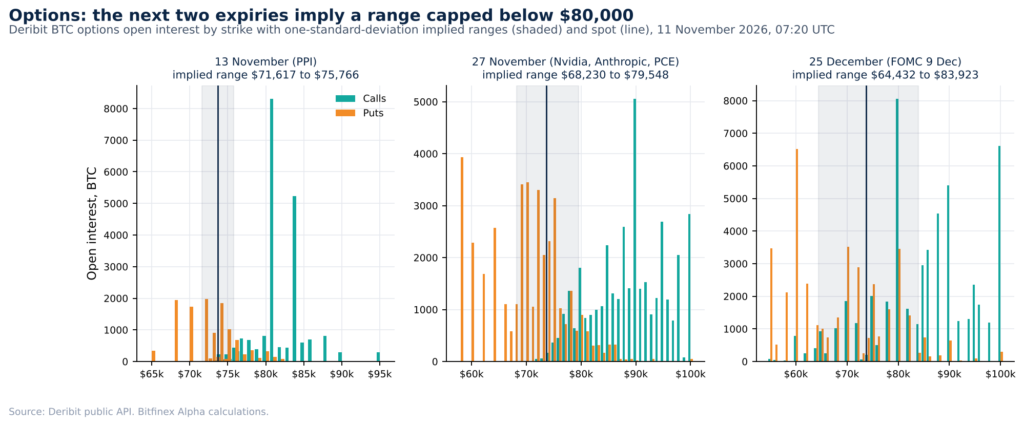
The implied one-standard deviation vary is $71,600 to $75,800 for the 13 November expiry, which comes simply earlier than the October Producer Value Index report on the identical day. The 20 November expiry carries decrease implied volatility than this week’s, indicating that merchants aren’t paying extra premium for Nvidia’s earnings or the Anthropic itemizing. Close to-dated places are concentrated at $72,000 and $70,000, ranges the place hedging flows may speed up a decline.
Altcoin Losses Are Working at Virtually Twice Bitcoin’s
The median of 12 massive altcoins on Bitfinex is 27.8 p.c beneath its 21 September shut, in opposition to 14.8 p.c for bitcoin. That could be a ratio of 1.9 instances, in contrast with the 1.1 to 1.9 instances recorded throughout the six earlier pullbacks as we mentioned within the 12 October Bitfinex Alpha. The ETH/BTC ratio fell to 0.0278 on 10 November, its lowest since 9 July. US spot ETH ETFs have recorded outflows on 11 of the 12 classes since 26 October, totalling $983 million.
Two components clarify the hole: leverage is extra concentrated in altcoins, as ether liquidations ($262 million) exceeded bitcoin liquidations ($205 million) within the 24 hours to the morning of 11 November, whereas speculative capital can be being drawn elsewhere, with Nvidia, semiconductor, SpaceX and Anthropic-linked contracts now showing in the identical derivatives venues and liquidation knowledge as main crypto belongings. If bitcoin exams $70,000, an extra fall of about 5 p.c, the ratios above suggest an extra eight to 10 p.c decline for the median altcoin.
Macro: Charges Rejoin Equities as a Driver. The AI Commerce Units the Subsequent Take a look at
Core CPI rose 0.3 p.c in October, above the 0.2 p.c forecast, pushing fee expectations greater. The two-year yield recorded its largest one-day rise since April 2025, whereas the 10-year yield traded above 5 p.c earlier than settling at 4.98 p.c. As a result of short-end yields rose quicker than long-end yields, the curve flattened, indicating that the market is pricing a extra aggressive Federal Reserve relatively than stronger progress. Gold fell with bonds as the actual yield rose. Bitcoin fell 2.1 p.c on the day in opposition to 0.6 p.c for the Nasdaq 100, suggesting that charges, relatively than expertise shares, led for the primary time for the reason that fairness sell-off started.
For what comes subsequent, the extra vital shift is that bitcoin’s relationship with equities has turn out to be one-sided. Over the 25 classes for the reason that Nasdaq 100’s file on 6 October, bitcoin has taken 91 p.c of the index’s losses on its down days and 58 p.c of its good points on its up days. Over the 60 classes earlier than that, the equal figures had been 23 p.c and 129 p.c. On 9 November, the Nasdaq 100 rose 3.4 p.c and bitcoin was 0.7 p.c decrease than on the earlier fairness shut.
In our view, this displays the flows described above: with out ETF or treasury shopping for, there isn’t a marginal purchaser to hold an fairness rally into bitcoin, whereas leveraged lengthy futures positions be certain that fairness declines are transmitted in full.
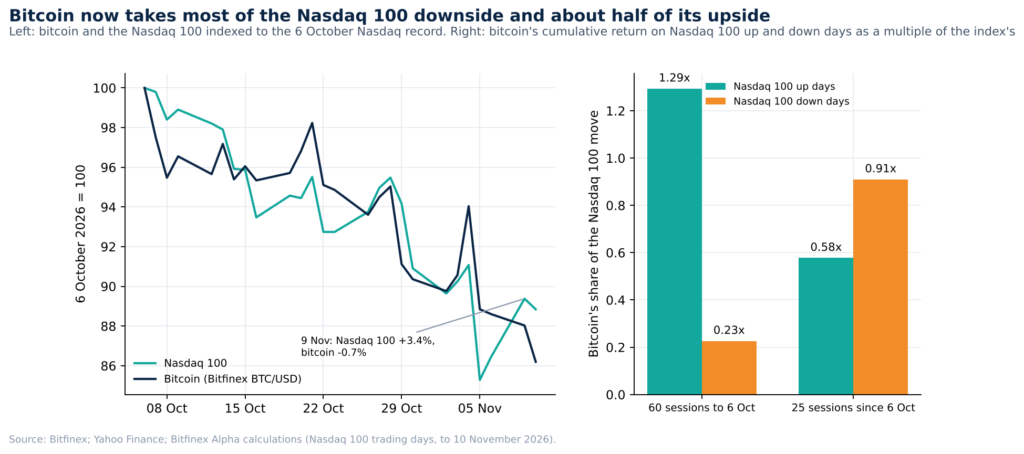
Subsequent week exams that asymmetry. Nvidia studies earnings on 17 November with its shares 31 p.c beneath their October excessive. Anthropic can be attributable to record on 19 November at a valuation of as much as $64.4 billion.
We count on bitcoin to reply by way of three channels. The primary is sentiment: Anthropic’s valuation is effectively beneath the roughly $2 trillion mentioned in September, so its reception shall be learn as a verdict on AI valuations and transmitted to bitcoin by way of the Nasdaq. The second is liquidity, with a couple of fifth of the providing reserved for retail buyers, drawing on capital that overlaps with crypto’s retail base. The third is direct: greater than $260 million of open curiosity has in-built pre-listing contracts on crypto derivatives venues, buying and selling about 23 p.c above the high quality.
The SpaceX precedent suggests the itemizing day itself is probably not the principle value occasion: bitcoin was flat from the beginning of the roadshow on 4 June by way of the primary week of buying and selling, having already fallen 18 p.c between the 20 Could submitting and the roadshow throughout a broader capitulation. Given the seize figures above, our studying is {that a} poor reception is a bigger danger for bitcoin than a robust one is a chance, until ETF flows have turned constructive by then.
OUTLOOK
We count on bitcoin to commerce throughout the $71,600 to $75,800 vary implied by choices for the 13 November expiry, with dangers skewed in the direction of the decrease edge, as a result of leverage has been rebuilt into the decline whereas ETF outflows have slowed however not but reversed. Rallies in the direction of the short-term holder value foundation at $75,717 are prone to be bought till spot demand returns.
A reclaim of that degree alongside three consecutive ETF influx classes would point out that the break beneath it was a correction. A ten-year actual yield above 2.8 p.c, or a Nasdaq 100 transfer beneath 26,606, can be anticipated to set off lengthy liquidations in the direction of $70,000 to $71,200, whereas remaining beneath the associated fee foundation by 22 November would place this episode amongst people who have traditionally led to deeper resets.


